New Web3 Visions Brought by ERC-7683: From Multi-chain to Unified, From Fragmented to United
TechFlow Selected TechFlow Selected
New Web3 Visions Brought by ERC-7683: From Multi-chain to Unified, From Fragmented to United
How can Ethereum achieve "unification"? This article guides you further into the ERC-7683 standard.
 Navigating Web3 tides with focused insights
Author: Bulu
In the multi-chain landscape of the blockchain world, achieving more secure and convenient cross-chain interoperability has always been a significant challenge. As user demand for cross-chain transactions grows, these challenges become even more pronounced. Common issues include:
Security
Security is the most prevalent challenge in cross-chain transactions. Cross-chain bridge protocols that attract large-scale asset deposits have become primary targets for hackers in recent years.
Blockchains rely on validators to verify and execute transactions, and cross-chain bridges similarly depend on trusted third-party validators to process cross-chain transactions. If a bridge’s incentive mechanisms are insufficient, validator counts are low, or its trust model is overly centralized, attackers may compromise the validators to break the bridge and steal assets. Additionally, smart contract vulnerabilities within the cross-chain protocol itself often serve as entry points for attacks.
On August 6, 2024, Ronin Bridge was reportedly attacked, resulting in the theft of approximately 4,000 ETH and 2 million USDC, valued at around $12 million. In March 2022, Ronin Bridge had already suffered what was called "the largest loss in DeFi history," when hackers compromised 5 out of 9 validators and stole 173,600 ETH and $25 million worth of USDC, totaling over $600 million in losses.
High Gas Fees
Cross-chain transactions generally incur higher gas fees. Users must account for gas costs on both the source and destination chains when calculating total transaction expenses.
Complexity
Each blockchain operates independently, with its own consensus mechanism and protocol. This fragmented, isolated state leads to relatively complex and cumbersome operations when users transfer assets and data across chains. Frequent traders are especially susceptible to price slippage, increasing transaction difficulty.
To address these issues, Uniswap Labs and the interoperability protocol Across jointly proposed a new standard, ERC-7683, on May 20, 2024, aiming to make cross-chain transactions simpler, faster, and more secure through a shared execution network.
ERC-7683
The ERC-7683 standard is built upon the CrossChainOrder structure and introduces an ISettlementContract smart contract interface, enabling standardized APIs for cross-chain transaction execution systems.
The core technical proposal of ERC-7683 is: all "cross-chain intents" follow the same order structure, significantly enhancing flexibility and user-friendliness in cross-chain operations.
As Uniswap Labs highlighted on its social platform X: "ERC-7683 provides a clear path toward unifying Ethereum."
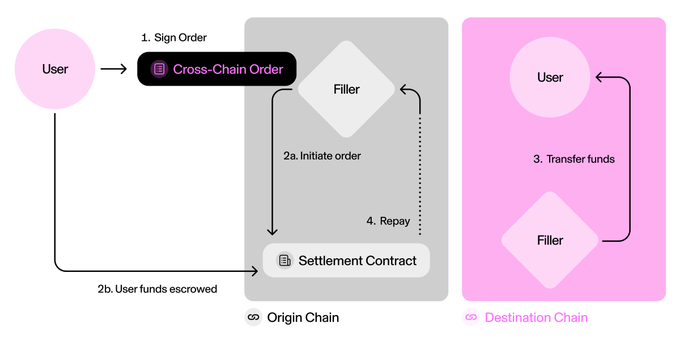
△ Figure 1: Illustration of cross-chain order structure under the ERC-7683 standard
Source: Uniswap Labs
Current Development and Adoption
On August 21, 2024, Layer 2 solution Optimism announced adoption of the ERC-7683 cross-chain standard to enable more efficient transfers of ETH and USDC across the Superchain, further promoting application-layer interoperability throughout the broader Ethereum ecosystem. Optimism has now integrated Across's cross-chain solution.
In May 2024, Uniswap Labs stated at the launch of ERC-7683 that it would adopt the standard for cross-chain collaboration with UniswapX.
Notably, since ERC-7683 only standardizes the API interface for cross-chain execution systems—ensuring consistent user experience—it cannot fully mitigate a common cross-chain challenge: Can sufficient cross-chain liquidity be obtained?
For ERC-7683 implementation, insufficient cross-chain liquidity means there may not be enough active "Fillers" (see Figure 1) to support users’ "cross-chain intents." Without sufficient Fillers, users’ intents cannot benefit from competitive mechanisms to achieve lower costs or better experiences.
This implies that successful implementation of ERC-7683 requires a wide-area effect—more use cases adopting the standard and more users utilizing it will attract more Fillers, ultimately improving overall cross-chain transaction efficiency.
For more details on ERC-7683, visit: https://www.erc7683.org
View the Ethereum Request for Comments jointly submitted by Uniswap Labs and Across to the Ethereum Magicians forum: https://ethereum-magicians.org/t/erc-7683-cross-chain-intents-standard/19619
Support from Ethereum's Co-Founder
Public media reports indicate that Ethereum co-founder Vitalik Buterin specifically endorsed the development of the new cross-chain standard ERC-7683 via his social platform, noting that operations under ERC-7683 could include batched transactions, Merkle proofs, and other on-chain activities. He illustrated how the standard would work, stating:
“With ERC-7683, users can simply paste an ERC-7683 address into their wallet and, with just one click, easily transfer assets from any chain to another account.”
Multi-chain architecture is an inevitable evolution of the Web3 era. For the next stage of Web3 development, optimizing, simplifying cross-chain transactions, and further unlocking liquidity will be critical challenges. The ERC-7683 standard directly addresses pain points in cross-chain transactions and can significantly enhance interoperability between blockchains. Its adoption will have profound implications for the blockchain ecosystem. Currently, users can expect improved user experience from ERC-7683 implementations, bringing direct benefits to more DeFi projects—injecting additional liquidity and accelerating growth.
Join TechFlow official community to stay tuned
Telegram:https://t.me/TechFlowDaily
X (Twitter):https://x.com/TechFlowPost
X (Twitter) EN:https://x.com/BlockFlow_News
 @imTokenOfficial