








A Brief Analysis of BNB Chain's Stablecoins and DeFi Growth Potential
TechFlow Selected TechFlow Selected
A Brief Analysis of BNB Chain's Stablecoins and DeFi Growth Potential
With stablecoins and the DeFi ecosystem both developing steadily, BNB Chain is one step closer to its goal of bringing in the next billion Web3 users.
 Navigating Web3 tides with focused insights
Author: Golem, Odaily Planet Daily
DeFi and stablecoins have long been seen as two pillars for the long-term growth of the BNB Chain ecosystem—DeFi to build the on-chain economy, and stablecoins to drive mass adoption and attract the next billion Web3 users.
This article examines recent achievements by BNB Chain in gas-free stablecoin transfers and TVL incentive programs, analyzes the strategic initiatives behind these efforts, and explores the strong potential within BNB Chain’s DeFi ecosystem.
Achievements So Far
BNB Chain recently launched initiatives including gas-free stablecoin transfers and a TVL incentive program. During the campaigns, users could transfer stablecoins to BNB Chain or opBNB from CEXs or other chains without paying gas fees. To enhance stablecoin retention on its network, BNB Chain also introduced a TVL incentive program, accelerating DeFi growth across the ecosystem.
The results have been promising:
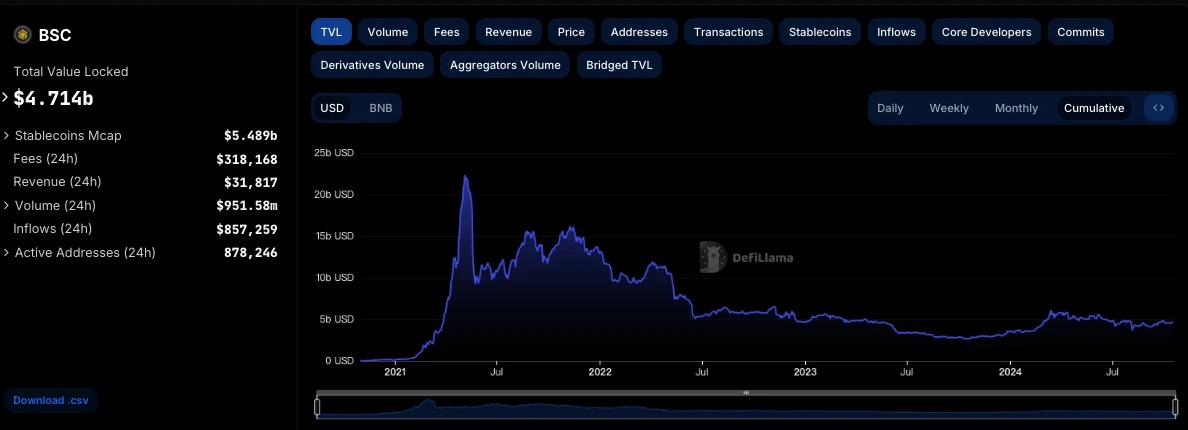
According to DefiLlama data, as of October 18, the market cap of stablecoins on BNB Chain reached $5.489 billion—an increase of $491 million from $4.998 billion before the start of the gas-free transfer campaign on September 19.
Meanwhile, since the launch of the TVL incentive program on September 12, BNB Chain’s total value locked (TVL) has grown from $4.408 billion to $4.714 billion, an increase of over $300 million—and the upward trend continues.
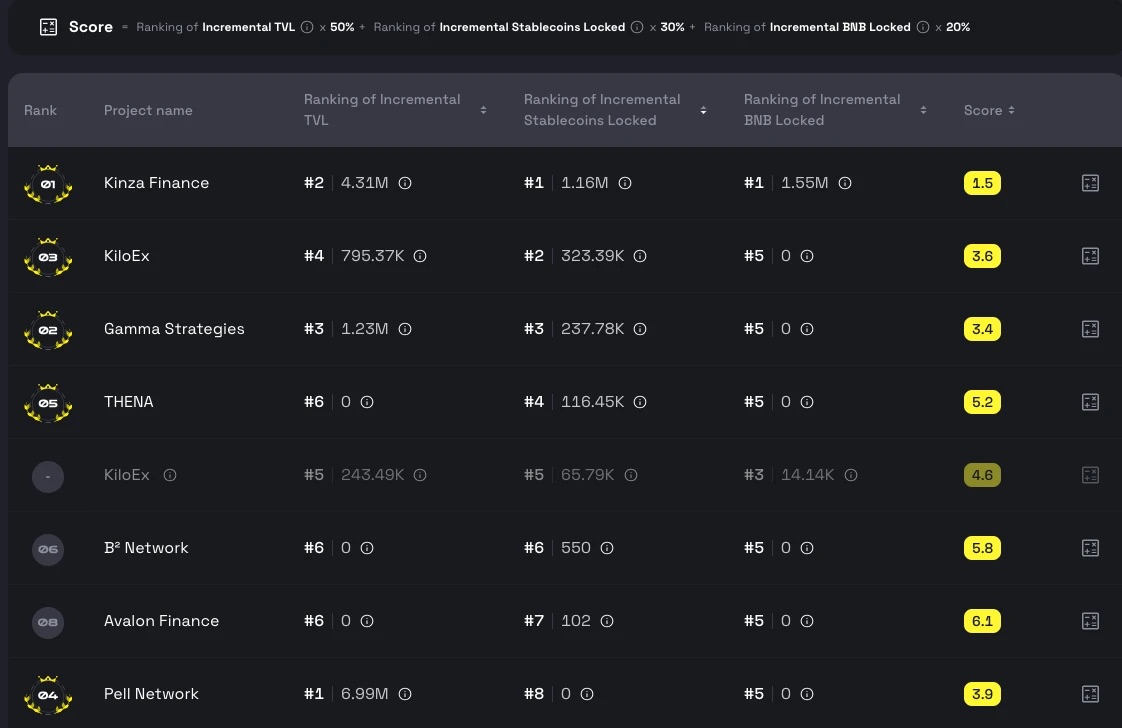
The TVL incentive program has also attracted significant new capital to DeFi applications within the ecosystem. According to official leaderboard updates, as of October 11, the TVL Challenge had drawn over $1.904 million in incremental stablecoin deposits.
BNB Chain's Strategic Approach to DeFi
Initiatives are temporary and subject to change; what matters is understanding the strategy behind them. What can we infer about BNB Chain’s strategic intentions from these activities? The answer lies in its strong commitment to building DeFi.
To understand how BNB Chain is developing its DeFi ecosystem, it’s important to first examine the current industry landscape.
According to DefiLlama, BNB Chain ranks fourth globally in terms of TVL, behind Ethereum, Tron, and Solana. However, in terms of stablecoin market capitalization, BNB Chain ranks third worldwide, trailing only Ethereum and Tron.

These figures show that while BNB Chain remains among the top players, it still lags somewhat behind Ethereum and Tron.
Ethereum's position at the top of the TVL rankings is unsurprising given its status as the birthplace of DeFi. But why has Tron managed to surpass both Solana and BNB Chain to claim second place? This success stems largely from its early advantages in stablecoin transfer performance.
In many ways, stablecoins represent one of blockchain’s “killer applications.” Thanks to lower transaction fees than Ethereum (with exchange withdrawals once costing less than 1 USDT) and faster block times, Tron gradually evolved into a payment-focused public chain, where stablecoin transfers account for over 90% of on-chain activity—helping it amass a large user base. Leveraging this strength in stablecoins, Tron later developed a diverse and vibrant DeFi ecosystem.
BNB Chain’s strategy shares some similarities: incentivizing users to move stablecoins from off-chain exchanges and other blockchains onto BNB Chain. The goal is to attract capital flows and lay the financial foundation for on-chain DeFi development.
Once users bring stablecoins onto BNB Chain, the ecosystem further encourages the growth of DeFi applications through reward programs. High-quality apps with attractive incentives not only help retain new capital but are also key to long-term user engagement.
DeFi Is More Than Just On-Chain Retention
Competition among major blockchains now extends beyond just speed and throughput—it centers on ecosystem development and differentiation. In today’s user-driven race, unique and rich ecosystems serve as the real "moat" for public chains.
Each major blockchain has carved out its own niche: Ethereum, with its long history and vast developer and user base, hosts the most mature and comprehensive smart contract ecosystem; Tron rose to prominence through low-cost stablecoin transfers, becoming the “payment chain”; Solana stands out with its vibrant meme and DePIN ecosystems; TON integrates tightly with Telegram, growing via mini-apps.
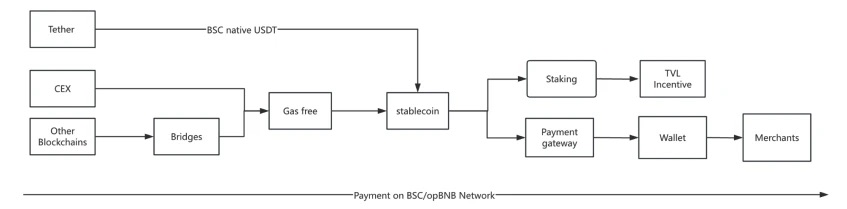
For BNB Chain, DeFi has always been the cornerstone of its ecosystem. Its vision goes beyond mere on-chain capital retention. While its strategies may resemble Tron’s in some aspects, BNB Chain does not aim to become another “payment chain.” Instead, it seeks to build a powerful ecosystem rooted in DeFi—integrating CeFi and cross-chain collaboration to attract stablecoins, while also combining on-chain yields (staking) and off-chain stablecoin payments.
High On-Chain Yields
In terms of on-chain returns, users can stake stablecoins on platforms like Venus and PancakeSwap, which offer more competitive yields compared to Solana. As shown below, staking USDT on Kinza within the BNB Chain ecosystem delivers an annualized return of up to 14.7%, significantly higher than those on Ethereum and Solana (data as of October 17).

Moreover, holding stablecoins can be a better option for asset preservation and wealth management compared to local fiat currencies. For example, from December last year to September this year, Argentina’s inflation rate hit 153%, while unofficial dollar exchange rates rose less than 20%. The USD has broken through 1,200 pesos, finding support between 900 and 1,050 pesos.
A similar situation exists in Turkey, where inflation exceeds 80%, the lira has hit a record low of 18.41 against the dollar, depreciated nearly 30% year-to-date, and lost around 70% of its value over the past three years.
For citizens in countries with weak economies and high inflation, holding stablecoins on-chain offers a more stable and valuable return.
Integration with Off-Chain Stablecoin Payments
For off-chain payments, BNB Chain has partnered with payment gateways such as Alchemy Pay, Oobit, Lunu, MugglePay, Now Payments, DePay, Xion, Portal Pay, and Slash Vision, enabling users to spend stablecoins in real-world shopping scenarios. This breaks down the boundaries of decentralized finance and provides users with an alternative to traditional payment methods.
Beyond that, BNB Chain is exploring integration between stablecoin payments and AI agents. As AI technology matures, AI agents could assist humans in areas like personal management and intelligent decision-making. Blockchain and stablecoin payments can empower AI with complex transaction capabilities and automated settlements, paving the way for a truly intelligent economy.
In summary, BNB Chain maintains differentiation and competitive advantage in the multi-chain landscape through low gas fees, high TPS, strong daily active user numbers, and a mature DeFi system that bridges on-chain and off-chain use cases.
Conclusion
BNB Chain’s mission and vision is to bring the next billion users into Web3. Whether through expanding on-chain and off-chain stablecoin adoption or offering more attractive DeFi yield strategies, every initiative aligns with this core purpose.
For users, standing with the BNB Chain ecosystem, actively participating in early-stage programs, and engaging in its development journey will likely lead to substantial ecosystem rewards.
Join TechFlow official community to stay tuned
Telegram:https://t.me/TechFlowDaily
X (Twitter):https://x.com/TechFlowPost
X (Twitter) EN:https://x.com/BlockFlow_News
 Odaily






