









Wealth creation, narrative power, and capital preference have completely overshadowed mainstream coins—will MEMEs become the new mainstream?
TechFlow Selected TechFlow Selected
Wealth creation, narrative power, and capital preference have completely overshadowed mainstream coins—will MEMEs become the new mainstream?
What underlying changes occurred during the rise of MEME over the past year? Can this boom be sustained behind its prosperity?
 Navigating Web3 tides with focused insights
By Frank, PANews
Since the beginning of this bull cycle, memes, inscriptions, and airdrop farming have continuously dominated attention. Previously mainstream tokens failed to deliver expected rallies, while several high-profile airdrops disappointed communities due to underwhelming valuations or falling prices.
In contrast, meme coins—once a niche segment—have gradually become a key barometer for the entire crypto industry. Why have mainstream tokens lost favor? Why are more traditional institutions shifting toward meme coin holdings? What underlying shifts occurred during the rise of memes over the past year? And can this boom be sustained? Seeking answers to these questions, PANews has conducted research and reflection on the evolution of memes.
Memes Offer Greater Wealth Creation Than Mainstream Coins
Over the past year, most mainstream coins have performed poorly. Highly anticipated airdrop projects have also largely fizzled out. Against this backdrop, stories of wealth creation from meme coins continue to emerge. In comparison, is investing in so-called "value" tokens really unprofitable?
According to a report by Keyrock, most airdropped tokens in 2024 crashed within 15 days, with 88% experiencing significant declines within three months.
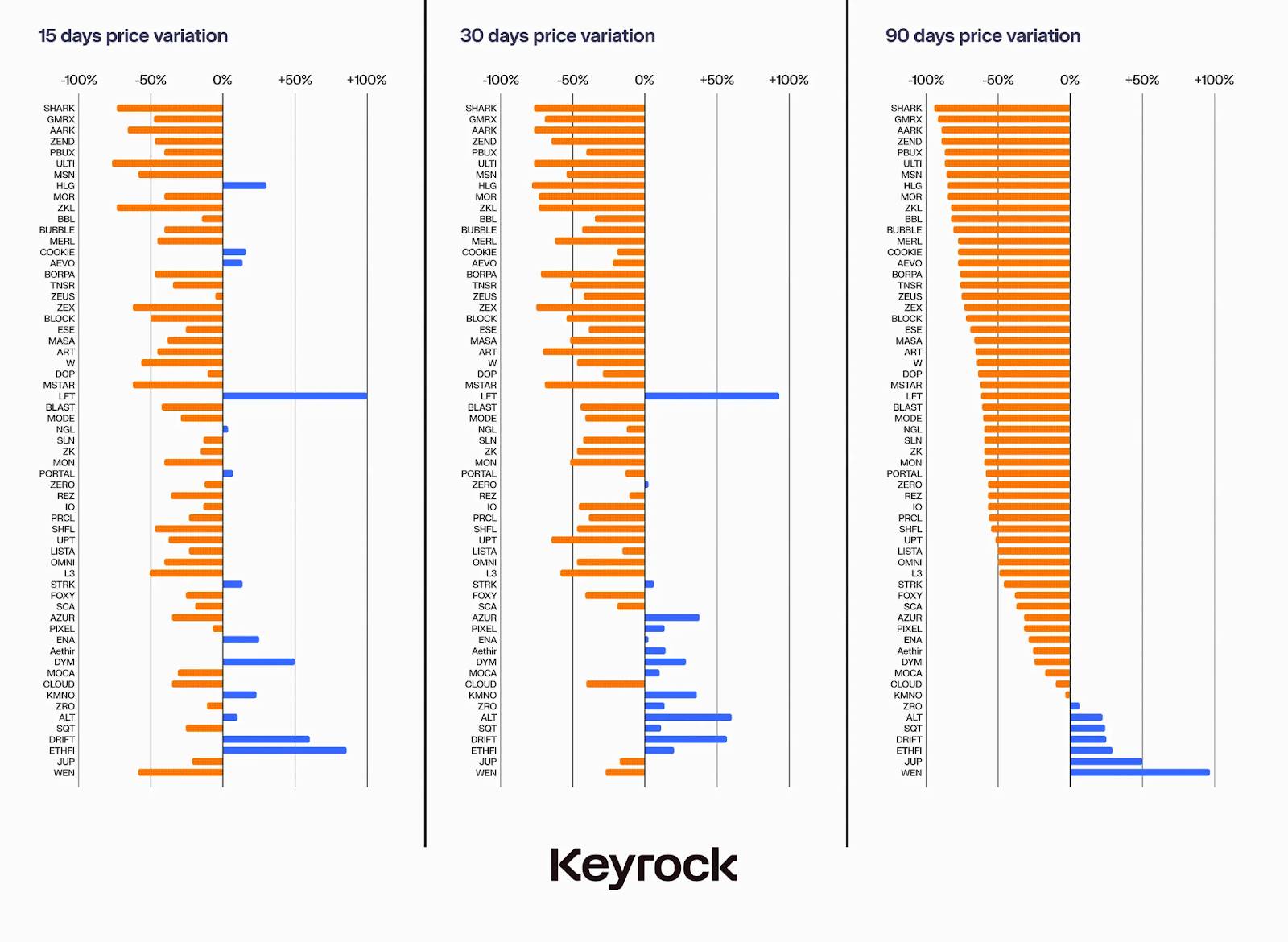
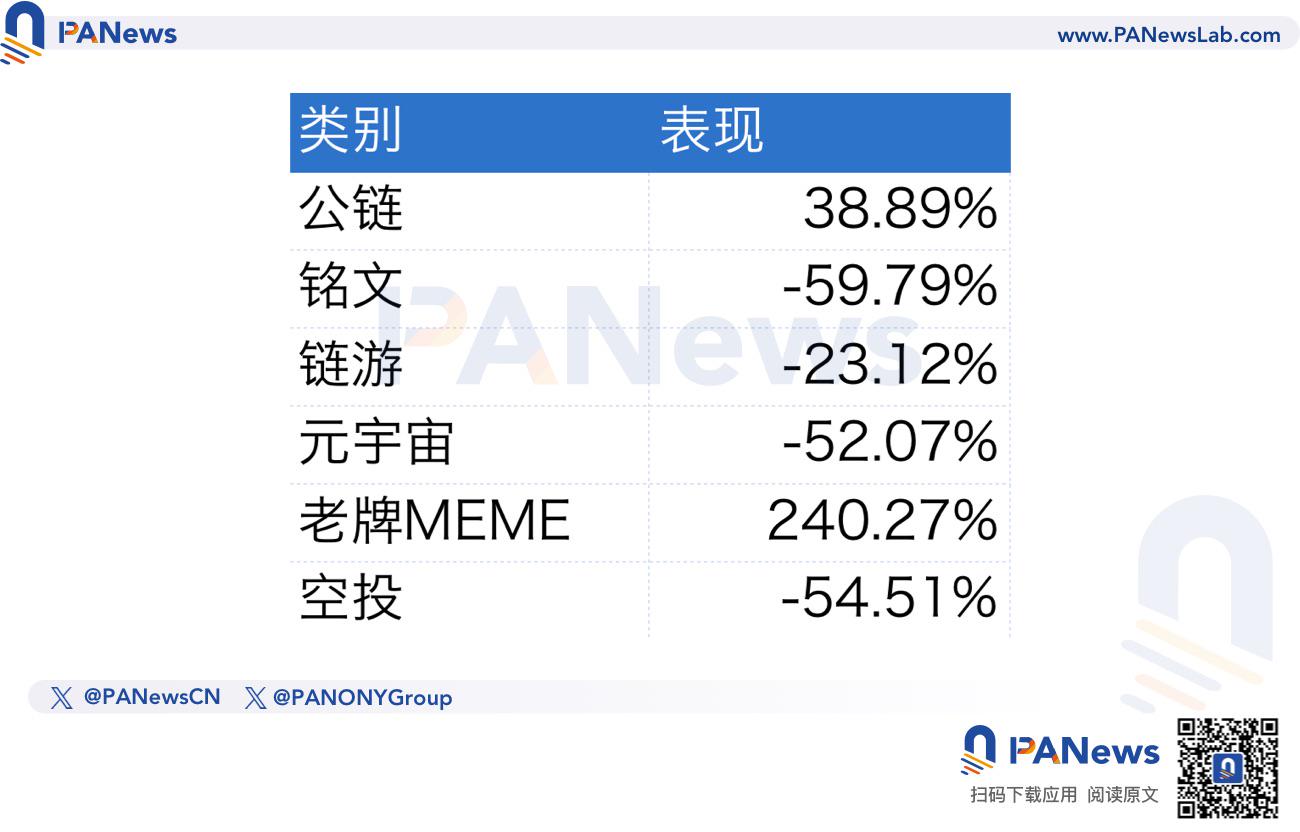
To conduct a comprehensive comparison, PANews analyzed performance data from January 1, 2024, to October 15, 2024, across several categories: major public blockchains, blockchain gaming, metaverse, inscriptions, airdrops, and established meme coins. The data shows only legacy meme coins and major public chains posted upward trends this year. Both popular airdrops and inscription-based tokens saw average declines of around 50%, while blockchain gaming and metaverse sectors dropped by 23% and 52% respectively.
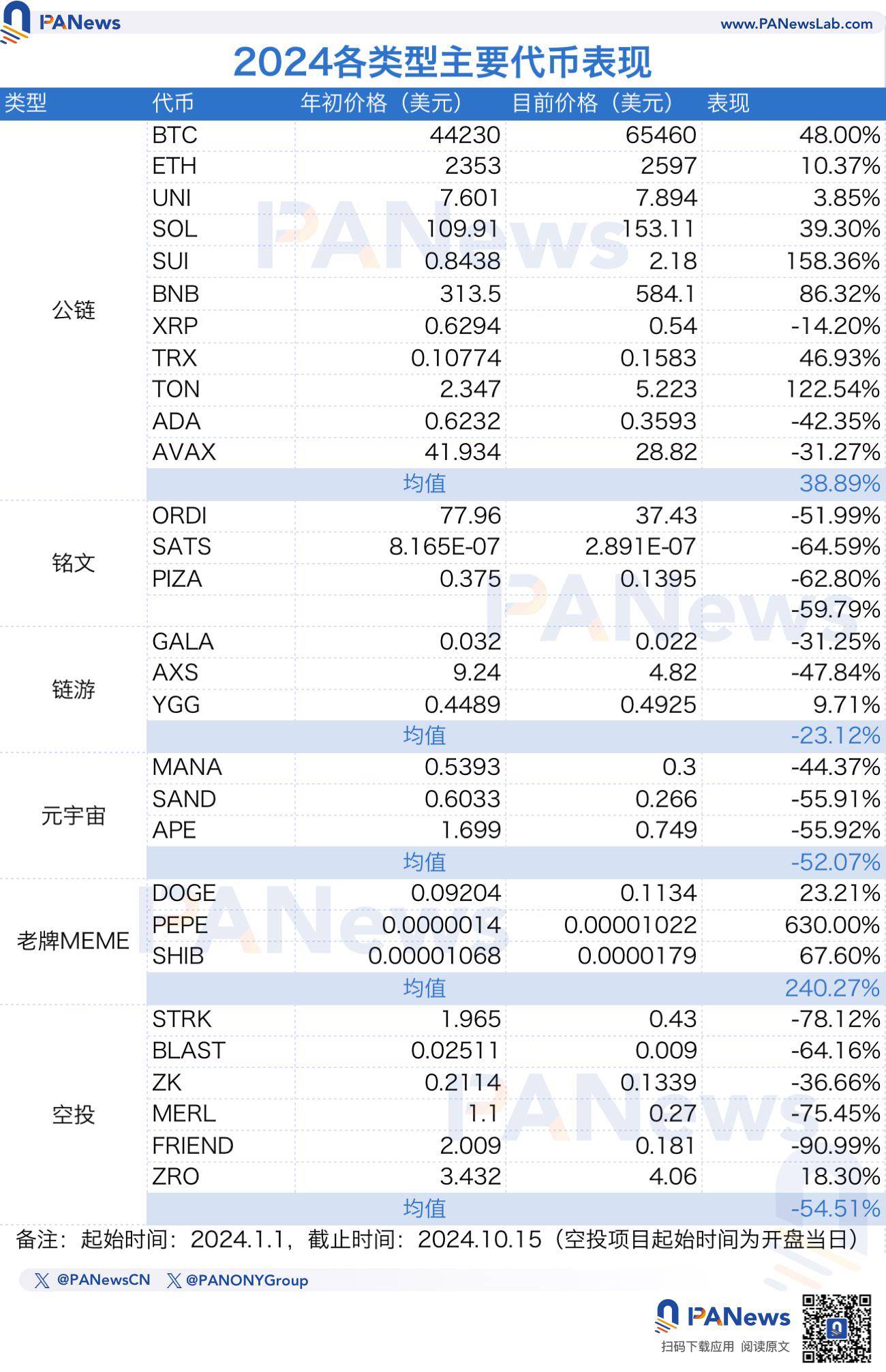
Aside from a few hot chains (e.g., SUI, TON, BNB), nearly all other mainstream tokens underperformed Bitcoin. Notably, this analysis excludes emerging meme coins, which themselves are defined by explosive growth. Due to their low initial market caps, new meme coins easily achieve hundredfold or even thousandfold returns. The primary reason memes are displacing mainstream tokens is simply superior market performance.
Shifts in Narrative Logic and Accessibility
Mainstream projects have long relied on compelling narratives as their foundation. From Ethereum’s smart contracts and EOS as a third-generation chain, to Layer 2, cross-chain interoperability, metaverse, blockchain gaming, and now re-staking, Bitcoin ecosystem developments (inscriptions, runes, sidechains), social, AI, and beyond—the technological jargon keeps evolving. These changes stem from saturated markets forcing teams to invent new niches to secure funding. Meanwhile, airdrops have morphed into complex point systems, and activities like inscription farming or coding tasks have raised barriers to entry, leaving retail investors confused and discouraging new users.
Meme coins, however, operate on an entirely different narrative: a simple idea, an image, a name, or a symbol—united by a shared cultural meme. Users don’t need to understand technical details or verify whether a project team actually delivered on promised innovations.

Moreover, with Solana's rise, malicious contract patterns like honeypots,貔貅 (rigged mints), and unauthorized minting that plagued Ethereum have significantly decreased, lowering the barrier for ordinary users to enter the meme space. This year, more tools have further enhanced the meme experience. Platforms like Dexscreener and Birdeye now support price charts across multiple chains.
The widespread adoption of one-click token launch platforms like Pump.fun has been pivotal. As such tools gain mainstream traction, meme coins have effectively resolved many code-level vulnerabilities, allowing cultural relevance, capital, and community—the core attributes of memes—to take center stage.
These developments reflect two opposing trends within the crypto community: on one end, new projects grow increasingly complex and inaccessible; on the other, meme coins embrace minimalism and specialized division of labor, reducing entry barriers.
In a market with limited capital and users, the balance is clearly tilting toward memes.
Crowds Lead, Capital Follows
As retail investors flock to meme coins, institutional capital appears to be shifting resources accordingly. According to Lookonchain, Wintermute has been accumulating NEIRO (Neiro on Ethereum) since September 6, amassing 62.45 million NEIRO (worth $7.39 million), representing 6.25% of total supply. NEIRO is now among Wintermute’s largest meme coin holdings. On October 11, The Data Nerd reported that apart from Wintermute, three other market makers (MMs) and one venture capital firm also hold $NEIRO_ETH tokens.
Data provided by @thedefiedge shows that as of October 15, Wintermute holds approximately $10.52 million worth of PEPECOIN, making it the third-largest holding in its portfolio, along with $3.48 million in NEIRO—making it the most publicly visible market maker in memes. Jump Trading also holds $1.2 million in SHIB.
Recently, Gotbit—a market maker indicted by U.S. federal prosecutors—was revealed to have provided liquidity for Neiro. Following this news, multiple meme projects including Beercoin, WaterCoin, and Hamster Kombat issued urgent clarifications distancing themselves from Gotbit. These incidents suggest that professional market makers’ participation in meme coin markets has become commonplace.
Furthermore, based on PANews' repeated analyses of trending meme coins, market makers often use tactics like distributing funds across wallets, staggered buying, asset transfers, and hidden sell-offs to avoid detection by on-chain trackers. These practices make the true extent of institutional holdings in memes a mystery.
From a capital perspective, the incentives are clear. Investing in mainstream value projects requires large upfront capital, long development timelines, user acquisition via airdrops and point systems, and extended lock-up periods before monetization. In contrast, investing in meme coins is simpler: select battle-tested assets, hold liquid, unlockable tokens, leverage capital advantages to influence price, and realize high returns with immediate liquidity. All factors considered, the current meme coin market better aligns with institutional profit motives.
From Ansem to Murad: A New Generation of Kings
Recently, Murad has emerged as a new legend in the meme world, gaining fame through his speech on the “Memecoin Super Cycle” and reportedly holding over $24 million in meme coins. Meanwhile, former meme king Ansem appears to be facing skepticism. Beyond their track records, we may observe notable shifts in player strategies.
Ansem first rose to prominence through WIF, embodying the “diamond hands” philosophy—investing small amounts early and holding until peak valuation. This approach was once dominant among meme investors, who focused intensely on identifying promising meme coins and entering at the earliest stages. However, this method carries high risk: falling victim to rigged mints or malicious developers could lead to devastating losses. Ansem excelled at this game, consistently spotting undervalued gems early and cashing out profitably.
Murad’s rise represents a shift toward a different strategy. He outlines his criteria for meme investments as follows: mid-cap tokens ($5M–$200M); based on Solana or Ethereum; with at least six months of history. These standards indicate a preference for relatively mature tokens rather than betting on brand-new launches. Additionally, compared to Ansem’s frequent trading, Murad trades far less frequently, often holding positions for months—resembling institutional investment behavior in traditional value tokens.

Meme Season: Decline or New Opportunity?
From an industry-wide perspective, mainstream value projects remain the backbone of the ecosystem and are still preferred by institutions. Thus, many fear that the rise of meme coins could undermine crypto’s foundational values. If manipulating prices and managing communities alone can generate massive wealth, how many will still dedicate themselves to technological innovation and driving transformative change—not just in crypto but across Web2?
This is indeed a legitimate concern. Looking back at famous meme coins, few project teams or communities have introduced innovative technical frameworks or governance models to the broader crypto space. Instead, as memes flourish, on-chain hackers, sandwich attackers, and meme packaging teams reap enormous profits. Whether retail investors truly benefit remains debatable.
However, if we separate cryptocurrency from blockchain technology, we see two distinct paths: technology evolves independently, while meme coins represent the development of crypto as an asset class. Behind mainstream value tokens, genuinely innovative projects will continue to earn recognition from capital and the market. What memes have displaced are not real tech innovators, but rather fake projects disguised as technological breakthroughs. As Murad puts it, ordinary investors are gradually realizing that the token itself is the product—not the software. He believes the crypto industry remains fundamentally an asset-generating sector, with technology playing a supporting role.
Thus, the trend of memes becoming mainstream appears inevitable. For speculators, profit-seeking is natural. But the decline of mainstream value tokens challenges the traditional VC value system. It’s time for reflection and reform—time to reclaim their stage.
Join TechFlow official community to stay tuned
Telegram:https://t.me/TechFlowDaily
X (Twitter):https://x.com/TechFlowPost
X (Twitter) EN:https://x.com/BlockFlow_News
 PANews






