Crypto Investment Rules: Patience or Quick Profits?
TechFlow Selected TechFlow Selected
Crypto Investment Rules: Patience or Quick Profits?
Profitability-driven transactions can sometimes generate returns more quickly and may have higher internal rates of return (IRR) than durability-focused transactions.
 Navigating Web3 tides with focused insights
Author: Social Graph Ventures
Translation: TechFlow
This article discusses the framework we use at Social Graph Ventures when evaluating venture investments. I call it the Durability and Profitability Framework for token evaluation—an approach unique to crypto venture investing, enabled by early liquidity from token generation events.
Today, 95% of the crypto deals we engage in include token warrants, Simple Agreements for Future Tokens (SAFTs), or other legal instruments specifying how early-stage investments convert into tradable tokens upon a project's launch.
Our method for assessing these tokenized venture deals is binary: either durable or profitable.
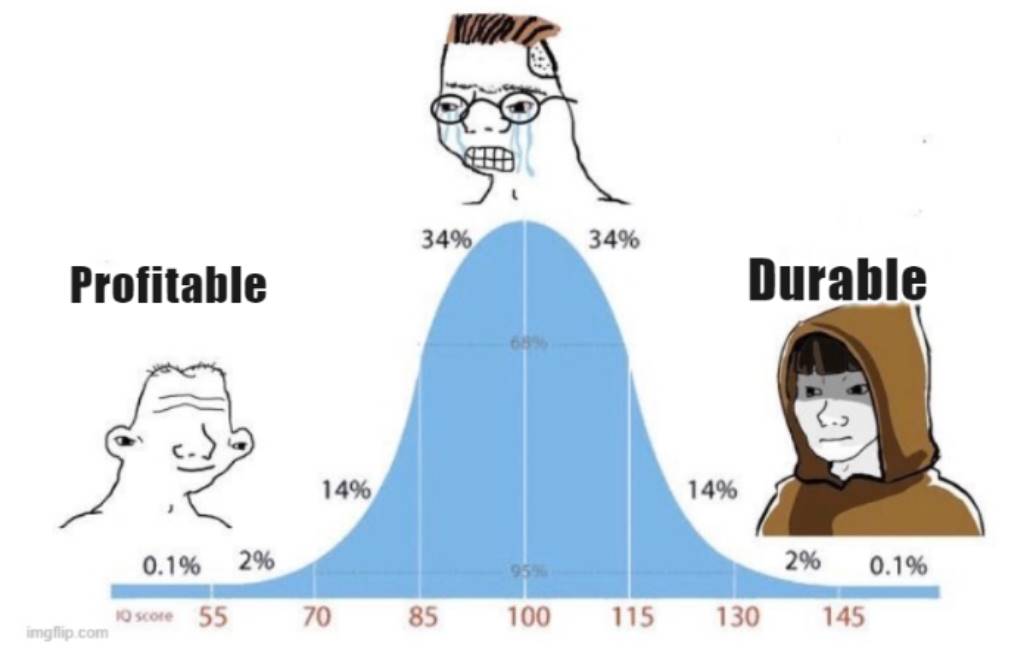
Durability
The durability investment thesis holds that a token’s value can remain stable over time. This means the project has a clear path to generating sustainable revenue streams that can underpin the fundamental value of the token. The token exhibits a flywheel effect, aligning stakeholders. It governs the allocation of these revenues, derives direct value from them, and controls the project’s future. This is an elegant model. Sometimes, a durable thesis doesn’t even require issuing a token at all.
When evaluating a durability thesis, ask yourself:
-
Do I believe these founders are pursuing their life’s mission? Will this become their lifelong endeavor? What in their lives has positioned them to build this?
-
Does the current product have clear product-market fit that justifies a stable revenue stream now or in the future?
-
Is there a token model flywheel that accelerates the project’s growth trajectory and remains sustainable ten years from now? There are many other factors, but these are foundational. If the answers are yes, you likely have a durable project.
Profitability
On the other hand, we have the profitability thesis. In this case, as an investor, you assess the potential exit value of the token once it launches.
A prime example of this theory is memecoins. These tokens aren't backed by any revenue. Their value relies purely on attention, community, and speculation. They are highly volatile, and with the exception of a few memecoins (or NFTs) possessing strong brand equity, there is little reason to expect long-term persistence.
In similar domains, there are so-called "utility tokens" that lack a clear mechanism linking cash flows to the token. While the company may generate revenue, it might all or partially flow to equity holders. This dichotomy renders such digital assets ambiguous and difficult to value.
When evaluating a profitability thesis, ask yourself:
-
Can the team build a strong brand and community?
-
What is the token unlock schedule for me and others involved in this deal?
-
What is the narrative behind this project, and how long will it last after token launch?
-
At what valuation am I investing, and at what valuations do I expect it to trade at TGE and at various future points?
Durability vs. Profitability
Clearly, evaluating durability is more challenging than assessing profitability. Both can deliver returns to your portfolio—that’s the dilemma. Compounding this, profitable deals sometimes generate returns faster, with higher internal rates of return (IRR) than durable ones.
This mirrors value investing versus momentum investing in traditional finance—but occurs at an earlier stage, in less efficient markets rife with legal gray areas.
We aim to make our portfolio entirely composed of durable projects, but that’s hard to achieve. Passing on a profitable deal may not seem wise in the moment. The opportunity cost of missing out on profitable opportunities in crypto is extremely high. This explains why we see many "VC tokens" go through boom-and-bust cycles. It also explains why early entrants often capture most of the gains, while latecomers walk away empty-handed.
In summary: We strive to make your portfolio as durable as possible, but we won’t pass up “left-brain” deals that could deliver meaningful profits to the portfolio. ("Left-brain" deals typically refer to logical, analytical, data-driven investment decisions.)
This article is for informational purposes only and does not constitute advice to buy or sell securities or pursue any specific investment strategy. It should not be relied upon as the basis for evaluating any investment or particular investment strategy. You should consult your own advisors regarding the business, financial, tax, legal, and all other implications of any investment. The views expressed herein reflect the author’s current opinions and do not necessarily represent the views of Social Graph Ventures LLC.
Join TechFlow official community to stay tuned
Telegram:https://t.me/TechFlowDaily
X (Twitter):https://x.com/TechFlowPost
X (Twitter) EN:https://x.com/BlockFlow_News
 @paragraph_xyz