Unichain: Can Uniswap and Flashbots Solve the MEV Problem?
TechFlow Selected TechFlow Selected
Unichain: Can Uniswap and Flashbots Solve the MEV Problem?
Unichain empowers UNI by mitigating the negative impacts of MEV through built-in MEV redistribution mechanisms, fast confirmation times, and transparent transaction ordering rules, though it cannot completely eliminate MEV.
 Navigating Web3 tides with focused insights
By 0XNATALIE
Yesterday, Uniswap announced a collaboration with Flashbots to launch Unichain, an Ethereum Layer 2 specifically designed for DeFi. Built as an Optimistic Rollup based on the OP Stack, Unichain aims to address key challenges facing DeFi. Notably, Uniswap, Flashbots, and Optimism have all received investment support from Paradigm.
Currently, Ethereum L1 has a 12-second block time, and slow transaction speeds limit user experience. Additionally, MEV (Maximal Extractable Value) remains a pressing issue—existing block-building mechanisms allow certain participants to gain unfair profits by manipulating transaction ordering, reducing market efficiency. To tackle these issues, Unichain introduces 1-second block times and 250-millisecond "Flashblocks," combined with verifiable priority ordering and Trusted Execution Environments (TEE). This significantly accelerates transaction processing while enhancing transparency and fairness in transaction ordering, injecting new vitality into the Layer 2 DeFi ecosystem.
Technical Features of Unichain
1. Verifiable Block Building (VBB)
This is a novel block-building mechanism introduced by Unichain, implemented via Rollup-Boost. It aims to improve transparency in blockchain transaction ordering, reduce unfair MEV extraction, and accelerate transaction processing. The core idea is to use TEEs to execute the block-building process, offering a transparent and trustworthy ordering mechanism. Rollup-Boost, developed by Flashbots, is a verifiable block-building platform designed to enhance Rollup performance through TEE optimization. Unichain serves as its first real-world implementation. Integrated as a sidecar software on Unichain, Rollup-Boost leverages its technical capabilities—such as Flashblocks' rapid confirmation and verifiable priority ordering—to boost Unichain's performance and user experience.
How Verifiable Block Building works:
-
Block building using TEE: TEE is a hardware security technology that enables computation tasks to be executed within an isolated environment, ensuring they cannot be tampered with or interfered by external factors. In Unichain, block builders operate inside a TEE, guaranteeing secure and reliable block construction. The TEE simulates transaction execution, detects failing transactions, and removes them, preventing users from paying high fees for failed transactions.
-
Generating Flashblocks: Unichain produces a block every second and introduces a pre-confirmation mechanism called Flashblocks. Each block is divided into four flashblocks (i.e., a pre-confirmation every 250 milliseconds), which are transmitted in real-time to the sequencer. Users receive early confirmation before their transactions are officially included, protecting against rollbacks caused by block reorganizations and reducing uncertainty-related costs. This mechanism accelerates settlement and reduces opportunities for MEV extraction.
-
Priority ordering and verifiability: Rollup-Boost provides a verifiable transaction ordering method, allowing users to verify their transaction’s position within a block. By conducting block building within a TEE, transaction prioritization can be performed transparently according to specific rules (e.g., priority fees paid), and cryptographic proofs can verify whether the block construction adheres to these rules. This mechanism not only prevents block builders from abusing their ordering power but also internalizes MEV—by setting rules (such as an MEV tax) to redistribute part of the MEV revenue back to the protocol or liquidity providers.
2. Unichain Validation Network (UVN)
The Unichain Validation Network (UVN) mitigates risks associated with single sequencer architectures and accelerates economic finality through staking and distributed validation.
Composed of multiple nodes, UVN enables each node to independently verify block states, ensuring all transaction records are legitimate and unaltered. This safeguards against risks such as block equivocation or invalid blocks from a single sequencer, thereby enhancing network security. Operators wishing to become UVN validators must stake UNI tokens on the Ethereum mainnet. Nodes with higher stakes gain greater weight and a higher chance of becoming active validators.
Additionally, UVN offers a faster mechanism for economic finality by enabling parallel validation across multiple nodes, reducing potential delays from relying on a single sequencer. During each validation cycle, each node confirms the validity of a block and publishes verification data onto the network, increasing confidence in the chain’s state. Once a block is validated, its transactions are considered irreversibly settled (i.e., economically final). Validators must verify blocks and issue attestations during each cycle; otherwise, they forfeit rewards.
What Does the Community Think About Unichain?
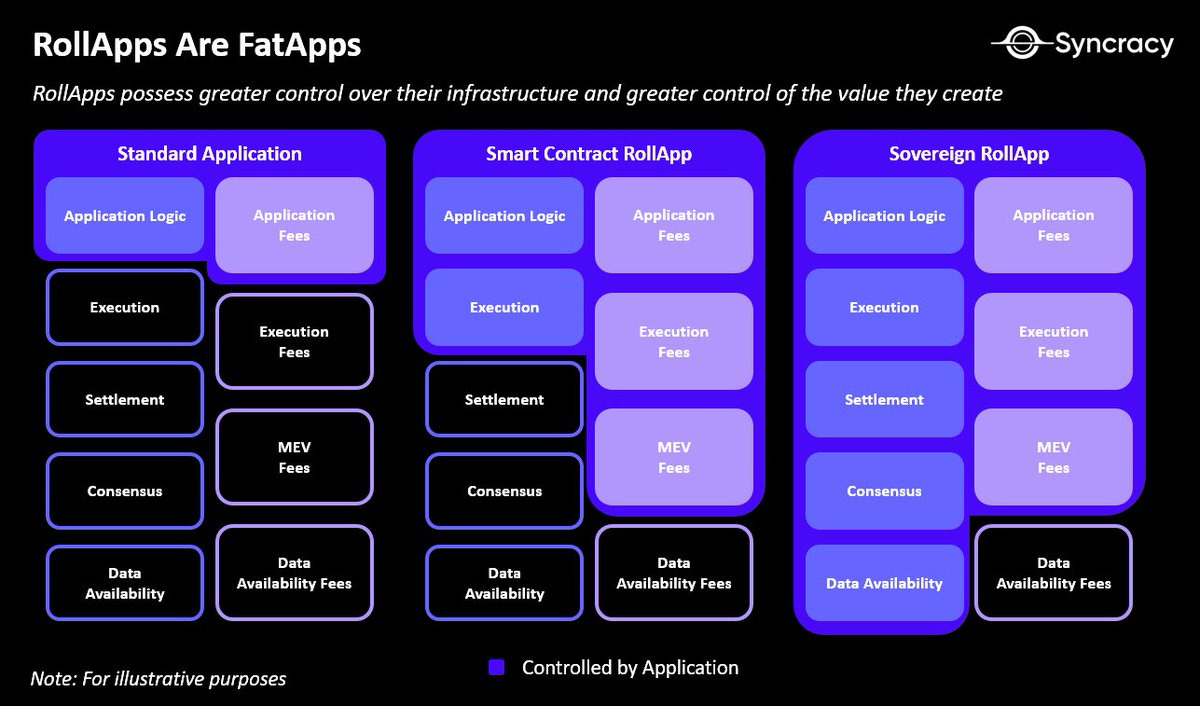
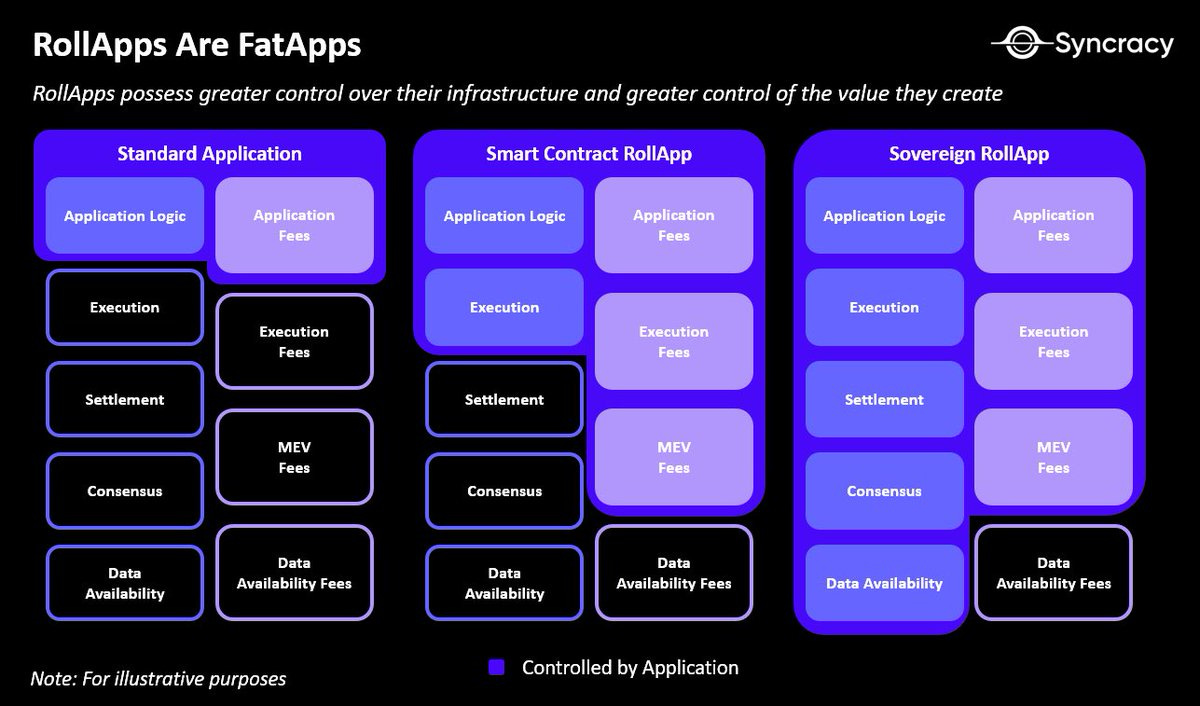
Ryan Watkins, co-founder of Syncracy Capital, proposed the idea that “RollApps are FatApps,” suggesting that RollApps like Unichain offer higher control and flexibility—akin to fat applications—with greater authority over infrastructure management and value capture. He categorizes application architectures into three types and compares their scope of control:
-
Standard Application: These apps control only application logic and fees, relying on blockchain infrastructure for execution, settlement, consensus, and data availability. Their control scope is relatively limited.
-
Smart Contract RollApp: These extend functionality and control by leveraging smart contracts to cover the execution layer. Apps manage their own execution logic and fees but still depend on the underlying blockchain (e.g., Ethereum) for consensus and data availability.
-
Sovereign RollApp: These apps exert control over nearly all layers (except data availability), achieving greater infrastructural independence and offering users and developers higher levels of customization and functional control.
Yuki, a researcher at Fenbushi Capital, pointed out that Unichain is not an app-specific blockchain (app-chain), but rather a general-purpose L2 solution with a built-in MEV redistribution mechanism. However, it still requires custom mechanisms (such as hooks) to ensure MEV proceeds flow to targeted groups (e.g., users or liquidity providers).
Researcher Haotian believes Uniswap launching Unichain does not represent a departure from Ethereum, but rather further advances Ethereum’s L2 ecosystem. Current L2 solutions have yet to fully unlock DeFi’s potential, and Unichain will act as a catalyst for expansion in the DeFi space. Unlike dYdX and MakerDAO, which adopted fully independent architectures and consensus mechanisms, Unichain is built on the OP Stack and aligns with Ethereum’s Rollup-Centric scaling roadmap. It also expands the utility of the UNI token. By competing alongside other L2s, Unichain will help invigorate the broader L2 market.
There are also dissenting views. For example, KOL sudo rm argues that current scaling strategies overlook fundamental problems. While L2s expand network throughput, user security remains inadequately addressed. Instead of investing heavily in L2 development, efforts should first focus on solving the most basic and critical issues in the Ethereum ecosystem, such as user security and attack resistance. KOL Temmy questions the necessity of Uniswap launching Unichain, expressing confusion about whether more L2 solutions are truly needed, given that existing L2s may already be sufficient. He warns that Uniswap’s move could lead to greater liquidity fragmentation, and if other dApps follow suit, the outcome could be worse than anticipated.
Join TechFlow official community to stay tuned
Telegram:https://t.me/TechFlowDaily
X (Twitter):https://x.com/TechFlowPost
X (Twitter) EN:https://x.com/BlockFlow_News
 @ChainFeedsxyz