








Lessons from History: What Happened to the 1,200 Crypto Projects That Raised Seed Funding Two Years Ago?
TechFlow Selected TechFlow Selected
Lessons from History: What Happened to the 1,200 Crypto Projects That Raised Seed Funding Two Years Ago?
Projects within the Binance ecosystem are the least likely to remain active, with one-third of teams ceasing operations.
 Navigating Web3 tides with focused insights
Author: Lattice Fund
Translation: TechFlow

Introduction
Last year, we published our 2021 seed-stage recap to gain a clear understanding of trends during that year’s seed phase. What percentage of companies had launched products on mainnet? How many found product-market fit (PMF)? Who launched tokens?
With the 2024 report, we now shift our focus to 2022 to better understand progress and trends in crypto at the seed stage. This report analyzes over 1,200 public pre-seed and seed rounds in cryptocurrency since 2022, offering insights into industry-wide, sector-specific, and ecosystem-level trends. As with our previous report, we are open-sourcing our database for further exploration and analysis. We invite your feedback and welcome any corrections; feel free to reach out to us at [email protected].
Executive Summary
The 2022 cohort raised funds during one of the most exuberant periods in crypto history. Teams announcing funding this year likely benefited from the bull markets of 2021 and early 2022. Given the market's frothiness, we expected these metrics might show negative outcomes compared to teams fundraising during bear markets. Our analysis confirms those expectations—but also reveals positive takeaways.
Since 2022, nearly 1,200 companies have collectively raised $5 billion, a 2.5x increase from the prior year. Key highlights include:
Breakouts in 2022
-
Every year has its standout success stories, and 2022 was no exception.
-
In infrastructure, we saw Eigenlayer (a restaking protocol), Privy (wallet-as-a-service provider), and parallel EVM Sei all raise seed funding. Notably, each of these teams helped catalyze broader narratives.
-
In DeFi, breakout stories included perpetual DEXs like Vertex and Apex, as well as specialized NFT exchange Blur.
-
Gaming was the primary consumer sub-sector, attracting nearly $700 million in investment. Despite heavy funding, the two largest successes raised relatively modest amounts—Pixels and PlayEmber each raised under $3 million in seed funding.
Launching Into a Challenging Market
-
Despite a bear market, nearly three-quarters of projects successfully launched products on mainnet. However, achieving product-market fit (PMF) and securing follow-on funding became more difficult compared to 2021, both declining significantly year-over-year.
-
18% of the cohort has shut down or halted development, up from 13% in 2021.
-
Only 12% of teams secured subsequent venture funding, a sharp drop from 50% in 2021.
-
Just 15% of projects launched a token, down from 50% in 2021.
Return to Infrastructure and CeFi
-
After the detour in 2021, investors returned to more proven categories like infrastructure and CeFi, investing nearly $2 billion and $450 million respectively—up 3x and 2x from 2021 levels.
-
80% of CeFi projects and 78% of infrastructure projects have launched on mainnet, reflecting strong investor confidence in these areas.
-
Results at the application layer are more mixed: 66% of consumer Web3 products and 68% of DeFi teams delivered products to mainnet.
-
Consumer teams are more likely to cease operations, with shutdown rates nearly double those of infrastructure teams.
-
Payment (86%) and wallet (90%) projects are most likely to launch on mainnet.
Ethereum Leads, Bitcoin Endures
-
In fundraising, Ethereum remains the dominant Layer 1 ecosystem, while Bitcoin-based projects continue to show resilience.
-
$1.4 billion was invested in Ethereum-based projects, followed by nearly $350 million in Solana-based projects.
-
Fundraising in the Polkadot ecosystem dropped sharply, down 40% year-over-year.
-
Teams building on Solana and Ethereum were equally likely to secure follow-on funding.
-
In contrast, no team in the NEAR ecosystem managed to raise follow-on capital.
-
Projects within the Binance ecosystem were least likely to remain active, with one-third of teams shutting down. Solana’s failure rate also doubled compared to 2021, reaching 26%.
-
Bitcoin projects show endurance, with 100% of teams still active two years later.
Methodology
This report is based on a combination of first-party data supplemented by insights from Messari, Root Data, Crunchbase, and other sources. To assess progress in the seed-stage market, we categorized each company by stage—including “active but not delivered” and “no longer active”—and further segmented by ecosystem and industry. While we have made every effort to ensure data accuracy, we acknowledge potential errors due to reliance on third-party sources. In ecosystems, we only included those with more than 15 teams raising initial funding in our charts.
One of the most challenging aspects of this analysis was determining whether a project achieved product-market fit (PMF). Unlike the objective milestone of “product delivery,” PMF is often subjective and fleeting, especially in fast-moving crypto markets. We used a combination of on-chain data from analytics providers such as Dune Analytics and DeFiLlama, along with information from company websites and blogs, to make these determinations.
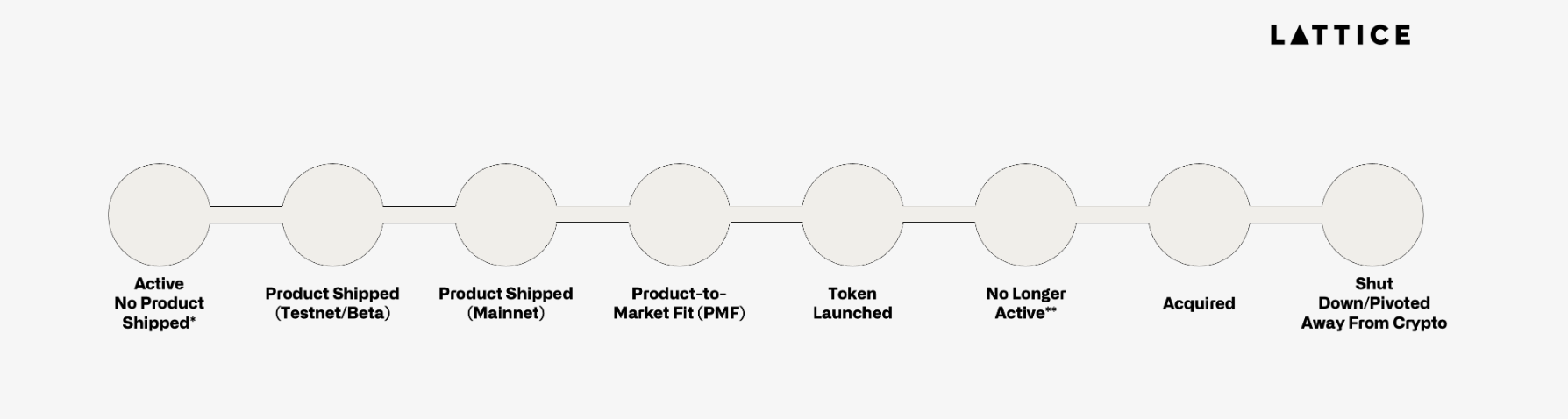
(Note: Lattice’s diagram categorizing analyzed products from left to right into stages such as active but undelivered, product delivered, PMF achieved, token launched, no longer active, acquired, and shut down.)
Seed Round Project Status
Our seed-stage review began as an internal analysis aimed at identifying projects gaining traction but yet to raise follow-on funding—potential targets for Lattice Fund. However, the data proved valuable enough to share with the broader industry.
This study is insightful because it reveals the health of various sectors, ecosystems, and the wider early-stage market over time. Since most seed-stage teams raise funds to sustain operations for about two years, we chose this timeframe to evaluate the 2022 seed cohort.
In 2022, over 1,200 crypto companies raised more than $5 billion in pre-seed and seed funding. Looking back at this cohort, 72% have launched on mainnet or equivalent networks, up from 66% last year. Meanwhile, 18% of projects either failed to deliver or have shut down, consistent with last year’s figures. However, the most notable decline is in teams finding PMF, which has dropped to around 1.5%. It's worth reiterating that it's difficult to assess real traction for off-chain running projects, so we may be missing some teams with early PMF.
Drawing users has become increasingly difficult during the bear market as retail interest wanes. Industries that were hot in 2022—such as NFTs, metaverse, and gaming—are no longer attracting users as they did two years ago. In contrast, infrastructure projects serving other crypto companies have proven more resilient. A prime example is Eigenlayer, which announced its seed round in January 2022 and successfully expanded its AVS listing strategy, attracting middleware projects eager to collaborate.
This serves as a strong reminder that today’s popular industries don’t always align with where investor interest ends up. For instance, the metaverse attracted 75 teams and nearly $280 million in funding, yet none found PMF, and over 21% of teams have already shut down—it's rare to hear anyone talking about the metaverse today. In contrast, DePIN and Ai, which barely registered in 2022, are now two of the hottest topics.
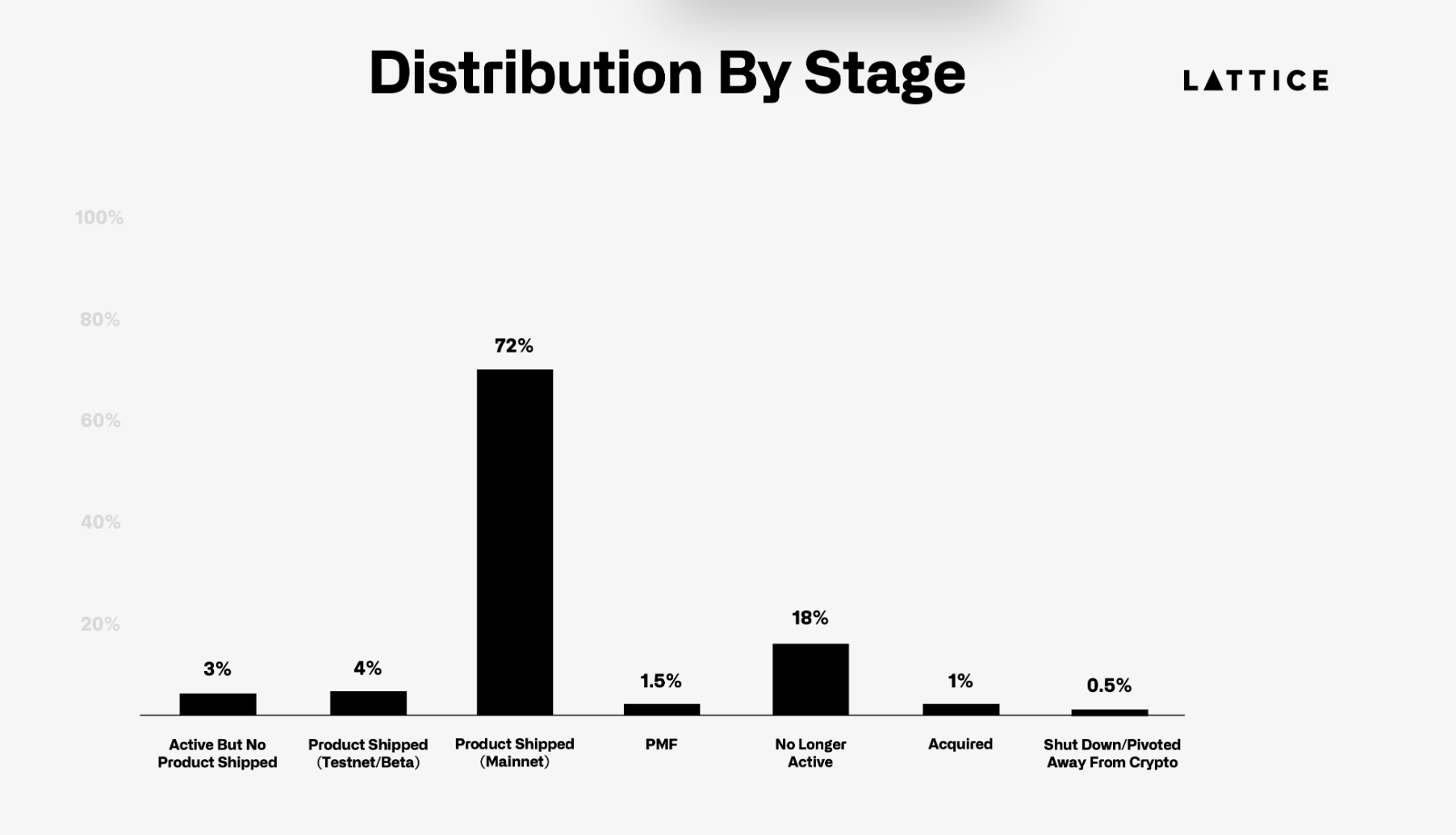
(Data chart showing that 72% of seed-funded projects in 2022 have launched on mainnet)
Venture Capital Tightens Wallets
The 2022 cohort raised funds during one of the most prosperous periods in crypto history. Teams announcing funding in 2022 likely did so before the collapses of Terra and FTX, which plunged the market into deep freeze. Although total fundraising increased 92% compared to 2021, the follow-on market tells a different story. Only 12% of the 2022 cohort managed to raise additional capital over the past two years—compared to nearly one-third of 2021 teams who secured follow-on funding.
Interestingly, token launches also declined year-over-year: only 15% of the 2022 cohort launched a token, down from 50% in 2021. This significant drop can be attributed to two main factors: 1) The 2022 cohort likely missed the bull market window, with many teams rushing to launch products in the first half of 2024, exhausting momentum through the summer. 2) With declining DeFi liquidity, launching on decentralized exchanges (DEXs) has fallen out of favor, shifting token launches toward centralized exchanges (CEXs). CEXs now charge high listing fees—often seven figures—and demand large portions of the token supply. Combined with a saturated token market, selective CEXs, and diminished appeal of DEX launches, bringing tokens to market has become significantly harder.
Flight to Infrastructure
Infrastructure investment tripled compared to 2021, reflecting a clear shift in investor focus. While interest in infrastructure appears to have cooled by late 2024, it was the most favored sector throughout 2022 and 2023. In contrast, DeFi was the only sector with declining investment, possibly due to the aftermath of the 2020 "summer of DeFi," when quick-profit schemes and Ponzi economics surged.
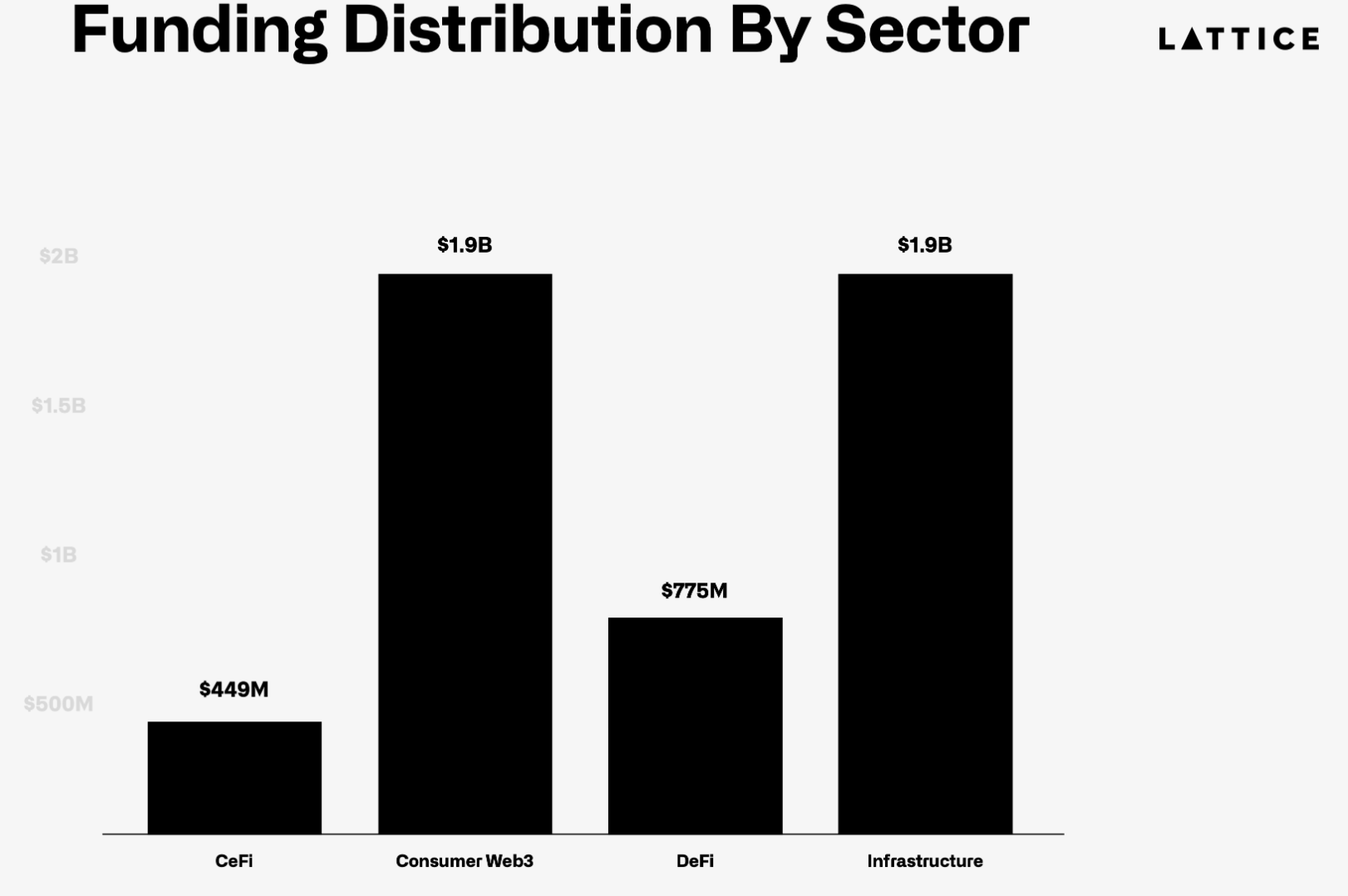
Investors who followed the infrastructure trend were rewarded—these teams were most likely to raise follow-on funding and launch on mainnet. Conversely, DeFi and consumer teams were more likely to launch tokens but also more likely to shut down. Pressure mounted on the application layer—without additional funding, teams were forced to either launch a token or shut themselves down.
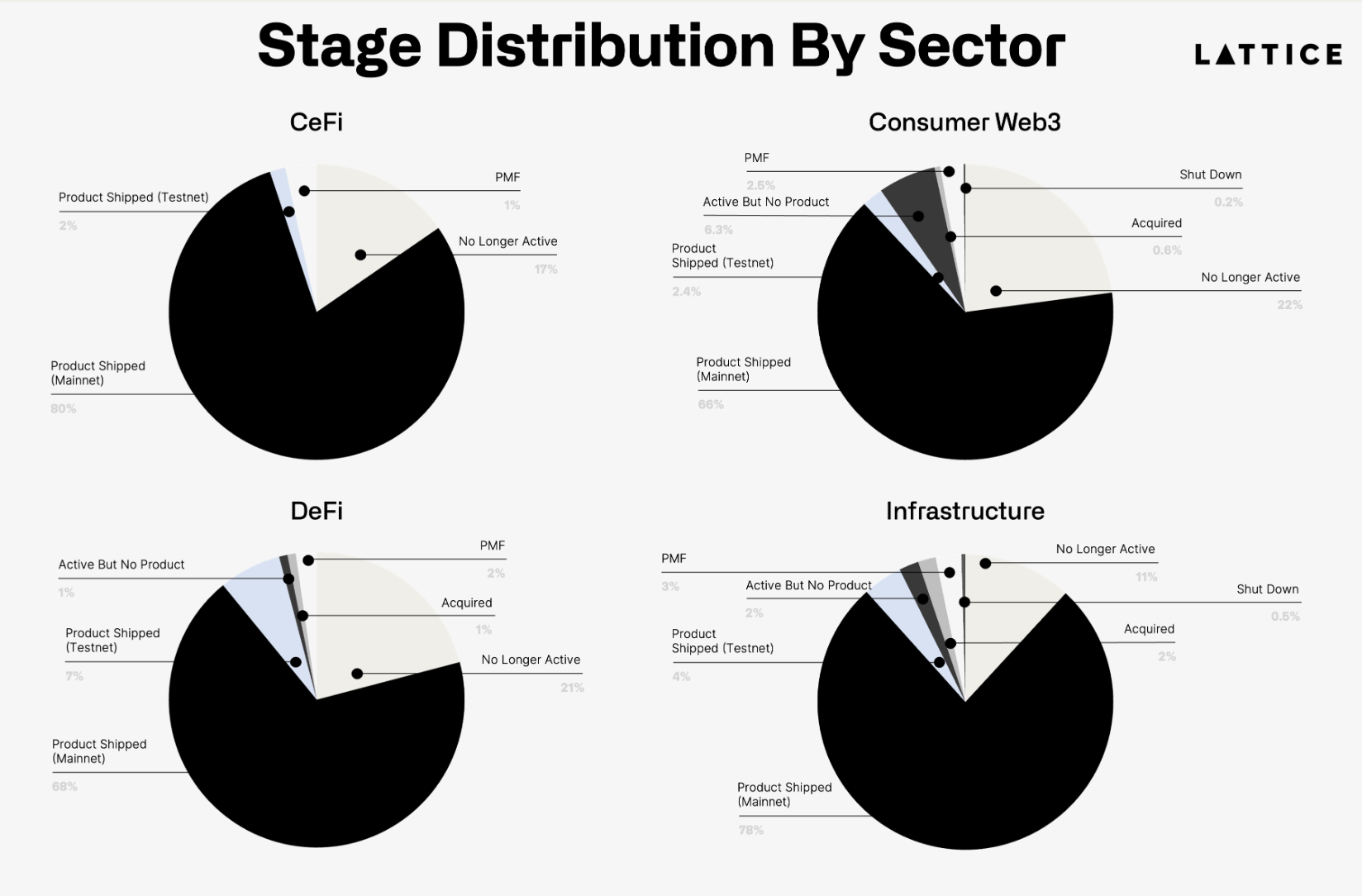
(Pie chart showing that across sectors, over 70% of seed-funded projects have delivered on mainnet [black segment], though most have not achieved PMF)
Not All Ecosystems Are Created Equal
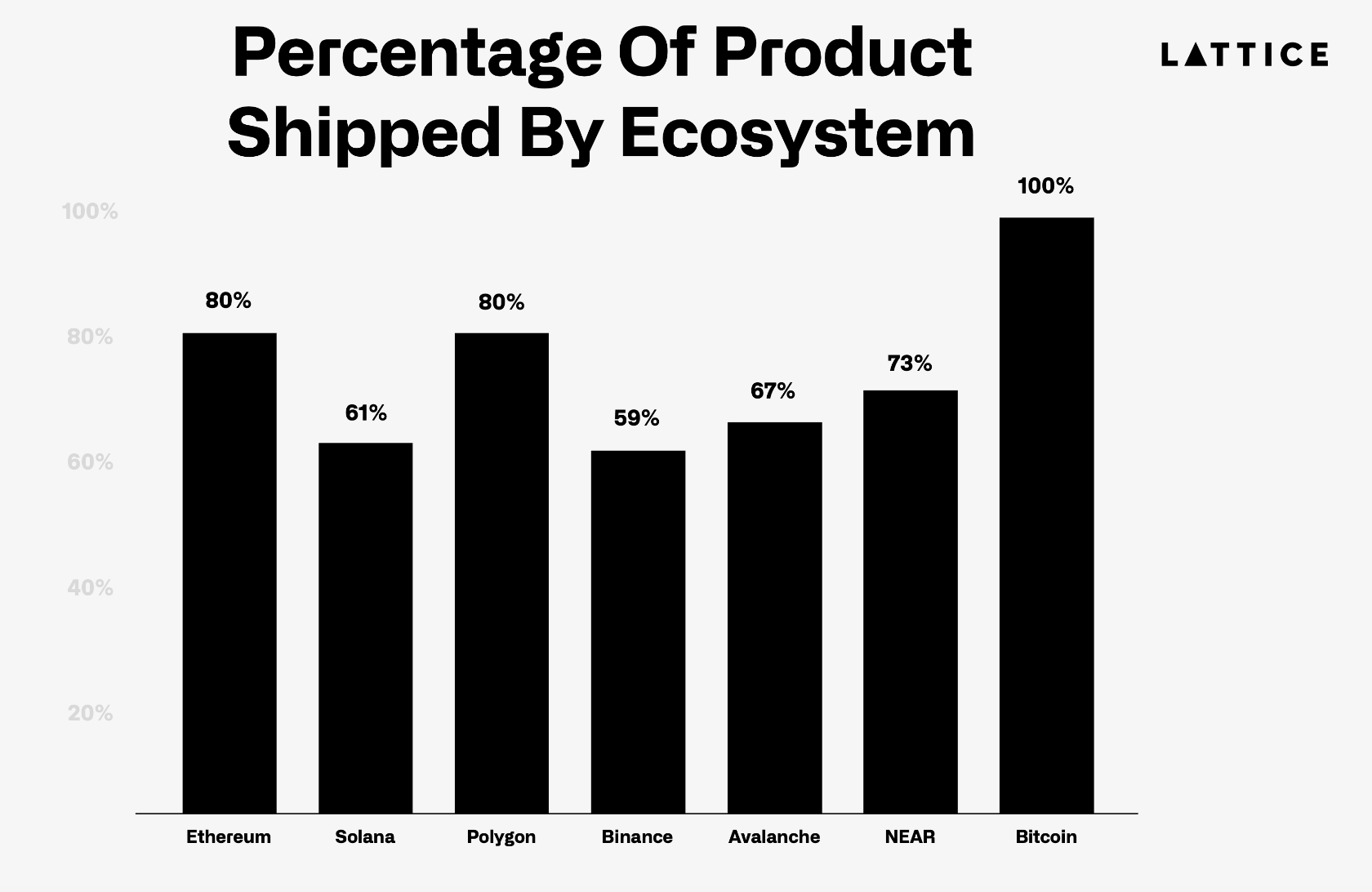
Cross-ecosystem development reveals significant differences in project success rates. Nearly 80% of Ethereum-based projects have delivered products, outperforming Solana, where only 61% have shipped—down from 75% in 2021. While Solana clearly weathered the bear market well, the massive capital inflow at the end of 2021 may have led to oversaturation.
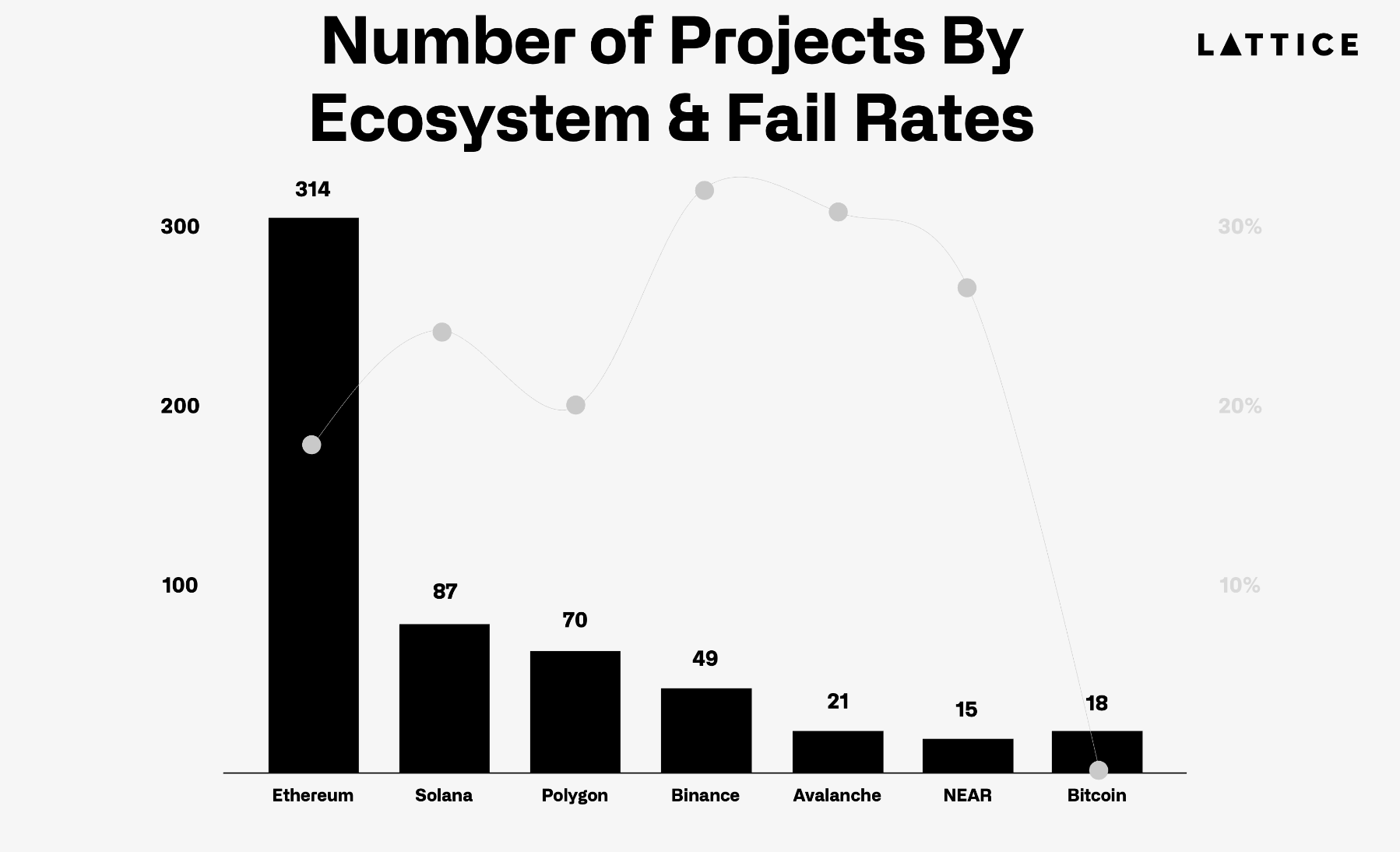
The failure rate among 2022 seed-stage teams remained consistent with 2021 cohorts, but notable disparities emerged within ecosystems. As observed last year, teams within the Binance ecosystem remain most prone to shutdowns, now joined by teams in the Avalanche ecosystem. Notably, failure rates among Solana-based projects doubled, with over 25% ceasing operations. This rise may stem from speculative capital flooding in during the bull run, leading to overexpansion and subsequent burnout during Solana’s particularly challenging post-FTX period. However, it’s clear that teams surviving this difficult phase have been rewarded. Moreover, the resilience of Bitcoin ecosystem teams stands out—they not only continued delivering but demonstrated extraordinary staying power, mirroring the reliability of the Bitcoin network itself.
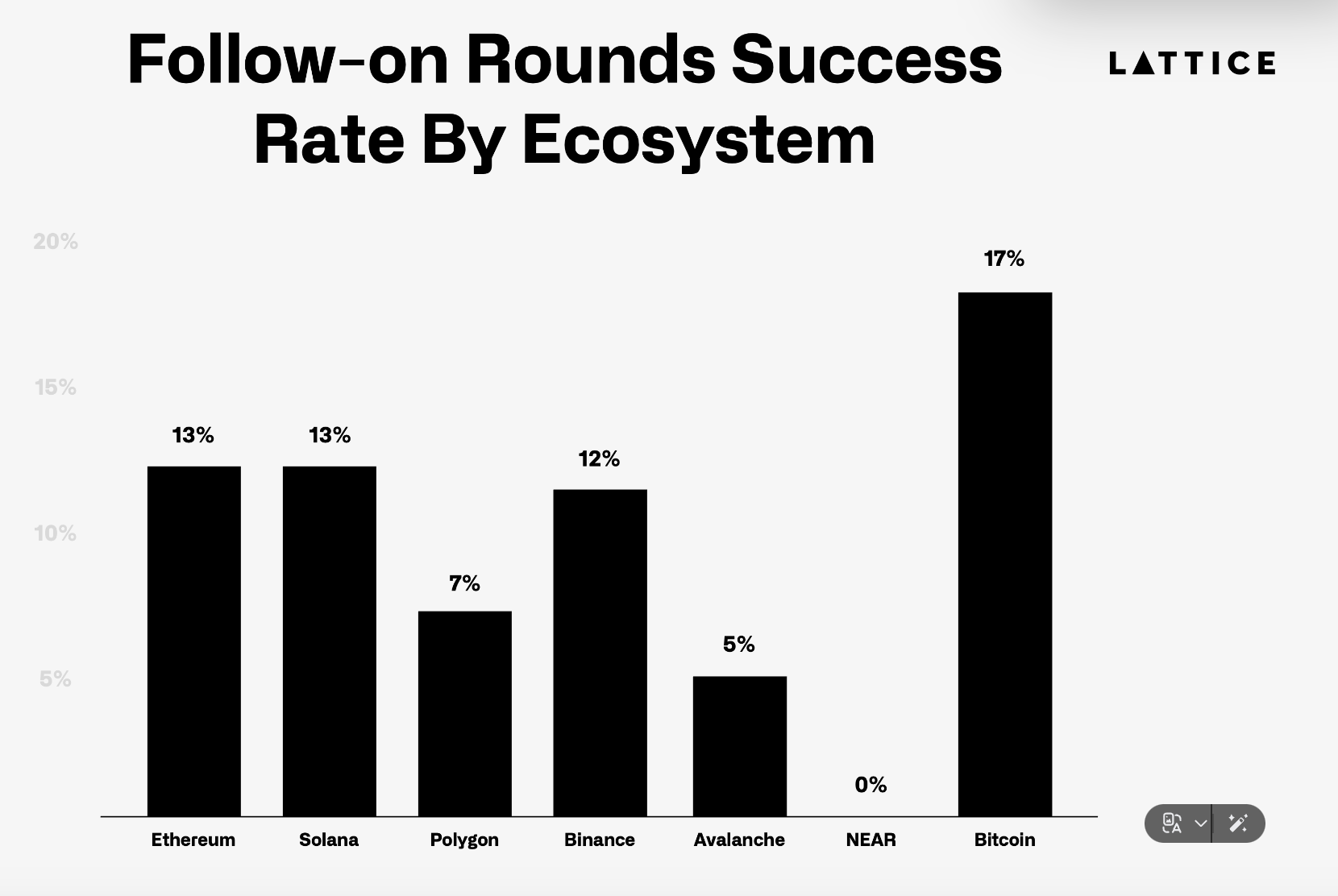
The follow-on funding landscape in 2022 revealed significant declines across all major ecosystems. Only 13% of Ethereum-based projects secured additional funding, down from 31% in 2021. Similarly, just 13% of Solana startups raised follow-on capital, a steep drop from 30% the previous year. Notably, ecosystems like Flow, StarkNet, and NEAR struggled to attract further investment—none of their projects received follow-on funding, highlighting challenges these platforms face in maintaining developer and investor engagement. This is particularly interesting given the volume of capital each ecosystem’s base layer attracted at the end of 2021 and in 2022—Dapper Labs raised nearly $600 million in 2021, NEAR raised $500 million in 2022, and Starkware raised close to $200 million in 2021 and again in 2022.
What Comes Next
The path for 2022 teams is more challenging than for 2021. In a sideways market without significant net new retail participation, finding PMF remains difficult. Some teams have pivoted toward currently popular retail-engagement sectors (e.g., gambling-related apps). Additionally, the sharp decline in teams securing follow-on funding will limit runway for experimentation. Finally, with a significant increase in seed-stage startups and a tightening token issuance market, more teams are competing for fewer opportunities.
Compounding these issues, investors have shifted attention to today’s trending sectors (e.g., DePIN and Ai) and ecosystems (e.g., Base and Monad). This underscores that returns don’t come from chasing today’s hype, but from anticipating what will be hot in 1–2 years.
We have no doubt the crypto seed-stage market will remain healthy, with nearly every fund actively participating—including a16z’s newly launched crypto startup school. For this cohort aiming to fundraise beyond Series A, the robustness of later-stage markets remains uncertain. Even within our own portfolio, we’ve seen shifts in narrative affect founders’ ability to raise capital.
Sectors and Trends to Watch
Privacy-Preserving Applications
Recently, investment in privacy-enhancing technologies has increased, with two key privacy infrastructure trends emerging over the past year: Zero-Knowledge Transport Layer Security (ZK TLS) and Fully Homomorphic Encryption (FHE). ZK TLS adds a privacy-enhancing layer to secure communications on the current internet. Projects like Opacity using ZK TLS are collaborating with Lattice portfolio company NOSH, enabling Nosh to leverage existing web2 delivery marketplaces. In this example, a driver logs into the Nosh driver app using Doordash credentials, which the protocol treats as proof of identity. When network demand matures, the driver can fulfill deliveries via the Nosh driver app; if the order originates from the protocol network (rather than Doordash), the driver earns tokens. We expect more use cases to emerge from this new privacy primitive.
Similar to ZK TLS, advances in FHE infrastructure could unlock a new class of crypto applications—from private DeFi to DePINfied data collection. An early practical example involves sharing sensitive health data with AI companies. Lattice portfolio company Pulse uses the DePIN flywheel to collect health data, monetizing pattern or biomarker discovery by allowing researchers to analyze encrypted genetic data without accessing raw genetic information, preserving confidentiality. As privacy infrastructure advances and converges with broader trends—AI agents and decentralized physical infrastructure networks (DePIN) for data collection—it could spark a new wave of consumer- and enterprise-focused applications.
Augmented Reality Applications and Infrastructure
Broad tech trends heavily influence where crypto founders direct their efforts and where investor capital flows. We witnessed this firsthand with the surge in AI-related startups from 2023 to 2024 following OpenAI’s breakthroughs. As Apple, Meta, and Snap all roll out major AR strategies, we expect increasing numbers of crypto startups to emerge as AR technologies finally reach mass adoption. A Lattice portfolio example is Meshmap, which is building a decentralized 3D world map. As AR device installations explode over the coming years, having a 3D map for developers to build experiences upon will be critical. The excitement around virtual metaverses in 2021 may have been premature, but the lesson from last year’s and this year’s reports is that people aren’t paying attention to where alpha can emerge.
Blockchain-Supported Collectibles Markets
Collectibles trading is largely associated with digital assets (especially NFTs), but blockchain-supported physical collectibles markets are emerging—from liquor markets like BAXUS to watch platforms like watch.io and Kettle. Collectibles trading is already a massive off-chain market, but plagued by issues like lack of instant settlement, physical custody, and reliable authentication.
We believe these challenges present an opportunity for “Blockchain-Enabled Collectibles Markets” (BECM)—platforms purpose-built for collectors. BECM enables instant transactions via cash settlement, drastically reducing settlement times from weeks to seconds using stablecoins, and employs NFTs to represent physical assets held by trusted custodians. This model can unify fragmented markets, enhance liquidity, eliminate personal storage burdens, and establish trust through verified ownership. BECM also supports financial innovation, such as borrowing against collectibles, making collecting financially dynamic. With these efficiency gains, BECM has the potential to significantly expand the total addressable market for collectibles by attracting more traders, liquidity, and inventory.
Ecosystem Rotation
Our tables and charts include only ecosystems with more than 15 projects raising venture funding—the smallest numbers hover just below 15 and were therefore excluded. Perhaps unsurprisingly, we anticipate significant ecosystem shifts: Polkadot, NEAR, and Avalanche may be replaced by Layer 2 ecosystems and emerging Layer 1s and Layer 2s like Monad, Berachain, and MegaETH, based on current trends.
Join TechFlow official community to stay tuned
Telegram:https://t.me/TechFlowDaily
X (Twitter):https://x.com/TechFlowPost
X (Twitter) EN:https://x.com/BlockFlow_News
 @lattice_fund











