








Historic airdrop sees users earn average of $3, who's really winning in the Hamster Kombat game?
TechFlow Selected TechFlow Selected
Historic airdrop sees users earn average of $3, who's really winning in the Hamster Kombat game?
Hamster Kombat has created the largest airdrop user base to date, but as with other major airdrops, community skepticism continues to grow.
 Navigating Web3 tides with focused insights
Author: Frank, PANews
On September 26, Hamster Kombat, a tap-based mini-game on the TON ecosystem reportedly boasting 300 million players, officially launched its token airdrop. Its ecosystem token HMSTR simultaneously went live on over ten major exchanges including Binance, OKX, Bybit, Gate.io, and Bitget.
Hamster Kombat has created the largest airdrop in terms of user scale to date. However, similar to previous large-scale airdrops, it has drawn continuous criticism from the community. Many users reported earning only around $1 worth of tokens after months of tapping, while leaked images revealed numerous obvious bot accounts receiving massive allocations. Once again, have dedicated grinders ended up doing all the work for the project team? And who are the real winners behind this airdrop involving hundreds of millions of users?
Average Airdrop Value Only $3, Sybil Rules Under Scrutiny
With such massive user accumulation, distributing the airdrop became Hamster Kombat's biggest challenge. Previous large airdrops, such as Jupiter and Zksync, involved user bases in the millions—rarely exceeding tens of millions—and there was little precedent for projects at this scale. Particularly for Hamster Kombat, which had not implemented anti-Sybil mechanisms early on, a significant number of farming syndicates participated. If Sybil detection failed, genuine users would be harmed. According to official data, Hamster Kombat claimed 300 million users, with 131 million ultimately qualifying for the airdrop, meaning about 2.3 million Sybil addresses were detected.
The total supply of HMSTR is 100 billion tokens, with 60% allocated to the airdrop—amounting to 60 billion tokens. With 131 million eligible users, each received an average of approximately 458 tokens. At a price of $0.007, this amounts to roughly $3.20 per user.
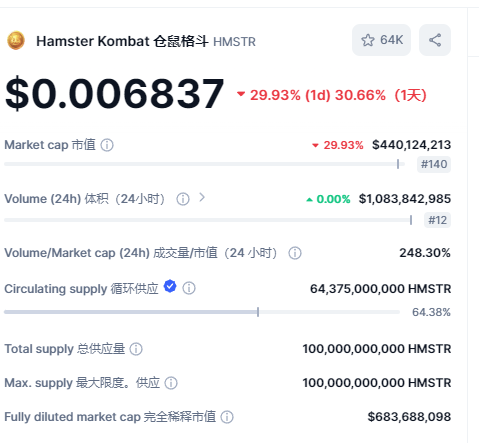
Data shows that HMSTR’s market cap stands at around $440 million, lower than DOGS’ initial $640 million and significantly below NOT’s debut market cap of $1 billion. This suggests that Hamster Kombat did not achieve higher valuation premiums despite its massive user base. Delays in airdrop distribution and token listing, combined with declining market interest following the launch of multiple traffic-driven products in the TON ecosystem, contributed to the low per-user token value.
Unsurprisingly, the community expressed widespread dissatisfaction. User @roe1527 complained on X (formerly Twitter) that after participating for 109 days, they received only about $17 worth of tokens, which will be unlocked in batches. @roe1527 concluded: “I might not care much about this small airdrop, but you should still respect people’s labor. This is too harsh—it’ll really ruin your reputation.”
PANews also published an article after the airdrop rules were announced titled "Token Distribution Sparks Controversy: The Hamster Game That Once Boosted Massage Guns Still Offends Players", quoting a player named Timbo who said he played almost from day one, spending 4–5 hours daily for two months and earned about 500 tokens—worth just $3.50.
Project Team, TON Blockchain, and Exchanges Emerge as Biggest Winners?
Besides users, the project team, exchanges, and the TON blockchain itself emerged as clear beneficiaries of this massive airdrop.
For the TON blockchain, data shows wallet addresses increased by 30 million since September, a rise of about 50%. Recently, the TON Foundation announced in its channel that monthly active wallets on TON reached 10 million, a new record high.
This exponential growth in TON’s ecosystem metrics is largely driven by the surge of mini-games. In early June, TON had only 27 million addresses. According to Binance’s report, as of September 12, Hamster Kombat had linked with 55 million TON wallets.
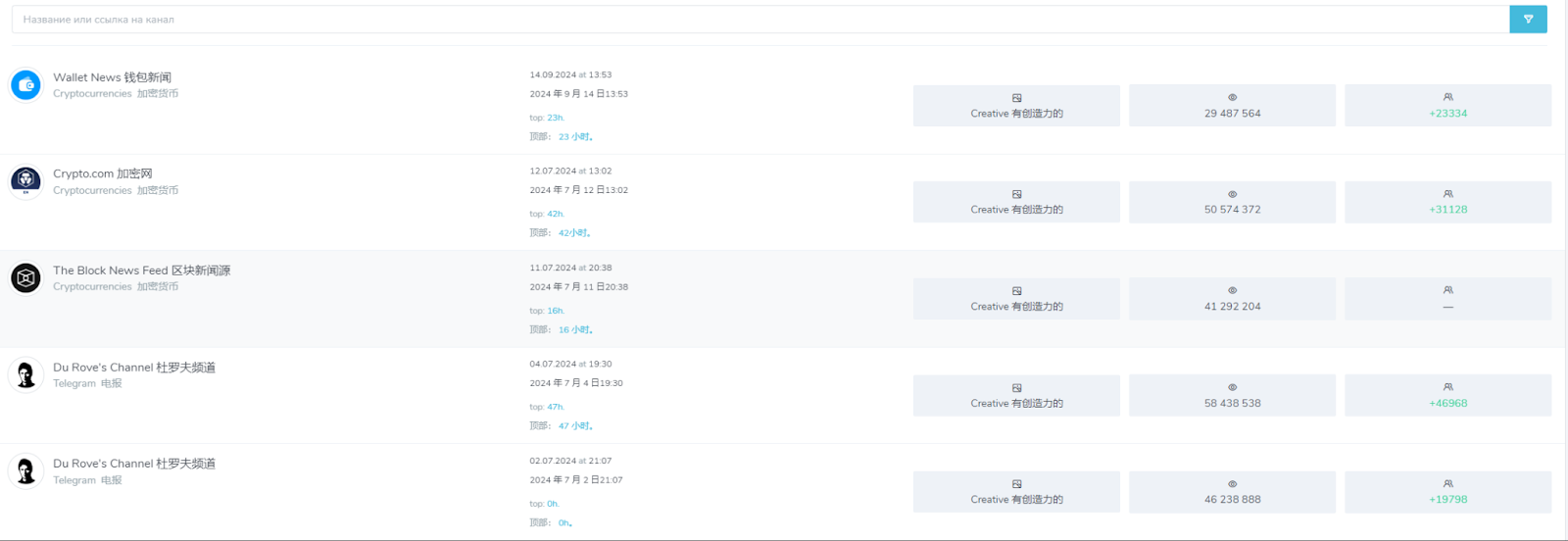
The massive user base may also have brought substantial advertising revenue to Hamster Kombat. Its Telegram channel has around 60 million subscribers, its YouTube channel has 37.6 million, and it has 14.2 million followers on X. Such massive reach represents monetizable assets on any platform. Hamster Kombat’s official Telegram channel began accepting ad placements early on. Assuming a minimum CPM (cost per thousand impressions) of €2 on Telegram, and considering one recent ad received 50 million views, that single ad could have generated at least €100,000. Given that ads are pushed nearly daily on the channel, total ad revenue could potentially reach tens of millions of dollars.
Beyond the project team and TON ecosystem, the Hamster Kombat airdrop triggered exchange-led user acquisition battles similar to those seen during the DOGS launch. Binance, OKX, HashKey Global, Bitget, and others rolled out trading incentives or airdrop campaigns for HMSTR. In this battle for traffic and capital, Binance emerged as the biggest winner.
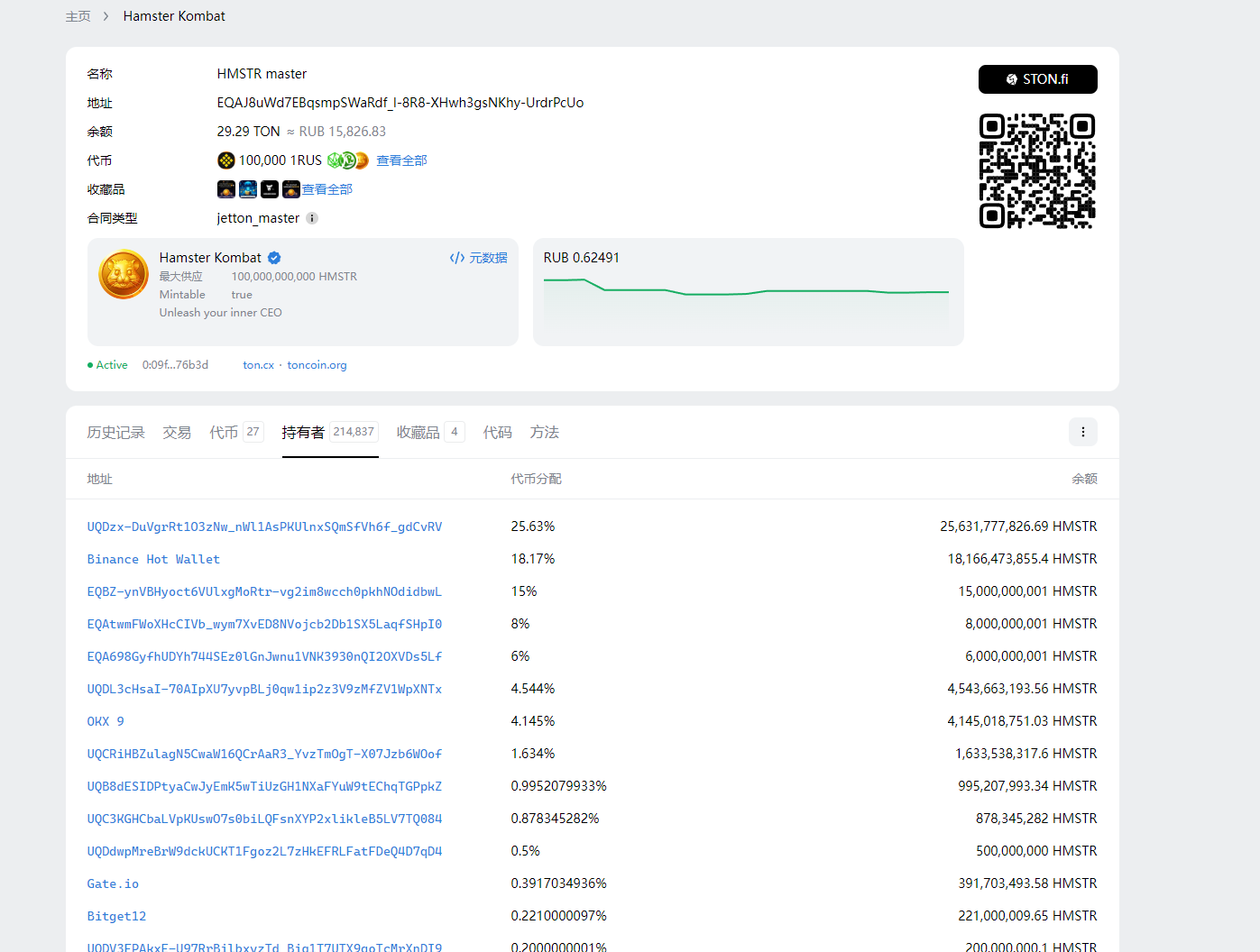
As of September 27, Binance held approximately 18% of all HMSTR addresses—the highest among exchanges—with Bybit and OKX trailing closely. According to CoinMarketCap, HMSTR’s 24-hour trading volume exceeded $1 billion, ranking it 12th globally among all tokens. Binance accounted for nearly half of that volume, making it the dominant marketplace post-airdrop. However, exact figures on how many new users Hamster Kombat brought to these exchanges remain unknown. Bybit co-founder Ben Zhou previously told Wu Talk that Hamster’s user acquisition effect might already be tapering off. On-chain data shows only 214,000 unique addresses currently hold HMSTR.
Looking Back: Gameplay and Smart Marketing Propelled It to Become the World’s Top-Subscribed Channel
Hamster Kombat’s success is an atypical case. In March 2024, Hamster Kombat launched its Telegram channel and game without any public funding announcements or well-known backing. PANews was among the first Chinese media outlets to cover the game. When PANews noticed it in May, there was barely any discussion on X. At the time, inspired by Notcoin, several tap-to-earn mini-games emerged on the TON ecosystem, benefiting from Notcoin’s traffic spillover. Hamster Kombat was one of them. Other games riding the same wave included Tapswap and Catizen.
In May, Hamster Kombat had 15 million users—fewer than Tapswap’s 20 million—but its Telegram channel already ranked third globally. Over the following months, Hamster Kombat claimed user numbers grew to 300 million. Today, its Telegram channel has 69 million subscribers, making it the most-subscribed channel worldwide.
One key reason for Hamster Kombat’s breakout success lies in its superior gameplay. While similar to other tap games in allowing users to earn coins through tapping, its core evolved into a simulated investment mechanic where players use in-game coins to upgrade virtual businesses. In essence, Hamster Kombat is a business simulation game using tapping as an entry point, giving it higher replay value compared to competitors.
Another factor driving rapid growth was the team’s savvy marketing strategy. The game incorporated referral systems and required following social media accounts for bonus points. Uniquely, Hamster Kombat introduced a daily news show, hiding large-reward passwords within episodes. Players had to watch videos or scour social media comments to find them. This tactic accelerated follower growth across platforms and generated high organic view counts, earning favorable algorithmic recommendations from social platforms—likely playing a crucial role in Hamster Kombat’s subsequent traffic monetization.
Overall, Hamster Kombat’s success offers new insights for project teams: rather than relying solely on high-profile fundraising plus airdrops to attract users, building engaging gameplay and a strong airdrop anticipation can lay the foundation for massive traffic, which can then be converted into monetizable assets (such as social media followings). However, compared to earlier airdrops that yielded thousands or even tens of thousands in returns, this model—with so many participants sharing limited rewards—is unlikely to satisfy dedicated grinders. Perhaps the era of lavish airdrop feasts is truly over.
Join TechFlow official community to stay tuned
Telegram:https://t.me/TechFlowDaily
X (Twitter):https://x.com/TechFlowPost
X (Twitter) EN:https://x.com/BlockFlow_News
 PANews






