








A crypto event about "network states"—what did tech leaders like Balaji, Vitalik, and Naval say?
TechFlow Selected TechFlow Selected
A crypto event about "network states"—what did tech leaders like Balaji, Vitalik, and Naval say?
Naval Ravikant believes that AI is more about repetitive intellectual labor, and personal curiosity and self-improvement are the keys to progress.
 Navigating Web3 tides with focused insights
Author: Nancy, PANews
In the past week, Singapore has been buzzing with excitement in the crypto space, drawing key players including projects, VCs, exchanges, developers, media and KOLs. Among these events, Token2049 and Solana Breakpoint have dominated market discussions, with numerous firsthand accounts and industry insights shared by attendees.
In contrast, the annual Network State Conference, also packed to full capacity, received little attention domestically. Initiated by renowned Silicon Valley angel investor Balaji Srinivasan—author of the Wall Street Journal bestseller *The Network State*—this conference challenges traditional governance models by proposing that online communities could one day crowdfund territory globally and evolve into sovereign entities. Balaji, a staunch Bitcoin advocate, formerly served as general partner at a16z and CTO at Coinbase, and has invested in major crypto projects such as Ethereum, Solana, NEAR, and Chainlink.
From the Concept of Network States to Pop-up City Experiments
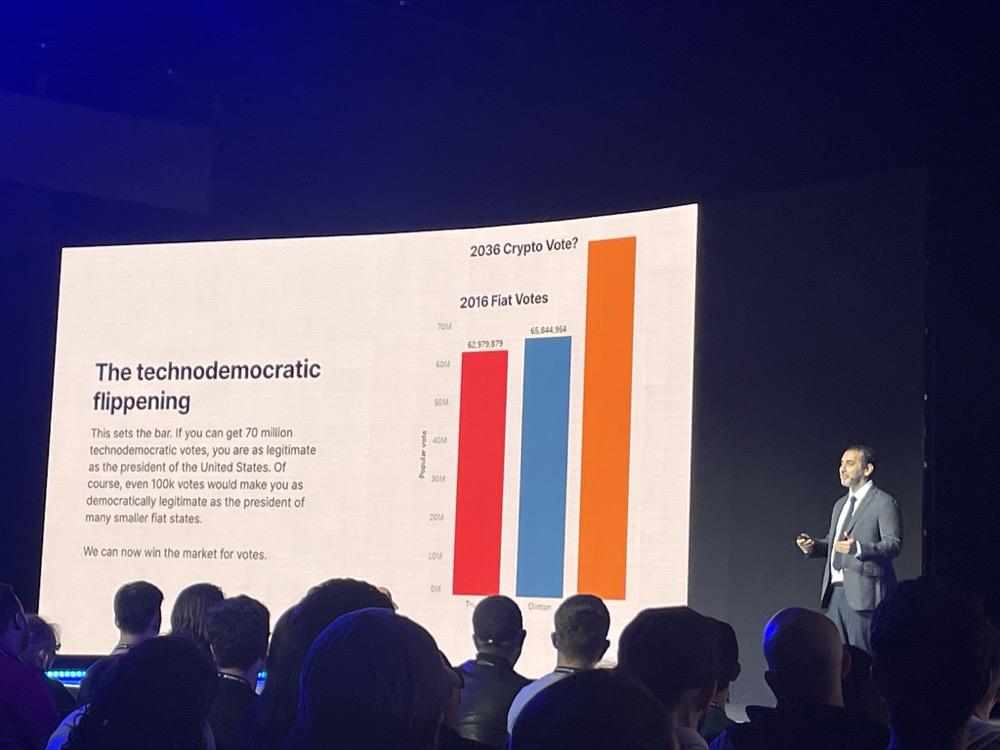
"Just as Google was founded in a garage and Facebook created a new community of three billion people from a dorm room, and Bitcoin launched a new currency from a whitepaper—can we now build a new kind of nation: a Network State? If Bitcoin is decentralized money, then a Network State is a decentralized country," said Balaji. He explained that communities first form online around shared interests or values, then acquire physical land to become self-governing entities—“states”—with their own laws. These states would coexist with, and eventually rival or even replace, traditional nation-states in scale. By building parallel societies within small physical communities, innovative concepts like cryptocurrency can be tested for feasibility. Parallel institutions would then be established within these communities to support and service such innovations.
The conference featured several “pop-up city” projects, including Cabin, a networked urban community composed of modern villages with branches in the U.S., Portugal, and elsewhere; Culdesac in Arizona, a remote-work-focused neighborhood; Edge City, aiming to serve as a "social incubator" for new ideas, technology, culture, and organizations; and Vitalik Buterin’s experimental project Zuzalu.
Beyond discussions on network states, this nearly 12-hour-long event also served as a launchpad for The Network School—an innovative university founded by Balaji on an island near Singapore. Inspired by his book *The Network State*, this three-month pop-up city experiment aims to offer new educational opportunities for global “Dark Talent” while breaking free from traditional institutional constraints. Since opening applications, it has received thousands of applications from over 100 countries.
The Network School officially opened on September 23, focusing on four core pillars: Learn, Burn, Earn, and Fun. As previously revealed by Balaji, students complete daily tasks—ranging from coding to social media posting—in small classrooms and receive NFT-based "proof-of-learning" credentials upon completion. They can also compete for a daily $1,000 "crypto prize" by contributing to open-source projects, creating AI content, or completing microtasks.
Network School student @twone.eth recently shared on X (formerly Twitter) that unlike previous pop-up cities dominated by crypto professionals, the student body here is highly diverse, featuring individuals from all walks of life: an American working in K12 education, a Dutch professional from traditional banking, someone who lived for years in the Colombian jungle and spent five years in Shanghai dedicated to natural movement practices...
@twone.eth added that Balaji envisions The Network School evolving into a "permanent" tech hub, better suited than San Francisco or Silicon Valley for technological innovation. The school is actively lowering living costs so entrepreneurs can live and work affordably, aiming to attract high-caliber talent and foster a tight-knit community. Daily operations include fitness facilities, workspaces, cafes, and regular lectures and events designed to strengthen interactions among members. Additionally, The Network School plans to establish nodes worldwide, enabling participants to freely move between locations and engage in community activities. Blockchain technology will ensure transparency and openness, with all activities recorded immutably on-chain.
From Pop-up Cities to Digital Nomads: What Do Tech Leaders Think?
Centered around the theme “Everything related to the startup society,” Network State Conference 2024 brought together more than 30 prominent figures, including Ethereum co-founder Vitalik Buterin, Coinbase co-founder Brian Armstrong, Solana founder Raj Gokal, historian Niall Ferguson, and AngelList founder Naval Ravikant. Compared to last year, this edition expanded its scope to include new discussion tracks such as “Parallel Institutions,” “Parallel Health,” and “Digital Nomadism.”
Vitalik: Pop-up Cities Must Address Governance and Membership
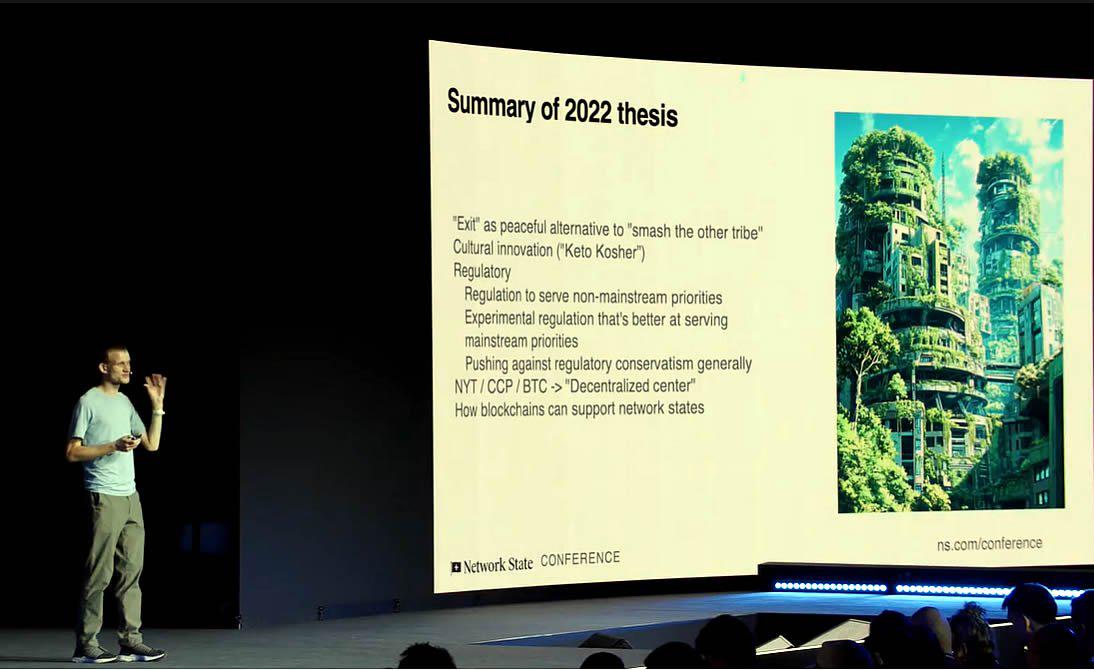
Vitalik introduced Zuzalu, an experimental community that brought together around 200 members—including Ethereum contributors, crypto executives, biotech entrepreneurs, and scientific researchers—to Montenegro for two months to collaboratively tackle collective challenges like human longevity. Participants enjoyed healthy diets, cold plunges, yoga, and other wellness activities. While interpersonal connections proved vital and overall satisfaction was high, the long-term direction of Zuzalu remains unclear. Vitalik noted, “Pop-up cities are a new medium. Network states need to build productive relationships with each other, because the tribalism we see on social media today is ‘zero-sum and ineffective.’ Pop-up cities show product-market fit, but they still need to solve problems around governance and membership.”
Naval Ravikant: AI Automates Repetition, but Curiosity Drives Progress
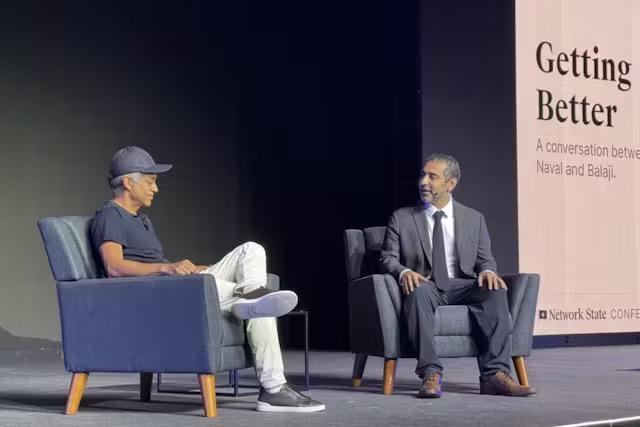
Naval Ravikant, founder of AngelList—a platform valued at $4.1 billion—and early investor in companies like Uber, Twitter, and Yammer, is a firm believer in Bitcoin. His book *The Almanack of Naval Ravikant* is a bestseller in business circles. In a fireside chat with Balaji, Naval reflected on personal growth, stating that nearly all his significant achievements stemmed from following intense intellectual curiosity. “If you become obsessed with something and dive deeper into its details than anyone else—driven purely by your own curiosity, whether it’s about network states, artificial intelligence, or cryptocurrency—that becomes the foundation of all so-called ‘self-improvement.’ Personal curiosity and continuous self-development are essential for meaningful progress.”
He emphasized that fulfilling basic material needs is crucial, noting that in this physical world, one must wield some form of leverage—meaning you must create something society values. “Wealth isn’t money—it’s the ability to transform one thing into another: monetized knowledge, infinite creativity… Enormous wealth is simply value frozen in time.”
On AI development, Naval stated, “AI is natural language processing. It excels at automating existing jobs. Real breakthroughs will come from tackling unsolved problems and generating novel ideas—not just scaling up compute power. Expecting AI to be safe by design is absurd—it’s a logical contradiction.”
Naval also shared three things money cannot buy: a healthy body, a peaceful mind, and a home filled with love. He recommended two books: *The Beginning of Infinity* and *The Fabric of Reality*.
Raj Gokal: Solana Powers the Development of Network States
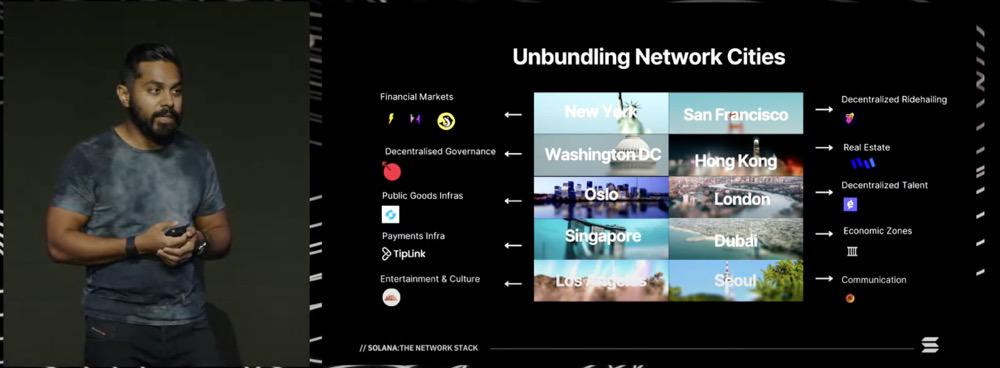
Solana co-founder Raj Gokal recalled that a year ago, an intern mentioned building a parallel financial system on Solana capable of replicating every function of traditional finance via decentralized protocols. Today, Solana has become one of the blockchains with the highest volume of decentralized transactions, hosting millions of users and hundreds of billions of dollars flowing through decentralized protocols covering land, governance, payments, energy, and communications. These decentralized narratives are forming the foundations of network states on Solana.
For example, if a network state wants to crowdfund land acquisition and gain diplomatic recognition, products offering decentralized physical infrastructure become highly attractive. On Solana, Helium's decentralized hotspot network leverages crypto incentives to provide essential infrastructure for such land. Tools like MetaDAO act as prediction markets for resource allocation, applying financial market mechanisms to governance and voting—an approach seen by younger generations as the most engaging way to interact with the world.
Solana aims to make future network states more intuitive, faster, fun, and user-friendly—so people join not just out of ideological alignment, but because participation itself is enjoyable. This, according to Gokal, is one of Solana’s core principles.
Brian Armstrong: Builders Need a Haven for Freedom and Innovation
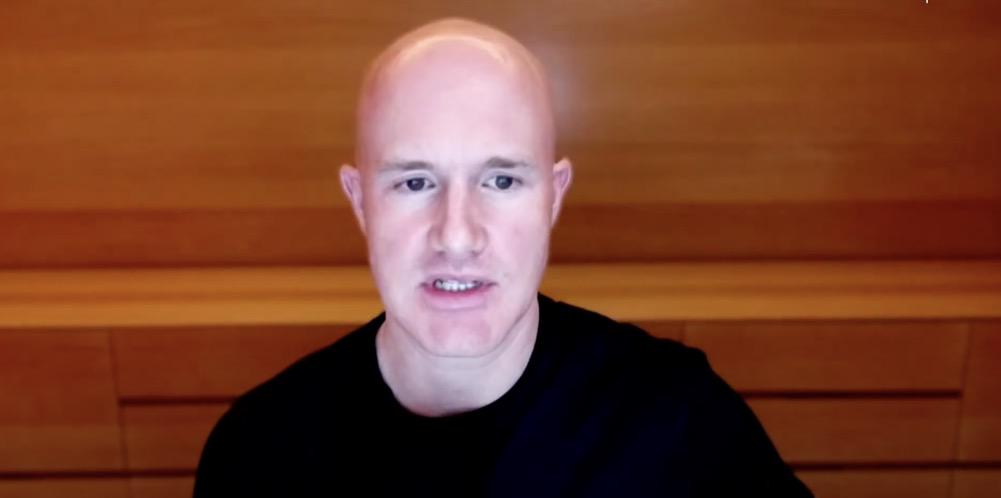
Coinbase CEO Brian Armstrong stated that a shift is underway—from tech companies to tech communities—allowing people to reshape hierarchical structures and find greater purpose. Cryptocurrencies like Bitcoin have already deconstructed money from the nation-state; the next layer being unbundled from the state is identity. Traditional forms of identity are increasingly outdated, and cryptographic proof offers a promising alternative.
Armstrong pointed out that trust in Western institutions is eroding, leaving people with a choice: internal reform or exit. Creating global special zones could be the alternative path. Despite the challenges, there remains an opportunity to build the next Singapore or Hong Kong—a protective archipelago ensuring that global builders have a place to live freely when speech or monetary freedom is under threat. The ideal network state, he believes, would be one built by techno-optimists or efficient network nations.
Pieter Levels: 100–200 Million Digital Nomads Worldwide; Internet and Crypto Power Network States
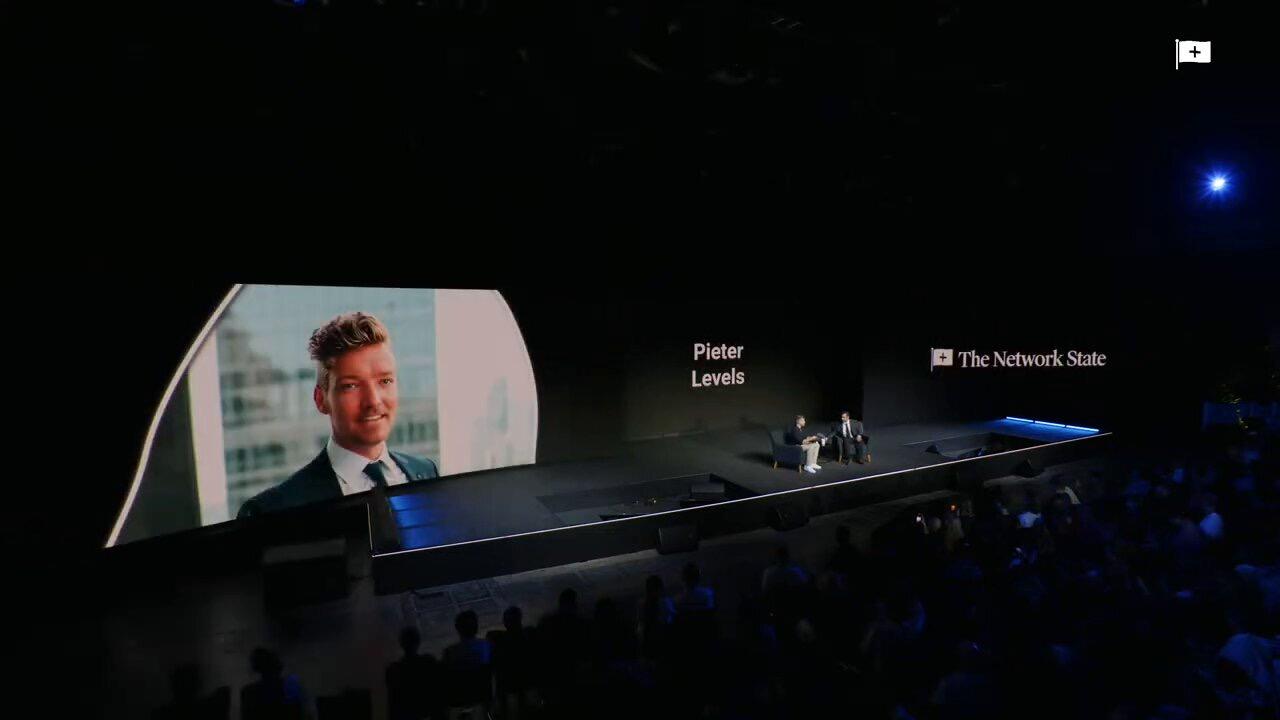
Pieter Levels, a Dutch entrepreneur, programmer, and digital nomad, earns $2.7 million annually from four successful products: PlayMyInbox, GoFuckingDoIt, Tubelytics, and Nomads.com. Nine years ago, he predicted there would be one billion digital nomads by 2035. During a fireside chat, Levels discussed Nomads.com—one of the earliest network states he built a decade ago—which now hosts tens of thousands of globally mobile members and attracts tens of millions of digital nomads annually, with physical hubs in Bali, Thailand, Mexico, and Miami.
Levels shared several fascinating statistics about digital nomads: currently, one-third of the global workforce operates remotely or hybrid, with approximately 10–20% living as digital nomads—totaling between 100 million and 200 million people. Remote work is expected to reach one billion people by 2024. Most digital nomads are not financially struggling backpackers; their average annual income is around $125,000, and 90% hold university degrees—making them highly desirable talent for any country or network state. Among male digital nomads, 34% work in software development; among women, 16% are in marketing. 66% of digital nomads are single, and 72% of female digital nomads identify as progressives. Moreover, most aren't constantly wandering—they stay in one place for months. The main reason for moving is visa limitations preventing longer stays, a solvable issue for both nation-states and network states through targeted visa policies.
"We can easily visualize maps of the physical world, but imagining a digital map is much harder. The internet allows us to form deep relationships across distances, where relational and interest-based proximity matters more than physical location. Unlike physical nations that rely on guns and armies for protection, network states and digital assets are secured through cryptography—the unbreakable boundary and ultimate firewall. The strength of network states lies in their media, currency, and agility," Levels added.
Join TechFlow official community to stay tuned
Telegram:https://t.me/TechFlowDaily
X (Twitter):https://x.com/TechFlowPost
X (Twitter) EN:https://x.com/BlockFlow_News
 PANews






