Vitalik's 2049 Speech: Ethereum Must Meet Demand While Upholding Open-Source and Decentralized Values
TechFlow Selected TechFlow Selected
Vitalik's 2049 Speech: Ethereum Must Meet Demand While Upholding Open-Source and Decentralized Values
We are in the early stages of crypto adoption.
 Navigating Web3 tides with focused insights
Compilation: BlockBeats
Ethereum co-founder Vitalik Buterin delivered a keynote speech titled "What Excites Me About the Next Decade" during the first day of the TOKEN2049 main conference, discussing how he sees today's crypto landscape as fundamentally different from the past. He stated plainly: "Crypto is no longer in its early stage; Ethereum today must meet the demands of mainstream adoption while preserving open-source and decentralized values."
Below is the full transcript of Vitalik’s speech:
People often say that crypto is still in its early days, that we’re still building infrastructure. Indeed, things like the internet took a long time to mature, and since Bitcoin launched, people have been saying this almost continuously. But now we face a real challenge: crypto today is simply not in its early stage anymore.
The Ethereum project has existed for over 10 years, and in the 15 years since Bitcoin’s creation, we’ve seen something like ChatGPT emerge from nothing to reshape the entire understanding of artificial intelligence almost overnight.
So we must ask ourselves: How should we really view all of this? Are we still in the early phase? My answer is no—we are not in the early days of crypto, but we are in a special phase.
What exactly happened? Let me go a bit deeper. I remember visiting Argentina in 2021—it was my first time there. What struck me immediately was a segment of the population across the country who weren’t just excited about crypto—they were actively using it at scale.
On Christmas Day, I walked around and noticed one café open. I went in, the owner recognized me, and let me pay with ETH for coffee and desserts for me and my friends. But they weren’t using decentralized technology.
This reminded me of what initially doomed the early vision of “getting everyone to accept Bitcoin as money”—fees. If you recall the original marketing, one major argument was PayPal and credit card companies charging high fees—exorbitant, terrible fees. Yet Bitcoin itself had fees ranging from $1 to $50.
Ethereum transaction fees also rose.
The highest fee I've personally paid on Ethereum was actually for a privacy-preserving transaction. Gas prices kept rising, and every time I made a transaction, Twitter would be full of comments. Privacy protocols clearly had strong market fit. Some transactions cost up to $800. Many projects failed because of fees. So what’s changed in 2024?
This chart shows the strange phenomenon of Ethereum fees. They've dropped from between $10 and $0.50 down to less than one cent—essentially close to zero. At the same time, OP and ARB, two major Ethereum Layer 2s, have reached an important security milestone called Stage 1. Several ZK-based rollups have also told me they plan to reach Stage 1 soon. So rollups are becoming significantly more secure.
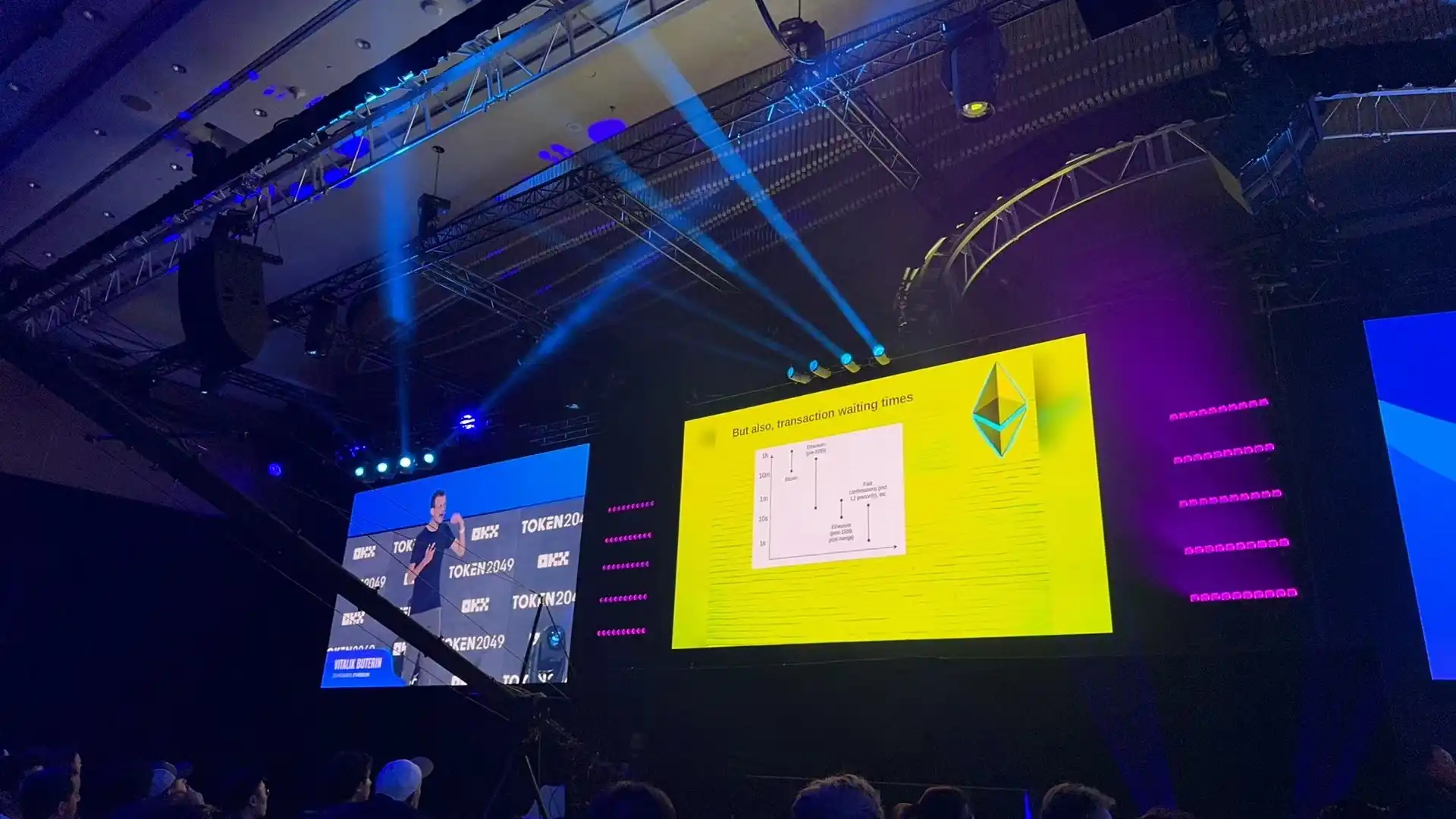
Fees are finally affordable. But that's not the only improvement. I vividly remember another frustration during my trip to Argentina: trying to send funds via the Ethereum mainnet, where the transaction fee was about $4 and confirmation took roughly five minutes. Even though EIP-1559 was already live, this particular wallet hadn’t upgraded.
Bitcoin generates a block every 10 minutes, so you might wait 10 minutes—or even an hour—for confirmation. Ethereum’s theoretical block time is 13 seconds, but due to historically inefficient gas markets, sometimes if you were unlucky, you’d wait a completely random amount of time—five minutes or even longer—for your transaction to be included. EIP-1559 has largely solved this issue.
As a result, transaction finality is now consistently between 5 and 15 seconds. With Layer 2 solutions offering fast, free confirmations, it often takes just one second. These two issues were precisely why, back in 2021, centralized user experiences vastly outperformed decentralized ones.
We can also assess application-level UX quality. You can see (on the presentation slide) a tweet from 2015 showcasing a hackathon demo. Next to it is Firefly, a client for Farcaster, Twitter, and Lens. Looking at the UI quality, there’s virtually no difference from Web2 products—and yet it’s a fully decentralized application.
This year we’ve also seen progress in account abstraction. More users are adopting security tools. We’ve seen EIP-7702. We’re beginning to see mainstream use of ZK-SNARKs across various applications. So we now have new, better privacy protocols.
Even existing usability improvements—just a few years ago, people complained constantly about having to manually switch networks. Today, I don’t think I’ve manually switched networks in at least the past year. Technical limitations that once held us back are fading. I even remember when CryptoKitties seemed like it might become a real hit. But then what happened? CryptoKitties drove Ethereum gas prices through the roof.
Ethereum became nearly unusable, which inherently limited its growth. That’s no longer true today. This means the excuses for not using crypto are disappearing. But what about the reasons to get in?
I think one common mistake people make is viewing crypto as purely an efficiency technology. This is something many talked about ten years ago.
Let’s look at how people described Bitcoin in 2013—the benefits of adopting Bitcoin include simpler payments, greater fund security and control, near-zero fees, and protection of personal identity. Of these four points, two represent truly unique features of crypto. The other two—were they once unique to crypto? Are they still?
Today we have Venmo, better payment systems, and WeChat Pay. Centralized systems keep improving—but they still fail in certain areas.
Access to payments and financing remains extremely difficult. Why? It’s not due to technical barriers. It’s fundamentally because of global political constraints. So it’s crucial to remember: the value crypto brings to the world isn’t about incremental tech upgrades. Upgrading from a regular jet to a supersonic one is a technological improvement—but this is a different kind of advancement.
What kind of technology am I referring to? One perspective comes from a blog post written by Josh Stark at the Ethereum Foundation about two years ago, titled “Atoms, Institutions, Blockchains.” His argument is that blockchains allow us to create digital solidity—persistent, robust digital structures of any social form.
These structures resist tampering, much like physical buildings made from concrete. When you compare blockchain to other technologies, consider early cypherpunk tools like mixnets, Tor, BitTorrent. You’ll realize blockchain’s core innovation lies in creating persistent, extremely resilient systems.
If your file-sharing network goes down, it’s no big deal—you switch to another. A week later, nobody remembers. But if a locking mechanism fails and you switch, people lose all their money. That’s a fundamental difference.
Blockchains enable the internet not only to bypass weaknesses in old-world systems but also to build stronger alternatives that solve similar problems.
Blockchains are like digital concrete. So what do you build with digital concrete? You build virtual sky castles. Now, who here has seen the movie *Castle in the Sky*? Come on, raise your hand if you’ve seen it.
One reason this film is interesting is that I genuinely love it. I think it’s a masterpiece from Studio Ghibli—I’ve watched it at least five times. But it turns out the film accidentally became an inspiration for Ethereum, though I didn’t realize it at the time. In 2013, while browsing Wikipedia’s list of fictional elements, I came across the word “Ethereum.”
It sounded like a great name. It reminded me of the 19th-century scientific concept of “aether,” a medium thought to permeate all space. So I picked the name “Ethereum.” Two months later, a designer at the Ethereum Foundation—before it was even called the Ethereum Foundation—decided to use this diamond shape as Ethereum’s logo. I thought it was cool and beautiful—that’s why I liked it.
The blend of seriousness and whimsy in crypto is something I want people to remember. A castle can protect you, your family, and your tribe. A castle can also be Disneyland’s castle, where your community enjoys fun. A castle can be a museum preserving your culture’s thousand-year history. A castle can be all these things—and all kinds of digital councils. Anything we can build on Ethereum.
Once we’ve built these digital castles, what should our key goal be? My consistent view is: we must meet the needs of mainstream adoption while preserving open-source and decentralized values. What does that mean?
Take wallet security, for example. Historically, there were basically two ways to manage your funds.
One is extreme self-sovereign individualism: you write down a seed phrase, do everything offline, engrave it on a titanium plate, lock that in a stronger titanium vault, bury it 10 meters underground—then your coins are safe. That’s one approach.
The other is: “I’m just a normal person—I don’t want the hassle.” So you give your coins to someone trustworthy—a “good guy” named Sam, who appears alongside Clinton at events. He must be trustworthy, right? But two years later, it turns out your judgment of who’s trustworthy was a bit off. So I believe these aren’t the only two options.
If you want protection from bad actors in centralized systems, you need traditional self-protection methods. But what if you're using a centralized exchange and want both convenience and security? That’s where multi-signature smart wallets come in.
Multi-sig means you have multiple keys—say, six keys, and you need four to sign a transaction. You can even set rules: small transactions require only one key. These keys can be any combination you control.
Friends, family—you can create an Ethereum account as a smart contract wallet that only allows transactions after proving control of a specific email address. You can essentially bring Web2 trust anchors into the Web3 world, and even diversify your trust sources. Personally, I trust my multi-sig wallet more than any single centralized account.
For instance, here’s a demo wallet (shown in slides)—fully based on Ethereum, yet its user experience is identical to Venmo. Through special mechanisms, users can prove their withdrawal originates from a deposit without revealing which one, while proving their deposit wasn’t from illicit sources.
This enables ordinary users to enjoy strong privacy while meeting critical compliance requirements—without introducing backdoors.
You can have both privacy and trust. On the Ethereum mainnet, numerous technical improvements are underway, making Layer 1 more decentralized, easier to validate, faster to finalize, and higher in capacity. These changes are already happening.
This is the direction of the Ethereum ecosystem—and, I believe, the entire crypto space over the next decade.
Join TechFlow official community to stay tuned
Telegram:https://t.me/TechFlowDaily
X (Twitter):https://x.com/TechFlowPost
X (Twitter) EN:https://x.com/BlockFlow_News
 @VitalikButerin