Strategy Testing Final Edition | OKX and AICoin Research Institute: Summarizing 8 Major Trading Strategies in One Article
TechFlow Selected TechFlow Selected
Strategy Testing Final Edition | OKX and AICoin Research Institute: Summarizing 8 Major Trading Strategies in One Article
In the simplest way, we'll guide you through classic strategies.
 Navigating Web3 tides with focused insights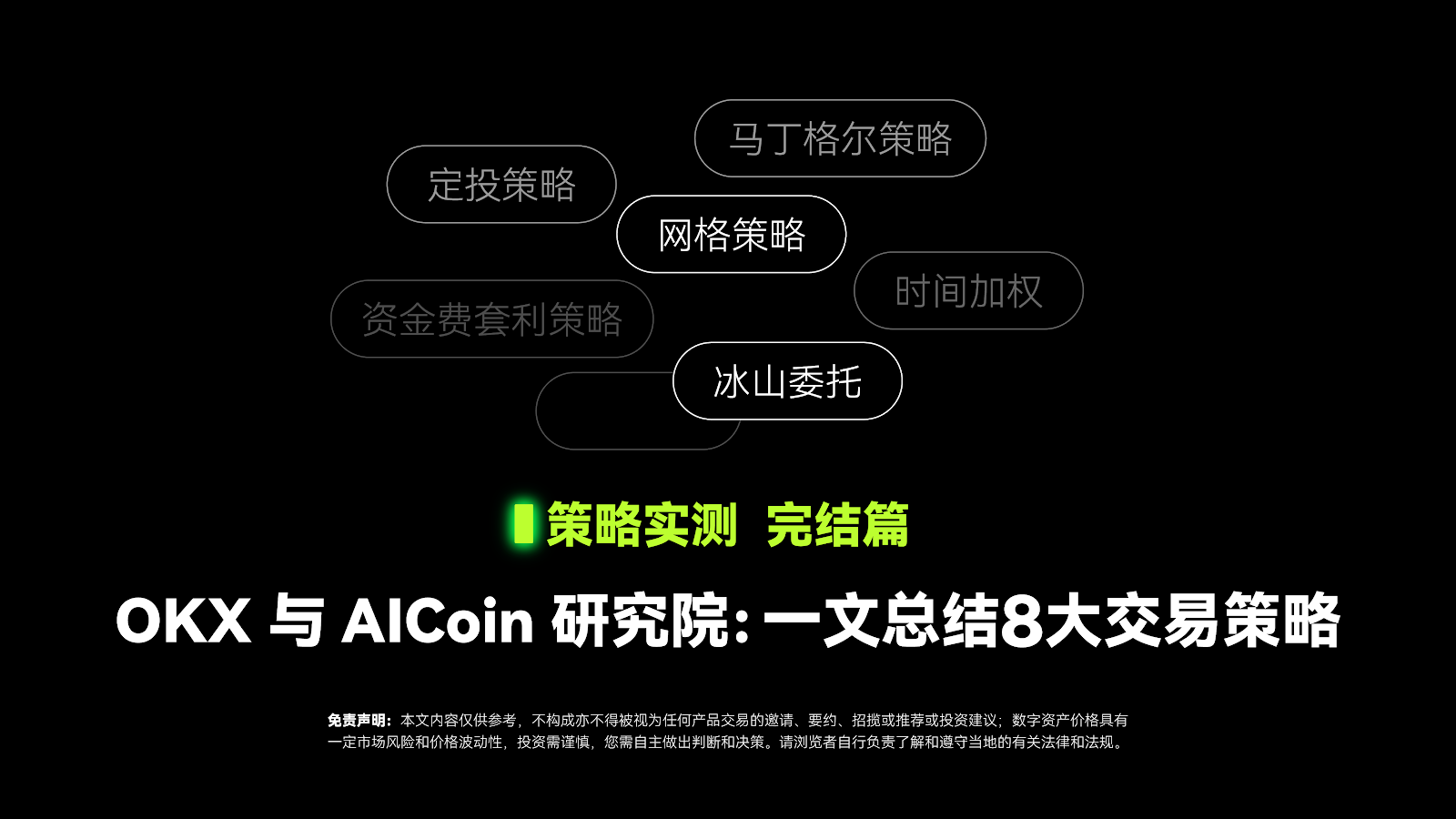
OKX, in collaboration with the premium data platform AICoin, has launched a series of research studies on classic trading strategies. By analyzing core dimensions such as data-driven performance and strategy characteristics, this initiative aims to help users better understand and learn various strategies while minimizing blind or uninformed usage.
This article serves as the concluding piece of the strategy testing series, summarizing the key insights from the previous five editions to give users a comprehensive overview of eight classic trading strategies. These summaries illustrate how different strategies perform and apply under specific market conditions. Traders should select strategies based on their own risk tolerance and market outlook, continuously optimizing them to adapt to evolving market dynamics.
1. Dollar-Cost Averaging (DCA) Strategy
The DCA strategy involves investing a fixed amount at regular intervals, thereby spreading out the risk of lump-sum investment and leveraging the power of time and compounding to maximize returns. This approach is particularly suitable for long-term holders, aiming to reduce psychological stress and trading risks caused by market volatility.
Data Sample
Analysis of Bitcoin’s DCA returns across different halving cycles shows that the DCA strategy achieved a win rate above 50% in all periods. Notably, between the second and third halvings, the strategy yielded a return of 170.03%. However, this return still underperformed compared to Bitcoin’s overall market gains during the same period. Recent four-year DCA data reveals a return of -48.75% in 2022, highlighting the potential risks of employing DCA during bear markets.
Advantages and Disadvantages
-
Advantages: The DCA strategy reduces exposure to market fluctuations by spreading investments over time, making it ideal for traders with lower psychological resilience. It is simple to execute and carries relatively low risk, especially suited for long-term investors.
-
Disadvantages: DCA cannot fully capture maximum gains during sharp market rallies and requires long-term commitment. During prolonged market downturns, returns may remain low.
Strategy Summary
DCA provides a relatively stable trading method in highly volatile markets but may fail to capture peak gains when market trends are clearly directional. Traders should adjust this strategy according to market conditions and personal objectives.
2. Grid Trading Strategy (Spot & Futures)
Grid trading involves setting predefined price ranges divided into multiple levels ("grids") and executing buy and sell orders as prices fluctuate within these bands. This strategy works best in ranging markets, generating steady profits through frequent small trades.
Data Sample
Backtesting results comparing neutral futures grid and spot grid strategies show that the neutral futures grid delivered the highest return—33.91%—in an upward-trending volatile market, while the spot grid returned 19.05% under the same conditions. In contrast, the spot grid incurred losses in a downward-trending volatile environment, revealing its limitations in bearish markets.
Advantages and Disadvantages
-
Advantages: Grid trading performs well in sideways markets. The neutral futures grid, in particular, leverages margin and frequent trading to achieve high returns. It is flexible and highly adaptable.
-
Disadvantages: Performance deteriorates in one-sided trending markets. Spot grids are prone to losses in falling markets. While futures grid strategies offer higher returns, they also carry significantly greater risk due to leverage.
Strategy Summary
Grid trading offers an effective way to generate returns in volatile, range-bound markets. The neutral futures grid performs consistently well across various environments. However, traders must use leverage cautiously and be mindful of adverse impacts from strong directional trends.
3. Martingale Strategy (Spot & Futures)
The Martingale strategy is a high-risk approach where position size is doubled after each loss to lower the average entry cost, aiming to recover all prior losses with a single winning trade. Suitable for traders with substantial capital, it performs better in ranging or bullish markets.
Data Sample
Testing under various market conditions shows both spot and futures Martingale strategies can yield significant returns in rising markets. The futures version excels particularly in sideways, choppy markets. However, both face considerable drawdown risks in declining markets, with the futures variant posing even greater danger due to amplified leverage effects.
Advantages and Disadvantages
-
Advantages: By increasing position sizes progressively, the Martingale strategy lowers average costs and holds high profit potential in flat or rising markets. When applied to futures, leverage magnifies gains.
-
Disadvantages: The primary risk lies in sustained downtrends, which could lead to catastrophic losses—especially in leveraged positions, including liquidation events. The strategy demands strong mental fortitude and ample capital reserves.
Strategy Summary
The Martingale strategy can deliver impressive returns under favorable market conditions, but its high-risk nature means only those with sufficient risk tolerance and financial strength should consider using it. Extreme caution is advised in strongly bearish markets, and adjustments may be necessary to mitigate risk exposure.
4. Funding Rate Arbitrage Strategy
Funding rate arbitrage exploits differences in funding rates between perpetual futures contracts and spot prices to generate profit. This strategy is most effective in low-volatility markets with pronounced funding rate spreads, aiming to lock in consistent returns from rate differentials.
Data Sample
Empirical tests show that when funding rates are high and stable, this strategy achieves consistent annualized returns. However, during periods of extreme market volatility or abnormal funding rate swings, profitability may be compromised.
Advantages and Disadvantages
-
Advantages: Funding rate arbitrage locks in predictable income from rate spreads, offering relatively stable returns—particularly effective in calm, low-volatility environments. Risk levels are generally low, making it suitable for long-term deployment.
-
Disadvantages: Success heavily depends on market conditions. The strategy performs poorly when funding rate spreads are narrow or unstable. Unusual shifts in funding rates can prevent expected returns from being realized.
Strategy Summary
Funding rate arbitrage provides a stable return mechanism in low-volatility settings, ideal for risk-averse traders. However, users must closely monitor funding rate movements and adjust strategies promptly to manage risks arising from market volatility.
5. Time-Weighted and Iceberg Order Strategies
Time-weighted and iceberg order strategies are commonly used for splitting and executing large orders. The time-weighted strategy disperses a large order execution evenly over a set period to minimize market impact. The iceberg strategy hides the full size of a large order by placing smaller visible portions, preventing drastic price movements.
Data Sample
In bull markets, the time-weighted strategy reduced market impact by batching purchases, leading to improved returns. In bear markets, by setting limit prices for taking liquidity, it avoided buying at elevated levels, thus reducing downside risk. The iceberg strategy effectively concealed the true scale of large buy orders in rising markets, preventing artificial price surges; in falling markets, it masked large sell orders to avoid triggering panic selling.
Advantages and Disadvantages
-
Advantages: The time-weighted strategy reduces market slippage by spreading execution over time, resulting in smoother, more controllable pricing. The iceberg strategy protects trade privacy by concealing order size and demonstrates strong adaptability.
-
Disadvantages: During sharp market moves, the time-weighted strategy may miss optimal entry points and become vulnerable to front-running. The iceberg strategy faces liquidity risks and can be detected by sophisticated algorithms.
Strategy Summary
Time-weighted and iceberg order strategies provide effective solutions for executing large orders, especially valuable in volatile or illiquid markets. Traders should tailor strategy parameters based on prevailing market conditions and individual needs to optimize execution quality.
How to Access OKX Strategy Trading?
Users can access the "Strategy Trading" mode via the 'Trade' section on the OKX app or official website. From there, clicking on 'Strategy Square' or 'Create Strategy' allows immediate exploration. Besides creating custom strategies, the Strategy Square currently features “Premium Strategies” and “Top Performer Strategies,” enabling users to copy or follow strategies directly.
OKX Strategy Trading offers multiple core advantages: ease of use, low fees, and robust security. For usability, OKX provides intelligent parameter suggestions to help users set trading parameters scientifically, along with step-by-step图文and video tutorials for quick mastery. Regarding fees, OKX has comprehensively upgraded its fee structure, significantly lowering transaction costs. On security, OKX employs a world-class security team providing bank-grade protection.
How to Access AICoin Strategies?
On AICoin, users can find grid trading strategies, all-coin DCA strategies, and funding rate arbitrage strategies under the left sidebar's "Strategy" tab. AI grid strategies and spot DCA strategies are available under the "Market" tab. Dollar-cost averaging (DCA) strategies can be found in the 'Custom Indicators / Backtesting / Live Trading' section of the Market page. Smart order-splitting strategies are accessible via the 'Trade' panel on the right side of the Market interface.
AICoin’s Strategy Square curates high-quality strategies: arbitrage bots offer low risk and stable returns; AI-powered grids excel at rapidly capturing spread opportunities; and all-coin DCA enables cost averaging and systematic accumulation across all tokens—making them suitable for diverse investor profiles.
Summary of Data-Driven Strategy Testing Series
Strategy Test 01 | OKX & AICoin Research: DCA Strategy
Strategy Test 02 | OKX & AICoin Research: Grid Strategy
Strategy Test 03 | OKX & AICoin Research: Martingale Strategy
Strategy Test 04 | OKX & AICoin Research: Funding Rate Arbitrage Strategy
Strategy Test 05 | OKX & AICoin Research: Time-Weighted and Iceberg Order Strategies
Disclaimer
This article is for informational purposes only and reflects the authors’ opinions, not necessarily the views of OKX. It does not constitute (i) trading advice or recommendations; (ii) an offer or solicitation to buy, sell, or hold digital assets; or (iii) financial, accounting, legal, or tax advice. We do not guarantee the accuracy, completeness, or usefulness of the information provided. Holding digital assets—including stablecoins and NFTs—involves high risk and may result in significant value fluctuations. You should carefully evaluate whether trading or holding digital assets is appropriate for your financial situation. Consult your legal/tax/trading professionals regarding your specific circumstances. You are solely responsible for understanding and complying with applicable local laws and regulations.
Join TechFlow official community to stay tuned
Telegram:https://t.me/TechFlowDaily
X (Twitter):https://x.com/TechFlowPost
X (Twitter) EN:https://x.com/BlockFlow_News
 OKX
OKX