








TechFlow Deep Dive: How PIN AI, Backed by a16z, Is Rewriting the AI Landscape with Web3
TechFlow Selected TechFlow Selected
TechFlow Deep Dive: How PIN AI, Backed by a16z, Is Rewriting the AI Landscape with Web3
PIN AI is an open AI network where developers can build useful AI applications.
 Navigating Web3 tides with focused insights
Author: Heimi
Honored to complete this research under the guidance of Meteorite Labs, based on hands-on experience and exchanges with hundreds of Web2 AI applications.
PIN AI is a selected project in the a16z Crypto Startup Accelerator Fall Program, having raised a $10 million seed round. Notable VCs backing the project include a16z Crypto, Stanford Blockchain Accelerator, Hack VC, and Foresight Ventures. Angel investors include Illia Polosukhin (co-founder of NEAR Protocol), Scott Moore (co-founder of Gitcoin), Lily Liu (President of Solana Foundation), Evan Cheng (CEO of SUI/Mysten Labs), and DCBuilder (research engineer at Worldcoin).
I've just finished reading an article co-authored by PIN AI’s three co-founders, and found it to be the most compelling Web3 AI project I’ve seen recently—aside from Sahara—with remarkably interesting use cases. (Article link: https://www.pinai.io/post/pin-ai-the-open-platform-for-personal-ai)
PIN AI is an open AI network where developers can build useful AI applications. “Useful AI Applications” — the emphasis on usefulness is central to its product philosophy. Similar to Web2 AI agents like MultiOn or Jace.ai, it focuses on delivering practical value in users’ daily lives by fulfilling user intents such as online shopping, travel planning, or investment decisions.
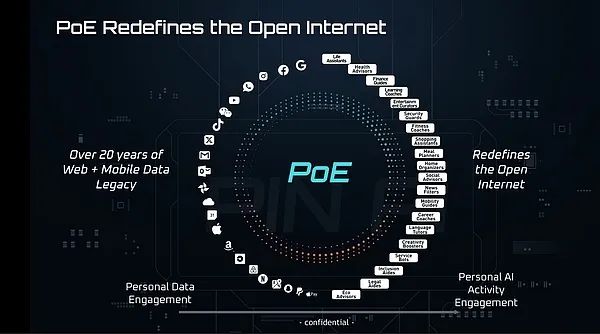
A quick introduction to Jace.ai: It is an AI agent capable of autonomously completing browser-based tasks using LLMs and its proprietary AWA-1 (Autonomous Web Agent-1) model, which enables AI to perform actions directly on web pages.
Jace’s greatest strength lies in its ability to autonomously plan and execute tasks within a browser on behalf of users.
For example, if you tell Jace: “I’m traveling to Beijing for a week starting September 20th, with a budget of 5,000 RMB—please help me plan,” Jace will automatically generate a full itinerary including attractions, hotels, and dining options. If you approve the plan, it will proceed to book all activities, find the best-value hotel on Meituan, and place the order. You only need to input personal information and confirm payment with one click.
In essence, PIN AI aims to do something very similar. The key difference from generative AI is that these types of AI projects focus primarily on enhancing everyday life rather than work-related productivity.
1. Deconstructing PIN AI's Design Philosophy
In simple terms, PIN AI = AI + DePIN
The PIN AI network consists of two types of AI:
-
Personal AI: A personalized AI agent that adapts in real-time to user preferences. It acts as the interface between users and agentic services—like a coordinator. Users can download it onto their smartphones or computers for local use.
-
Agentic Services: AI agents built on-chain for specific Web2 platforms, capable of performing tasks across top-tier Web2 platforms, with execution processes and outcomes recorded immutably on the blockchain.
-
The team also mentioned External AI, which may support future integration with other LLMs or Web2 AI agents.
Core Architecture of PIN AI:
PIN Protocol—a DePIN-based distributed data storage network allowing anyone to connect their devices and share data. It integrates a BERT-based model to anonymize user data at every processing stage, ensuring privacy compliance and adherence to data protection regulations.
Personal AI is built atop this protocol. On one hand, it draws personalized data from the network; on the other, it supplies relevant data to agentic services.
PIN Protocol comprises three core components:
1. Private Storage and Compute Layer: Decentralized data storage that securely holds user-shared device data (including photos, videos, etc.), making the most relevant data readily available for both Personal AI and Agentic Services. Users can connect their devices to the network, contribute data, and earn native $PIN token rewards.
2. Data Connectors: Utilize zk technology to track and verify user data connected to the network. These function similarly to nodes in the PIN network. Node operators must stake $PIN tokens to validate data, while other token holders can delegate their stakes to nodes—both earning staking rewards.
3. Agent Link: Designed to match Personal AI with appropriate Agentic Services. Composed of an Agent Registry and a matching mechanism. The registry tracks performance metrics, while the matching engine determines optimal pairings based on each service’s cost, performance, and quality of completion.
User Flow / Business Logic:
When a user makes a request, PIN AI follows these steps:
Step 1: Personal AI — Collects User Request
The user submits a request to their Personal AI, which forwards it to the PIN Protocol.
Step 2: PIN Protocol — Prepares for Task Execution
The protocol breaks down the user’s intent into actionable steps, identifies the most suitable and cost-effective Agentic Service(s), retrieves the most relevant data, and delivers it to the agent(s). (If multiple Web2 platforms are involved, the intent may be split across different agents.)
Step 3: Agentic Services — Execute Tasks
Step 4: PIN Protocol — Delivers Results Back to User
Since most daily-life tasks involve financial transactions, the flow of funds in PIN AI works as follows:
Users pay a gas fee to the PIN Protocol (likely to activate the intent transaction). Since the protocol decomposes the user’s intent and provides highly relevant data to the agentic service, the agent pays a portion of its service fee back to the protocol upon task completion.
Thus, both the PIN Protocol and the agentic service can take a cut from the user-paid service fee.
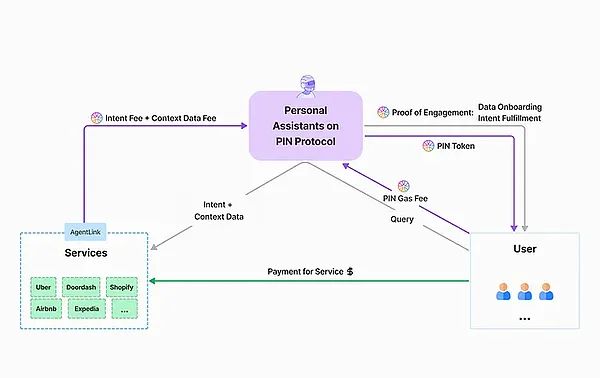
Example:
A user downloads Personal AI to their phone or computer and requests: “Buy the cheapest GTX 3080 graphics card on Amazon,” paying the total cost (product price + service fee + PIN Protocol gas fee).
Personal AI forwards the request to the PIN Protocol.
After interpreting and breaking down the intent, the PIN Protocol sends the detailed task steps along with relevant data to the most suitable Agentic Service. There might be dozens of Amazon-shopping-specific agents, so the protocol selects the optimal one based on cost, performance, and historical success rates.
The agent locates the best-value GTX 3080 on Amazon and completes the purchase. Upon completion, it pays a fee to the PIN Protocol for intent decomposition and data access. Finally, the PIN Protocol and Personal AI deliver the result to the user, who may receive $PIN tokens as a reward.
Network Participants
Personal AI Users: Install Personal AI on their devices and connect personal data to the PIN Protocol, earning $PIN token rewards.
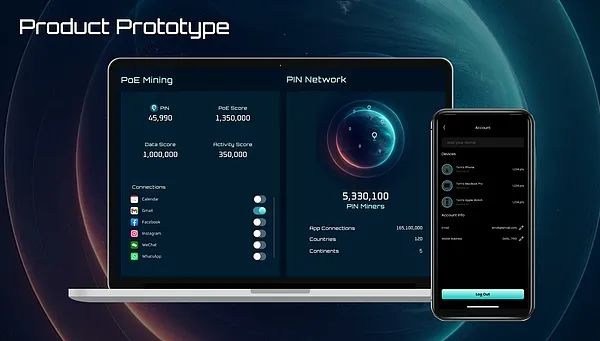
Value-Transacting Users: As described above, users engaging in valuable transactions also earn $PIN token rewards.
PIN Protocol Nodes: Responsible for tracking and verifying user data on the network. Operators must stake $PIN, and token holders can delegate to nodes—both earning staking rewards.
Agentic Services: Developers who build and operate agents earn service fees.
2. Core Development Team
Davide Crapis - Co-founder
Background in blockchain protocol design with some AI expertise.
Former Senior Data Scientist at Lyft, where he designed and implemented incentive distribution algorithms that delivered millions of dollars annually in growth incentives to riders and drivers. After leaving Lyft, he worked independently researching incentive mechanisms and token distribution models. Prior to founding PIN AI, he served as a Research Scientist at the Ethereum Foundation focusing on "robust incentives."
Developed a machine learning model measuring consumer sensitivity to interest rates on investment/credit products. Served as a researcher and mentor in machine learning at Columbia Business School for four years. Was part of the Web2 developer community "South Park Commons," exploring intersections between large language models and blockchain.
Ben Wu - Co-founder
Operations background, likely contributes strategic direction and AI product ideas.
Graduate of MIT and alumnus of Y Combinator. Before co-founding PIN AI, he served as Director of Databases and Operations in Yahoo’s Strategic Data Solutions division, overseeing operations and management of large-scale data projects.
Bill Sun - Co-founder & Chief Scientist
Background in quantitative trading and AI.
Ph.D. in Mathematics from Stanford University. Conducted AI research at Google DeepMind. Former AI/quantitative trading equity portfolio manager at a Wall Street asset management firm. Founded AI+Club, an AI research organization, and AGI House, an AI tech community. Angel investor in the a16z scout fund. Also founder of Generative Alpha, providing enterprise-grade AI solutions.
3. Reflections and Summary
The First Industrial Revolution freed our hands through machinery;
The Second Industrial Revolution broke the boundary between day and night with electricity;
The Third Industrial Revolution blurred the line between physical and digital through the internet.
AI is widely regarded as the hallmark of the Fourth Industrial Revolution, and AI agents are the tickets to this journey—allowing each of us to board the great vessel sailing toward a future of human-machine collaboration.
Over the past few decades, massive amounts of activity and data have been generated across the internet, yet users have never truly owned their data.
The iPhone 16 has just launched with Apple Intelligence, but PIN AI has the potential to build an even more open AI agent ecosystem than Apple’s offering.
Here, developers can earn rewards by building innovative agentic services for Web2 platforms, driving continuous improvements in agent performance and quality—and sparking a wave of innovation.
Meanwhile, billions of mobile users can not only use personalized Personal AI, but also earn rewards by sharing their device data.
User data powers the entire PIN AI ecosystem—this is the power of users, and precisely the starting point of Web3: decentralization and ownership.
I look forward to seeing the PIN AI network launch soon, and whether its incentive mechanisms can effectively attract a large army of open-source contributors—igniting an even larger wave of innovation. The testnet is expected to launch in October, with mainnet going live and TGE scheduled for January next year—definitely worth watching.
Join TechFlow official community to stay tuned
Telegram:https://t.me/TechFlowDaily
X (Twitter):https://x.com/TechFlowPost
X (Twitter) EN:https://x.com/BlockFlow_News
 Baize Research


