Pump Pump Superhero: How Does dappOS Lower Barriers and Enhance the Web3 User Experience?
TechFlow Selected TechFlow Selected
Pump Pump Superhero: How Does dappOS Lower Barriers and Enhance the Web3 User Experience?
The guests analyzed dappOS's technological innovation, market potential, and future development direction from different perspectives.
 Navigating Web3 tides with focused insights
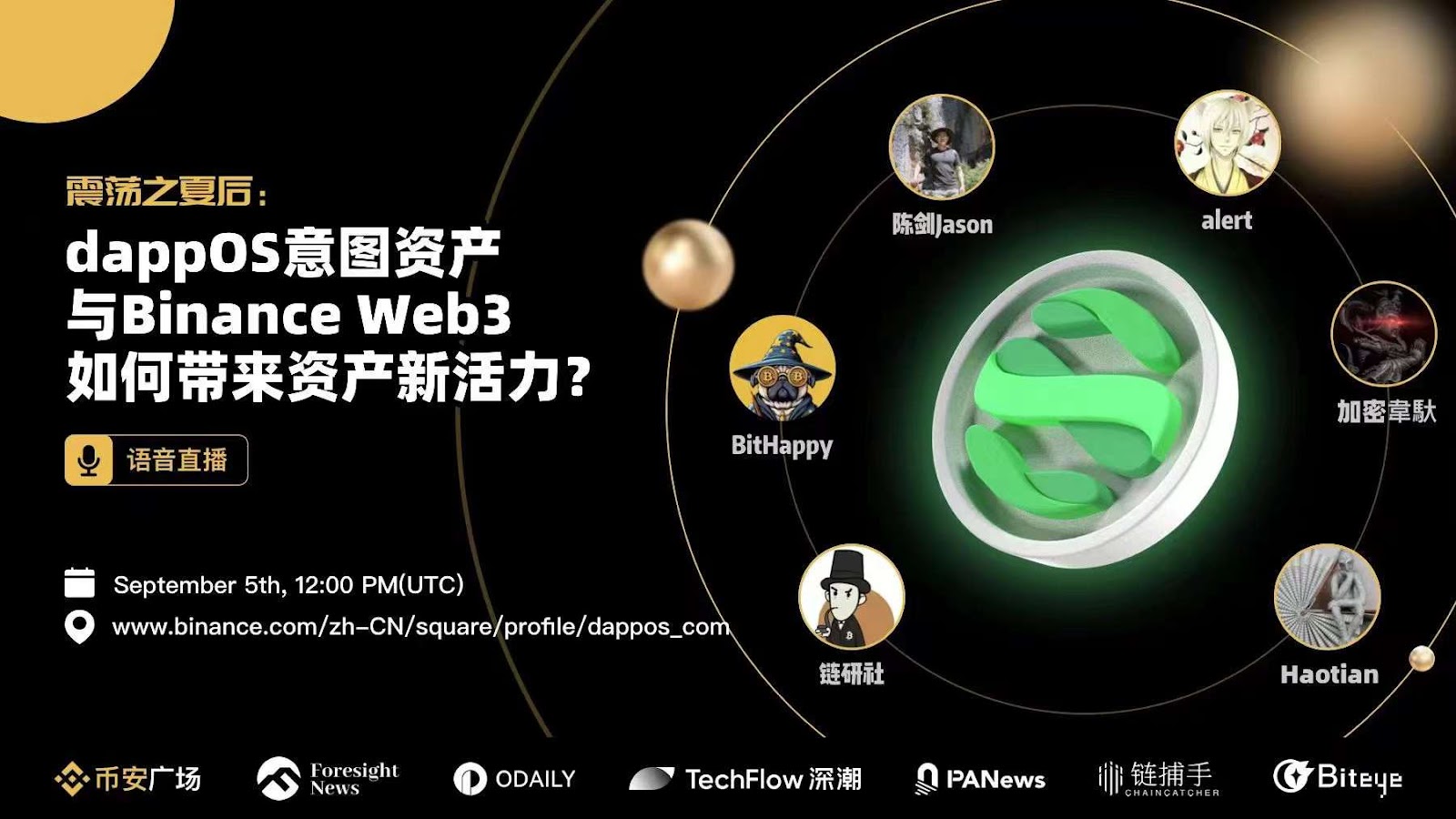
In a volatile market environment, people in the Web3 space are constantly seeking new industry opportunities. dappOS has emerged as a focal point in the current market due to its unique intent assets and collaborative campaign with Binance Web3 Wallet. On September 5, during a live audio broadcast on Binance Square, numerous well-known guests gathered to deeply explore the topic: "After the Summer of Volatility: How Can dappOS Intent Assets and Binance Web3 Bring New Vitality to Digital Assets?"
The guests analyzed dappOS from multiple perspectives, including technological innovation, market potential, and future development directions.
Below is a recap of the highlights from this live session.
Guests: Jason Chen (Chen Jian), Alert, Jia Mi Wei Tuo (Crypto韦陀), Haotian, Lian Yanshe (Chain Research Society), BitHappy
Time: September 5, 20:00
Theme: "After the Summer of Volatility: How Can dappOS Intent Assets and Binance Web3 Bring New Vitality to Digital Assets?"
Venue: Binance Square Audio Live
Jason Chen: Re-understanding dappOS – Nodes Independently Formulate Strategies and Fulfill User Intentions via Quoting
Jason Chen: My understanding of dappOS has completely changed. I posted a tweet yesterday—before that, I always thought the process of fulfilling user intentions was governed by predefined rules set within the dappOS system, where nodes simply executed these rules and earned fees. However, after a comprehensive explanation from dappOS's research lead yesterday, I realized that in reality, the strategies for fulfilling intentions are independently formulated by individual nodes across the network. After formulating their strategies, nodes compete through a bidding mechanism. This free market of nodes represents a significant innovation: nodes can leverage their own strengths to choose suitable strategies, participate in competitive bidding, and ultimately deliver professional execution efficiency and low costs to users. Meanwhile, dappOS’s OMS (Order Management System) mechanism ensures user security.
Pumpman Superhero: dappOS Lowers Barriers for Users and Developers, Enhancing Web3 Experience
Superhero: From a Web2 perspective, using Web3 products today feels like directly calling API endpoints. Ideally, we should provide users with an app interface that delivers functionality based on their needs, rather than requiring them to interact directly with APIs. Take cross-chain bridges and AA wallets, for example. While AA wallets allow one-click function calls, they come with higher gas fees, and certain assets remain scattered across different interfaces—meaning the problem isn’t fully solved. Cross-chain solutions face similar issues: high friction costs and poor user experience make them feel clunky and unintuitive.
However, in the intent-based paradigm, I see dappOS as an operating system for dApps that anyone can use. I believe we should first lower the learning curve so more people can easily get started. Only then can they truly grasp the underlying purpose. This direction is far more promising than competing solely on complex infrastructure. The idea here is simple: abstract away all underlying infrastructure into backend APIs, provide users with a graphical interface, and focus purely on achieving desired outcomes through specialized nodes. This leads to smoother experiences and improved user retention.
On dappOS, it’s just like Alipay—you deposit funds, the system tells you the annualized yield, and you simply purchase. For Web3 developers, building with intent assets is much cleaner and more straightforward, eliminating the need to handle chain-specific differences or compatibility issues. Overall, both users and developers benefit from a significantly better experience.
Alert: dappOS Security Mechanism Allows Users to Harness AI Power Safely; As AI Advances, Users Will Shift Toward Automated Experiences
dappOS plays a crucial role in advancing AI adoption in Web3—and will also benefit from ongoing AI progress. A major concern users have when interacting with AI is the inability to understand its decision-making logic, leading to fears about potential losses. However, dappOS’s security model focuses solely on outcomes, not processes. It guarantees that if an AI fails to fulfill a user’s intent and causes loss, the user receives pre-defined compensation. This allows users to enjoy the full power of AI without bearing the risk—an enormous boost for AI integration into Web3. Once AI accuracy reaches a certain threshold, widespread user adoption becomes inevitable.
Moreover, as AI technology continues to improve, the performance gap between AI-powered service nodes and regular users will widen dramatically. Eventually, users will abandon manual operations altogether and transition to dappOS’s intent-execution network for a far more efficient and automated experience.
Haotian: Could dappOS Be the Key Catalyst Behind the Next Surge in Ethereum TVL?
AI was initially proposed to solve intent-related challenges, but after some time, the discussion faded. I believe this is because applying AI to the intent space is currently too premature—it feels difficult to implement in practice. That’s why I find what dappOS is doing particularly compelling: they’re not overhyping AI concepts but actually delivering tangible applications. This sector deserves attention. As Professor Jason Chen mentioned earlier, Ethereum’s ecosystem may have over-invested in foundational infrastructure. Coincidentally, this month marks the six-month anniversary since the Cancun upgrade. I recently wrote an article analyzing the current state of Layer 2s, noting that transaction volumes haven’t increased significantly, and many L2s have stalled Ethereum’s TVL growth.
dappOS, as a Web3 operating system, abstracts accounts and assets, offering users a unified operational pathway. Users no longer need to worry about which chain their assets are moving across—they convert their assets into intent assets and let intent nodes handle the rest. This reminds me of my early days as a programmer: back then, programming required assembly language, where developers had to manage different CPU instruction sets, disk write timing, and memory usage. But with the advent of operating systems—especially Microsoft’s Windows 95—personal computers became accessible to the masses.
BitHappy: dappOS Lowers Trading Barriers, Making On-Chain Operations as Simple as Using a CEX
In 2021 and 2022, I focused entirely on BSC and didn’t engage with other chains, largely because switching chains to buy tokens felt too cumbersome. This is a common hurdle for newcomers. Although many in this room are experts or long-time participants, for most users on Binance Square—where Binance is seen primarily as a centralized exchange—the audience consists largely of traders unfamiliar with on-chain operations.
dappOS effectively lowers these barriers, helping CEX-centric users gradually understand Web3 and on-chain interactions—a highly meaningful advancement. Another thing I appreciate about dappOS is its broad support for multiple chains and ecosystem projects, greatly expanding user choice and experience.
Crypto韦陀 (Jia Mi Wei Tuo): Web3’s Primary Need Is Liquidity—dappOS Simplifies Liquidity Management
As others mentioned, the experience now feels much smoother. For example, I enter with ETH, convert it into intent assets, earn yield, and immediately use them for contract trading on platforms like GMX or KiloEX—to hedge against potential ETF downturns. Previously, such interactions involved significant costs: slippage of several percentage points per transaction, plus hidden costs like operational complexity. If the process was too complicated, mistakes could happen, making users anxious. In those cases, it often seemed better to just convert everything into USDT—saving time and effort, even if it meant losing a few percentage points in returns, which was still within acceptable limits.
Now, tools like dappOS solve these problems by streamlining workflows and drastically reducing operational costs.
Besides these insightful remarks, we’ve compiled frequently asked questions from the live session and recent community discussions for your reference:
Q: dappOS has become extremely popular. If ordinary users join the joint campaign between Binance Web3 Wallet and dappOS now, will they still be able to benefit?
A: The reward structure of this campaign is intentionally designed to favor retail users. Large holders cannot receive rewards proportional to their capital size (though they can earn proportionally from the yield of intent assets). Additionally, Binance Web3 Wallet enforces strict authenticity checks when distributing rewards—for example, requiring KYC verification. This makes it significantly more costly for farming farms or bot operators to exploit compared to using purely on-chain addresses.
Q: Where are intent assets stored? Are they centrally custodied by dappOS?
A: Intent assets are decentralized and non-custodial—one of their key advantages over certain crypto wealth management products. These assets are held in smart contracts on each respective blockchain, though not necessarily in native token form—they might take the form of whitelisted assets like Pendle. Users can redeem their value directly by interacting with the contract. As long as the assets are moved to the correct chain, users can retrieve equivalent value, and redemption does not require going through the dappOS intent execution network.
Q: If the underlying yield-generating project backing intent assets encounters issues, could users’ attempts to exit cause the intent asset to de-peg?
This depends on the nature of the issue faced by the yield-generating project:
1. If the yield-generating assets can still ultimately be redeemed for their native assets (BTC/ETH/USDT), even if temporarily illiquid or closed to general redemptions, de-pegging won’t occur. Execution fees may rise slightly, but nodes typically bypass DEXs and deal directly with the project. Moreover, since the underlying assets are diversified across multiple yield sources, nodes can switch to alternative yield-bearing assets if one becomes temporarily unredeemable.
2. If the yield assets become irredeemable, losses would first be covered by surplus yield reserves in the treasury. De-pegging would only occur if the treasury is insufficient. However, thanks to risk diversification, losses would still be smaller than if users held the failing yield assets directly.
Currently, only rigorously vetted projects qualify as underlying assets—primarily those already listed on Binance with total value locked (TVL) exceeding $1 billion.
Q: What’s the difference between the use cases addressed by intent assets and those of cross-chain aggregating DEXs or wallets?
-
Lower-cost, more efficient transactions enabling retail users to achieve institutional-grade execution: Relying solely on DEX liquidity depth is feasible for average users, but professional nodes operate differently. For instance, a node could use VIP loans to front-fund user withdrawals and repay later, reducing costs to less than 0.01% for well-capitalized nodes. Large nodes may also batch-process redemptions directly with project teams (this explains why the treasury’s ETH balance decreases even when some LRTs are publicly non-redeemable).
-
Earn interest while maintaining usability: Using intent assets is far more convenient than combining yield-bearing assets with cross-chain DEXs. For example, holding intentUSD allows direct display and usage in dApps requiring USDT, functioning almost identically to standard USDT with negligible differences in fees or speed. In contrast, using a cross-chain DEX requires converting yield assets back to plain USDT and incurs higher total costs—especially during cross-chain transfers.
Chen Jian: This is completely different from my previous understanding of dappOS. Yesterday I posted a tweet—before that, I had always assumed that the process of fulfilling user intents was governed by predefined rules set by the dappOS system itself, and nodes merely executed these rules to earn service fees. But after a thorough explanation from Linchuan yesterday, I finally understood that in fact, during the intent fulfillment process, the actual strategies are independently formulated by individual nodes across the network. After formulating their strategies, nodes then compete through a quoting mechanism.
Superhero: From a Web2 perspective, using Web3 today feels like directly calling API endpoints. Normally, we should offer users an app interface that provides needed functions instead of forcing them to call APIs manually. Look at cross-chain bridges and AA wallets—AA wallets have drawbacks too. Even though they allow one-click operations, their gas fees are higher, and some assets remain scattered across different interfaces, meaning the core issues aren’t fully resolved. Cross-chain solutions face similar friction costs and poor user experience, making them feel unintuitive and clunky. But with the intent-based approach, it’s like having a dApp operating system that everyone can use. We should first lower the entry barrier. Once people start using it, they’ll quickly understand its true purpose. This direction is worth exploring—it’s far better than endlessly competing on fragmented infrastructure. Here, various infrastructures are abstracted into API calls, and users interact through a graphical interface, resulting in smoother experiences and higher user retention. That’s my take.
Emotionless Live Relay Machine: dappOS significantly promotes AI adoption in Web3 and will benefit from advancements in AI. A key user concern with AI is the lack of transparency in its logic, raising fears of potential losses. But dappOS’s security model focuses only on outcomes, not processes, ensuring users receive pre-defined compensation if AI fails to fulfill their intent. Thus, users gain AI’s power without the risk. As AI grows stronger, the capability gap between AI-driven service nodes and regular users will widen, leading users to abandon manual operations and fully adopt dappOS’s intent execution network.
Haotian: AI was proposed to solve intent challenges, but I noticed people stopped talking about it after a while—because applying AI to this space today feels too premature, making it seem impractical. That’s why I’m impressed with what dappOS is doing: they’re not exaggerating AI buzzwords but actually implementing real solutions. I think this space is worth watching. Thank you all.
As Professor Chen previously noted, Ethereum’s ecosystem may have overbuilt its infrastructure. This month also marks the halfway point since the Cancun upgrade. I recently wrote an article on the current state of Layer 2s—essentially pointing out that transaction volumes haven’t risen noticeably, and many L2s have stalled Ethereum’s TVL growth.
A Web3 operating system abstracts both accounts and assets, offering users a unified way to operate. Users no longer need to track which chain their assets are on—they convert everything into intent assets and let intent nodes handle the rest. It reminds me of my programming background: early computing used assembly language, requiring programmers to manage different CPU instruction sets, save timing, and memory usage. But with modern operating systems—like Microsoft’s Windows 95—computers entered mainstream households.
Superhero: With dappOS, it’s just like Alipay—deposit money, see the annualized return, and buy directly. For Web3 developers, building with intent assets is much cleaner—they don’t need to worry about cross-chain differences or compatibility. Both users and developers get a better experience.
BitHappy: From 2021 to 2022, I stayed entirely on BSC and didn’t touch other chains, mainly because switching chains to buy tokens felt too troublesome. This is a universal pain point for new entrants. Though many here are veterans, for most Binance Square users—who view Binance as a centralized exchange—many are just traders unfamiliar with on-chain operations. dappOS solves these entry barriers, helping CEX users gradually understand Web3 and on-chain activity. That’s incredibly valuable. Another thing I love about dappOS is its extensive support for chains and ecosystem projects.
Crypto韦陀: Web3’s top priority is liquidity—users don’t want to sacrifice liquidity for future airdrops.
Crypto韦陀: Earlier speakers mentioned the smooth experience—say I enter with ETH, convert to intent assets, earn yield, and directly use them for contracts on platforms like GMX or KiloEX to hedge against ETF declines. Previously, such flows incurred costs—slippage of several percentage points, plus hidden costs like operational complexity. If it got too complicated, you’d worry about making mistakes. So you’d think, “Forget it—just convert to USDT, save time and stress.” Losing a few percent in yield was acceptable. Now, tools like dappOS solve exactly these problems—streamlining processes and cutting costs dramatically.
Join TechFlow official community to stay tuned
Telegram:https://t.me/TechFlowDaily
X (Twitter):https://x.com/TechFlowPost
X (Twitter) EN:https://x.com/BlockFlow_News
 @dappOS_com