With the Fed's rate cut approaching, where is the crypto market headed?
TechFlow Selected TechFlow Selected
With the Fed's rate cut approaching, where is the crypto market headed?
A soft landing for the U.S. economy is particularly important.
 Navigating Web3 tides with focused insights
Article by: Tuoluo Finance

With institutional capital entering the market, the crypto sector has transitioned from independent price movements to sector-wide correlations, increasingly aligning with macroeconomic cycles. This year, major cryptocurrencies like Bitcoin have repeatedly experienced roller-coaster swings, closely tracking global market volatility. As a result, macro indicators have become central to crypto market analysis. Among these, the U.S. federal funds rate has emerged as the definitive industry barometer.
Looking back at this benchmark's impact, from March 2022 to July 2023, the Federal Reserve raised interest rates 11 times consecutively, increasing rates by a cumulative 525 basis points—the most aggressive tightening cycle in nearly half a century. During this historic rate hike episode, financial institutions faced liquidity crises, and institutions such as Silicon Valley Bank and First Republic Bank were inevitably forced into collapse. The crypto market also suffered severe setbacks. A notable example is the collapse of FTX—while internal mismanagement was clearly a factor, the trigger was ultimately the tightening liquidity caused by macroeconomic contraction.
This year, although ETF approvals have given the crypto market brief respite, weakening liquidity continues to cast a deep bearish shadow. However, recently, as the September FOMC meeting approaches, the macro landscape appears to be finally approaching a turning point after nearly a year of high interest rates.
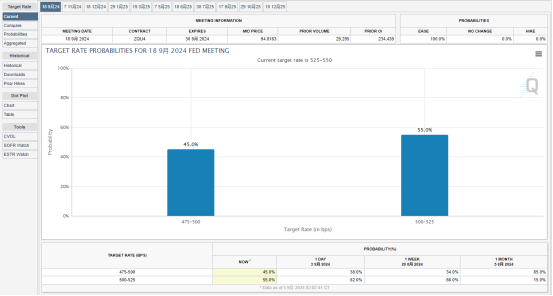
On September 5, according to CME’s "FedWatch" tool, the probability of a 25-basis-point rate cut by the Fed in September stood at 55%, while a 50-basis-point cut had a 45% chance—up from just 38% the previous day. It is clear that a rate cut has become the market consensus; only the magnitude remains uncertain.
Rate cuts typically signal liquidity release, generally serving as a strong positive for risk assets—including crypto. Yet historical data shows that rate cuts often coincide with sharp equity declines. Given crypto’s close correlation with U.S. tech stocks, its performance may not always meet expectations.
What will the upcoming rate cut mean for markets? Will it bring long-awaited relief or merely calm before the storm? Opinions remain divided. However, recent comments from multiple industry analysts suggest that the nature of the rate cut—dictated by the state of the U.S. economy—is key, and as the decision nears, volatility risks are intensifying.
Arthur Hayes, co-founder of BitMEX, recently stated that rate cuts will not provide short-term benefits to Bitcoin, emphasizing the role of the Reverse Repo Facility (RRP) in this dynamic.
The RRP is an overnight instrument used by large banks and fund managers, offering higher returns compared to other safe investments, enabling broader yield optimization. Under this program, securities are sold to counterparties with an agreement to repurchase them at a higher price on a future date. Currently, the RRP rate stands at 5.3%, above the 4.38% yield on Treasury bills. Hayes argues that this rate differential causes large money market funds to shift capital from Treasuries into the RRP, thereby reducing funds available for higher-risk investments like cryptocurrencies.
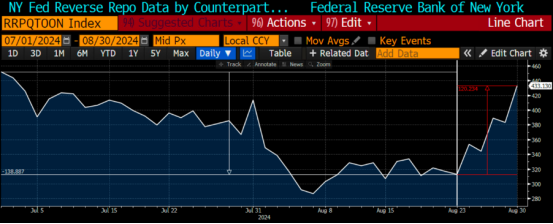
Under this backdrop, contrary to market expectations, Hayes said that in the two weeks preceding an actual rate cut, market liquidity could become even tighter. "In the best-case scenario, Bitcoin will trade sideways around current levels. In the worst case, it may gradually fall toward $50,000, as capital flows out of Treasuries and back into the reverse repo facility."
Interestingly, despite his short-term bearish outlook, Hayes emphasized he would not sell any of his crypto holdings.
Analysts at Bitfinex took a more pessimistic and aggressive stance, analyzing the impending rate cut through historical data. They noted that after months of sluggish price action, crypto investors had hoped for a September Fed rate cut to spark a bull run. However, growing fears of an economic recession could instead lead to deeper corrections. "If a loosening cycle coincides with a recession, Bitcoin could drop 15%-20% following the September rate cut. Assuming BTC trades around $60,000 before the cut, the potential bottom could lie between $50,000 and $40,000."
"Typically, rate cuts are seen as a positive catalyst for risk assets. A 25-basis-point cut might mark the beginning of a standard easing cycle, potentially leading to long-term gains in Bitcoin prices as recession concerns ease. Such a move would signal the Fed’s confidence in economic resilience, lowering the likelihood of a severe downturn. On the other hand, a larger 50-basis-point cut could initially push BTC up 5%-8%, but then trigger sharper declines as mounting fears of an imminent recession weigh on asset prices—erasing earlier gains. This mirrors past patterns: large rate cuts initially boost asset prices, but economic uncertainty ultimately suppresses sustained rallies."
Additionally, seasonal trends offer little support for Bitcoin. Historical data since 2013 shows that over the past decade, Bitcoin has posted positive returns in September only three times. The average monthly return for September is -4.78%, with a 72.7% chance of closing lower—making it one of the weakest months for the asset.
Markus Thielen, founder of 10x Research, shares this view. "If the Fed cuts rates in September 2024 solely due to inflation pressures, that would be a short-term positive for Bitcoin. But if the cut is driven by a recession—whether in September or later—Bitcoin will face significant selling pressure."
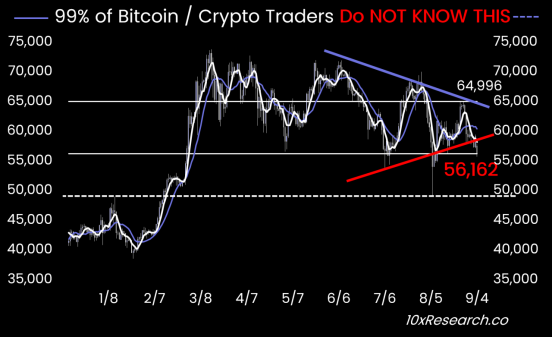
Historically, Bitcoin performs strongest when the Fed pauses its hiking cycle. Initial rate cuts usually generate muted reactions. "During the Fed’s pause in rate hikes until July 2019, Bitcoin surged explosively, delivering a 169% return. Seven months after the pause, the Fed began cutting rates, launching a sharp easing cycle. Bitcoin reacted positively, rising 19% within a week of the July 31, 2019 rate cut. However, two weeks later, momentum flattened," Thielen added. The second-half 2019 rate cuts occurred amid rising economic uncertainty, which impacted BTC prices. CoinDesk data shows BTC prices fell 33% in the second half of that year.
It's evident that analysts center their views on whether the U.S. economy achieves a soft landing. While data remains unclear, the market itself shows certain inclinations.
An article from EMC Labs notes that the market broadly expects a U.S. soft landing, hence has not priced in a broad downturn for U.S. equities under a hard-landing scenario. Under this soft-landing assumption, some capital has rotated out of the already sharply-rising "Magnificent Seven" stocks into other blue-chips with lower gains, helping drive the Dow Jones Industrial Average to new highs.
Therefore, if a 25-basis-point rate cut occurs in September and no major economic or employment data contradicts the "soft landing" narrative, U.S. equities are likely to stabilize. If the Magnificent Seven rebound, BTC ETFs are highly likely to resume net inflows, pushing BTC upward and retesting the psychological $70,000 level—or even challenging new highs. Conversely, if key economic and labor data suggest the economy is veering away from a soft landing, U.S. equities would likely correct downward—especially the Magnificent Seven—and BTC ETF capital flows would probably remain weak, potentially pushing BTC down again toward the lower boundary of its recent "post-high consolidation range" around $54,000.
Zach Pandl, Head of Research at Grayscale, also leans toward viewing this rate cut as defensive in nature. He said in an interview that the Fed typically cuts rates during recessions, but this time is different—the Fed is cutting because it has achieved a阶段性 victory in its prolonged battle against inflation.
"A rate cut under a soft landing scenario creates an environment unfavorable for the U.S. dollar but favorable for assets like Bitcoin—that's my core thesis. I believe the crypto market will retest all-time highs in the coming months. The main risk now lies in the health of the U.S. economy. The optimistic view assumes a soft landing and avoidance of recession, which is currently the consensus among most economists. Therefore, U.S. labor market data must be closely watched.
If unemployment continues to rise, with visible signs of layoffs and economic weakness emerging, Bitcoin and many other assets—such as tech stocks or credit spreads—will weaken in a typical cyclical manner. But in my view, periods of recession are excellent opportunities to accumulate Bitcoin. We’re likely to see accommodative monetary and fiscal policies deployed to lift the economy out of recession, leading to a price rebound. However, if the U.S. labor market deteriorates further and plunges into a brief recession, downside risks will become pronounced—this is the primary risk we’ll face over the next 6 to 12 months."
Matrixport’s report echoes these sentiments. After August’s steep decline, Bitcoin quickly rebounded. Although spot Bitcoin ETFs continue to see outflows, some investors are buying the dip. The回升 in the 30-day minting ratio suggests new fiat capital is flowing into the crypto market, with investors taking advantage of lower prices—possibly positioning ahead of the anticipated September Fed rate cut.
From a market perspective, despite heightened short-term uncertainty, whales appear to have taken defensive measures, while long-term signals remain bullish. QCP data shows volatility curves are expected to steepen further, with more long-dated call options being rolled into March next year. Recently, 200 additional contracts were added for Bitcoin call options expiring March 28, 2025, with a strike price of $120,000, bringing open interest to 2,100 contracts—indicating sustained investor optimism about medium- to long-term prospects.
In summary, industry experts agree: a U.S. soft landing is the prerequisite for renewed vitality in the crypto market. If achieved, the upcoming rate cut will be defensive in nature. Otherwise, it will be a recession-driven cut, and once the U.S. enters recession, the crypto market—which is deeply tied to macro cycles—could face renewed declines. Current data presents mixed recession signals: a weakening labor market offset by resilient consumer demand, making the overall trajectory difficult to determine. For retail investors, monitoring U.S. macro data and waiting for directional clarity post-rate-cut may be the safer strategy.
Join TechFlow official community to stay tuned
Telegram:https://t.me/TechFlowDaily
X (Twitter):https://x.com/TechFlowPost
X (Twitter) EN:https://x.com/BlockFlow_News