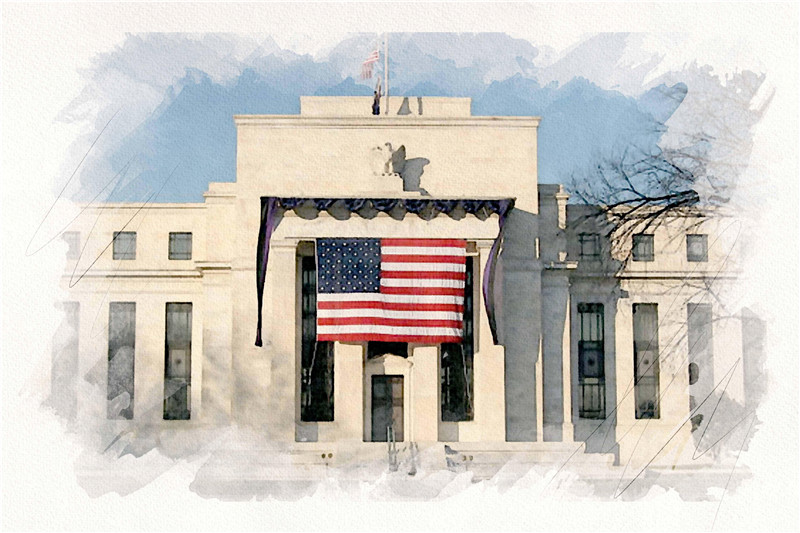
After closely observing Waller, Morgan Stanley's chief economist insists: The Fed will not raise rates this year.
TechFlow Selected TechFlow Selected
After closely observing Waller, Morgan Stanley's chief economist insists: The Fed will not raise rates this year.
Morgan Stanley maintained its baseline forecast of no rate hikes for the full year and stated bluntly that the popular narrative that "AI will inevitably lead to rate cuts" is "almost certainly wrong."
 Navigating Web3 tides with focused insights
Author:Zhao Ying
The policy stance of new Federal Reserve Chair Wash is under close scrutiny by the market. Morgan Stanley Chief Global Economist Seth Carpenter, writing after attending the European Central Bank's annual meeting in Sintra, Portugal, pointed out that based on employment data, inflation forecasts, and policy signals, the Federal Reserve will not raise rates this year.
Carpenter wrote in the report that Wash's remarks at the Sintra Policy Forum continued the tone of his inauguration press conference—a strong commitment to price stability, but deliberately avoiding the specific path to achieve this goal. Carpenter noted two changes worthy of attention:
First, Wash's wording on the dual mandate has become more balanced, shifting from a near-single focus on inflation to a clearer acknowledgment of the full employment goal;
Second, Wash specifically emphasized that the recent policy meeting (coupled with falling oil prices) has lowered market inflation expectations and term premiums; this statement leads Carpenter to believe that a Fed rate hike in July is unlikely.
Against the backdrop of uncertainty in the Fed's policy path, Morgan Stanley's maintenance of its baseline forecast of no rate hikes for the year means the market does not need to price in near-term rate hike risks.
Wash's Sintra Signals: Balancing the Dual Mandate, Downplaying Rate Hike Urgency
Carpenter witnessed Wash's speech at the Sintra Policy Forum firsthand and interpreted it as a dovish marginal shift. He pointed out that Wash previously left the market with the impression that price stability was placed as an overriding priority, while this speech more clearly incorporated full employment into the policy framework.
More critically, Wash proactively pointed out that the policy meeting has pushed market inflation expectations and term premiums lower, and mentioned that multiple "working groups" are being formed and will take time. Carpenter believes this combination of wording conveys a clear signal: the Federal Reserve is not in a hurry to take action in July.
Data Supports Patience: Inflation Forecasts Below FOMC Median, Nonfarm Payrolls Provide Buffer
At the fundamental level, Carpenter cited multiple factors supporting the maintenance of the no rate hike forecast. The nonfarm payrolls data released last week continues to provide room for the Federal Reserve to stay put. Meanwhile, Morgan Stanley's inflation forecast is significantly lower than the median forecast of FOMC members, and methodological revisions to PCE inflation create the possibility of further substantially lowering inflation readings.

Carpenter stated that the combination of the above factors makes him feel "comfortable" with the judgment of maintaining no rate hikes throughout the year. Data could certainly change the conclusion, but current evidence points in the same direction.
AI and Productivity: Not Simple to Bet on Rate Cuts
Carpenter also discussed the impact of artificial intelligence on monetary policy and questioned the popular narrative that "AI will bring deflation and drive rate cuts." He pointed out that the wave of AI capital expenditure appeared earlier and on a larger scale in the United States, having a marginal upward effect on inflation in the short term.
More importantly, he raised three counterarguments: First, the state of the business cycle will dominate policy direction; second, the deflationary effect is just one of many impacts, and higher productivity will also boost demand through consumption and investment; third, faster productivity growth means higher equilibrium interest rates (what economists call r*), which further weakens the logic for rate cuts. Carpenter stated plainly that the simple assertion that AI will inevitably lead to rate cuts is "almost certainly wrong."
ECB Path Divergence: Another 25 Basis Points in September Possible, But Soft Data Leaves Variables
In contrast to the Federal Reserve, the European Central Bank's policy direction is more clearly biased towards tightening. Carpenter pointed out in the article that ECB President Lagarde reiterated at Sintra that the June rate hike was a carefully considered decision, not merely a "preventive rate hike," a statement that in his view means there is still room for subsequent rate hikes.
Morgan Stanley's baseline forecast is that the ECB will raise rates by another 25 basis points in September. However, Carpenter also pointed out that last week's soft European inflation data and the sharp decline in oil prices leave room for policy—if inflation continues to soften or PMI is significantly weak, the path for further rate hikes could be obstructed. He believes that a rate hike in July or more than one rate hike within the year are both unimaginable at present.
Join TechFlow official community to stay tuned
Telegram:https://t.me/TechFlowDaily
X (Twitter):https://x.com/TechFlowPost
X (Twitter) EN:https://x.com/BlockFlow_News