Understanding Intent Assets: The Web3 Version of Yu'ebao, a New Revolution for Idle Assets
TechFlow Selected TechFlow Selected
Understanding Intent Assets: The Web3 Version of Yu'ebao, a New Revolution for Idle Assets
Breaking the TVL deadlock: How Intent assets can become the gateway to mass adoption of Web3 assets?
 Navigating Web3 tides with focused insights
Author: Mike @Foresight Ventures

The Revolution of Idle Assets
In 2013, Alibaba's Yu'ebao emerged out of nowhere, ushering asset management into a whole new era. Before that, ordinary users found it difficult to locate a method that was both secure and efficient for managing their idle funds. Bank current accounts offered low interest rates, while wealth management products were complex and hard to understand. The emergence of Yu'ebao changed everything.

The Birth of Yu'ebao
It was an era when internet finance was just beginning to emerge. The Alipay team realized that users often had idle funds in their payment accounts; if these funds could be invested, it would not only generate returns for users but also enhance user experience. Thus, they partnered with Tianhong Asset Management to launch a product called "Yu'ebao."
Yu'ebao is simple to operate—users need only tap a few times within the Alipay app to transfer account balances into Yu'ebao and start earning daily returns. This transparent and convenient financial model quickly won user favor. Soon, Yu'ebao’s user base surpassed tens of millions, and the scale of managed funds rapidly grew.
Opportunities in Web3
With the development of blockchain technology and Web3, a new era of asset management is arriving. Products similar to Yu'ebao are also emerging in the Web3 space.
Web3 versions of Yu'ebao hold immense potential because they can fully leverage the advantages brought by blockchain technology and capitalize on the vast market opportunity presented by large amounts of idle assets already on-chain:
1. Billions of Dollars in Idle On-Chain Assets
The blockchain ecosystem contains massive underutilized assets worth hundreds of billions of dollars. Many users store their cryptocurrencies in wallets, waiting for price increases, while these assets earn no returns during periods of idleness. A Web3 version of Yu'ebao could effectively utilize these idle assets by offering money-market-fund-like functionality from traditional finance, providing users with stable returns. This model not only increases asset utilization but also promotes liquidity and activity across the entire blockchain ecosystem.
2. Decentralization and Transparency
Built on blockchain technology, the Web3 version of Yu'ebao benefits from decentralization and transparency. Unlike traditional financial institutions, users can directly perform investment operations via smart contracts without relying on intermediaries. This decentralized structure reduces middlemen, lowers operational costs, and improves investment efficiency. Moreover, all transactions and fund flows are recorded on-chain, allowing users to view and verify them at any time—enhancing trust through full transparency.
3. High Liquidity and Convenience
Compared to traditional financial products, Web3-based Yu'ebao typically offers higher liquidity. Users can deposit or withdraw funds anytime without worrying about lock-up periods or early redemption penalties. This high liquidity makes Web3 Yu'ebao more flexible and better able to meet diverse user needs. Additionally, user-friendly interfaces and simplified processes offer a seamless investment experience.
4. Diversified Sources of Yield
A Web3 version of Yu'ebao can leverage various decentralized finance (DeFi) protocols on the blockchain to provide diversified yield sources. For example, users can earn returns by participating in lending protocols, liquidity mining, staking, and more. Unlike traditional money market funds, these yield sources include not only interest but also platform token rewards and other forms, resulting in richer and more diversified investment returns.
5. Broader User Reach
Blockchain technology enables Web3-based Yu'ebao to serve global users without geographical or national limitations. Anyone with internet access can participate, opening up broad market prospects. Especially in regions where traditional financial services are underdeveloped, Web3 Yu'ebao can provide a new path for wealth management, filling gaps in financial inclusion.
In the Web3 domain, the emergence and growth of LSTs (Liquid Staking Tokens) and LRTs (Liquidity Re-Staking Tokens) demonstrate this market’s enormous potential. Although most such products generate stable yields, their application scenarios remain relatively limited. Yu'ebao supports peer-to-peer transfers and shopping on Taobao, offering a user experience nearly indistinguishable from a bank account. However, current Web3 products have yet to achieve the same level of widespread adoption as USDT or ETH.
Traditional TVL Model Hits a Deadlock
During the first half of this year’s crypto bull market, “Total Value Locked” (TVL) became the core metric for project promotion. TVL generally measures the total value of assets locked in DeFi projects, reflecting user participation and market confidence. In past crypto cycles, TVL served as a relatively effective indicator because it represented real “skin in the game,” with much higher fabrication costs compared to metrics like address count or social media engagement. As such, projects with high TVL enjoyed clear advantages in marketing and attracting investors.
Under this context, many projects attracted users to deposit assets onto their platforms by offering high yields and airdrop incentives, rapidly inflating their TVL figures. While intended to showcase strength and appeal, this strategy exposed problems in the current market cycle.
The Stagnation of TVL
As the market evolved, investors noticed significant flaws in the TVL narrative this cycle. After launching tokens and listing on exchanges, many projects saw their TVL plummet rapidly. These TVL figures were not contributed by broad retail participation but rather inflated short-term by a few whales or pre-arranged partners using “farm-and-dump” tactics to cash out. This “stagnant TVL” does not reflect genuine ecosystem vitality but instead represents artificially manipulated spikes in data.
This phenomenon has triggered broader industry issues—for instance, some high-TVLL projects repeatedly delay airdrop distributions or unlock schedules due to fears that once users gain access, TVL will quickly drain away. Consequently, TVL’s credibility and effectiveness as a measure of on-chain ecosystem health are now being questioned.
Why Is TVL Becoming Stagnant?
The root cause lies in the fact that for average crypto users, absolute returns from participating in these projects are limited, and when market volatility occurs, the cost of withdrawing or converting assets is high, or requires long waiting times, potentially causing them to miss market opportunities. In other words, the opportunity cost for ordinary users is too high, leading to low participation and leaving TVL dominated by whales who use it as a tool for exit liquidity.
Deep Dive: Why TVL Projects Fail to Meet Users’ Asset Usage Needs
Project teams recognize this issue and attempt optimizations, but these efforts often yield limited results and fail to truly satisfy user demands. Current TVL projects mainly offer two ways to exit assets: one is for users to apply directly to the project for redemption; the other is exchanging derivative assets (e.g., xxETH) on decentralized exchanges (DEXs).
However, regardless of the method, ensuring good liquidity experience comes at a high maintenance cost borne by someone. For example, in redemption schemes, the project must bear ongoing operational costs, which usually forces users to wait extended periods before accessing funds. In liquidity pool models, LPs (liquidity providers) also incur costs, often resulting in shallow pools, high slippage, and even significant price gaps between derivative and native assets during market volatility.
Therefore, when liquidity solutions require specific parties to shoulder high maintenance costs, those costs are ultimately passed on to users, degrading user experience. To resolve this structural problem, fundamental reforms at the foundational layer are required. Through in-depth research, we find that dappOS’s recently launched Intent Assets effectively address this challenge.
dappOS Intent Assets: Making Yield-Bearing Assets Always On-Chain Usable
dappOS is an intent execution network backed by top-tier investors including Binance Labs and Polychain, with a latest valuation reaching $300 million—making it arguably the leading project in the intent sector. dappOS’s Intent Assets allow users to enjoy high yields while ensuring their assets remain instantly usable on-chain—whether transferring Intent Assets natively to exchanges or buying new MEME coins, users can directly spend them. They can trade or transfer Intent Assets freely, without long waits or high slippage.
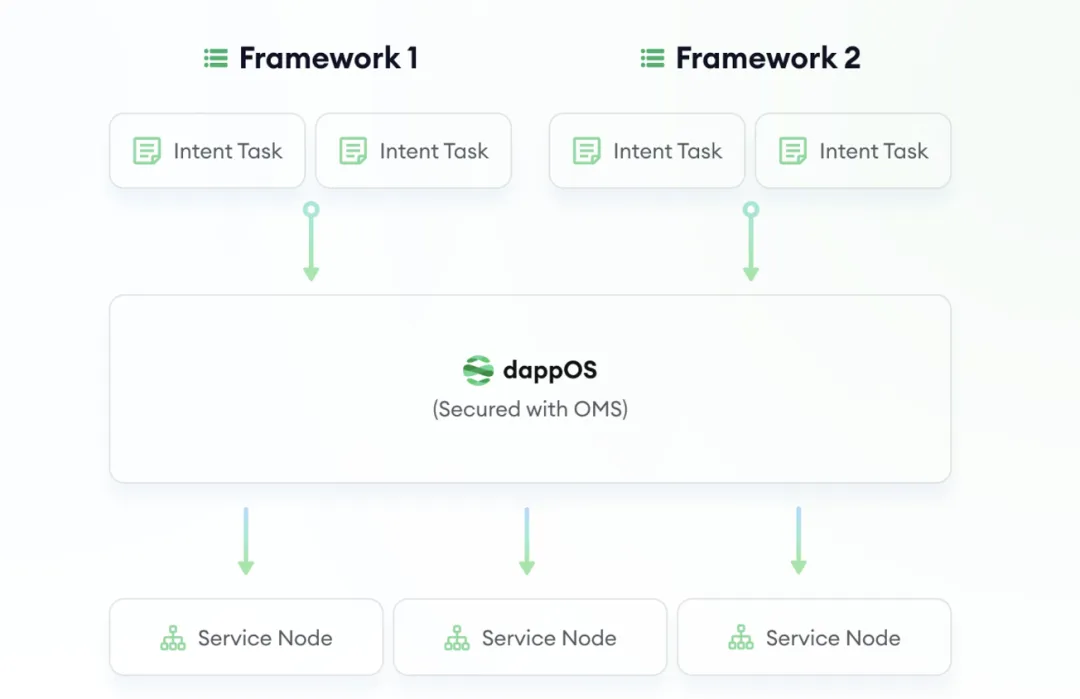
The reason Intent Assets achieve this lies in dappOS’s underlying intent execution network, which includes numerous decentralized service providers. When a user submits a “convert Intent Asset” request, the network queries these providers for quotes and selects the optimal one to fulfill the task. Each provider can quote based on their own capacity and complete the task at minimal cost. The network doesn’t care how the job is done—only whether it’s completed within the deadline.
Through this approach, the dappOS intent execution network eliminates the need for any single party to bear high maintenance costs, achieving dynamic balance between liquidity upkeep costs and actual demand. By allowing service providers to use on-chain or off-chain solutions—including tools from centralized exchanges—the network further reduces liquidity maintenance costs and enhances user experience.
What Are Intent Assets?
Intent Asset is a new type of asset supported by dappOS that automatically adapts to different scenarios and earns interest when idle. Similar in principle to Yu'ebao, it aggregates yield-generating protocols and applications such as Pendle, Babylon, Benqi, Berachain, BounceBit, Ether.Fi, GMX, KiloEx, Manta, Puffer, Pendle, QuickSwap, Taiko, and Zircuit, then executes conversions via nodes in the intent network, enabling Intent Assets to earn yield while maintaining broad usability.
Take stablecoins as an example: dappOS offers a flexible asset called intentUSD. This asset functions as currency and earns interest when idle. This innovative approach allows stablecoins to automatically switch between forms based on user needs. For instance, when USDT is needed, intentUSD acts as USDT; when trading USDC, intentUSD seamlessly becomes USDC.
Using its intent execution network, dappOS handles the staking, unstaking, and conversion of yield-bearing assets on behalf of users, ensuring direct usability across different contexts. As a result, Intent Assets functionally match native assets like USDT or ETH—but continue generating returns when idle.
Key advantages include:
-
Instant Redemption: No waiting or lock-up periods.
-
High Yields: e.g., 12% annual yield for USDT/USDC, 7% for ETH, with earnings distributed in real-time—no need to wait for token launches.
-
Convenient Use: When interacting with dApps or withdrawing to exchanges, USDT/ETH balances load directly, delivering a user experience indistinguishable from native USDT/ETH.
In this way, Intent Assets match native assets in functionality while continuously generating returns when idle—greatly improving asset utilization and return levels.
Interaction Examples:
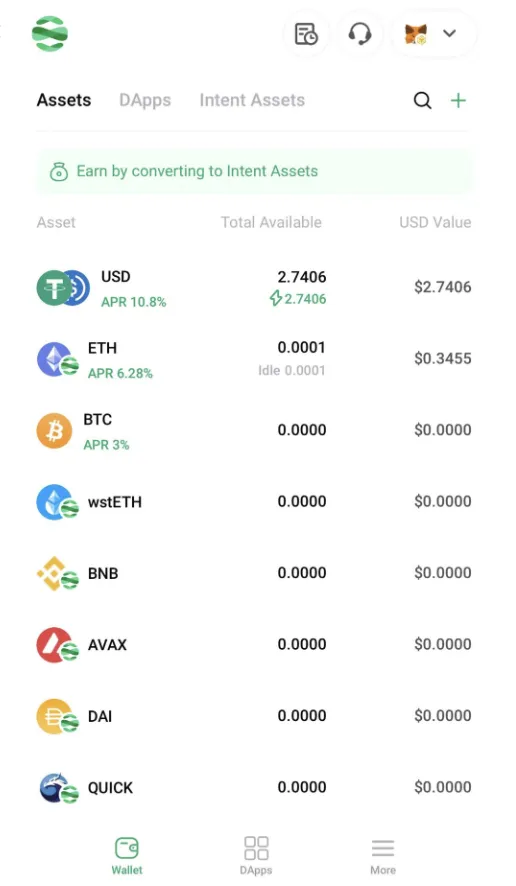
The image below shows the interface where intUSD continues earning interest after being generated on dappOS.
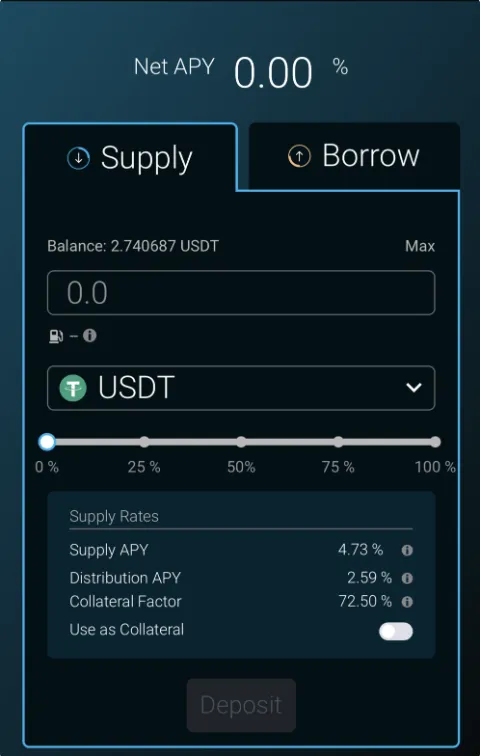
When switching to Benqi, we see that Benqi automatically recognizes intUSD as USDT and allows normal usage.
On SyncSwap’s interface, intUSD is similarly recognized as USDT/USDC. Across different dApps, intUSD can be used as any USD-denominated asset supported by that dApp.
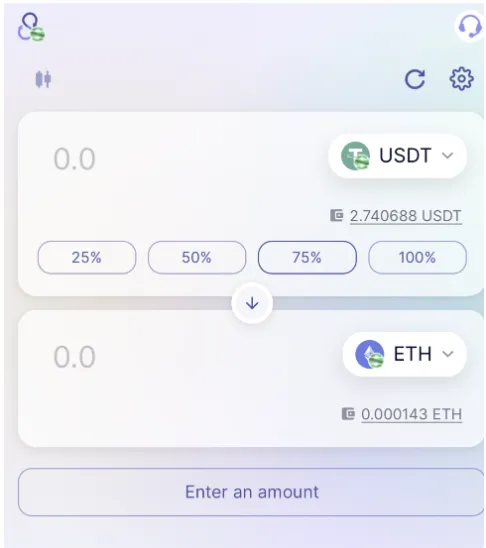
The use cases for Intent Assets are extensive, offering unique advantages across different user groups and scenarios:
DeFi Power User: Alex
Alex is an experienced DeFi user, well-versed in various decentralized financial protocols and tools. One day, he discovers dappOS’s Intent Assets and sees a great opportunity to put his idle assets to work.
Alex holds some idle ETH and decides to convert it into intentUSD to generate yield. He stakes intentUSD in dappOS’s liquidity pool to begin earning staking rewards. Later, spotting a new liquidity mining project offering high returns, he moves part of his intentUSD into that pool to capture additional rewards.
Soon after, Alex needs some stablecoins to join a new DeFi project. He converts part of his ETH into intentUSD and uses it directly in the project. This way, he maintains asset flexibility while maximizing returns across multiple DeFi platforms. Alternatively, if Alex wants to top up collateral on GMX on Arbitrum for perpetual contract trading, he finds he can use intentUSD directly as USDC—without any extra conversion steps.
Newcomer: Lisa
Lisa knows little about Web3 and cryptocurrency but has heard exciting stories about digital assets and DeFi, so she decides to give it a try. She buys some USDT but isn’t sure how to best utilize it.
Through a friend’s recommendation, Lisa learns about dappOS’s Intent Assets. She decides to convert her USDT into intentUSD. At first, she simply keeps intentUSD in her wallet, checking daily interest accruals. She appreciates this simple and convenient way to earn yield—delivering significantly higher returns than traditional bank deposits, without requiring complex cross-chain swaps, staking, or asset conversions.
One day, Lisa wants to use some of her earned interest to buy groceries. Unfamiliar with on-chain operations, she tries withdrawing IntentUSD directly to an exchange and using the exchange’s debit card for spending. Despite previous frustrations with blockchain complexity, she discovers that IntentUSD can be smoothly withdrawn to the exchange and magically converted into USDT/USDC—and gas fees can even be paid using IntentUSD itself.
Institutional Investors
Imagine a large traditional investment firm managing billions of dollars in assets. They’re highly interested in blockchain and DeFi and are seeking stable, efficient investment methods.
They notice dappOS’s Intent Assets and see an opportunity to optimize capital management. The institution allocates part of its funds into intentUSD to earn steady returns without sacrificing liquidity. Using dappOS’s Intent execution network, they convert and diversify intentUSD across chains to reduce risk.
They also deploy intent assets into high-yield DeFi projects. For example, they allocate part of intentUSD to liquidity mining for extra rewards. During market volatility, they can instantly redeem intent assets, ensuring rapid conversion to fiat when emergencies arise—guaranteeing immediate entry and exit with full flexibility, driving stable return growth. Thanks to the intent network’s design, security remains robust, enabling efficient portfolio management and optimization.
Whether seasoned DeFi traders, new Web3 adopters, or major institutional investors, dappOS’s Intent Assets offer tailored solutions for diverse needs. Through these examples, we see the broad applicability and immense potential of Intent Assets across various scenarios—helping users achieve efficient asset management and maximize returns in the blockchain world.
How Intent Assets Work
Intent Assets leverage the unique capabilities of dappOS’s execution network, taking users’ regular or intent assets as input and outsourcing complex settlement tasks to network service providers to deliver desired outcomes. Users don’t need to worry about underlying processes—they focus solely on end results like earning yield, interacting with dApps, or withdrawing to centralized exchanges.

dappOS’s OMS (Order Management System) mechanism grants nodes high freedom to optimize cost and efficiency without compromising user security. By assigning preset values to each intent task, OMS allows nodes to flexibly adjust resources based on real-world conditions, achieving optimal performance and cost-effectiveness. As a result, user intent tasks are executed at maximum speed and minimum cost, ensuring smooth, efficient experiences while maintaining strong asset protection.
dappOS’s Intent execution network handles various types of intent tasks while ensuring seamless compatibility across different blockchains and decentralized applications. Users can freely use Intent Assets in multi-chain environments without worrying about interoperability. For example, users can withdraw intentUSD as USDT to an exchange when needed, or use it as USDC on GMX on Arbitrum. This flexibility and compatibility enable Intent Assets to be deployed across a wide range of applications, delivering unparalleled convenience.
Users holding intent assets (such as intentUSD, intentETH, intentBTC) earn yield based on USDT, ETH, and BTC. These returns primarily come from steady appreciation of underlying assets (like wstETH, sUSDe, sDAI, and stBBTC) and yield-generating activities within DeFi protocols. Designed for consistent growth, these underlying assets ensure stable and rising returns, enabling users to maximize gains while preserving liquidity.
Potential Future Challenges
Despite dappOS Intent Assets’ tremendous potential in on-chain liquidity and global accessibility, their success faces challenges related to user adoption, technical complexity, market competition, regulatory compliance, liquidity management, and user experience. Only through continuous improvement in these areas can they achieve widespread adoption and long-term growth within the blockchain financial ecosystem.
1. Regulatory Pressure
As fund规模 grows, regulators may impose stricter risk management requirements on Intent Assets. As a novel on-chain fund attracting many retail investors, Intent Assets face increasing scrutiny over fund flows and risk controls. To prevent systemic risks, regulators might introduce restrictions such as capping individual investment amounts or raising liquidity requirements—potentially impacting yield and user experience.
2. Intensifying Market Competition
As Intent Assets gain attention, they will attract numerous competitors. Various ecosystems may launch their own Intent Assets to capture market share, offering higher APYs, aggressive strategies, or airdrop expectations to lure users. However, dappOS’s first-mover advantage in the intent network and its team’s foresight will raise the barrier to entry.
3. Declining Yields
As market conditions evolve and fund规模 expands, Intent Asset yields may fluctuate. While still competitive, a downward trend compared to earlier high returns could dampen investor enthusiasm and trigger outflows. dappOS can maintain yield leadership by aggregating more protocols or exploring off-chain yield opportunities. Its key advantage lies in MEV searchers who actively fill market gaps whenever new opportunities arise, capturing fresh yields and returning them directly to users’ wallets.
4. Liquidity Management
As a highly liquid fund-like asset, Intent Assets must always meet user withdrawal demands. This requires maintaining sufficient highly liquid reserves while sustaining attractive yields—a complex balancing act, especially during volatile markets. Ensuring adequate liquidity remains a critical focus area.
5. Diversified User Needs
As user numbers grow, financial needs become increasingly diverse. Different users have varying preferences regarding risk, return, and liquidity. Intent Assets must offer more diversified products and services. Yet, too many choices increase operational complexity and risk. Striking the right balance between meeting demand and controlling risk is a key challenge.
6. Technology and Security Risks
As a financial product dependent on a Solver network, Intent Assets face technological and security risks. With frequent on-chain hacks, DeFi protocol rug pulls, and associated MEV attacks, safeguarding user funds remains a top priority. Additionally, rapid tech evolution demands constant upgrades to dappOS’s Solver system to stay competitive.
7. User Adoption and Education
Although Intent Assets offer flexible yield generation, users need time to understand and accept this new asset class—especially those unfamiliar with crypto and blockchain. Over the long-term development of Web3, dappOS must conduct extensive user education and outreach to help people learn how to use Intent Assets and appreciate their benefits.
Join TechFlow official community to stay tuned
Telegram:https://t.me/TechFlowDaily
X (Twitter):https://x.com/TechFlowPost
X (Twitter) EN:https://x.com/BlockFlow_News
 Foresight Ventures