








How long until TON achieves mass adoption compared to WeChat?
TechFlow Selected TechFlow Selected
How long until TON achieves mass adoption compared to WeChat?
TON needs to improve infrastructure and business models to achieve mass adoption.
 Navigating Web3 tides with focused insights
Authors: Evan, Joy, Aaron J, Waterdrip Capital
1. The Time Has Come to Prioritize Mass Adoption as a Primary and Explicit Goal
Mass Adoption has always been Web3’s core challenge. However, the market often focuses more on short-term wealth effects, overlooking sustainability and key factors required for achieving Mass Adoption. Since BTC's launch in 2009, across numerous sectors, only centralized exchanges such as Binance—boasting over 200 million users—have become typical products that achieved Mass Adoption within the Web3 space.
With the approval of BTC ETFs, the market has entered a bull cycle uniquely driven by BTC OGs and believers. In contrast, due to insufficient liquidity, new tokens have performed underwhelmingly, altcoins are far from replicating the diverse boom seen during the previous bull market, and most Web3 users have not benefited from this bull run. During the last bull market, crypto users grew from fewer than 50 million in 2019 to 420 million in 2022—a tenfold increase. However, from early 2024 to now, global crypto user growth has amounted to only 30 million, significantly slower than the prior cycle.
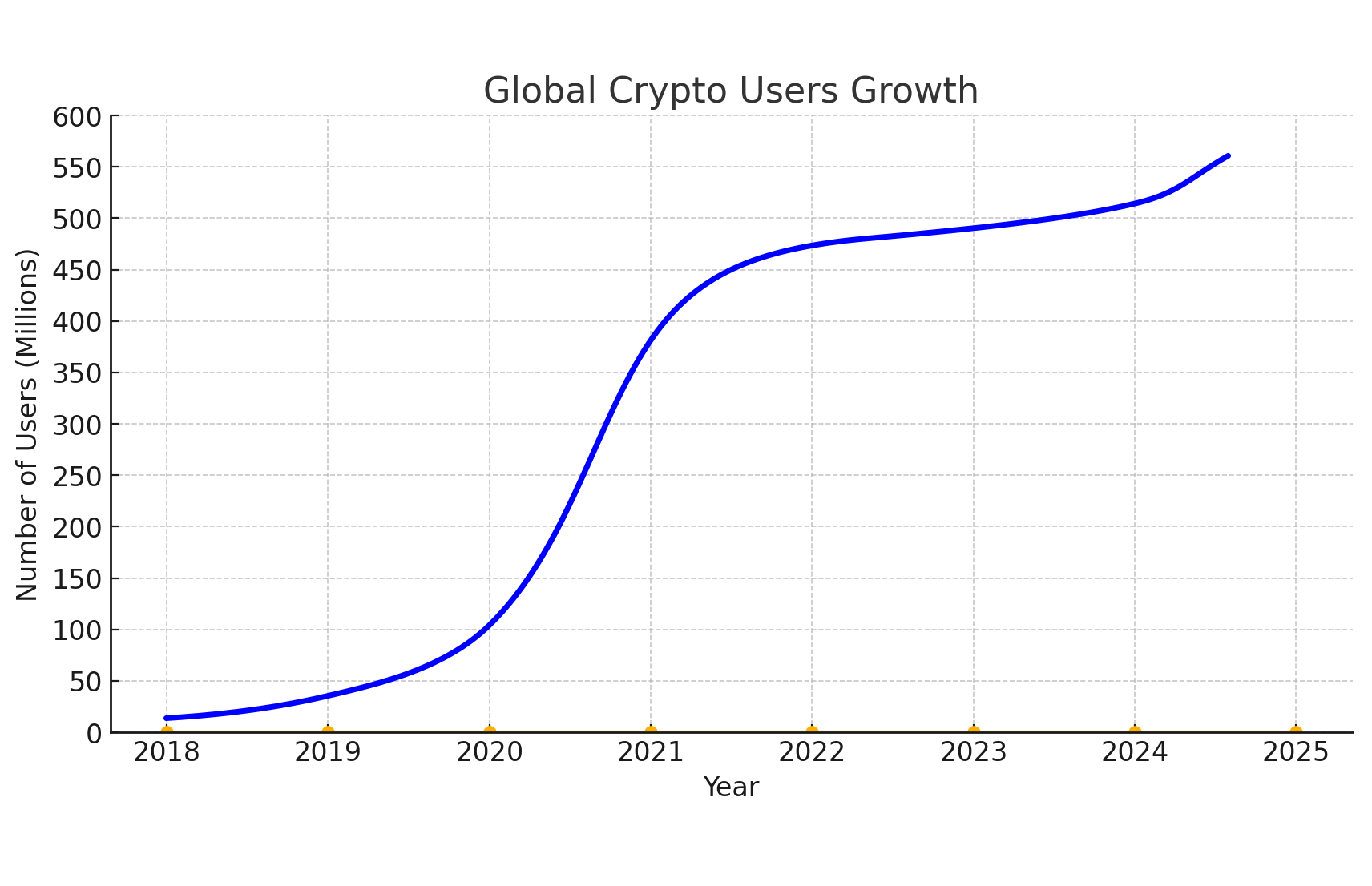
Global Web3 User Growth Chart, Data Source: Triple-A, https://www.triple-a.io/cryptocurrency-ownership-data
From a first-principles perspective, the fundamental reason behind this gap is clear: now is precisely the moment to make Mass Adoption an explicit priority in development efforts.
2. Barriers to Achieving Mass Adoption in Web3
A16Z emphasized in its "Big Ideas in Tech 2024" report that simplifying user experience is foundational for Web3 to achieve Mass Adoption.
Binance, in its "Road to One Billion On-chain Users" report, pointed out two core conditions necessary for Mass Adoption: (1) there must be on-chain applications users want to use; and (2) these applications must be easy to understand and access. Many products that achieved Product-Market Fit (PMF) and successfully weathered market cycles validate these two critical conditions. Additionally, the crypto industry needs to build essential infrastructure, tools, and public awareness so that the concept of “digital ownership” becomes accessible and understandable to global society.
Mark Suster, Managing Partner at Los Angeles-based venture firm Upfront Ventures, noted that building Mass Adoption products requires not only PMF but also a business model capable of generating sustained profits and targeting a sufficiently large market.
Mass Adoption isn’t just about acquiring users—it’s about capturing the liquidity they hold.
IOBC Capital believes that solving compliance pathways for traditional institutions entering Web3 is another key to Mass Adoption. Compliance is considered soft infrastructure. With the approval of BTC/ETH ETFs, BlackRock launching its RWA fund, and U.S. presidential candidates including Web3 development in their campaign platforms, regulatory progress and compliant channels are advancing steadily and irreversibly.
In summary, achieving Mass Adoption in Web3 requires meeting the following conditions:
1. Addressing a genuine real-world need (i.e., achieving PMF);
2. Targeting a market of at least hundreds of millions or billions of people, or worth tens of billions of dollars;
3. Low user adoption barriers and high product usability;
4. Mature upstream and downstream supply chains and infrastructure supporting the product’s core value and user experience;
5. Capable of large-scale, precise user acquisition;
6. Possessing a long-term sustainable business model.
We observe that Conditions 1–4 have seen continuous investment and improvement across various Web3 projects. Telegram and TON offer advantages for Condition 5. Yet Condition 6 remains largely unaddressed. The underlying logic here includes:
-
PMF ≠ Business Model—great products don’t automatically generate revenue
-
Without sustainable profitability, it's difficult to maintain long-term, large-scale, and precise user acquisition. While airdrops can drive low-cost explosive growth initially, if projects cannot sustainably earn revenue, who will continuously pay for the distributed tokens?
Looking back at the previous cycle, DeFi, GameFi, NFTs, and the metaverse all provided strong momentum toward Mass Adoption, each satisfying multiple criteria above. Axie Infinity and YGG addressed income challenges for unemployed populations in the Philippines during the pandemic; STEPN aligned with users’ fitness needs while lowering entry barriers via built-in wallets. Despite such notable successes, many of these projects ultimately failed to sustain Mass Adoption due to unsustainable business models. Non-financial reward-based products struggled to convince users to pay, highlighting crucial lessons learned.
3. TON Ecosystem’s Advantages and Challenges in Achieving Mass Adoption
3.1 Advantages
Leveraging a 1-billion-user social viral network—enabling massive user acquisition
To date, Telegram has reached 950 million monthly active users, offering vast potential for social virality marketing. Word-of-mouth (WOM) marketing remains one of the most efficient methods for mass user acquisition, which is a critical prerequisite for Mass Adoption.
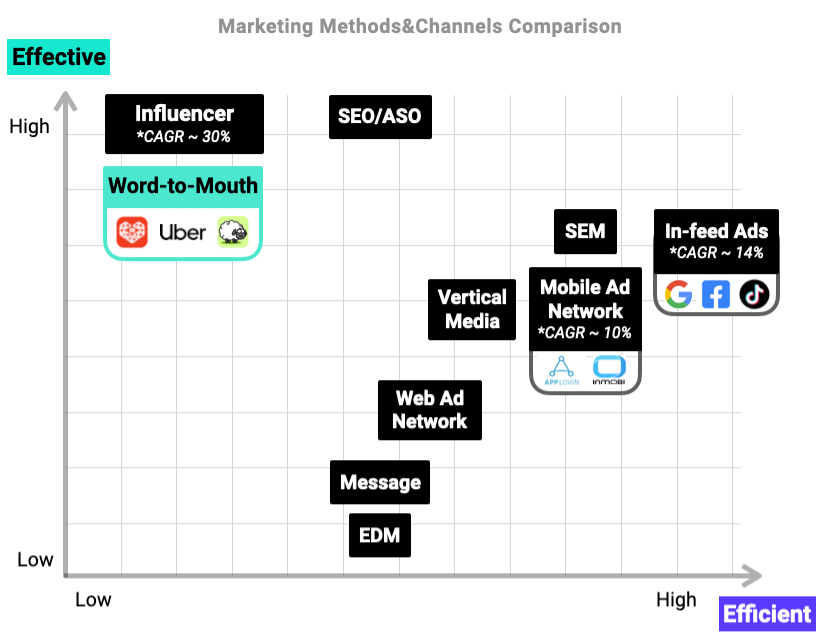
Comparison of Marketing Methods and Channel Effectiveness in the Web2 Era, Data Source: Miniton
Leveraging this strength, the TON ecosystem has already nurtured several projects with tens of millions of users, 60% of which are games. Notcoin led the way, attracting over 35 million crypto users since launch. Its token $NOT went from launch to exchange listing in less than a month and surged 400% within two weeks, becoming one of the few standout altcoins in this bull cycle.
Attracting developers through mini-program frameworks—maximizing coverage of end-user needs (PMF)
For ecosystems and infrastructure, achieving PMF is probabilistic—increasing the number of products increases the likelihood that one will meet user demand. Clearly, the combination of Telegram mini-programs and the TON ecosystem attracts a large number of developers creating diverse mini-apps aiming to fulfill various user needs.
The incentive for developers to join Telegram and TON is straightforward: massive user bases, coupled with high conversion rates from exposure to app usage. Mini-programs provide the shortest possible access path—no URL input, no downloads, instant use upon clicking. This not only lowers user barriers but also improves user acquisition conversion rates.
Banana Gun, a Telegram bot launched on Binance on July 18, 2024, enables both automated and manual trading on Ethereum and supports manual buying/selling of tokens on Solana. Banana Gun’s success clearly benefits from Telegram’s bot and mini-program support, along with its advantage in reaching users directly within Telegram.
Highly integrated MPC wallet—low barrier, high usability
TON currently offers two wallet tools: Telegram Wallet and TON Space. Except for users in the United States, others can activate Telegram Wallet by adding the wallet bot and then launch TON Space within the Telegram Wallet mini-program. For transactions inside the Telegram app—from registration and account setup to transfers and payments—Telegram Wallet delivers the most seamless user experience available today, comparable to WeChat Pay.
Thanks to TON’s low-barrier wallet solution, Catizen achieved a 10% on-chain user conversion rate, amassing 25 million players, approximately 1.5 million on-chain gamers, and over 500,000 paying users globally, generating over $16 million in in-game revenue.
On July 23, Binance Labs announced an investment in Pluto Studio, the publishing platform behind Catizen. He Yi, Co-founder of Binance and Head of Binance Labs, stated: “Binance Labs has always been enthusiastic about supporting projects like Pluto Studio that have the potential to bring billions of users into Web3. We look forward to backing more visionary builders focused on creating products designed for Mass Adoption.”
3.2 Challenges
Overreliance on Telegram
The biggest advantage of the TON ecosystem lies in exclusive official support from Telegram—the only Web3 infrastructure integrated and promoted within Telegram. However, this also represents its greatest risk. Any change at Telegram could systematically impact TON. For example, when Telegram founder Pavel Durov was arrested, TON’s TVL dropped over 60% in a single day, underscoring the systemic risks associated with dependence on a centralized entity.
Underdeveloped DeFi Sector
While users represent the foundation of capital, not every product or team can effectively monetize traffic. The current issue of limited spending power among Telegram users is not necessarily an ecosystem-wide problem but rather stems from product design and team execution. For instance, Catizen and many trading bots/miniprograms have successfully captured liquidity behind Telegram traffic. Moreover, in highly profitable Web2 WeChat mini-games, around 60% of traffic originates from decentralized product virality. Nevertheless, TON’s TVL remains disproportionately small, primarily due to a lack of DeFi projects. Currently, STON.fi and DeDust account for 80% of TON’s total TVL.
Inadequate Commercialization Infrastructure
Developers typically focus on four aspects when evaluating an ecosystem:
1. Platform scale
2. Completeness of infrastructure
3. Efficiency in reaching users
4. Support for monetizing traffic
Points 3 and 4 fall under commercialization services/infrastucture. In both areas, TON has only achieved about 50% maturity.
In terms of user reach, TON enables large-scale, efficient access. Current user acquisition in the TON ecosystem relies mainly on non-performance-based CPM advertising via Telegram Ads and cross-promotion积分walls between mini-programs, aside from sharing/viral models. However, due to data privacy policies, targeted and performance-driven marketing remains impossible unless Telegram compromises its core principle of user privacy by collecting extensive personal data.
Regarding monetization, TON provides excellent payment tools—including Web3 solutions like Telegram Wallet and TON Space, and Web2 solutions like Telegram Stars. However, most user-demanded products—such as free utilities and casual games—are unsuitable for direct monetization. These free offerings often struggle to establish stable, reliable business models, a prerequisite for achieving Mass Adoption. Thus, shortcomings in commercialization services appear to be the final ambiguous obstacle preventing Mass Adoption in the TON ecosystem.
Nonetheless, there are active participants addressing this issue. MiniTon, funded by the TON Foundation, is a commercialization service provider offering a TaaS (Tournaments as a Service) revenue model for casual and competitive game developers. This helps them move beyond reliance on ad-only monetization. Modeled after Friend Tech protocol, MiniTon restructures game social operations to build sustainable Web3 business models.
Tournament-based monetization (EF & RK) stands alongside advertising (IAA) and in-app purchases (IAP) as one of the three major game monetization models. It is widely used in PvP games such as card and board games, which command an annual market exceeding $30 billion in Web2 and remain top-selling categories in social apps—often credited as drivers of Mass Adoption in Web2. By leveraging cryptographic technology, MiniTon seamlessly integrates tournament monetization with Telegram while optimizing operational models for the over-$30-billion PvP gaming market using crypto-native social protocols.
MiniTon received significant investment and incubation support from Waterdrip Capital from its early stages. Today, MiniTon offers a social competition platform where players can enjoy esports-like experiences even in single-player casual games through battle contracts, forming new social connections. Developers can integrate MiniTon’s monetization solution via SDK in just 1.5 days.
To date, MiniTon has completed Alpha I closed testing with 30,000 participants and achieved a 1% paying user conversion rate. It plans to launch Alpha II by the end of September, expanding the test to hundreds of thousands of users.
Notably, MiniTon’s game contract is a multi-chain protocol, not fully dependent on any single ecosystem, giving it strong resilience against systemic risks.
4. How Much Can the TON Ecosystem Learn from WeChat’s Successes and Failures?
4.1 Is WeChat a Valid Reference Point?
Like Telegram, WeChat is a social product built on communication and social relationships. However, Telegram and WeChat users differ significantly. Below is third-party monitored data reflecting Telegram’s user metrics over the past week:
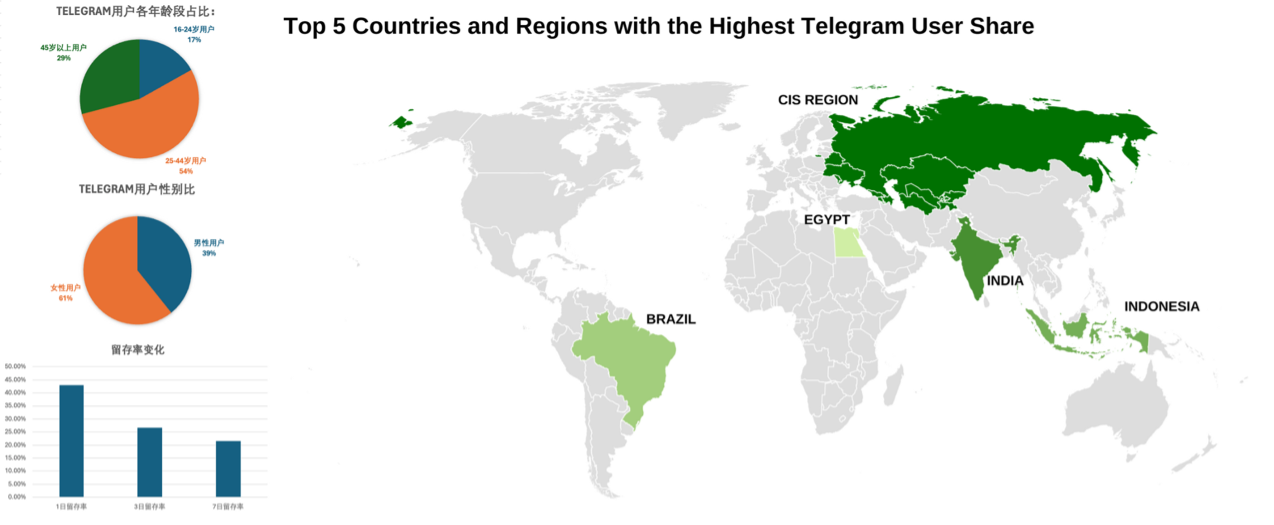
Telegram User Overview, Data Source: Waterdrip Capital
4.2 Differences in User Profiles Between Telegram and WeChat
Beyond geographic distribution differences, the most significant distinction lies in user behavior:
-
WeChat is a classic close-contact social app based on strong social ties, whereas Telegram supports broader, looser social interactions—more akin to QQ.
-
Average daily time spent per user is 1.5 hours on WeChat versus 0.5 hours on Telegram.
As of June 2024, WeChat mini-programs reached a staggering 930 million monthly active users, with penetration exceeding 90%. Combined with mature commercialization infrastructure, this makes user acquisition and monetization highly effective—the core reasons why developers succeed in the WeChat mini-program ecosystem:
1. Ultra-lightweight user access: no download or URL entry required, instant use upon click
2. Effective social-relation-based user acquisition: ~60% of traffic comes from user sharing
3. Access to new incremental markets: As of February 2024, WeChat mini-games had 755 million MAUs—surpassing mobile game apps’ 650 million
4. Efficient commercialization system: Powered by WeChat Ads and WeChat Pay, mini-game revenues reached $3 billion in 2023
Telegram mini-programs already possess the first three advantages listed above. Compared to WeChat, Telegram’s shortcomings are evident:
1. Weak user spending power: Majority of users come from regions with low purchasing power;
2. Inability to target precisely: Privacy principles prevent ad targeting capabilities similar to WeChat Ads, making it hard to reach high-value or specific audience segments;
3. Low payment penetration: Telegram Wallet penetration is only 5%, compared to WeChat Pay’s 92.4%.
Nevertheless, Telegram remains the most penetrated product within the crypto space. Targeting existing high-net-worth crypto users may help offset current weaknesses in the Telegram mini-program ecosystem. Therefore, WeChat’s success model is absolutely worth referencing.
4.3 Project Development Pathways Inspired by the WeChat Mini-Program / Mini-Game Ecosystem
By analyzing the evolution of WeChat’s mini-game ecosystem, we find developer survival heavily depended on the level of support provided by WeChat’s official developer services.
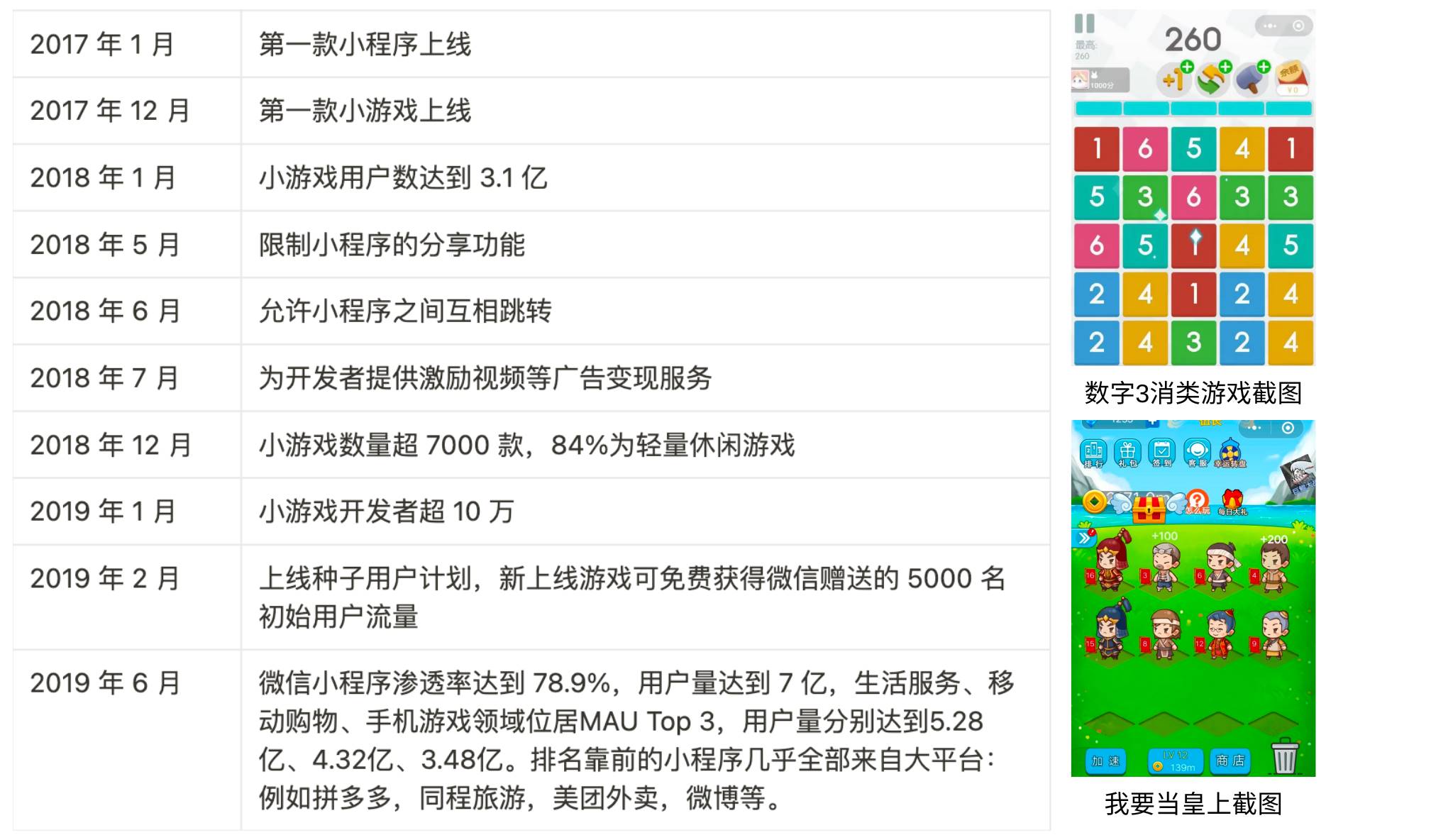
Timeline of WeChat Mini-Program Development and Key Projects, Source: Waterdrip Capital
Period of Unregulated Growth in WeChat Mini-Programs
During this phase, WeChat’s operations lagged, leading to uncontrolled ecosystem expansion. Viral sharing enabled rapid user acquisition, resulting in many “reskin” games being developed in five days and recouping costs within three days of launch—leading to generally low-quality games.
Mini-game distribution was decentralized, relying primarily on referrals from other mini-programs and WeChat Ads.
Revenue for mini-games and free mini-programs came mostly from ad monetization (IAA), either by referring users to other games/apps or integrating WeChat’s ad plugins.
A key takeaway for Web3 developers: Telegram is currently in a similar stage. Excluding the breakout hit “Pirate Came,” 98% of the Top 50 games during this period were casual or casual competitive titles—such as “Happy Landlord,” “Number Match Puzzle,” “Brain Battle,” “Geometry Escape,” and “I Want to Be Emperor.” Notably, “I Want to Be Emperor” shares gameplay mechanics similar to today’s Catizen.
2020–2022: Ecosystem Adjustment Phase
This period coincided with the pandemic, introducing macro-specific dynamics—e.g., health code mini-programs reached 800 million users by 2020.
By October 2022, WeChat mini-programs reached 1 billion MAUs. The ecosystem simultaneously expanded into traditional sectors like education, healthcare, and food services, while guiding game developers to improve quality. WeChat provided developers with over 100 new features and APIs, continuously enhancing its IAA and IAP monetization services.
During this time, the only breakout hit was “Sheep Meets Wolf.” Due to stricter content quality standards and restrictions on viral sharing behaviors, WeChat mini-games exhibited a “smile curve” in user engagement. Ultimately, however, WeChat’s strategy proved successful: among curated games, 50 earned over $50 million, and 7 surpassed $100 million in revenue.
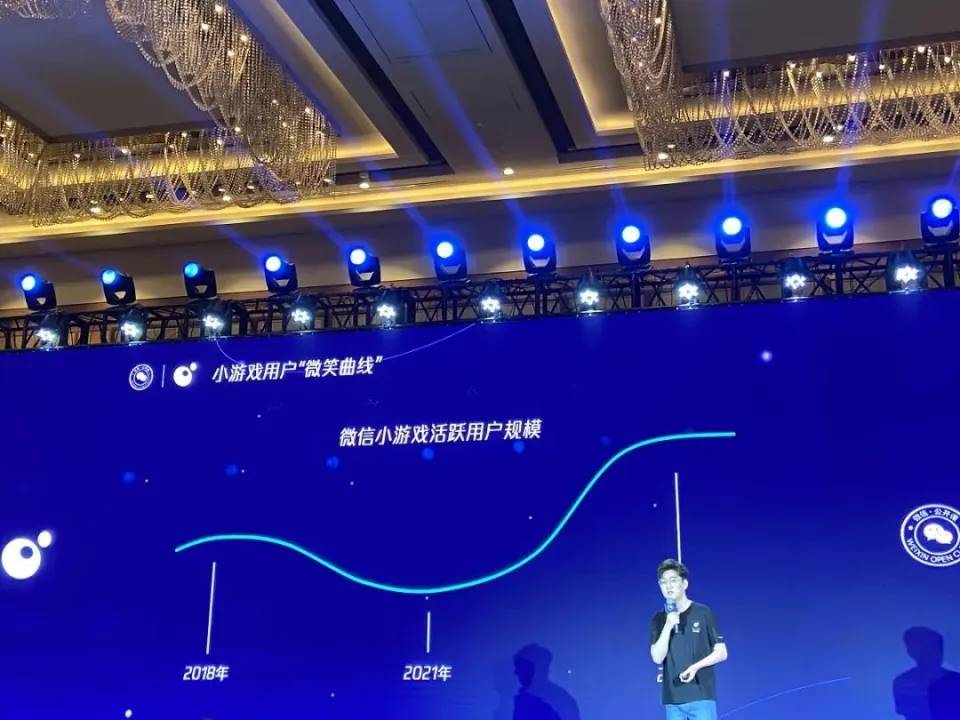
"Smile Curve" of WeChat Mini-Game User Engagement, Source: Waterdrip Capital
Key insight for Web3 developers: Top-performing games remained casual competitive genres like card and board games. From a gameplay standpoint, card games, MMORPGs, management sims, and idle games generated the highest revenues.
2023–Present: Stable Growth Followed by Explosive Expansion
Thanks to WeChat’s ongoing encouragement of high-quality content and continuous technical upgrades for mini-games, mid-to-heavyweight, high-revenue games began emerging in large numbers.
According to Tencent’s Q1 2024 earnings report, total user time spent on WeChat mini-programs increased over 20% year-on-year. In 2023, WeChat mini-game revenues tripled compared to 2022, with over 240 games achieving quarterly revenues exceeding 10 million RMB.
Reasons for this surge:
-
Allowing mini-games and mini-programs to advertise on external platforms (e.g., Douyin), improving ad efficiency;
-
Adding live-streaming as a new user acquisition channel;
-
Top-selling game genres shifting from predominantly card/board games to MMORPGs, idle, card, and simulation games;
-
Monetization evolving from单一 IAA or IAP models to hybrid approaches combining both.
4.4 Lessons TON Can Draw from WeChat Mini-Program Evolution
-
Continuously address developer concerns (PMF), such as improving game engine compatibility, increasing user acquisition efficiency, opening performance-based marketing channels outside Telegram for Telegram mini-programs, boosting wallet penetration, and strengthening support for monetization solutions;
-
Maintain agility and responsiveness akin to WeChat, which frequently adjusted its ecosystem policies (sometimes multiple times per month) in its early days;
-
Provide maximum support for early-stage products—for example, offering dedicated, free traffic incentives for each mini-program (comparable to WeChat’s curation programs);
-
Encourage the creation of high-quality content within the ecosystem.
Join TechFlow official community to stay tuned
Telegram:https://t.me/TechFlowDaily
X (Twitter):https://x.com/TechFlowPost
X (Twitter) EN:https://x.com/BlockFlow_News
 Waterdrip Capital


