Understanding the New Proposal ACP-77: How to Unlock Avalanche L1?
TechFlow Selected TechFlow Selected
Understanding the New Proposal ACP-77: How to Unlock Avalanche L1?
ACP-77 is a community proposal that would completely overhaul the design for creating and managing Avalanche L1s.
 Navigating Web3 tides with focused insights
By: Eden Au, The Block
Translation: Felix, PANews
Key Takeaways:
-
ACP-77 is a community proposal that will transform validator dynamics for Avalanche Layer 1s (formerly known as subnets).
-
Avalanche L1 validators will no longer be required to validate the mainnet or stake at least 2,000 AVAX. Instead, they will follow requirements set by their respective sovereign Avalanche L1.
-
Avalanche L1 validators will pay ongoing dynamic fees to register information on the P-Chain.
-
The proposal benefits both institutional and retail-focused Avalanche L1s by enabling regulatory compliance and lowering validator entry barriers.
Avalanche has long championed horizontal scaling through "subnets," now rebranded as Avalanche Layer 1s (L1s). Avalanche L1s are sovereign, often application-specific blockchains customizable to meet the unique needs of various use cases.
This infrastructure has attracted numerous crypto-native and institutional clients to host their Web3 platforms on Avalanche L1s, including Konami, the Japanese gaming giant’s NFT platform, and Intain’s security tokenization platform.
Over the years, Avalanche L1s have undergone multiple upgrades to enhance functionality. For example, the Banff upgrade enabled cross-subnet communication via Avalanche Warp Messaging (AWM). Meanwhile, Evergreen introduced a framework for enterprises to launch privacy-preserving, compliant, permissioned Avalanche L1s.
Nonetheless, existing Avalanche L1 validation requirements still present high entry barriers. Currently, Avalanche L1 validators must simultaneously validate Avalanche’s mainnet—comprising the Contract Chain (C-Chain), Platform Chain (P-Chain), and Exchange Chain (X-Chain).
For reference, mainnet validators must allocate at least 8 AWS vCPUs, 16 GB RAM, and 1 TB of storage for network validation, along with a minimum stake of 2,000 AVAX.
At the network’s inception, this staking requirement was modest. However, due to significant token appreciation over the years—peaking above $250,000 during previous market highs—the current value stands at approximately $41,000. These high total operating costs hinder decentralization of the Avalanche L1 validator set and could impair the reliability and adoption of the Avalanche ecosystem in the long run.
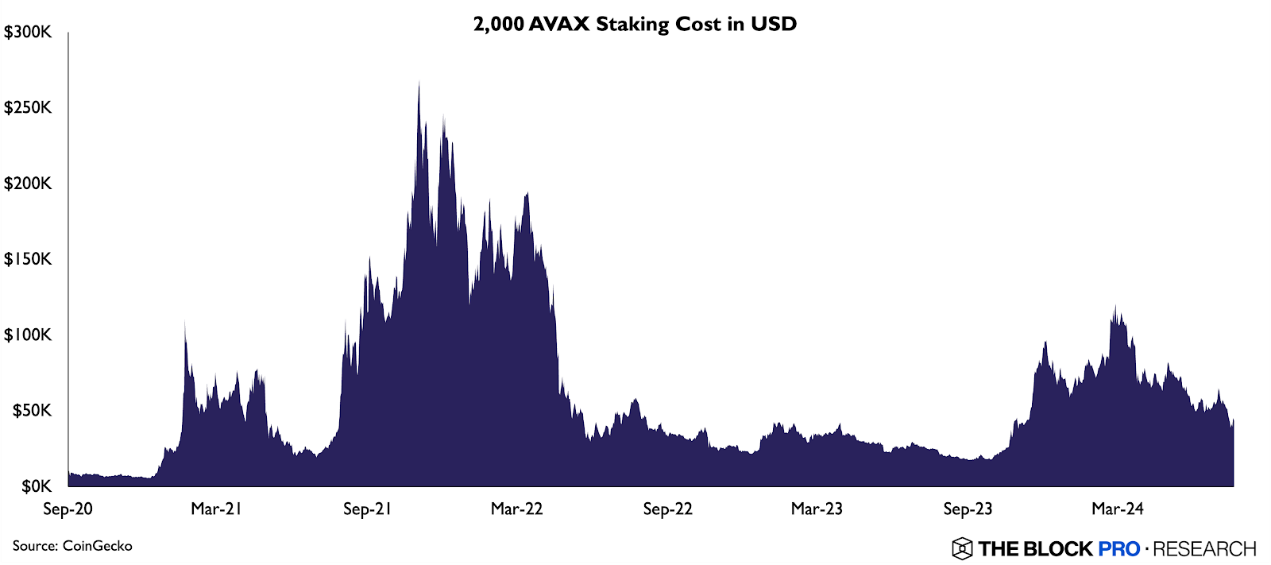
Cost of staking AVAX (in USD)
ACP-77
ACP-77 is a community proposal that will fundamentally reshape the design of creating and managing Avalanche L1s, granting greater flexibility and autonomy to Avalanche L1 validators.
Sovereignty
Under the proposal, Avalanche L1 validators will no longer need to validate the mainnet. They will only need to sync with the P-Chain, which tracks changes in their own Avalanche L1 validator set and handles cross-L1 communication via AWM. This change significantly reduces both operational and staking costs for participating in Avalanche L1 validation.
This separation will also allow regulated entities to validate only their permitted Avalanche L1s, as they can now choose not to validate the permissionless mainnet, which may include transactions deemed potentially high-risk or non-compliant from their perspective.
Furthermore, Avalanche L1s will be able to define and enforce their own validation rules and staking requirements. The P-Chain will no longer manage staking reward distribution for Avalanche L1s. In other words, sovereignty shifts back from the P-Chain to the individual L1 itself—marking a milestone toward horizontal scaling with multiple sovereign blockchains running in parallel.
Dynamic Fees
On the other hand, the proposal shifts the P-Chain’s fee mechanism from a fixed per-transaction model to a dynamic one better aligned with user-pays principles. This change aims to ensure long-term economic sustainability after removing the 2,000 AVAX staking requirement.
The new dynamic fee mechanism requires Avalanche L1 validators to make continuous payments based on several factors, such as the total number of Avalanche L1 validators registered on the P-Chain. Fees will adjust according to network utilization: increasing when the total number of validators exceeds the target threshold, and decreasing otherwise.
The rationale is that each additional Avalanche L1 validator adds load to the P-Chain, which is responsible for storing critical validator metadata in memory—such as IP addresses and BLS keys.
In practice, an Avalanche L1 validator’s balance on the P-Chain will gradually deplete and require periodic top-ups to maintain uninterrupted operation. This approach lowers entry barriers by reducing upfront staking and hardware costs, while ensuring ongoing contributions to network sustainability.
Conclusion
In short, ACP-77 aims to redesign the relationship between Avalanche L1s and the mainnet. Specifically, Avalanche L1s will gain greater flexibility and sovereignty, as validators will no longer need to comply with stringent mainnet validator requirements—such as the 2,000 AVAX minimum stake—significantly reducing operational costs for Avalanche L1 validators.
Avalanche L1 validators will pay dynamic fees to the P-Chain to continuously store essential metadata used for communication purposes. This ensures the mainnet is fairly compensated for its critical role in supporting every Avalanche L1 validator, each Avalanche L1, and cross-L1 communication.
The proposal will make it easier for institutional L1s to achieve regulatory compliance, while retail-centric L1s benefit from a more decentralized validator set. These advantages will foster a larger, more diverse Avalanche ecosystem and expand the scale of the blockchain landscape.
Join TechFlow official community to stay tuned
Telegram:https://t.me/TechFlowDaily
X (Twitter):https://x.com/TechFlowPost
X (Twitter) EN:https://x.com/BlockFlow_News
 The Block