Interpreting Solana's First AI Sidechain HajimeAI: Democratizing AI through a Decentralized Multi-Agent Graph
TechFlow Selected TechFlow Selected
Interpreting Solana's First AI Sidechain HajimeAI: Democratizing AI through a Decentralized Multi-Agent Graph
HajimeAI's mission is clear: to combine the strengths of Web3 and AI, creating a complete business loop and ecosystem for AI Agents.
 Navigating Web3 tides with focused insights
Author: Block unicorn
Artificial intelligence (AI) is leading us into the Fourth Industrial Revolution, ushering in a new era of human development. While industry giants such as OpenAI's ChatGPT, Meta's Llama, and Google's Gemini have delivered impressive AI achievements and driven the global AI wave, one critical challenge remains: How can we democratize AI and accelerate its adoption? The answer lies in AI Agents.
An AI Agent is a pioneer in the field of artificial intelligence—a sophisticated software built upon advanced large language models (LLMs) capable of handling diverse real-world tasks. For example, these agents can autonomously or semi-autonomously perform operations ranging from scheduling appointments to providing customer support.
Since the launch of Stanford’s AI Virtual Village and MIT’s AI Town, AI Agents have increasingly emerged as the vehicle through which AI enters everyday households. In the future, each of us may own numerous AI Agents serving our needs—just as people today have many mobile apps on their smartphones. However, for AI Agents to truly replace clunky mobile applications, we must overcome several significant barriers:
- Currently, most AI Agents operate in silos, lacking effective collaboration mechanisms among multiple agents required by users and enterprises, making it difficult to meet complex scenario demands.
- Many emerging AI Agent projects struggle with fundraising, failing to achieve timely product-market fit. This is especially evident today, as the AI industry focuses on large-model competitions dominated by tech giants, leaving many promising niche-focused AI products under-recognized.
- Top-tier AI Agents often rely on proprietary expertise and private data, making them hesitant to join or initiate multi-agent networks based on Web2 centralized architectures.
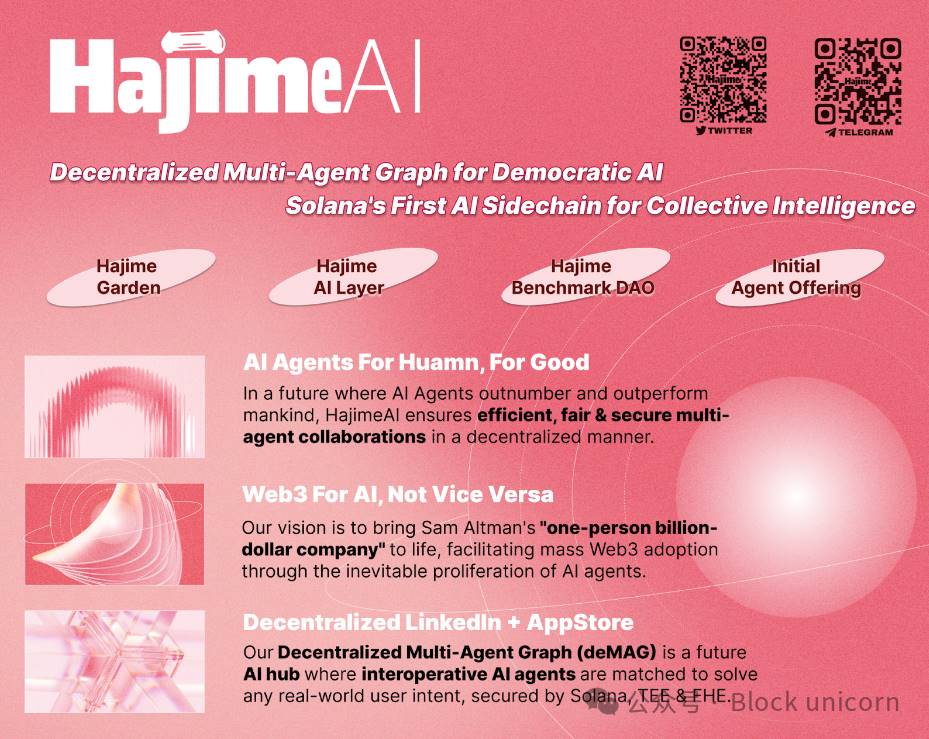
This year, HajimeAI—the award-winning project at Solana Renaissance Hackathon—is leveraging crypto-native technology to directly address these challenges, bringing a Web3 paradigm to advance the development of AI Agents. Inspired by OpenAI CEO Sam Altman’s vision of “one person building a billion-dollar company,” the HajimeAI team is committed to shaping a decentralized future where collaborative AI Agents form a decentralized Multi-Agent Graph (deMAG), satisfying real-world user intent.
HajimeAI’s underlying architecture is an AI-functional extension layer on the Solana L1 blockchain. As the first scaling solution on Solana specifically designed for multi-agent collaboration graphs, HajimeAI offers more than just Hajime AI Layer—the first Solana sidechain optimized for AI operations. It also serves as a powerful computational engine for multi-agent workflows, capable of meeting the massive processing demands expected from an explosion of future multi-agent solutions.
Leveraging Solana’s robust security, HajimeAI enables anyone to issue on-chain AI Agent assets and grow their user base through abundant liquidity on Solana’s mainnet. HajimeAI aims to diversify the Solana ecosystem and prepare for the upcoming wave of mass Web3 adoption driven by AI Agents.
HajimeAI has a clear mission: combining the strengths of Web3 and AI to create a complete commercial loop and ecosystem for AI Agents. According to official analysis, the project consists primarily of the following components:
Hajime Benchmark DAO
Hajime Benchmark DAO is an open, contribution-based Decentralized Autonomous Organization (DAO) and one of HajimeAI’s core features. The DAO evaluates AI Agents and scores them across key dimensions, forming the Web3 space’s only decentralized AI Agent leaderboard, enabling anyone to easily discover the most suitable AI Agents.
Members of Hajime Benchmark DAO are incentivized through external revenue sharing, HajimeAI token distributions, and protocol revenue shares. HajimeAI plans to gradually expand the DAO’s scope—from Solana to key Web2 institutions such as major AI players, universities, and industry associations.
Hajime Garden
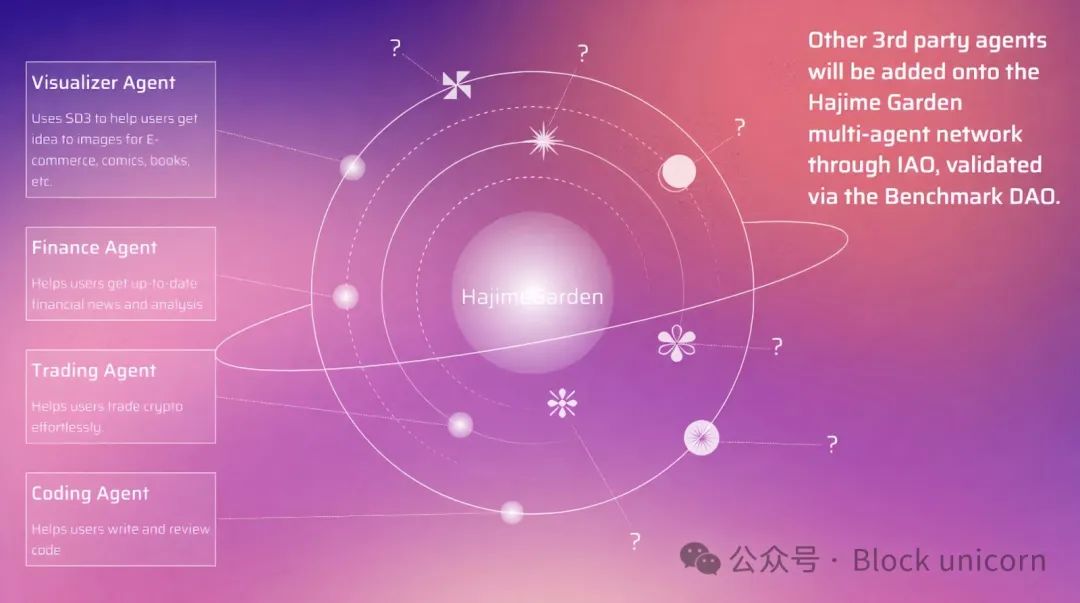
Hajime Garden is a curated collection of AI Agents evaluated by Hajime Benchmark DAO, including well-known external Web2 and Web3 AI Agents such as:
- Search engine Perplexity
- Twitter Personality AI Agent—built on Wordware for scoring and matching Twitter accounts
- Chat companions from Character AI
- Sahara AI’s upcoming personalized data sovereignty agent, and
- On-chain AI Agents launched via HajimeAI’s Initial Agent Offering (IAO)
The IAO represents the true convergence point between AI and Web3, solving real-world challenges. HajimeAI’s IAO is essentially permissionless, allowing AI Agent developers to instantly mint assets on the Solana mainnet, following a Solana Improvement and Modification Document (SIMD) tailored specifically for AI.
While IAO is permissionless, only select high-quality AI Agents receive evaluation from Hajime Benchmark DAO, gaining initial user feedback, product insights, and placement on the Hajime Benchmark DAO AI Agent leaderboard to facilitate effective cold starts.
deMAG
The AI Agents within Hajime Garden are orchestrated, scheduled, and managed by HajimeAI’s self-developed decentralized Multi-Agent Graph (deMAG), centered around user intent. Powered by Hajime AI Layer, deMAG accepts any user intent and breaks it down into subtasks that individual AI Agents in Hajime Garden can autonomously complete.
Hajime AI Layer
Hajime AI Layer (HAL) is Solana’s first AI-dedicated sidechain, with deMAG running as its sole application layer. HAL aims to provide a more AI-friendly environment while inheriting most of Solana’s security, liquidity, and composability. Supported by a consensus mechanism specifically designed for AI workloads and integrating TEE (Trusted Execution Environment) and FHE (Fully Homomorphic Encryption), HAL delivers a fully open database and high-performance network for developers and users alike.
What makes HAL unique? Even excluding training, AI tasks like inference and orchestration still differ significantly in computational requirements from standard Web3 operations. Although Solana’s upcoming Firedancer upgrade will greatly enhance network performance, running AI Agents directly on Layer1 would impose intense computational pressure (e.g., spam attacks) on Solana. In contrast, HajimeAI stores its complex programs and data records off-chain in Merkle Trees, publishing only the Merkle Root on Solana.
HajimeAI plans to attract early adopters from the Solana Saga community through airdrops and lotteries, encouraging participation in Hajime Benchmark DAO and staking as PoS validators on Hajime AI Layer. Additionally, top contributors from leading and emerging Web3 AI projects will be invited to join HajimeAI’s early builder cohort, collectively strengthening Solana’s AI ecosystem.
Judging by the future blueprint HajimeAI is drawing, it is far more than just another “AI for Web3” startup. Rather, HajimeAI operates in the broader “Web3 for AI” category, leveraging Web3’s innovative mechanisms to nurture a new generation of on-chain AI Agents—enabling them to collaborate and interoperate in preparation for Solana’s flourishing AI Agent era.
HajimeAI’s mission aligns perfectly with Solana’s vision: by developing consumer-grade blockchain solutions optimized for AI, it promotes mass Web3 adoption and drives the next wave of AI application growth on Solana.
Join TechFlow official community to stay tuned
Telegram:https://t.me/TechFlowDaily
X (Twitter):https://x.com/TechFlowPost
X (Twitter) EN:https://x.com/BlockFlow_News
 @BlockUnicorn