








Analyst: Bitcoin may have another $5,000 downside in the short term
TechFlow Selected TechFlow Selected
Analyst: Bitcoin may have another $5,000 downside in the short term
Analysts believe the possibility of Bitcoin falling $5,000 is greater than rising $5,000.
 Navigating Web3 tides with focused insights
By Mary Liu, TechFlow
Financial markets reacted positively on Tuesday to the release of July's Producer Price Index (PPI) report, with both cryptocurrencies and U.S. stocks rising as PPI data showed continued cooling in U.S. inflation.
U.S. equities opened higher and maintained gains throughout the session, closing up across the board—S&P 500 rose 1.68%, Dow Jones climbed 1.04%, and Nasdaq advanced 2.43%.
According to TechFlow data, bullish momentum pushed Bitcoin to a daily high of $61,630 but met resistance on the upside. At the time of writing, Bitcoin was trading at $60,644, up 2.74% over the past 24 hours.
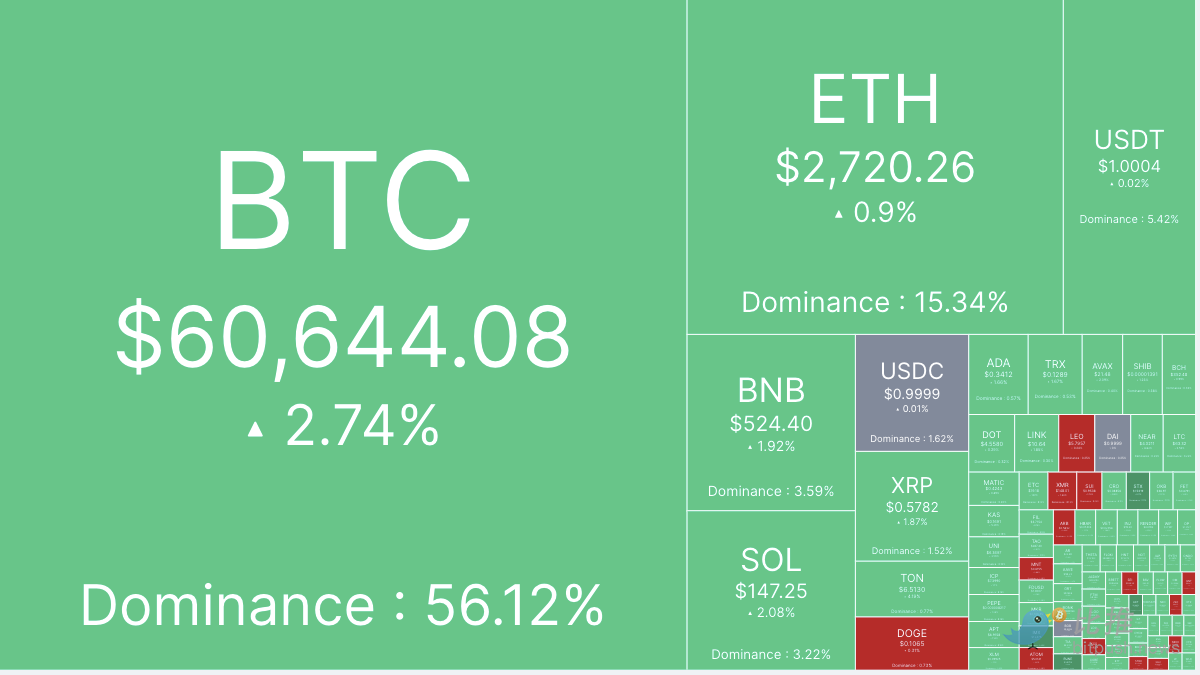
On Tuesday, the majority of the top 200 market-cap tokens posted gains. GMX led the rally with a surge of 13.2%, followed by THORChain (RUNE) up 12.2%, and Stacks (STX) rising 11.1%. Convex Finance (CVX) saw the largest decline, dropping 6%, while Sui (SUI) fell 5.7% and Threshold (T) declined 3.1%.
The overall cryptocurrency market cap currently stands at $2.14 trillion, with Bitcoin’s market dominance at 56.12%.
Analyst: Downside Risk of $5,000 for Bitcoin More Likely Than Upside Rally
One analyst expects Bitcoin to potentially drop around $5,000 in the near term.
"Bitcoin is more likely to fall $5,000 than rise by the same amount," said Alex Kuptsikevich, senior market analyst at FxPro, in an email.
Kuptsikevich's bearish outlook stems from Bitcoin’s failure to sustain gains above $60,000 following a death cross—a bearish crossover between the 50-day and 200-day simple moving averages (SMA).
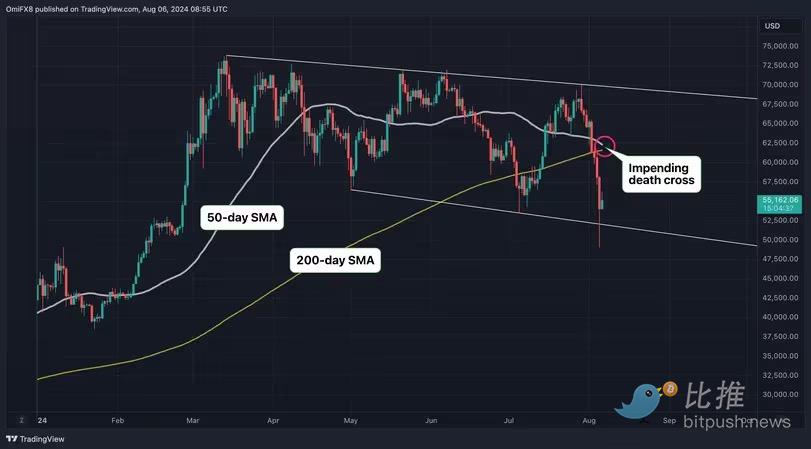
"Bitcoin attempted to break above the 50-day and 200-day moving averages late last week but failed to hold above $60,000 and faced selling pressure, indicating seller dominance," Kuptsikevich noted.
He added that the 14-day Relative Strength Index (RSI) no longer shows oversold conditions, suggesting further downside potential—consistent with recent seller control above $60,000.
The 14-day RSI is a momentum oscillator that measures the speed and magnitude of price changes. After the sharp drop last Monday, the RSI fell below 30, signaling oversold conditions typically associated with a pause in downtrends and potential rebounds.
"The daily RSI has moved out of the oversold zone and lost momentum for further upside," Kuptsikevich explained, reinforcing his bearish stance.
Bitcoin Lags Behind Gold in Performance
In recent weeks, there has been significant discussion comparing gold and Bitcoin as strategic reserve assets, largely driven by political uncertainty ahead of the U.S. election. While gold has long been viewed as a reliable store of value, Bitcoin has struggled to keep pace with gold’s recent rally.
"Bitcoin underperformed gold during the latest sell-off, instead moving in sync with tech stocks," wrote analysts at Kaiko. "The Bitcoin-to-gold ratio, which measures the relative performance of the two assets, dropped on August 5 to its lowest level since February, although it has recovered slightly since. A declining ratio indicates Bitcoin underperformance, and vice versa."
They questioned: "Does this recent underperformance suggest Bitcoin is losing its safe-haven appeal? While most ETF issuers position Bitcoin as a complement or alternative to gold, the two assets are driven by fundamentally different factors."
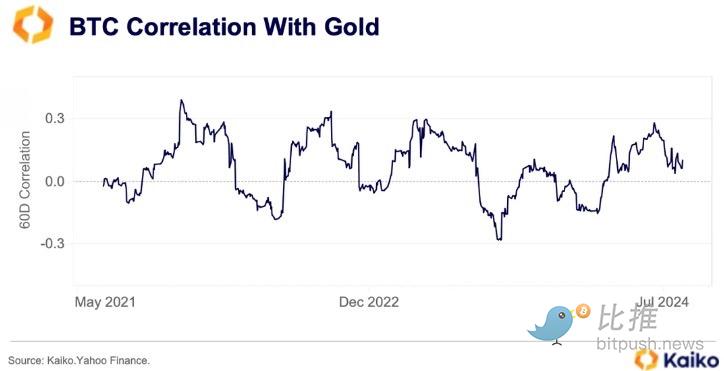
"This is evident in the 60-day correlation between Bitcoin and gold, which remains quite weak, fluctuating between -0.3 and 0.3 over the past two years. Bitcoin’s price is closely tied to U.S. markets and has benefited significantly from increased institutional adoption following the launch of spot ETFs in January."
Kaiko analysts added: "In contrast, gold has shown resilience amid global monetary tightening, supported by strong central bank demand. Central bank gold purchases doubled in 2022 and remained elevated throughout 2023."
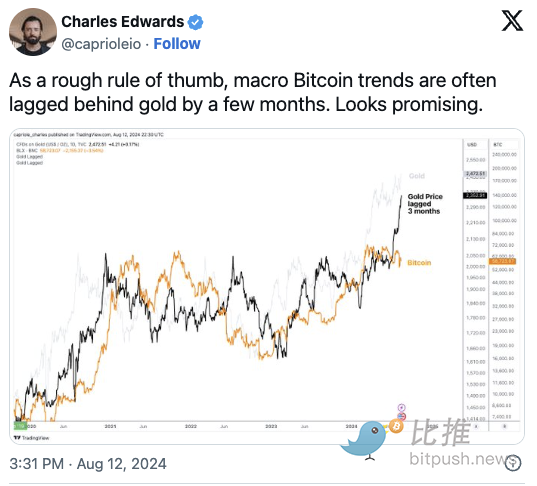
Charles Edwards, founder of Capriole Investments, suggested Bitcoin’s outlook may improve soon based on historical patterns relative to gold. As illustrated in a chart he provided overlaying XAU/USD and BTC/USD, Bitcoin tends to lag gold rallies by approximately three months.
William Clemente, co-founder of crypto research firm Reflexivity, echoed Edwards’ view by comparing Bitcoin’s post-BTC-ETF performance to gold’s trajectory after the launch of gold ETFs in 2004, noting that gold took 10–12 months before experiencing a significant rally.
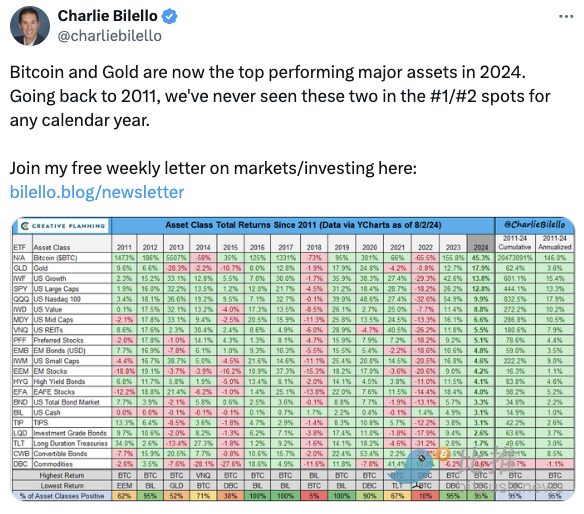
"Bitcoin and gold are now the top two performing major assets year-to-date in 2024. Looking back to 2011, we've never seen both assets rank first or second in any single year," tweeted Charlie Bilello, chief market strategist at wealth management firm Creative Planning.
Join TechFlow official community to stay tuned
Telegram:https://t.me/TechFlowDaily
X (Twitter):https://x.com/TechFlowPost
X (Twitter) EN:https://x.com/BlockFlow_News
 比推 BitpushNews











