








Bitwise: Learn from history, Bitcoin is an excellent long-term hedge tool
TechFlow Selected TechFlow Selected
Bitwise: Learn from history, Bitcoin is an excellent long-term hedge tool
When the stock market experiences a sell-off, Bitcoin is a better choice than gold for long-term investors.
 Navigating Web3 tides with focused insights
Author: Juan Leon, Senior Investment Strategist at Bitwise
Translation: Luffy, Foresight News
On August 5, global equities plunged into panic, with Japan's Nikkei index dropping 12%—its worst single-day decline since 1987—and the S&P 500 closing down 3%.
Unfortunately, Bitcoin was not immune, falling 14.52% between August 2 and August 5. This sharp correction sparked widespread media questions: Why did Bitcoin fail as a hedge? Is Bitcoin truly a hedging asset?
Out of curiosity, I decided to dive into historical data. I analyzed how Bitcoin and gold performed on days when the S&P 500 dropped more than 2% over the past decade. Then, based on each asset’s performance on those specific days, I categorized their returns into three groups:
-
Perfect hedge: the asset delivered positive returns;
-
Partial hedge: the asset posted negative returns but outperformed the S&P 500;
-
No hedge: the asset underperformed the S&P 500.
I found some insights more revealing than commonly reported.
Is Bitcoin a short-term hedge? No.
First, the bad news: the data shows that Bitcoin is an unreliable short-term hedge. In fact, its daily returns appear largely uncorrelated with stock market movements.
More than half the time (specifically 59%), it acted as a hedge—either rising significantly or falling less than equities on days when the S&P 500 sold off sharply. But during the remaining 41% of such days, Bitcoin declined more than the index.
Unfortunately, when stocks dropped 2% and Bitcoin performed poorly, its losses were severe, averaging a steep 7.80% decline.
This tells me that not all daily corrections are created equal. Of course, the reasons behind a 2% drop in stocks vary from day to day. The data suggests some triggers send Bitcoin sharply higher, while others drive it sharply lower.
If you're looking for a foolproof way to hedge against major equity pullbacks, Bitcoin is not the right choice.
Bitcoin’s performance as a hedging asset. Source: Bitwise Asset Management, Bloomberg. Data from January 1, 2014 to August 9, 2024.
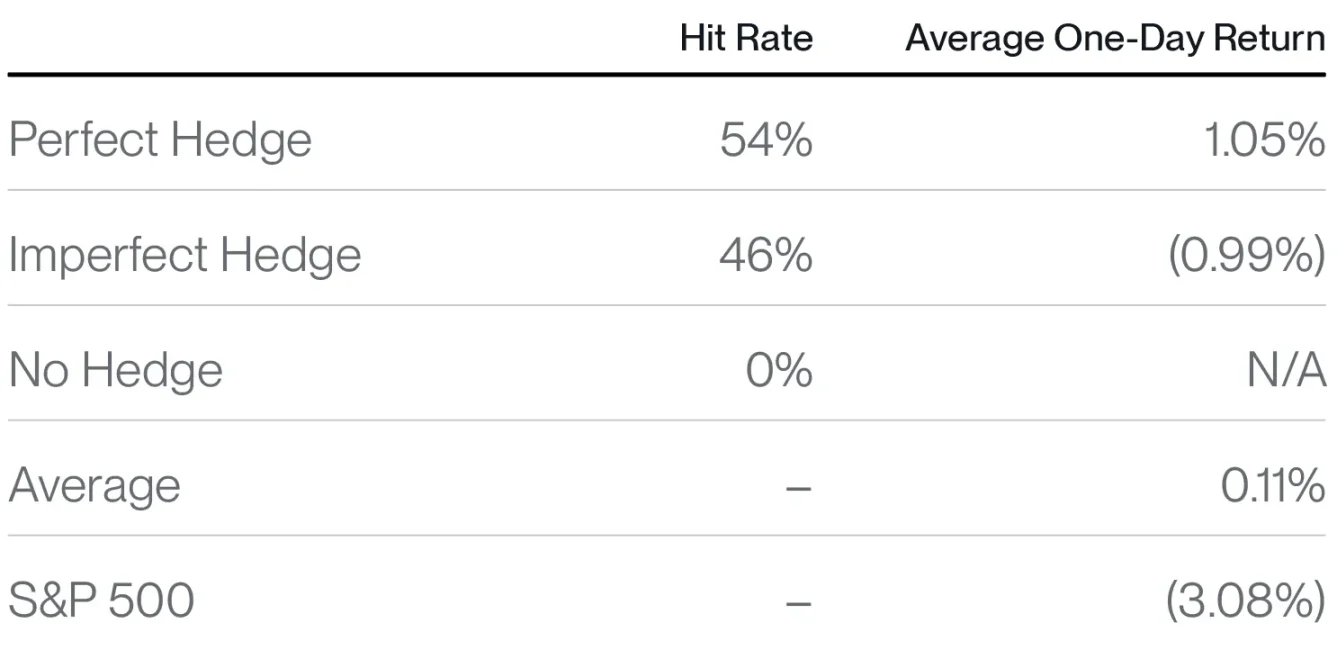
Gold’s performance as a hedging asset. Source: Bitwise Asset Management, Bloomberg. Data from January 1, 2014 to August 9, 2024.
Gold performs better. On 54% of the days when the S&P 500 fell sharply, gold generated positive returns. However, on average, gold only rose 1.05% on those days—making it challenging as an effective short-term hedge. You’d need to hold a large amount of gold for it to meaningfully impact your overall portfolio. If only 5% of your portfolio is in gold, a 1% gain won’t do much to offset a drawdown in a 60% equity allocation. For the remaining 46% of days, gold averaged a decline of 0.99%.
Luckily, most of us aren't investing for the short term—we’re long-term investors. So I wondered: How do these two assets perform as long-term hedges?
Is Bitcoin a long-term hedge? Absolutely.
The performance narratives of these two assets look completely different over longer horizons. One year after a day when the stock market dropped more than 2%, gold delivered an average return of 7.88%, far trailing the broader market rebound. In contrast, Bitcoin delivered an astonishing average return of 189.68%.
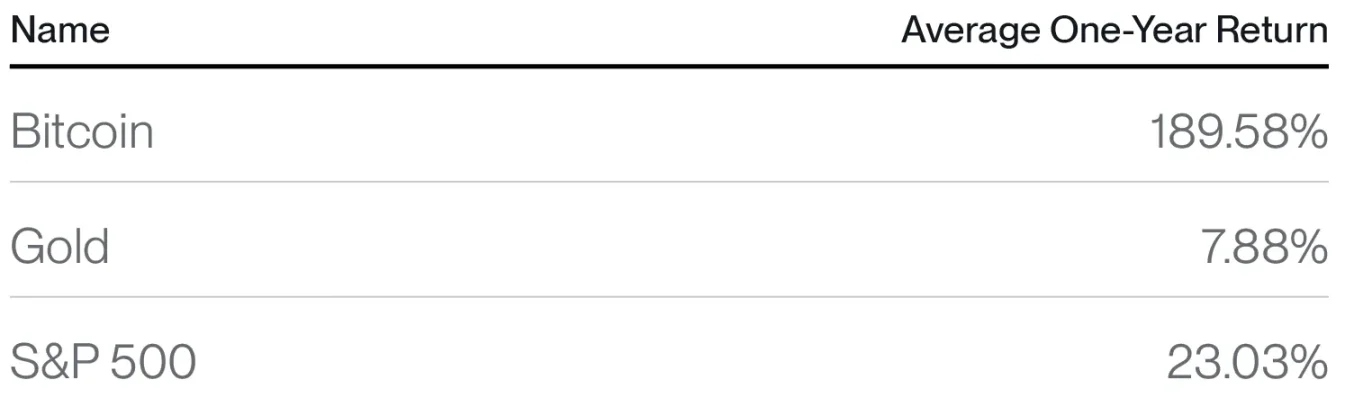
Average one-year returns following sharp S&P 500 declines. Source: Bitwise Asset Management, Bloomberg. Data from January 1, 2014 to August 9, 2024.
Why is this the case? Gold is a trusted asset that many instinctively buy during short-term panics. But because gold markets are mature, it doesn’t tend to deliver outsized gains over extended periods. Bitcoin, with its limited and diminishing supply, has strong store-of-value characteristics but remains in the early stages of adoption. As a result, it still exhibits risk-asset behavior—meaning it reacts more dramatically to market corrections, but delivers stronger returns over longer observation periods.
The past decade of market performance makes this clear: when markets retreat, buying Bitcoin pays off.
Will Bitcoin win again?
The most common critique of the above analysis is that past performance does not guarantee future results. While this time could be different, I believe Bitcoin’s outlook over the next 12 months is highly optimistic.
Consider the following potential catalysts:
Cash inflows into spot Bitcoin ETPs: Since January, inflows into Bitcoin ETPs have exceeded $17 billion—outpacing new supply and helping propel Bitcoin to all-time highs earlier this year. These flows don’t even include some of the biggest potential participants yet. Last week, Morgan Stanley became the first major brokerage to allow Bitcoin ETPs on its platform. We expect Merrill Lynch, UBS, Wells Fargo, and other institutions to follow suit.
Improved regulatory environment: A bipartisan coalition in Congress has already advanced three crypto-related bills through the House this year. With Republicans including cryptocurrency in their official 2024 platform and the Harris campaign reevaluating its stance, the crypto industry appears poised for greater regulatory clarity.
Fed rate cuts: Central banks like the ECB and the Bank of England have already begun cutting rates. As U.S. inflation slows and weak economic data fuels recession concerns, the Federal Reserve will likely need to catch up. Fed funds futures already price in a rate cut at the September meeting.
Are we out of the woods yet? Probably not. Investors remain uneasy about market volatility triggered by the unwinding of yen carry trades. Add to that uncertainty around the U.S. presidential election, signs of global economic slowdown, and geopolitical tensions involving Iran and Israel—more turbulence lies ahead. But the next time equities sell off, you’ll know exactly which asset stands as the best long-term hedge.
Join TechFlow official community to stay tuned
Telegram:https://t.me/TechFlowDaily
X (Twitter):https://x.com/TechFlowPost
X (Twitter) EN:https://x.com/BlockFlow_News
 @BitwiseInvest


