








Web3 Payment In-Depth Report: From Electronic Cash and Tokenized Money to the Future of PayFi
TechFlow Selected TechFlow Selected
Web3 Payment In-Depth Report: From Electronic Cash and Tokenized Money to the Future of PayFi
In this exploration, we embark on a journey to unravel the mystery of banklessness and reveal its profound impact on financial sovereignty.
 Navigating Web3 tides with focused insights
Author: Will Awang
If I were to envision how future finance should operate, I would undoubtedly incorporate the many advantages offered by digital currencies and blockchain technology: 24/7 availability, instant settlement, permissionless fair access, global liquidity, asset composability, and public transparency.
This envisioned future of finance, first proposed in 2008 by Satoshi Nakamoto in the Bitcoin white paper, is now being gradually built through tokenization—and could eventually achieve mass adoption via PayFi.
Since Bitcoin's emergence in 2009, the rise of digital currencies has swept across the globe. However, over the past decade, attention has been diverted by price speculation and market volatility, causing us to overlook the groundbreaking innovations that digital currencies and blockchain technology can bring.
As a16z partner Chris Dixon stated in his book *Read Write Own*: "Cryptocurrencies are just one of many applications enabled by blockchain technology. It is tokens—digital currencies built on blockchain networks—that will unlock the full potential of Web3’s value internet."
Digital currencies prevent value from stagnating, enabling it to move freely, nearly instantly, and at low cost across the Web3 value internet in a permissionless manner—accessible to anyone with an internet connection. At its core, payment is about transferring value.
Now, as underlying blockchain infrastructure continues to mature year after year and the wave of tokenization arrives, it becomes clear that the greatest opportunity for digital currency may not lie in treating it merely as digital money, but rather in combining it with blockchain to form an entirely new payment paradigm.
This revolutionary shift promises to liberate people from the constraints of traditional financial systems, bypassing today’s complex and outdated settlement infrastructures to embrace the possibilities unlocked by digital currencies and blockchain technology—much like how Starlink directly connects remote communities in the Serengeti, instead of waiting indefinitely for conventional telecom providers to lay cables.
Therefore, drawing upon my limited understanding of Web3 payments, RWA tokenization, and monetary systems, this article analyzes 13 recent Web3 payment cases to trace the evolution from Bitcoin’s grand vision to today’s era of tokenization, further exploring how PayFi might be realized and usher in the next chapter of Web3 payments.
If I still had doubts when writing last year’s 10,000-word report on Web3 payments—where industry giants are launching full-scale initiatives that could reshape the crypto landscape—I am now fully convinced: Web3’s killer application has arrived, and it is payments!
1. Overview of Web3 Payments
1.1 Payment and Payment Systems
Let’s begin with the definition of traditional payments: payment refers to the act of a payer transferring money or claims to a payee—a process where information flow and fund flow are matched to complete the exchange of goods and money. The essence of payment is the transfer of value (Exchange of Value).
According to the Bank for International Settlements (BIS) 2020 Annual Report, a payment system refers to a set of tools, processes, and rules established among multiple transaction participants (including payment service providers) for clearing and settling payment transactions. This financial infrastructure typically consists of “front-end” and “back-end” components:
The “front-end” interacts with end consumers and merchants, involving payment service providers who handle the information flow of payment transactions, including:
1) Source of funds;
2) Payment initiation channels;
3) Payment instruments;
The “back-end” handles the fund flow of payment transactions, primarily involving financial infrastructure such as payment settlement networks, covering:
1) Clearing—the transmission and reconciliation of payment instructions, sometimes including pre-settlement confirmation;
2) Settlement—the actual transfer of funds to fulfill obligations between two or more parties.
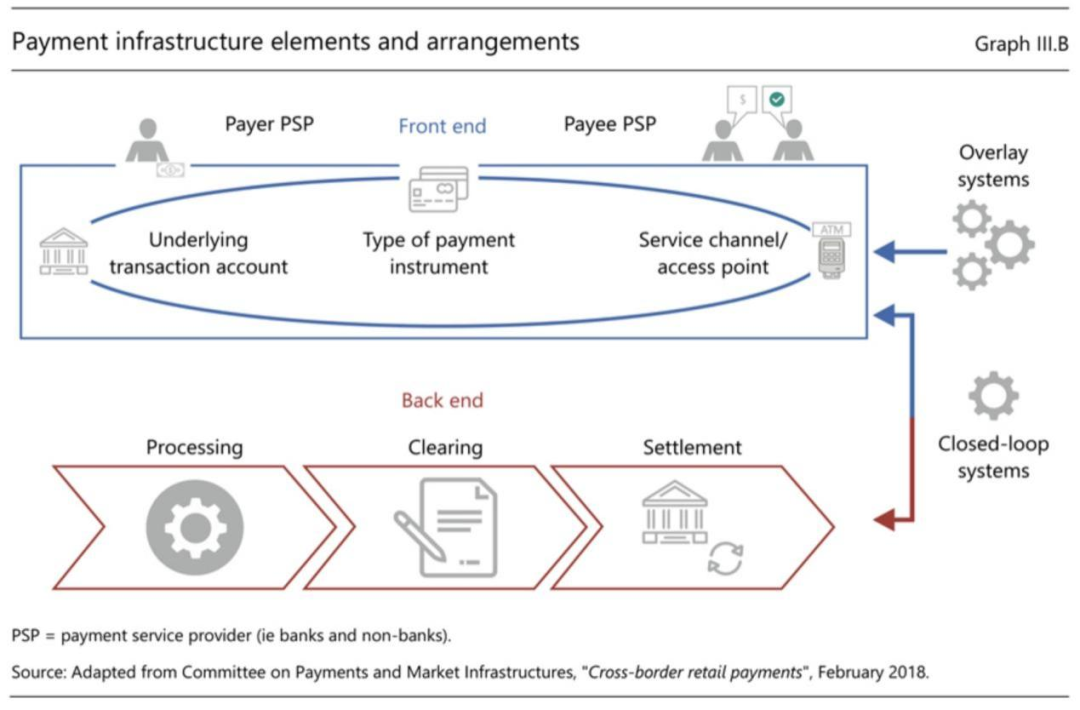
(Central banks and payments in the digital era)
The complexity of traditional payments is evident from the diagram above—not to mention cross-border payments, which involve domestic clearing systems (e.g., Fedwire led by the U.S. central bank, CNAPS led by China’s central bank), cross-border payment and settlement systems for settlement currencies (e.g., CHIPS in the U.S., CIPS in China), and international payment and clearing systems (e.g., SWIFT)—not to mention the numerous banks involved.
With the rise of cryptocurrencies (Cryptocurrency)—such as Bitcoin, dubbed “sovereign-free digital currency”—despite currently being priced in dollars, alongside privately issued stablecoins and central bank digital currencies (CBDCs) issued by various countries, new forms of money and new modes of circulation are emerging.
Web3 payments built on blockchain represent precisely this new form of money and new mechanism of circulation. Blockchain embeds digital currency directly into the Web3 value internet, serving as foundational infrastructure for monetary settlement—allowing value to be transmitted just as easily as data was shared during the early days of the internet.
More importantly, digital currencies combined with blockchain technology can use tokenization to represent real-world assets on the Web3 value internet in unique (or non-fungible) digital forms. Digital currencies and tokens representing real-world assets can rapidly open up a free market where anyone, anywhere, can participate anytime in buying, selling, financing, and trading assets—thanks to blockchain’s atomic swap capabilities.
The inherent nature of blockchain is financial infrastructure, originally designed to solve final consistency issues in payment clearing. Digital currencies built on blockchain can fully leverage their immense advantages: near-instant settlement, 24/7 availability, low transaction costs—all made possible by blockchain’s properties—as well as the programmability, interoperability, and composability with DeFi that unlock infinite possibilities.
All of these are highly desirable yet difficult to achieve within traditional financial payment systems.
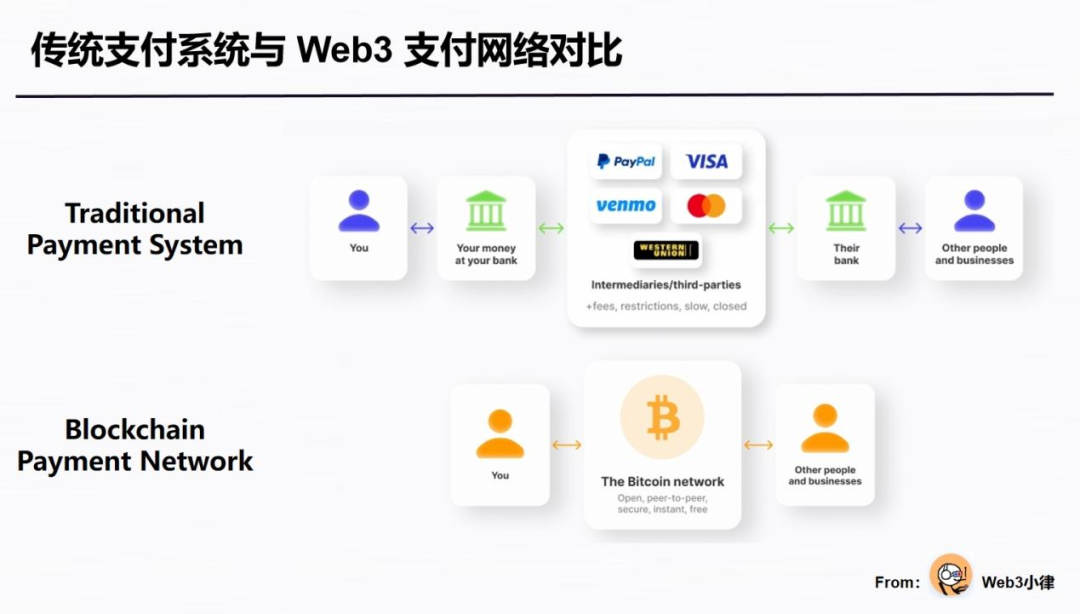
1.2 Outdated Infrastructure, Complex Payment Systems
To better understand the fundamental drivers behind Web3 payments, let’s first examine some historical context.
Today’s payment pathways and messaging protocols (such as ACH, SEPA, and SWIFT) form the global payment network—the international payment and clearing system. They enable large-scale transactions across geographies and time zones, ensuring relatively smooth operations.
However, these global payment infrastructures built over 50 years ago now appear largely obsolete and fragmented. This is an expensive and inefficient system, operating only during limited banking hours and relying heavily on intermediaries.
A key issue with current financial infrastructure is the lack of global standards. Fragmented national payment systems hinder seamless international transactions and complicate efforts to establish consistent frameworks. This complexity is best illustrated by the structure of cross-border payments (see below: a case of sending USD from the U.S. to receive EUR in Europe), revealing several practical pain points:
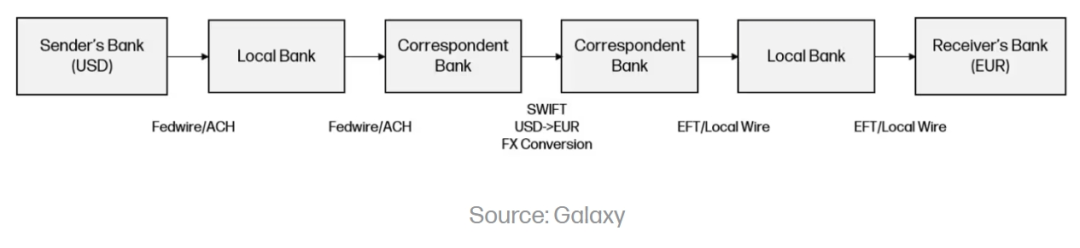
(Galaxy Ventures: The Future of Payments)
-
Multiple Intermediaries: Cross-border payments often involve multiple intermediaries—local banks, correspondent banks, clearinghouses, foreign exchange brokers, and payment networks. Each layer adds complexity, leading to delays and increased costs.
-
Lack of Standardized Processes and Formats: Different countries and financial institutions may have varying regulatory requirements, payment systems, and messaging standards, making it inefficient and challenging to streamline processes.
-
Manual and Closed Processing: Traditional systems lack automation, real-time processing, and interoperability with other systems, resulting in delays and manual intervention.
-
Lack of Transparency: Opacity in cross-border payment flows leads to inefficiencies. Limited visibility into transaction status, processing times, and fees makes it difficult for businesses to track and reconcile payments, causing delays and administrative overhead.
-
High Costs: Cross-border payments often incur high transaction fees, FX markups, and intermediary charges. Settlement typically takes up to five business days, with average fees reaching 6.25%.
Despite these challenges, B2B cross-border payments remain a necessity in a globalized world, representing a massive and growing market. According to FXC Intelligence, the total B2B cross-border payment market reached $39 trillion in 2023 and is projected to grow 43% by 2030, reaching $53 trillion.
1.3 The Urgent Need for Web3 Payment Adoption
As PayPal stated after launching its PYUSD stablecoin: "People want to pay however they want. Current payment networks struggle to meet demand, while payment networks built on digital currencies and blockchain technology are capable and practical. As a company committed to advancing payment innovation, we’re introducing a stablecoin-based payment solution to fulfill people’s desire for flexible, frictionless payments."
Today, digital currencies and blockchain technology offer a completely new Web3 payment pathway—one that simplifies clearing and settlement, enabling fast, cheap, and accessible payments to meet the needs of an increasingly global population.
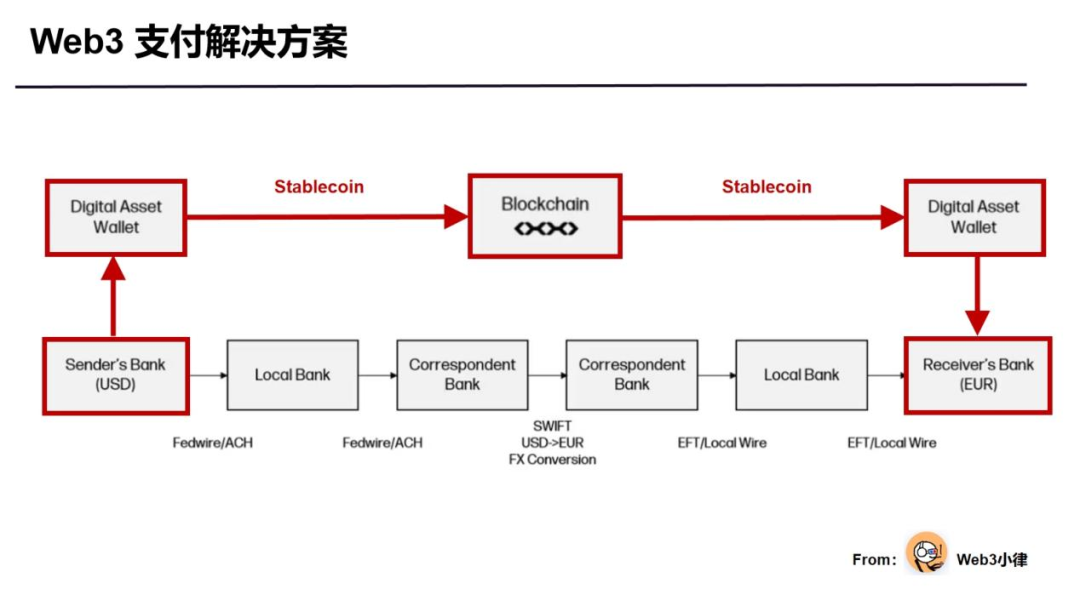
Stablecoins built on blockchain, as a primary form of tokenized money, have become ideal solutions to the existing challenges in areas like cross-border payments. Let’s revisit the previous complex cross-border example and examine Web3’s elegant alternative (highlighted in red):
-
Instant Settlement: Unlike traditional methods requiring days to settle, blockchain-based payments can settle globally in near real time.
-
Lower Costs: By eliminating intermediaries and leveraging superior technical infrastructure, blockchain payments offer significantly lower costs compared to existing solutions.
-
Transparency: Blockchain provides higher visibility in tracking fund flows and reducing reconciliation overhead.
-
Global Accessibility: Blockchain acts as a “high-speed rail,” easily accessible to anyone with an internet connection.
By using blockchain as the payment rail, the entire process is greatly simplified, reducing the number of intermediaries. Compared to traditional methods, fund flows become visible in real time, settlement speeds increase, and costs decrease significantly.
We urgently need Web3 payment solutions to help people transfer value quickly and affordably across the globe—addressing legacy issues of traditional payments: 1) slow settlement; 2) high transaction costs; and 3) incompatibility with underbanked and unbanked regions worldwide.
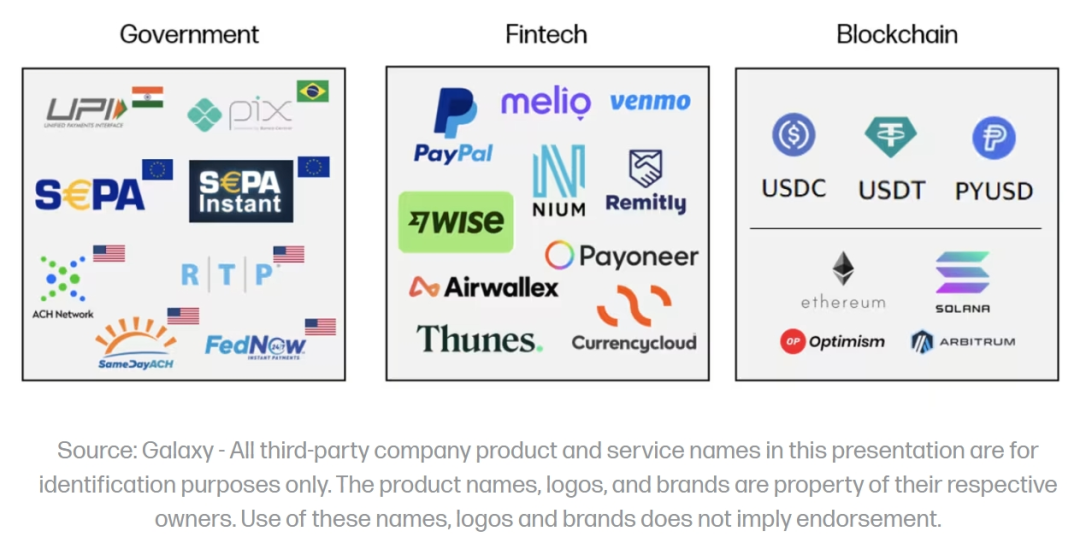
(Galaxy Ventures: The Future of Payments)
1.4 Web3 Payment Stack
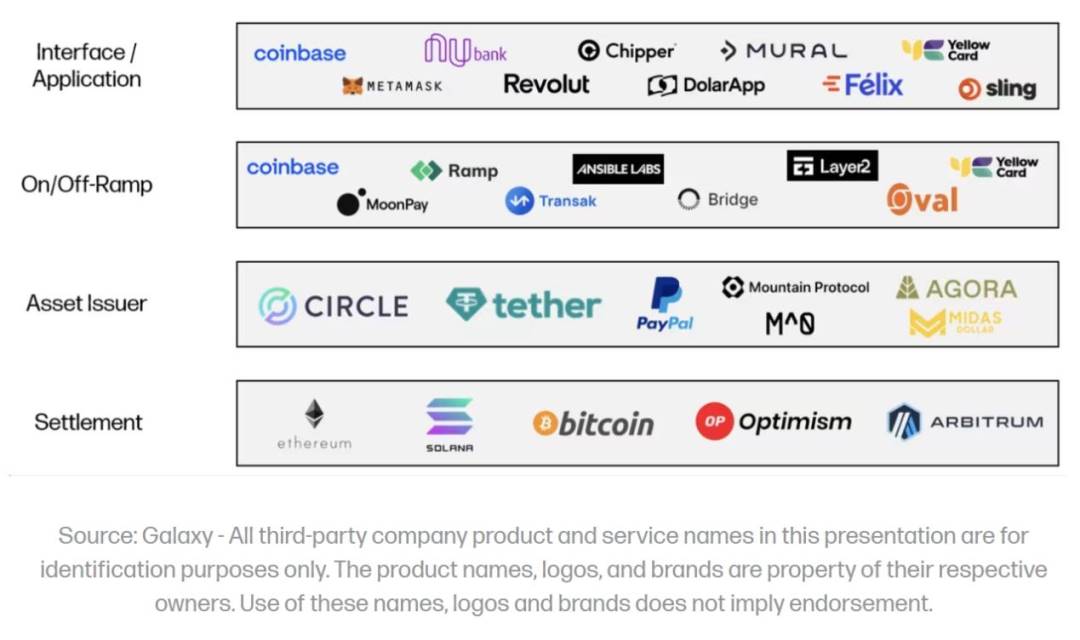
(Galaxy Ventures: The Future of Payments)
Upon closer inspection, the Web3 payment ecosystem consists of four main technological layers:
1.4.1 Blockchain Settlement Layer
The very design of blockchain is financial infrastructure—originally constructed to solve final consistency in payment clearing. Blockchains serve as the foundational infrastructure for payment transactions. Layer 1 blockchains like Bitcoin, Ethereum, and Solana, along with general-purpose Layer 2 environments like Optimism and Arbitrum, are selling block space. They compete across speed, cost, scalability, security, and distribution. Over time, payment use cases will become major consumers of block space.
1.4.2 Asset Issuers
Asset issuers are entities responsible for creating, maintaining, and redeeming financial instruments and payment mediums. Stablecoins, for instance, aim to maintain stable value relative to an underlying reference asset or basket (most commonly the U.S. dollar). Issuers like Tether (USDT), Circle (USDC), and PayPal (PYUSD) typically operate balance-sheet-driven business models: accepting customer deposits, investing them in higher-yielding assets like U.S. Treasuries, issuing stablecoins as liabilities, and profiting from interest spreads.
1.4.3 On- and Off-Ramps (Fiat-Crypto Exchange)
On- and off-ramp providers play a crucial role in increasing the usability and adoption of stablecoins and similar digital payment tools, driving mass adoption of Web3 payments. Fundamentally, they act as a technical layer connecting blockchain-based digital currencies with fiat money in traditional bank accounts. Their business models are often volume-driven, earning small commissions on the dollar amounts flowing through their platforms.
For example, GatePay leverages exchange liquidity to provide seamless Web3 payment solutions, bridging on-chain and off-chain payment paths. Meanwhile, Swiss Web3 bank Fiat24 directly builds banking logic onto blockchain, offering users seamless transitions between wallets (digital currency) and bank accounts (fiat).
1.4.4 Frontend Applications
Frontend applications are the customer-facing software in the Web3 payment stack, providing user interfaces for Web3 payments and leveraging other layers to execute transactions. Business models vary but often combine platform fees with volume-based revenue streams.
1.5 The Multifaceted Nature of Web3 Payments

In simple terms, Web3 payments refer to a payment method based on digital currencies and blockchain technology. However, due to the token nature of digital currencies and the characteristics of the underlying blockchain infrastructure, Web3 payments cannot be understood solely as a new type of payment.
Take Bitcoin, built on the Bitcoin blockchain—it possesses multidimensional attributes. It is not only a form of payment and medium of exchange but also a store of value and a financial infrastructure (distributed ledger), and can even function as a unit of account for pricing goods and services.
Thus, understanding Web3 payments requires looking beyond just the payment token (cryptocurrency, tokenized money, etc.) and considering the blockchain network itself (as financial infrastructure), examining how they jointly leverage blockchain technology to reduce costs, improve efficiency, and create new business models.
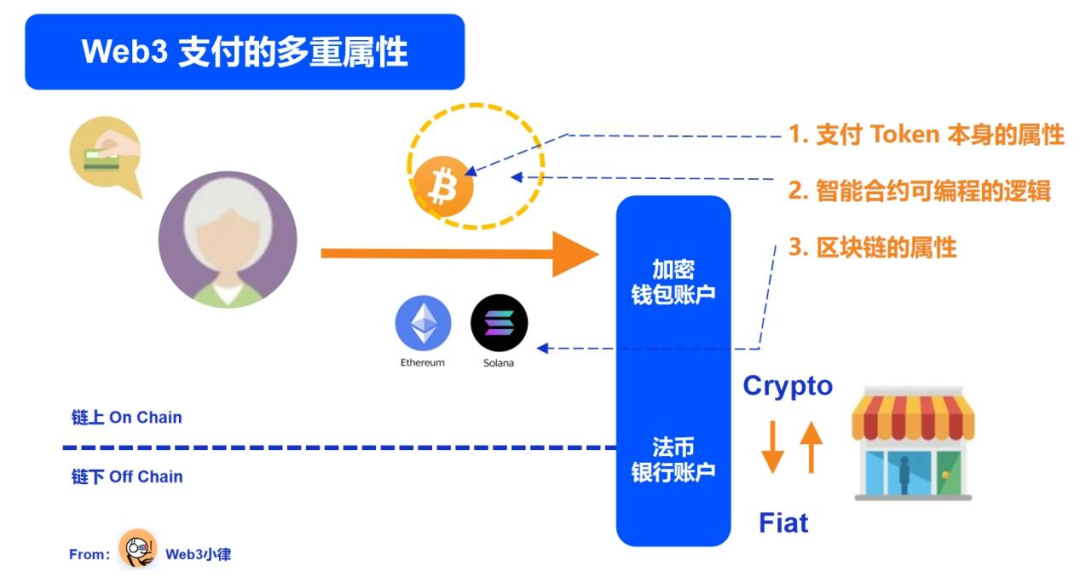
Just as discussing USD payments isn’t just about the dollar, but also the vast USD clearing and settlement network. Understanding this is critical—let’s look at PayPal’s launch of PYUSD.
Case Study A: PayPal’s Logic Behind Web3 Payments
On August 7, 2023, U.S. payment giant PayPal announced the launch of its stablecoin, PayPal USD (PYUSD), on the Ethereum blockchain. Fully backed 1:1 by U.S. dollar deposits, short-term U.S. Treasuries, and cash equivalents, eligible U.S. users can exchange between USD and PYUSD seamlessly. With this move, PayPal became the first tech giant to issue a stablecoin.
PayPal’s motivation is straightforward: it meets demand and works in practice.
Traditional online payment settlements remain slow (averaging 2–3 days in the U.S.), constrained by banking hours, further delaying settlements. Employers struggle to pay distributed workforces. A global population finds it difficult to conduct low-cost, efficient cross-border remittances. In short, people today cannot pay exactly how they want.
Now, Web3 payments powered by digital currencies and blockchain technology bring us closer to fulfilling that desire: fast, cheap, and global payments. This next-generation financial/payment infrastructure enables PayPal to better serve its 400 million users, empowering everyone to pay on their own terms.
Over a decade after the emergence of digital currencies and blockchain, PayPal stands again at a pivotal moment in payment history—just like the dawn of the internet in 2000—full of potential and opportunity. Just as PayPal brought payments online back then, it is now bringing payments on-chain.
PYUSD on Ethereum initially saw lukewarm traction, functioning more like an experimental product primarily within PayPal’s Super App. During this phase, PYUSD reached early adopters—crypto holders (~15% of the global population)—raising awareness and awakening early recognition.
(PayPal Launches Dollar-Pegged Stablecoin on Solana: A New Chapter in Blockchain Payments)
Then on May 31, 2024, PayPal announced PYUSD’s launch on Solana, a high-performance blockchain, targeting the most active and engaged segment of the crypto ecosystem—signaling, “PYUSD is truly here.” This stage marks PayPal’s transition from theoretical awareness to real-world utility.
Solana brings faster settlement, lower transaction costs, greater scalability, stronger interoperability and programmability, and broader global network support. Combined with Solana’s strengths, PYUSD can now deliver tangible payment utility across various scenarios—including peer-to-peer cross-border remittances (C2C), business transfers (B2B), and global merchant payments (B2C).
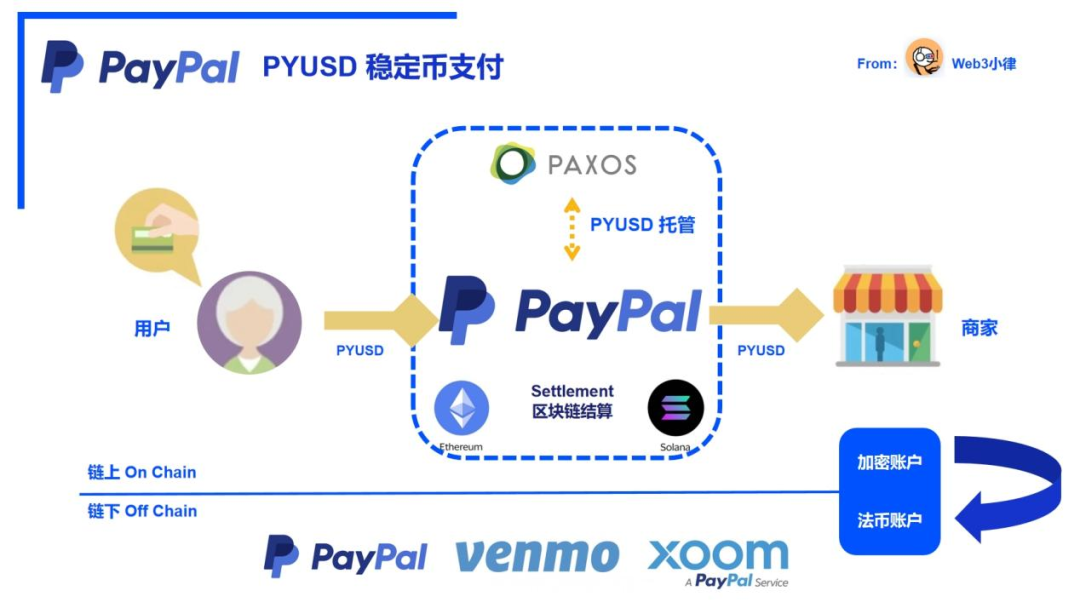
In this Web3 payment case, PayPal and Paxos, as stablecoin issuers, launched PYUSD—the only stablecoin supported within the PayPal ecosystem. PYUSD leverages Solana’s blockchain (as the settlement layer) for its efficiency, low cost, and programmability, aiming to connect all frontend applications within the PayPal ecosystem serving 431 million users—bridging fiat and digital currencies seamlessly for Web2 consumers, merchants, and developers.
Traditional and Web3 payments are not disconnected—they are converging. Fiat and digital currencies continuously interact, gradually merging into practical use cases such as stablecoins, tokenized deposits, and CBDCs. Web3 payments are redefining how we pay and how financial systems operate.
2. From Bitcoin’s Electronic Cash Vision
Before diving deeper into Web3 payments, we must revisit the “bible” of digital currencies and blockchain technology—the Bitcoin white paper—to trace the origins of Web3 payments, understand the significance of blockchain networks, and recognize that PayPal’s model (centralized trust, infinite inflation of payment currency, etc.) diverges from Bitcoin’s original decentralized ideal.
We must understand that Bitcoin and its blockchain network, created by Satoshi Nakamoto, represent a new digital-age solution to monetary problems—not only addressing humanity’s timeless challenge of moving economic value across time and space, but also solving the issue of third-party trust in payment transactions.
2.1 The Origin of Bitcoin
The traditional financial system relies heavily on intermediaries acting as trusted third parties. While convenient, this model suffers from flaws: unnecessary transaction costs, reversible transactions, and centralized abuse. The most painful lesson came from the 2008 global financial crisis.
Is there a new way allowing any two parties to transact directly without needing a trusted third party—like cash?
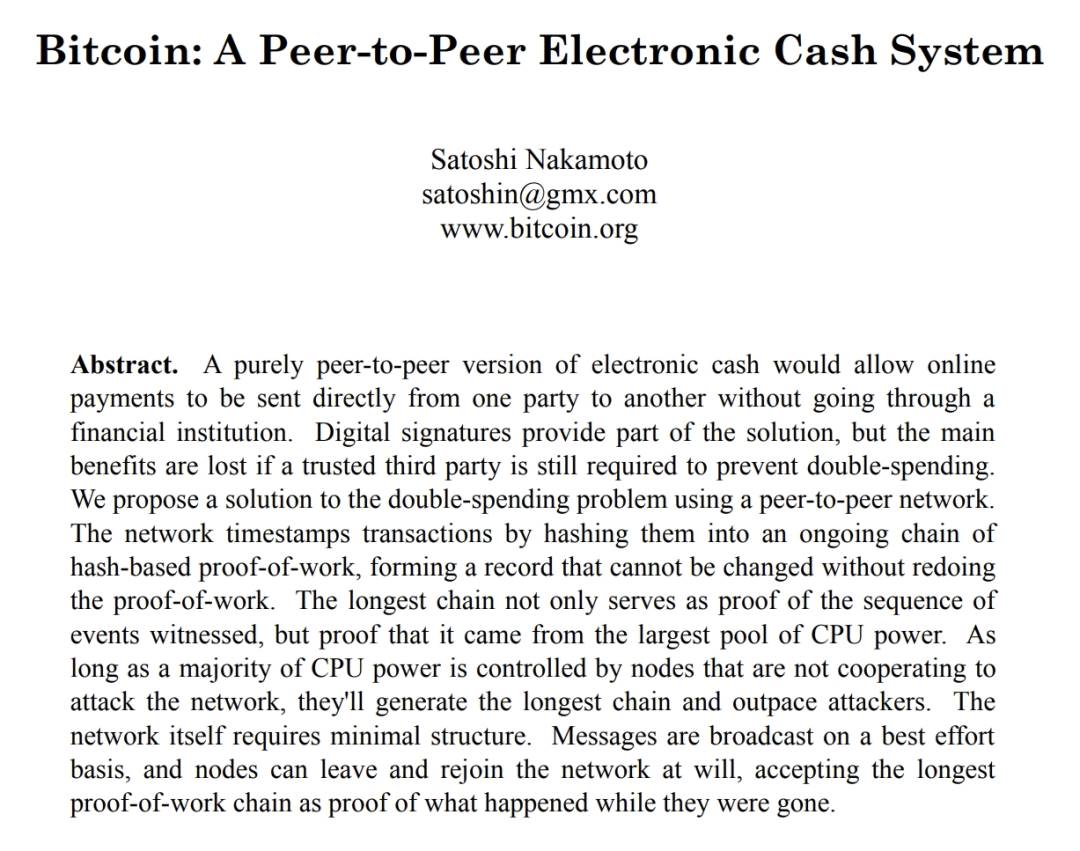
This is exactly what Satoshi aimed to achieve. In 2008, he published the Bitcoin white paper, *Bitcoin: A Peer-to-Peer Electronic Cash System*, proposing a decentralized electronic cash system based on blockchain technology—using distributed ledgers, asymmetric cryptography, and consensus mechanisms to enable peer-to-peer transactions without neutral, trusted third-party intermediaries.
The Bitcoin white paper combines innovative technologies with transformative social designs, aiming to change the bank-centric, centralized financial system, solve the problem of centralized trust, and offer users a safer, more convenient, and lower-cost payment method (“a peer-to-peer version of electronic cash (system) would allow online payments to be sent directly from one party to another without going through a financial institution”).
(Bitcoin: A Peer-to-Peer Electronic Cash System)
2.2 Collapse of the Trusted Intermediary Model
Cash payments are humanity’s oldest transaction method—immediate, with no third party able to effectively interfere. But as communication technologies evolved, cash became impractical for payments across locations, time zones, and contexts—giving rise to intermediary payments.
Intermediary payments require trusted third parties—banks, PayPal, and other payment providers—to offer innovations like credit cards, debit cards, wire transfers, and cross-border remittances. The biggest issue? Users must place full trust in these intermediaries. This trust comes with flaws: unnecessary costs, reversibility, and centralized abuse.
Bitcoin emerged in 2008 amid the collapse of the U.S. housing bubble. Major financial institutions suffered huge losses from mortgage-backed securities, pushing once-mighty banks to the brink of bankruptcy—triggering a global financial crisis.
The root cause of this financial tsunami and massive wealth destruction lies in forced, unconditional trust in the current financial system—entrusting centralized institutions like banks to control, hold, and manage our assets.
If banks merely stored cash, counterparty risk would be limited and manageable. But banks are profit-driven—they lend out people’s hard-earned savings to buy government bonds or make other investments. Sometimes, excessive lending leaves insufficient liquidity to meet redemption demands, leading to bank failures.
This is why Silicon Valley Bank—the 16th largest U.S. bank—collapsed in 2023. Signature Bank and Silvergate Bank soon followed—vivid, bloody examples.
Beyond that, the traditional financial system faces strict regulation. Despite information technology overcoming geographical and temporal barriers, payments remain tightly controlled by governments and state-owned monopolies. National and local regulations restrict how individuals use their hard-earned money—especially severe in countries with capital controls. These limitations severely undermine money’s performance. Money is weak when accumulated, but powerful only when freely circulating.
Due to modern communications, physical cash transactions are no longer feasible. The shift to digital payments weakens people’s control over monetary sovereignty, making them dependent on third-party intermediaries—with no choice but to trust.
Financial intermediaries like banks have failed before—and they will fail again.
2.3 Blockchain Rebuilding Trust
To avoid the opacity of trust and custody risks, and to eliminate single-point failure of intermediaries, Satoshi provided a blueprint in the Bitcoin white paper—rebuilding a payment network that requires no trusted third party through digital currencies and blockchain technology.
Satoshi thoroughly built Bitcoin on proof and verification—using distributed ledgers, asymmetric cryptography, and consensus mechanisms to enable decentralized peer-to-peer transactions, removing the need for trusted intermediaries. Every participant in the network can verify transaction authenticity without trusting each other.
Only through full verification can reliance on trust be eliminated. Don’t Trust, Verify.
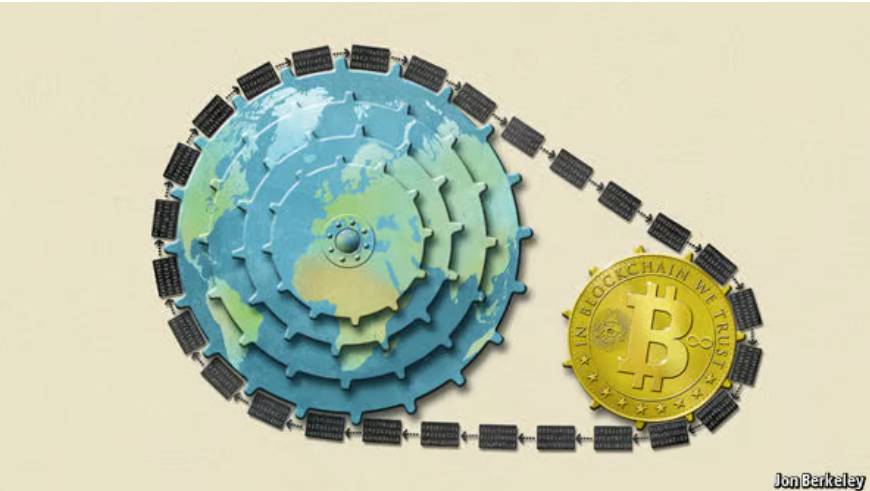
*The Economist* published an article in 2015 titled *The Trust Machine*, arguing that the technology behind Bitcoin would transform how economies operate. Blockchain allows untrusting parties to cooperate without relying on a centralized authority.
In short, it is a machine that creates trust. In Trustless We Trust.
Blockchain is a powerful technology—a shared, trusted, public ledger that anyone can inspect, but no single user controls. Participants collectively maintain and update the ledger according to strict rules. Bitcoin’s blockchain prevents double-spending and continuously tracks ledger integrity—this is key to realizing a currency without central bank control.
Admittedly, early Bitcoin gained notoriety due to illegal uses, but we must not overlook the extraordinary potential of blockchain technology behind it—its innovation extends far beyond cryptocurrency itself.
(*The Economist: Bitcoin - The trust machine*)
2.4 Bitcoin and Payments
Imagine a world where people no longer depend on traditional financial intermediaries to hold, manage, and dispose of their assets—where individuals truly control their financial destiny through digital wallets and blockchain technology, achieving financial sovereignty.
This is the core message of the Bitcoin white paper.
Although the mere nine-page Bitcoin white paper in 2008 couldn’t deliver a complete peer-to-peer electronic cash system, it served as a beacon of hope in darkness—a guiding light for those who lost faith during the financial storm.
16 years later, in this era defined by innovation and disruption, the financial landscape is undergoing a profound transformation. Over the past decade, billions of dollars have been invested in developing underlying blockchain infrastructure. Only in recent years have we developed blockchain networks capable of handling “payment-scale” operations—making blockchain-based payments increasingly viable and popular.
With the widespread adoption of digital currencies like Bitcoin (according to a recent Triple-A report, ~562 million people globally owned crypto in 2024, ~6.8% of the population) and growing acceptance by traditional Wall Street institutions—such as BTC/ETH ETF approvals, BlackRock launching its tokenized fund BUIDL—everything has changed.
The idealistic vision of Bitcoin as electronic cash is becoming reality—like seeds planted long ago, now flourishing.
We see that Bitcoin’s grand vision can now be fulfilled thanks to today’s advanced blockchain infrastructure. Web3 payments built on blockchain achieve instant settlement and global access. The widespread real-world use of stablecoins confirms that the greatest opportunity for digital currency may not be as currency itself, but as part of an entirely new payment paradigm combined with blockchain.
3. To the Arrival of the Tokenization Wave
Though Bitcoin was initially positioned as electronic cash, for a time people hoped it would become a new global currency fulfilling money’s three classic functions: medium of exchange (buying goods/services), store of value (long-term investment), and unit of account (pricing goods/services).
Over the past decade, due to its scarcity design, Bitcoin has excelled particularly in storing value—resisting global inflation. However, cryptocurrencies like Bitcoin were created to reward blockchain validators, and due to high price volatility and instability, they are unsuitable as units of account for pricing goods and services.
Hence emerged new digital representations of money—tokenized money—especially stablecoins. Typically pegged 1:1 to fiat currencies (especially the U.S. dollar), they serve as new mediums of exchange on blockchain networks. Designed to maintain stable value, stablecoins solve the pricing problem in payments and have seen widespread adoption in Web3 payment markets.
We’ve already witnessed the explosive growth of stablecoins in this wave of tokenization. But before delving deeper into today’s stablecoin-dominated Web3 payment market, we must first understand what tokenization is and the immense benefits it brings to money.
3.1 What Is Tokenization?
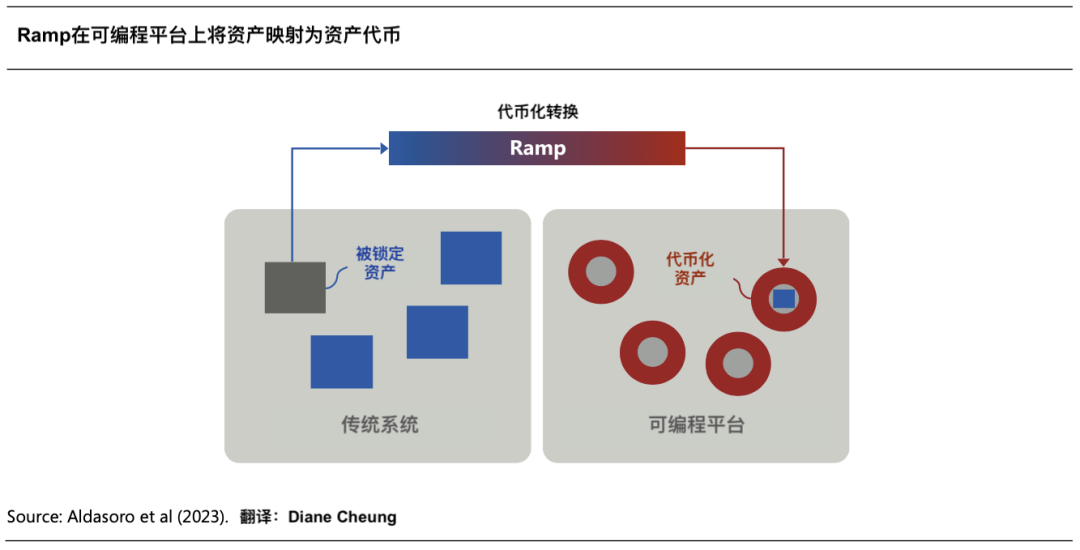
“Tokenization” refers to the process of recording ownership claims on financial or real-world assets from traditional ledgers onto programmable blockchain platforms, creating digital representations of those assets. These assets can include tangible assets (real estate, agricultural or mining commodities, analog art), financial assets (stocks, bonds), or intangible assets (digital art, intellectual property).
The resulting “tokens” are verifiable ownership records stored on programmable blockchains, facilitating trade while ensuring authenticity and traceability. Tokens are not just simple digital certificates—they often encapsulate the rules and logic governing the transfer of underlying assets from traditional ledgers. Thus, tokens are programmable and customizable, meeting specific use cases and regulatory compliance needs.
(*Tokenization and Unified Ledgers—Blueprint for the Future Monetary System*)
USDC, the world’s second-largest stablecoin, is issued by U.S.-based private firm Circle. Backed 1:1 by U.S. dollars, USDC exemplifies tokenized money.
Thanks to the U.S. dollar’s global dominance, USDC fulfills roles as both a transaction medium and unit of account, while showcasing significant advantages of being tokenized on blockchain—advantages difficult to achieve in traditional finance.
3.2 Advantages of Tokenization
Tokenization unlocks the full potential of digital currencies and blockchain technology. Broadly speaking, these advantages include:
1) Benefits from blockchain: 24/7 availability, data availability, and near-instant atomic settlement;
2) Benefits from tokens themselves: programmability—the ability to embed code into tokens, and composability with smart contracts—enabling higher automation and integration with decentralized finance (DeFi).
As tokenization scales beyond pilot stages, these benefits become increasingly apparent:
3.2.1 Improved Capital Efficiency
Tokenization significantly enhances capital efficiency. For example, tokenized repurchase agreements (Repos) or money market fund redemptions can settle instantly (T+0) in minutes, versus the current T+2 standard. In today’s high-interest environment, shorter settlement times save substantial capital. These savings may explain the recent surge in tokenized U.S. Treasury projects.
Case Study B: BlackRock’s Tokenized Fund BUIDL
On March 21, 2024, BlackRock partnered with Securitize to launch its first tokenized fund, BUIDL, on the public Ethereum blockchain. Tokenization enables instant settlement on a unified ledger, drastically reducing transaction costs and improving capital efficiency. It achieves (1) 24/7 fiat USD subscriptions/redemptions—this instant settlement feature is highly desired by traditional financial institutions; and (2) 24/7 instant 1:1 exchange between stablecoin USDC and fund token BUIDL via collaboration with Circle.
This bridge between traditional and digital finance marks a milestone innovation for the financial industry.
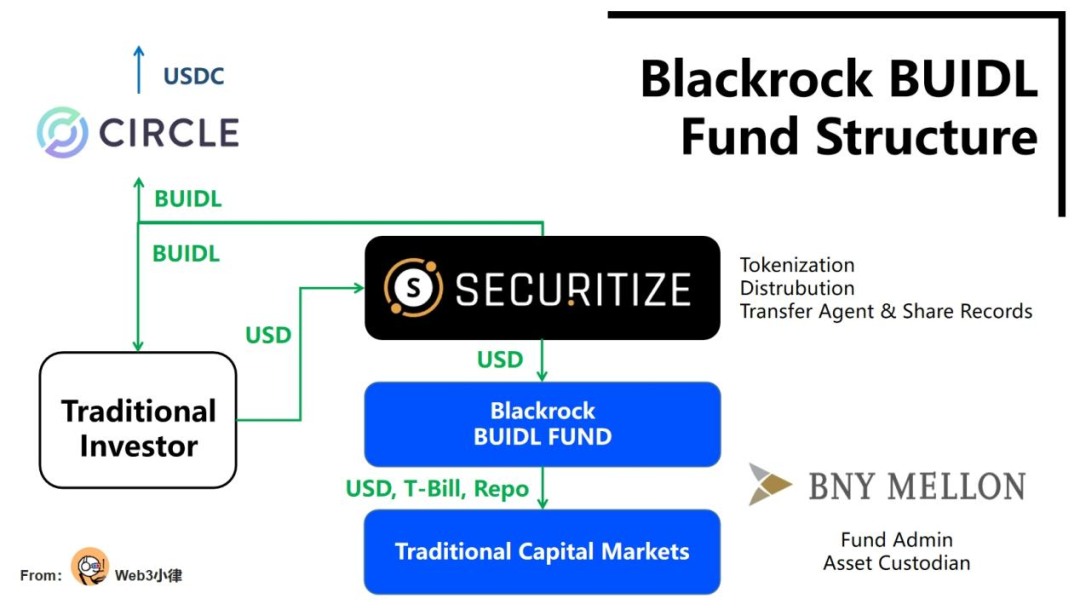
(*Analyzing BlackRock’s Tokenized Fund BUIDL: Opening a Beautiful New World of RWA Assets in DeFi*)
3.2.3 Operational Cost Savings
Token programmability offers another source of cost reduction—especially for asset classes that are highly manual, error-prone, and involve numerous intermediaries, such as corporate bonds and fixed-income products. These often involve custom structures, imprecise interest calculations, and coupon disbursements. Embedding such operations into smart contracts automates them, significantly cutting costs. Automation via smart contracts can also reduce expenses in services like securities lending and repo transactions.
Case Study C: Evergreen Tokenized Bond Project
In 2022, the Bank for International Settlements (BIS) and Hong Kong Monetary Authority launched the Evergreen project, issuing green bonds using tokenization and unified ledgers. The project used a distributed unified ledger to integrate all bond issuance participants onto a single data platform, supporting multi-party workflows with authorized access, real-time validation, and digital signing—greatly improving processing efficiency. Bond settlement achieved Delivery vs. Payment (DvP), reducing settlement delay and risk. Real-time data updates enhanced transparency.
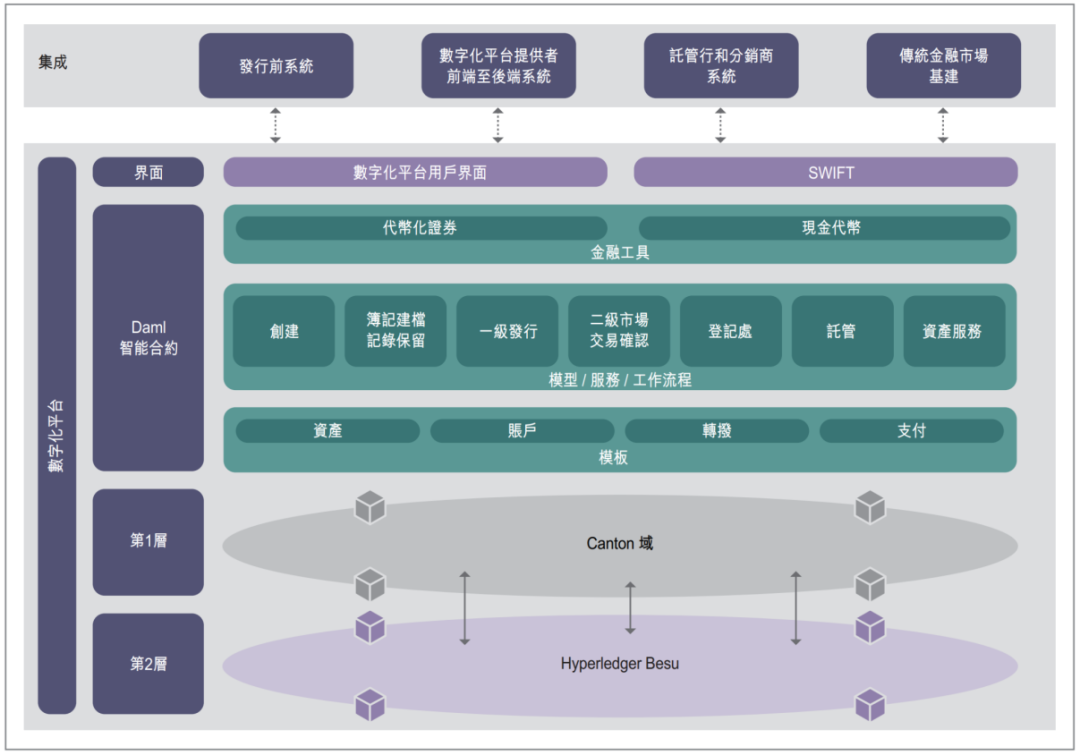
(Tokenization in Hong Kong’s Bond Market)
Over time, token programmability can create portfolio-level efficiencies, enabling asset managers to rebalance portfolios automatically in real time.
3.2.2 Permissionless Democratic Access
One of the most celebrated benefits of tokenization—or blockchain—is democratized access. The permissionless nature, especially when combined with fractionalization (dividing ownership into smaller shares), can potentially enhance liquidity by lowering investment thresholds—but only if tokenized markets gain broad adoption.
In certain asset classes, simplifying labor-intensive manual processes via smart contracts can dramatically improve unit economics, making services viable for smaller investors. However, access may be restricted by regulations, meaning many tokenized assets remain available only to accredited investors.
Case Study D: Tokenized Private Equity Funds
Prominent private equity firms like Hamilton Lane and KKR have partnered with Securitize to tokenize feeder funds of their PE funds—offering mainstream investors affordable access to top-tier private equity. Minimum investment dropped from an average of $5 million to just $20,000. However, individual investors still undergo accredited investor verification via Securitize, retaining some entry barriers.

(*RWA Deep Dive: The Value, Exploration, and Practice of Fund Tokenization*)
3.2.4 Enhanced Compliance, Auditability, and Transparency
Current compliance systems often rely on manual checks and retroactive analysis. Asset issuers can automate compliance by embedding relevant rules (e.g., KYC/AML/CTF, transfer restrictions) directly into tokenized assets. Additionally, blockchain’s 24/7 data availability enables simplified consolidated reporting, immutable recordkeeping, and real-time auditing.
3.2.5 Cheaper, More Flexible Infrastructure
Blockchains are inherently open-source, evolving rapidly thanks to thousands of Web3 developers and billions in venture funding. Businesses engaging in Web3 payments can choose to operate on public permissionless blockchains or hybrid public/private chains. Innovations like smart contracts and token standards can be adopted quickly and easily, further reducing operational costs.
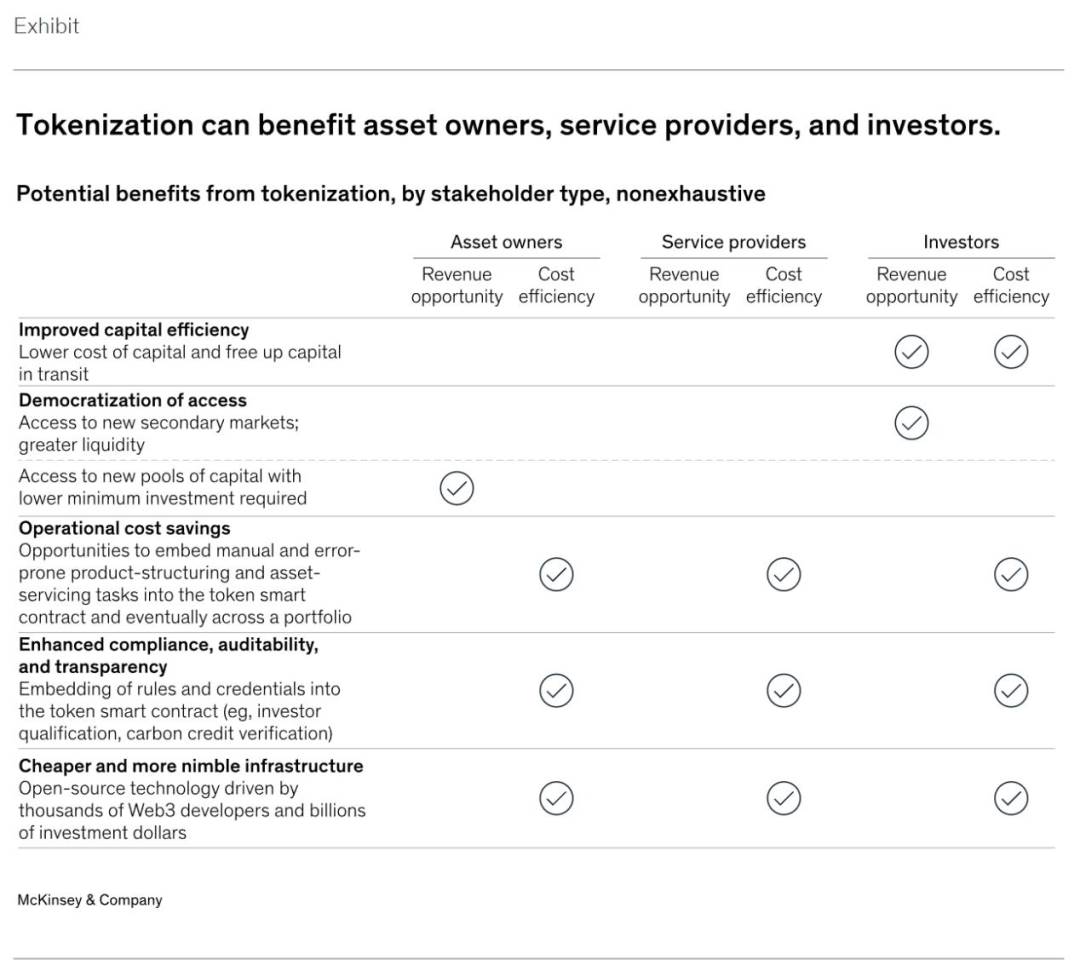
(Tokenization: A digital-asset déjà vu)
3.3 The Tipping Point for Mass Adoption
The previous phase of digitization succeeded as technology matured and economic benefits became measurable. However, widespread adoption of asset tokenization won’t happen overnight. The biggest challenge lies in transforming infrastructure within the heavily regulated financial services sector—requiring participation across the entire value chain.
Nevertheless, the first wave of tokenization has already arrived—driven by strong returns in today’s high-interest environment and real-world use cases (e.g., stablecoins, tokenized U.S. Treasuries).
In early 2024, BlackRock CEO Larry Fink emphasized tokenization’s importance: “We believe the next step in financial services is the tokenization of financial assets—meaning every stock, every bond, every financial asset will run on a single, unified ledger.”
Likewise, the Bank for International Settlements (BIS) previously expressed strong interest in tokenization, stating: “The global monetary system stands on the brink of a historic leap forward. After digitization, tokenization is the key to that leap. Tokenization transforms how intermediaries serve users, bridges gaps in messaging, reconciliation, and settlement, and greatly enhances the capacity of money and finance. It will create new economic activities impossible under the current monetary framework.”
Today’s tokenized asset flows are just the beginning of this new frontier. Internet history hasn’t just reshaped existing industries—it has also created entirely new business models unimaginable before technological and connectivity advances.
One of blockchain’s greatest breakthroughs is enabling “real-world assets” (homes, cars, office buildings, factories, concert tickets, loyalty points, stock certificates, etc.) to exist online as uniquely identifiable digital tokens. These tokens allow easy online tracking, transferring, and storing of ownership proofs in digital wallets.
Embedding ownership of these assets as digital currency into the Web3 value internet (directly linked with fund flows) may unlock a future where almost anything can be tokenized, financed, and traded by anyone, anytime, anywhere—without traditional financial intermediaries.
And powering these value flows is precisely Web3 payments.
4. Tokenized Money—A New Mode of Currency Circulation
Having understood tokenization, we now recognize that stablecoins, tokenized deposits, and CBDCs—the digital currencies underpinning Web3 payments—are all forms of tokenized money. This digital money represents a new mode of currency circulation based on blockchain—not a new method of money creation.
As human society evolves, so too does the concept and form of money—from Yap Island stone money and shell barter, to coins and paper currency, revolutionizing trade. Then came globalization and increasingly complex economic activity, driving demand for more efficient and secure payment methods—spurring the rise of internet-based digital payments and digital currencies, laying the foundation for improved financial efficiency, accessibility, and global integration.
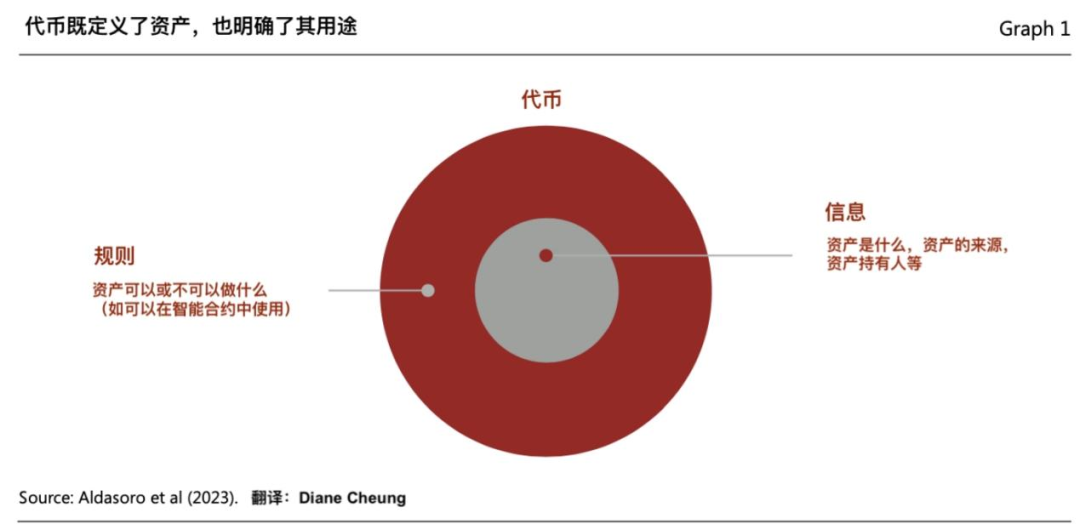
(*Tokenization and Unified Ledgers—Blueprint for the Future Monetary System*)
While fiat currencies backed by sovereign trust still dominate today, innovations like stablecoins, tokenized deposits, and CBDCs represent new forms of currency movement driven by digital currencies and blockchain technology in this era of transformation.
4.1 Central Bank Digital Currencies (CBDC)
The IMF defines CBDC as “a digital representation of sovereign currency issued by the monetary authority of a jurisdiction, appearing as a liability on the monetary authority’s balance sheet.” CBDC designs vary, notably between wholesale CBDC (for interbank transactions among financial institutions) and retail CBDC (for public use, intended to replace physical cash with digital cash for modern payments).
Among pilot projects by the BIS, national regulators, and leading private players, 15 out of 26 focus on CBDC and digital currencies—reflecting global recognition of this trend. These pilots demonstrate the stability, programmability, liquidity, and efficient asset transfer potential of tokenized digital currencies.
Different countries have varied motivations for CBDC pilots. The Monetary Authority of Singapore (MAS) proposed an open, interoperable digital asset network framework, piloting in asset management, fixed income, and foreign exchange. The European Central Bank (ECB) emphasizes the need for central banks to stay technologically advanced, keeping cash or central bank money attractive in transactions and ensuring stability in financial innovation. The European Commission proposed a legal framework for the digital euro, signaling EU progress toward a potential CBDC. Hong Kong shares similar motivations—focusing on practical use cases and exploring CBDC features like programmability to unlock new transaction types and develop tokenized markets. Other markets like Brazil, India, and Kazakhstan aim to use CBDCs to promote financial inclusion—for example, Visa’s pilot with Brazil’s Agrotoken uses CBDCs to give farmers access to digital finance by tokenizing crops as collateral and automating payments via smart contracts, reducing cost and risk.
4.2 Tokenized Deposits
Tokenized deposits are digital representations of commercial bank deposits issued on blockchain, combining the familiarity and reliability of bank deposits with blockchain advantages like programmability, instant settlement, and enhanced transparency.
They can be designed to operate like regular bank deposits—recorded as liabilities of the issuer—and are non-transferable. Central bank-provided clearing liquidity ensures payment functionality remains intact.
Tokenized deposits are likely to become an innovative cornerstone in traditional banking, driving new momentum for financial institutions.
Case Study E: JPMorgan’s Onyx Network
JPMorgan began experimenting with blockchain early, focusing on tokenized deposits. Its institutional-grade blockchain payment network, Onyx, currently processes $2 billion in transactions daily. This volume stems from JPMorgan’s “Coin System,” addressing clients’ cross-border payment and liquidity financing needs using JPM Coin as the digital currency for settlement.
Additionally, JPMorgan launched a digital asset platform, collaborating with Goldman Sachs on intraday repo solutions, with BlackRock and Barclays on a tokenized collateral network, and with municipalities to issue bonds. Beyond that, JPMorgan’s tokenization innovations include plans to launch tokenized funds following its participation in BIS’s Project Guardian, and using JPM Coin-based tokenized deposits for on-chain settlement via Broadridge’s DLR platform.
(Onyx by J.P.Morgan)
Case Study F: Visa’s Tokenized Deposit Pilot
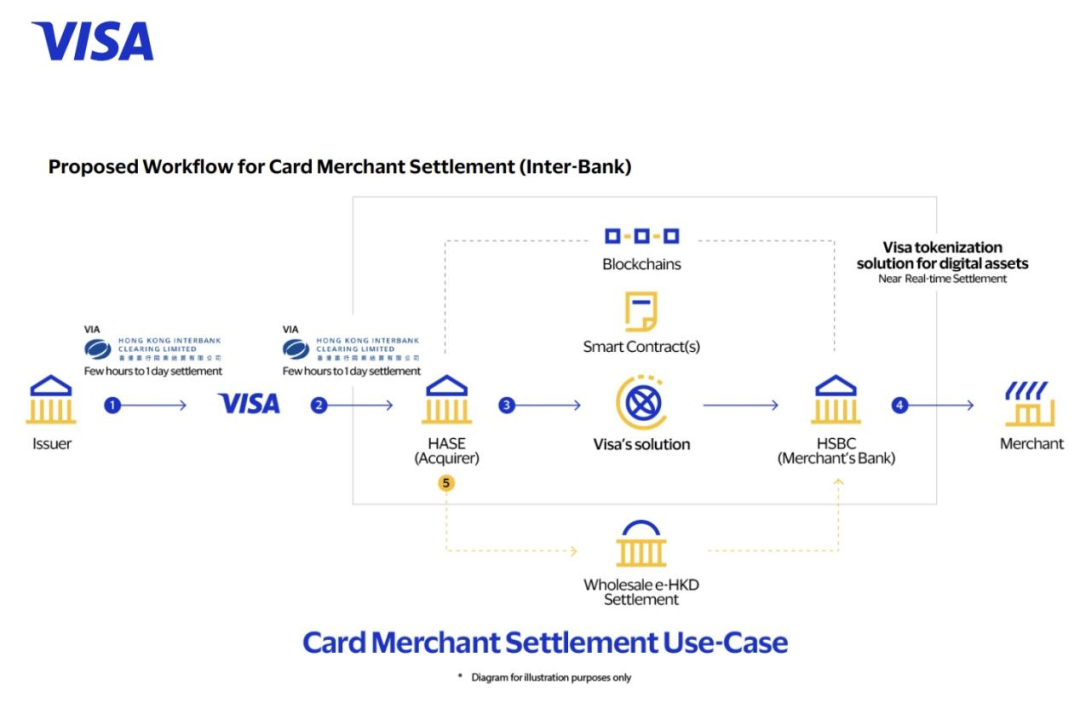
Another example comes from a joint pilot report by Hong Kong’s HKMA, Visa, HSBC, and Hang Seng Bank on tokenized deposits, presenting use cases that achieve end-to-end atomic settlement—showcasing improved efficiency in existing settlement processes and potential for application innovation.
First, tokenized deposits leverage the unified ledger advantage of blockchain to reduce settlement risk, enable instant settlement, and improve fund turnover efficiency. For example, in an interbank scenario (acquirer-to-merchant settlement), acquirers can streamline settlement, making it more transparent and seamless for merchants.
In the current workflow, acquirers process credit/debit card transactions on behalf of merchants. After a customer completes a purchase, the acquirer initiates settlement, eventually transferring funds to the merchant’s account. This process can take hours to a full day, leaving merchants with little real-time visibility—hindering cash flow and reconciliation.
(Visa, e-HKD and the future of global money movement)
With tokenized e-HKD and Visa’s solution, settlement between acquirer and merchant becomes nearly instantaneous. Merchants receive real-time notifications, improving reconciliation and reducing dispute risks. Blockchain’s immutability provides tamper-proof audit trails, enhancing overall transparency and trust.
Second, blockchain-based tokenized deposits can serve as payment media, enabling atomic settlement with other tokenized assets (real estate, securities, commodities, etc.)—facilitating real-time transactions and instant settlement. The same logic applies to other banking functions like collateral and pledge.
Finally, beyond blockchain benefits, tokenized deposits can use smart contracts for programmability, further enhancing payment functionality. This allows automation of complex business logic, enabling more efficient settlements and potentially fewer intermediaries—since ownership transfer and payment can be handled simultaneously via smart contracts.
For example, in real estate, a buyer can use tokenized deposits to secure a property and initiate payment. Smart contracts can automatically execute remaining steps—immediately triggering payment upon fulfillment of predefined conditions (e.g., due diligence completion, title transfer). This minimizes escrow needs, reduces manual intervention, and cuts transaction costs and settlement time.
4.3 Stablecoins
Over the past decade, the explosive growth of stablecoins has been particularly striking. Stablecoins are tokenized currencies pegged to fiat money (usually the U.S. dollar), designed to maintain price stability and avoid the volatility of Bitcoin-like cryptocurrencies. This makes them vital financial tools and mediums of exchange, playing an increasingly important role in crypto trading, cross-border payments, and international trade. Fiat-collateralized stablecoins dominate over 90% of the market—the following discussion focuses on them.
4.3.1 Explosive Growth in Stablecoin Data
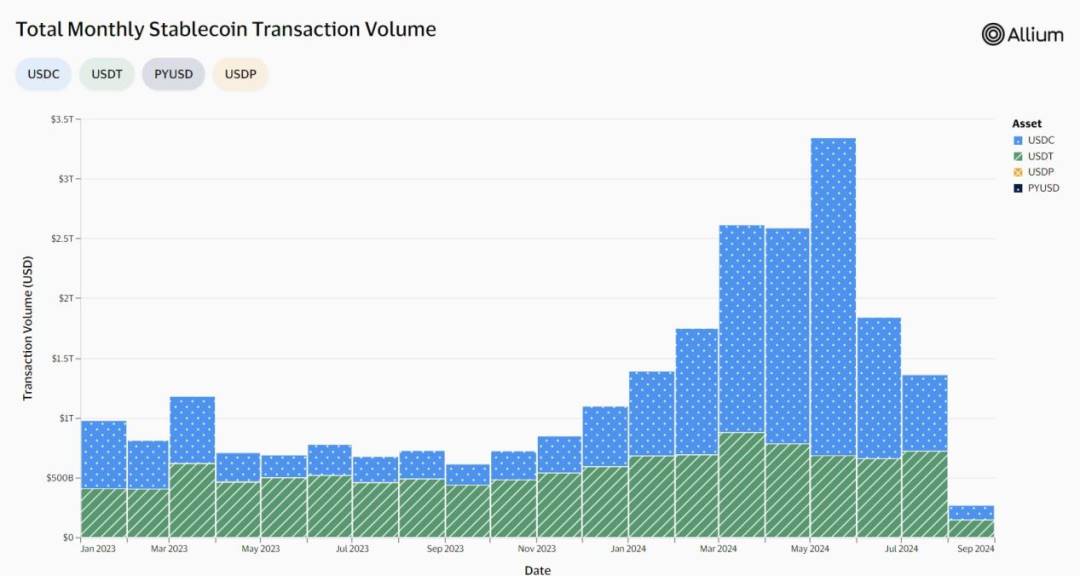
According to SoSoValue, approximately $165 billion in tokenized money circulated as stablecoins by July 2024. Coinmetrics reports that total stablecoin transaction volume reached nearly $7 trillion in 2023, with USDT accounting for about two-thirds.
Stablecoins are experiencing explosive global growth—a clear long-term trend. Visa recently launched a public on-chain stablecoin analytics platform (Visa Onchain Analytics), offering insights into this growth and demonstrating how stablecoins and underlying blockchain infrastructure facilitate global payments.
Overall stablecoin transaction volume grows ~3.5x year-over-year. When focusing on transactions initiated directly by consumers and enterprises (excluding automated HFT, large institutional flows, and smart contract interactions), stablecoin volume reached $2.5 trillion over the 12 months ending May 2024. For comparison, this exceeds PayPal’s 2023 annual volume ($1.53 trillion) by 1.5x (Mastercard: $9 trillion)—equivalent to the GDP of India or the UK.
(Visa Onchain Analytics)
4.3.2 Advantages of Stablecoins
Fiat-backed stablecoins offer the best of both worlds: low daily volatility plus blockchain advantages—efficiency, affordability, and global reach—making them the primary medium for Web3 payments and pricing goods and services. These blockchain benefits have been discussed earlier, but their dollar peg also confers unique value:
1) Alleviating Currency Depreciation—Store of Value
Currency volatility negatively impacts emerging market economies, costing 17 emerging markets $1.2 trillion in GDP between 1992 and 2022—averaging 9.4% of their GDP. Dollar-pegged stablecoins help mitigate uncertainty and economic loss by offering stable value.
2) Enhancing Dollar Accessibility—Settlement Currency
The U.S. dollar is stable, widely accepted, and dominates global trade. In 2022, it accounted for 88% of all forex trades and over 40% of cross-border payments. Direct use of dollars may be restricted in certain regions. As a digital alternative, dollar stablecoins can be sent instantly worldwide via the blockchain internet—operating 24/7, accessible with internet, and enabling seamless transactions.
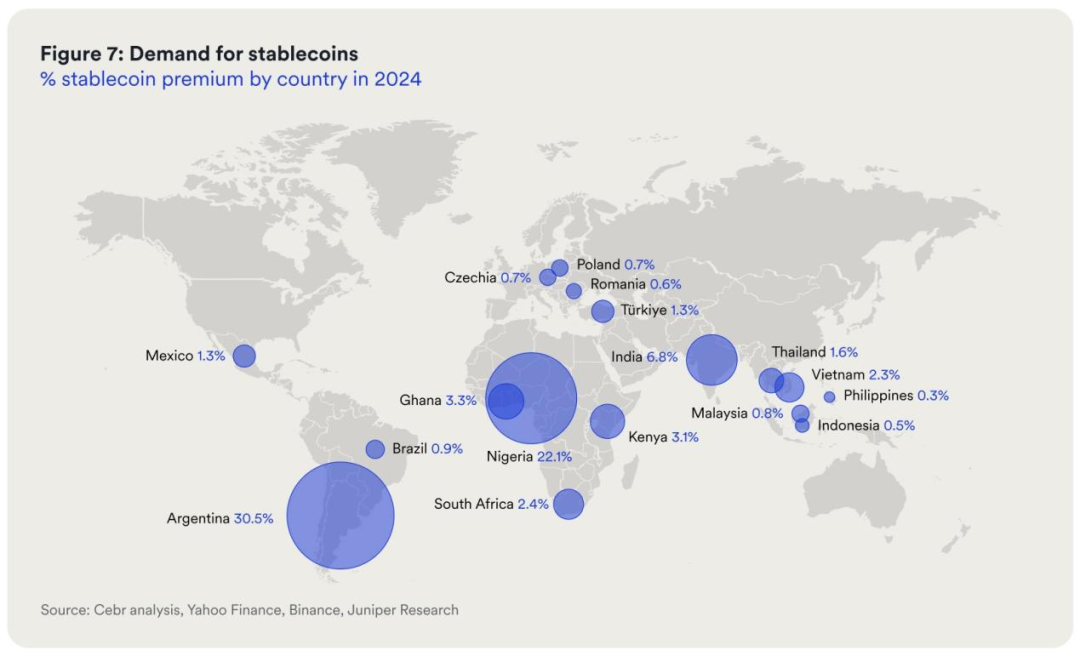
According to BVNK & Cebr’s report *The Decade of Digital Dollars*, demand for dollar stablecoins is high in emerging economies—manifested as a “stablecoin premium.” Surveyed businesses and consumers in 17 countries/regions paid premiums averaging 4.7% above standard dollar rates—rising to 30% in Argentina. Estimated premium payments will reach $4.7 billion in 2024 and $25.4 billion by 2027.
(*The Decade of Digital Dollars*)
3) Global Accessibility—Financial Inclusion
World Bank research shows about a quarter of the global population remains unbanked (especially in Asia, Africa, Latin America). Expanding electronic payments, internet access, and mobile phone usage can boost financial inclusion.
Stablecoins offer the best solution. Anyone with internet can use them—no traditional bank account or identity verification required. This promotes global financial inclusion, and low entry barriers sustain the stablecoin demand premium.
Global accessibility is key to stablecoin adoption in regions like Asia, Africa, and Latin America—where stablecoins, as digital/cash versions, safely store value and enable instant transfers. Wherever dollars are used, stablecoins can act as digital alternatives and a means to capture more value in commerce.
Case Study G: Circle USDC—The Next Evolution of the Dollar
Circle’s mission is to promote global economic prosperity through frictionless value exchange, leveraging the openness and interoperability of the internet to build a new internet financial system. Circle aims to harness breakthrough innovations in the next-generation Web3 value internet to enable free capital flow, making the world fairer and more prosperous.
In 2018, Circle launched USDC, a dollar-pegged stablecoin, now the second-largest by market cap—over $33 billion in circulation, ~20% of the stablecoin market. In 2023, USDC issuance/redeemption volume reached $197 billion, supporting use in over 190 countries and regions.
Five years ago, Circle CEO Jeremy Allaire envisioned a digital form of fiat currency—what he called “fiat tokens” (before “stablecoins” became common)—running on blockchain networks, enabling anyone to build interoperable value exchange applications on this open network.
Thus, Circle positions itself as an Open Platform for Money on the Internet—better understood as: a Web2 dollar API, and a dollar settlement layer atop the Web3 value internet. It’s a well-regulated, open-source building block easily integrated into fintech, traditional finance, and crypto projects—enabling pricing
Join TechFlow official community to stay tuned
Telegram:https://t.me/TechFlowDaily
X (Twitter):https://x.com/TechFlowPost
X (Twitter) EN:https://x.com/BlockFlow_News
 0xWillmfer


