From "Text" to a Game World Generated with One Click: AI Breaks the Ice in Web3 Gaming's Narrative "Winter"
TechFlow Selected TechFlow Selected
From "Text" to a Game World Generated with One Click: AI Breaks the Ice in Web3 Gaming's Narrative "Winter"
Leveraging AI generative models to solve the typical challenges faced by Web3 games is the best approach to achieve breakthrough and growth in the short term.
 Navigating Web3 tides with focused insights
By Kasou Kazoku
In the world of Web3 gaming, we are witnessing a particularly challenging era. Between 2018 and 2023, a total of 2,817 Web3 games were launched—yet tragically, 2,127 (75.5%) failed to succeed, highlighting the industry's difficulties.
Although Web3 games have not truly sparked a revolution since 2018, they are frequently rekindled with renewed hope whenever crypto enters a new chapter. Combined with current market bullishness, we may soon see many such games reach astonishing valuations.

Looking specifically at 2024 and 2025, the concentrated explosion of numerous AI models such as DALL-E, Stable Diffusion, Midjourney, and ChatGPT leads us to believe that "AI permeating into Web3" will become a key driving force. Based on breakthroughs in AI technology, DeGame officially announced in July the launch of its “AI-generated games” feature. Through a suite of interoperable, composable, programmable tools and modular models for generating games, video, and voice content, this initiative aims to bring a powerful revival to the Web3 gaming industry.
With nearly 3 billion Web2 gamers and almost 600 million Web3 users globally, Web3 gaming has a strong narrative foundation. However, capital and projects remain largely concentrated at the infrastructure level, lacking fresh catalysts for mass user adoption and narrative transformation.
The real driver behind game industry advancement lies in technological transformation. As AI application in game development matures, leveraging AI generation models to solve typical challenges facing Web3 games may be the optimal short-term strategy to achieve breakout growth and cross-boundary expansion.
Breaking the Ice from the 'Frozen Narrative' Era
Playability has long been the core weakness preventing Web3 games from attracting mainstream players. Monotonous gameplay and crude visuals often make players feel like they’ve stepped back a decade. For average gamers, however, the only true benchmark for judging a game is whether it’s fun. Overemphasizing “Fi” (finance) may attract gold farmers but fails to convert Web2 users at scale.
From a practical standpoint, gaming is an extremely capital- and time-intensive industry. Its breakout requires the convergence of funding, time, and technology. By 2024, AI appears capable of consolidating these elements. The maturation of modular AI generation tools now provides stronger support for Web3 games to advance toward AAA-quality production and higher standards.
In traditional games, NPCs (non-player characters) possess very limited artificial intelligence, usually operating under fixed conditions. With AI technology, NPCs can simulate human behavior more realistically and operate in smarter ways. For example, in *Save Me! Labor Law Guardian*, AI-powered NPCs enable real-time dialogue-based puzzle solving, significantly enhancing interactivity and immersion.
Additionally, AI can assist in generating environments, character designs, and balancing game mechanics, further enriching diversity and playability. It also enables more intuitive and natural interactions—beyond traditional keyboard-and-mouse inputs—to include voice commands, gestures, and facial expressions.
Overall, the most successfully implemented application of AI in gaming today is undoubtedly enhancing player experience and personalizing content. AI generation models can optimize development cycles, integrate the best aspects of traditional Web2 games at lower costs, and smooth the onboarding process for incremental users entering Web3 gaming—an essential step toward large-scale migration from Web2 to Web3 games.
Unleashing Infinite Creativity
Decentralized blockchain serves as a crucial counterbalance to AI (and machine learning). First, it can integrate with other technologies like ZK to improve trust frameworks in machine learning. Second, it efficiently leverages long-tail resources, reducing the cost and barrier to using AI. On the flip side, many Web3 applications sacrifice user experience for security and decentralization—this is where AI can step in to enhance usability. This symbiosis represents one of AI’s most promising roles in empowering Web3.
In terms of practical use cases, while AI+DeFi and AI+DID/social have seen some implementations, generative AI naturally fits genres familiar to Web2 users—text-based, sandbox, simulation, open-world, and UGC (user-generated content) games. By rewriting game logic with AI, introducing unpredictability and randomness, the fusion of Web3 and AI can spark entirely new forms of gameplay.
For instance, a major innovation in Web3 gaming is co-creation between users and platforms, moving beyond rigidly scripted experiences. In traditional games, lore is predetermined and fully predictable. But with AI models, diverse inputs can be synthesized into unpredictable outputs, enabling games with infinite possibilities.
Imagine a future where we access magical virtual worlds via AR/VR devices, instantly creating any 2D or 3D object we envision—or even things beyond imagination—simply by typing a prompt, like casting a spell. These creations would then become truly ours (data hosted on public blockchains). We could interact with intelligent AI NPCs within the virtual world, influencing the unfolding of its story—all powered by fully transparent, open-source infrastructure.
Under this vision, AI-driven Web3 gaming will unleash boundless creativity.
Rapid Evolution and Continuous Convergence
In fact, early traces of AI in game development may date back much further.
AI applications in game development trace back to classic titles like StarCraft and Diablo. At the time, developers relied on AI systems to build interactive virtual worlds and characters, establishing what later became standard practice for such platforms.
Early research focused primarily on controlling non-player characters (NPCs), but with advances in natural language processing (NLP), pioneering work emerged in using deep learning for procedural level generation.
A notable example is MarioGPT, which successfully generated sections of Super Mario Bros. levels using a fine-tuned GPT-2 model.
As models rapidly iterate, AI capabilities continue to grow stronger. For practitioners in the Web3 gaming space, mastering how to better leverage AI for high-quality game creation—and integrating AI generation models into the development pipeline—is central to capturing incremental users.
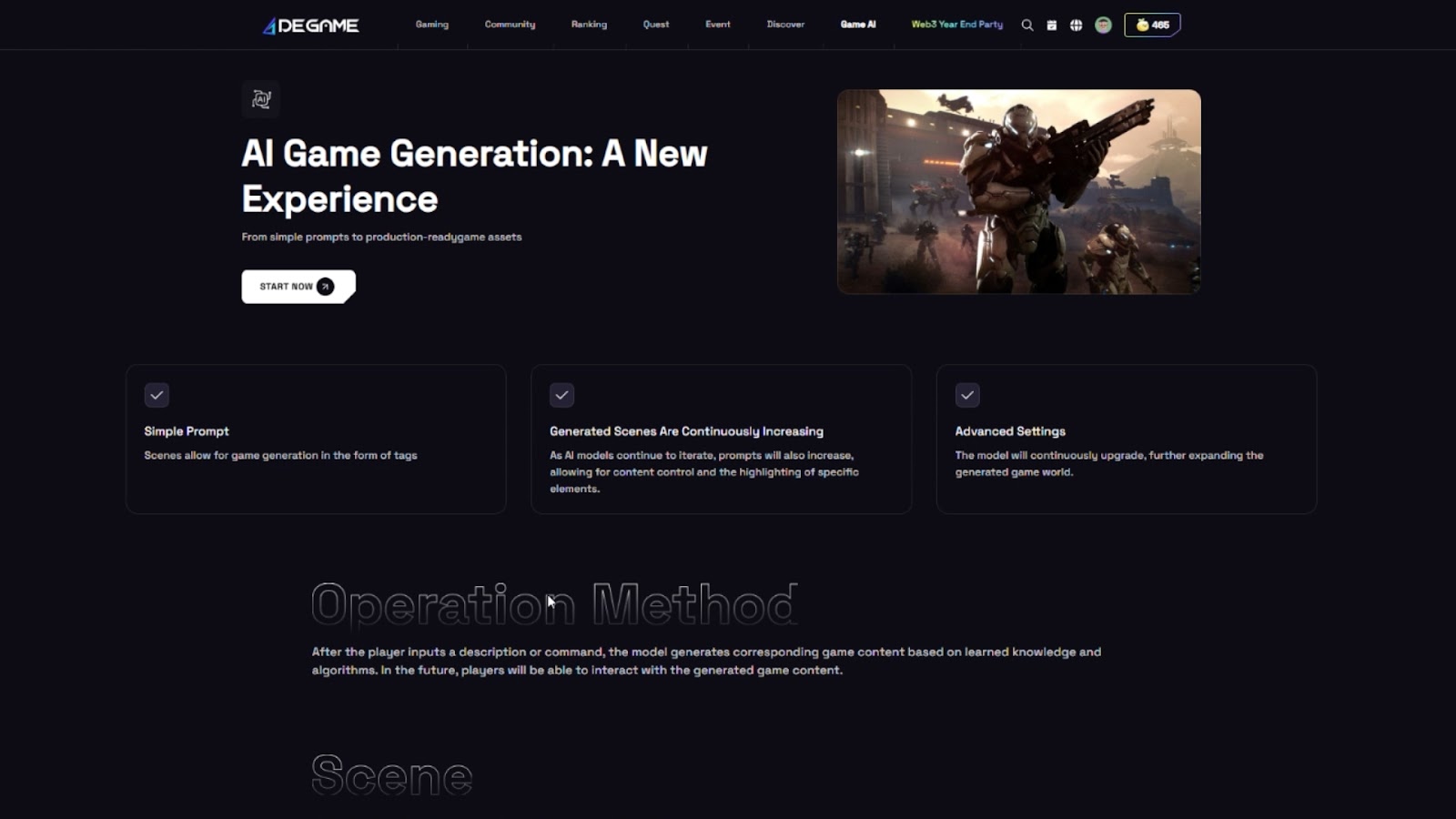
DeGame AI is a lightweight, generation-focused model and a no-code creator tool. It allows users to integrate DeGame AI’s tools into existing game development ecosystems, automating complex content creation tasks. Built on Transformer neural networks and enhanced by DeGame’s Annotation and Substation models, DeGame AI also supports text-to-game-video generation and similar functionalities.
We envision emergent, procedurally generated worlds—each with rich histories, inhabitants, and mysteries. Interactive novels could evolve based on player choices, narrated through generated images, videos, and audio, unlocking unprecedented possibilities for Web3 gaming.
Final Thoughts
If a Web3 game developer aims to complete a compelling game, they must address interactivity, playability, and a solid narrative core—considering character relationships, carefully designing quests, levels, and objectives. Leveraging cutting-edge AI generation models, creators can transform imagination into complex game mechanics and storylines, design AI NPCs with vivid personalities to guide players, influence plot developments, and simultaneously boost development and operational efficiency while lowering costs—ultimately creating new profit drivers.
AI has broad applications throughout game development and operations, including storyline planning, map generation, level design, quest creation, dialogue generation, narrative delivery, asset modeling, and even rule generation for in-game progression and economic systems.
This is just the beginning. We believe exploration at the intersection of AI and Web3 gaming will open a gateway to a new generation of games. As technology advances and applications deepen, players can look forward to increasingly unique experiences that transcend traditional boundaries, delivering deeper immersion and richer interactivity. For gamers passionate about innovation, this is truly an exciting era.
Join TechFlow official community to stay tuned
Telegram:https://t.me/TechFlowDaily
X (Twitter):https://x.com/TechFlowPost
X (Twitter) EN:https://x.com/BlockFlow_News