More Than Mini-Games: A Deep Dive into TON's Ambitions in the Payments Arena
TechFlow Selected TechFlow Selected
More Than Mini-Games: A Deep Dive into TON's Ambitions in the Payments Arena
As more high-quality applications are implemented and user traffic is converted, TON has the potential to secure a place in the global payment market.
 Navigating Web3 tides with focused insights
Author: Satou
In the blockchain space, The Open Network (TON) is gradually emerging in the payments赛道 due to its unique advantages and solid user base. In 2024, TON's ecosystem demonstrated strong growth momentum across multiple fronts. According to recent data, as of July 21, 2024, over 730 million USDT have been issued on the TON network, serving as a key driver for the development of TON’s payment ecosystem. Additionally, TON gaming platforms such as Notcoin, Hamster Kombat, and Catizen have achieved remarkable success, attracting 35 million, 230 million, and 25 million users respectively.
As the TON ecosystem continues to mature and expand, its application prospects in DeFi, GameFi, and SocialFi are becoming increasingly clear. The CGV Research team dives deep into TON’s ambitions in the payments赛道, exploring how it leverages its strengths to overcome challenges and achieve long-term development in crypto asset management and DeFi.
TON's Unique Advantage: Backed by Telegram's Massive User Base
According to Statista, as of April 2024, Telegram had 900 million monthly active users, ranking eighth globally among social networks. By comparison, Solana—the public chain with the highest number of monthly active addresses—had only 14 million, less than 2% of Telegram’s user count, according to Token Terminal estimates.

In terms of geographic distribution, aside from its origins in Russia and Ukraine and the diverse U.S. market, Telegram’s user base is primarily concentrated in developing regions such as Southeast Asia, Africa, and Latin America.
Based on user demographics, Telegram has a massive user base but relatively low per-capita income, making it better suited for traffic-driven services rather than high-net-worth client offerings.
Compared to other social networking projects, Telegram launched its own blockchain early on and tightly integrated the chain with its social platform.
-
In 2017, Telegram founders Pavel Durov and Nikolai Durov began developing the Telegram Open Network (TON) blockchain project, planning to launch its native cryptocurrency, Gram.
-
In 2018, they raised approximately $1.7 billion via an ICO, which attracted scrutiny from the U.S. Securities and Exchange Commission (SEC).
-
In 2020, due to regulatory issues, Telegram announced its withdrawal from the TON project, returning development to the community. The TON Foundation took over, rebranding the project as "The Open Network" and renaming the token Toncoin, while refunding ICO investors.
After several setbacks, in 2023, Telegram officially announced that TON blockchain would become its preferred Web3 infrastructure, with plans to integrate it directly into the Telegram app interface. In contrast, Facebook’s Libra (later Diem) cryptocurrency network was eventually abandoned after two and a half years of regulatory pressure and operational hurdles.
Moreover, Telegram’s privacy-focused and unregulated nature makes it more crypto-friendly. It also hosts gray-market industries that cannot pass regulatory scrutiny—industries that were among the earliest widespread use cases for cryptocurrencies. As a result, Telegram already hosts a large number of crypto users.
Overall, TON’s ecosystem has enjoyed a first-mover advantage in cryptocurrency development thanks to its integration with Telegram.
Traffic Monetization: Current State of TON Mini Games
Compared to Ethereum’s briefly popular “pure-play” fully on-chain games, the recent viral hits on TON are mostly fully off-chain games—casual (and sometimes seemingly juvenile) mini-games that attract users through economic incentives. Fully on-chain games rely on grand narratives of autonomous worlds and cultural identity to draw users but often fail to achieve mass adoption. TON’s mini-games, by contrast, are more straightforward: open your phone, tap the screen a few times, earn points, and later redeem those points for tokens with real value.
Recently, the explosion of TON gaming projects has revealed the industry’s vast potential.
-
Notcoin features extremely simple gameplay—users earn coins by tapping their screens, which can be exchanged for Notcoin tokens. It attracted over 35 million players, debuted on Binance and OKX, saw its price rise steadily post-listing, and reached a peak market cap close to $3 billion.
-
Hamster Kombat follows a similar “Tap to Earn” model but adds card purchasing/synthesis, daily check-ins, social media tasks, and referral rewards. It gained over 230 million registered users in under four months.
-
Catizen is a casual cat-raising game that combines in-game monetization with airdrops to generate direct cash flow, earning over $10 million in revenue, attracting over 25 million players, and converting 1.4 million users onto the blockchain.
Notcoin opened up the imagination for the赛道, Hamster Kombat dominated in user traffic, while Catizen represents a more refined and sustainable direction—showing that future success will require more than just taps; projects must establish a cash flywheel from day one.
On one hand, simple game design enables broader user participation and better user metrics. On the other hand, the simplicity also lowers botting costs, potentially inflating user data significantly.
Going forward, TON’s mini-game developers will inevitably shift focus from raw user numbers to conversion rates—requiring not only better game design but also sophisticated monetization systems that generate sustainable cash flow and ensure long-term viability.
Gauging Strategic Priorities Through Official Channels
According to TON’s official website, Mini Apps, GameFi, and DeFi are the key product categories the platform aims to onboard.
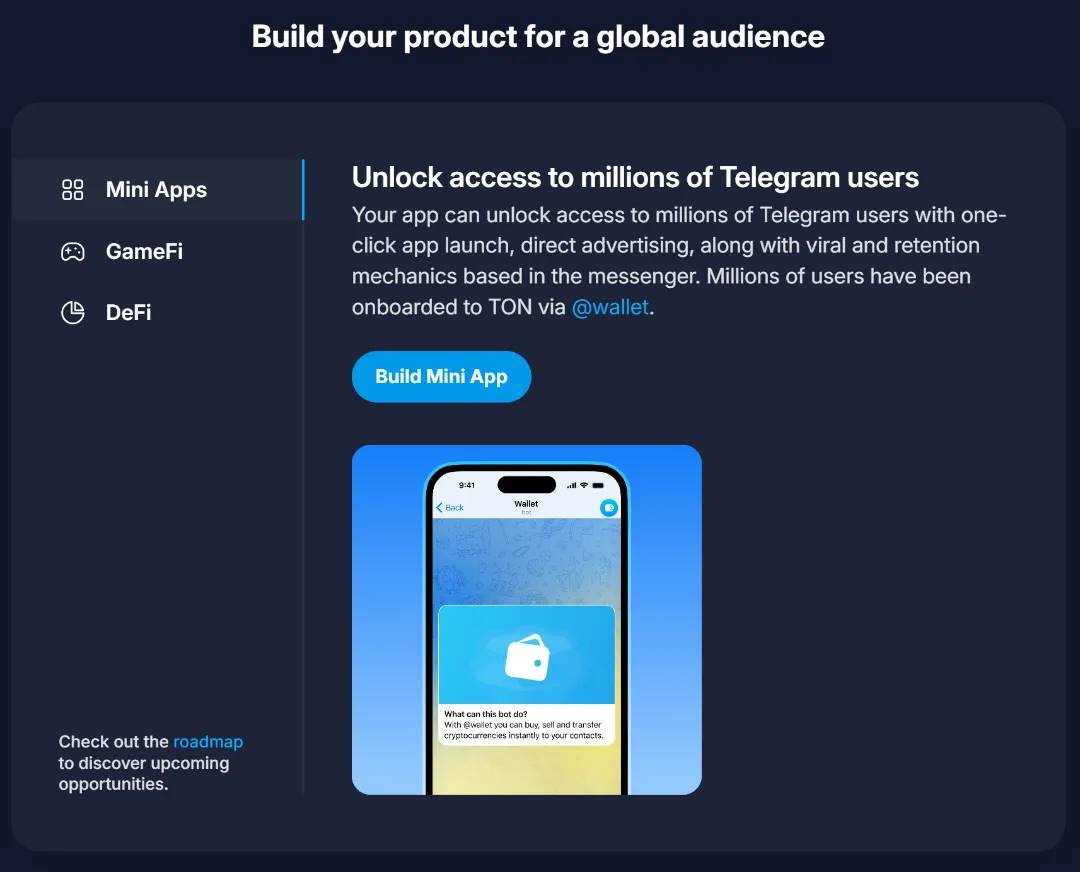
The TON Foundation’s Grants program explicitly supports these categories and provides examples for each. Below are key excerpts:
-
SocialFi: Creator economy
-
E-commerce: Marketplaces for digital or physical goods
-
Utility: Everyday tools with embedded Web3 elements
-
Community & Brand Management: Tools for managing Telegram communities
-
Onboarding Platforms: Bringing new users to @wallet or sub-custodied TON wallets through simple use cases
-
Telegram Mini Apps: Social Web3 Use Cases
-
Lending protocols
-
Derivatives DEXs
-
DEXs with weighted pools (like Balancer.fi)
-
Yield aggregators
-
Liquidity layers
-
Restaking
-
We are always happy to support web3 games with easy onboarding, viral social mechanics, referral programs, elements of competition (squads, leaderboards, group challenges), and exciting gameplay.
-
DeFi
-
GameFi
From the above, Social Web3 use cases supported by Telegram’s built-in Mini Apps will be a primary focus; for DeFi, TON aims to diversify application types; for GameFi, TON can assist games with user onboarding, viral social sharing, referral systems, and competitive mechanics.
Short-Term Outlook: The Pros and Cons of the TON Ecosystem
Why Not DeFi (For Now)
A key indicator of DeFi growth is Total Value Locked (TVL). Among current blockchains, Ethereum leads by a wide margin, with $60 billion in DeFi TVL—more than all other chains combined. This dominance stems from several factors: the high value of ETH itself inflates TVL; Ethereum hosts nearly every major DeFi innovation; wrapped assets like wBTC enhance liquidity; and staking & restaking mechanisms generate significant LST/LRT supply, further boosting TVL.
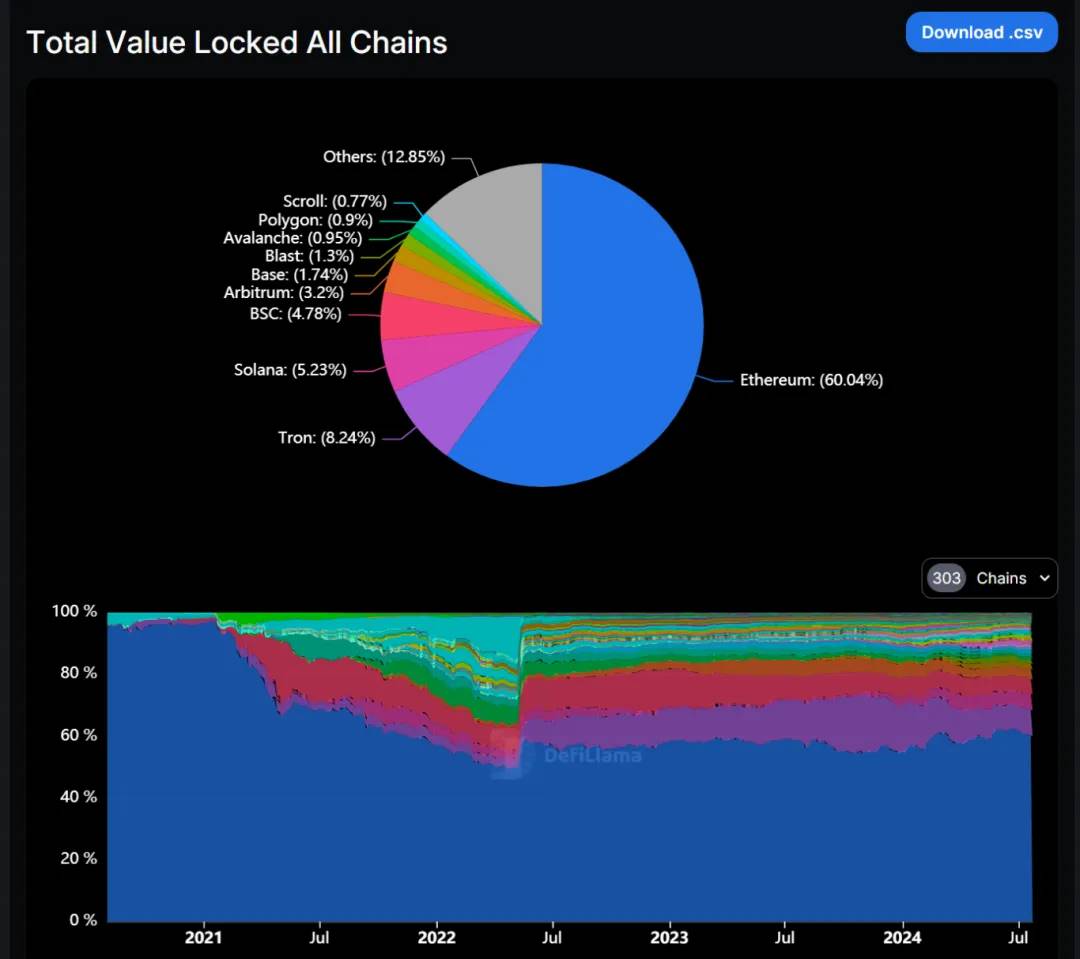
For TON, the largest asset on-chain is Toncoin, valued at around $17.5 billion. The second-largest is USDT, authorized by Tether, which surpassed $730 million on July 21, ranking fifth among all blockchains. However, according to DefiLlama, TON’s current TVL stands at $757 million—clearly insufficient.

In the view of CGV Research, TON’s DeFi breakout still lacks several conditions:
-
Onboarding of BTC, ETH, and other major assets: The most traded assets on CEXs are typically large-cap blue-chips like BTC and ETH. Therefore, secure, low-slippage, low-fee cross-chain bridges are needed to bring substantial BTC and ETH into TON. Currently, TON’s cross-chain bridge infrastructure remains under development.
-
More diversified liquid staking products: TON transitioned from PoW to PoS, with initial supply allocated to miners and the team. After transitioning to PoS, inflation is capped at 0.6% annually to reward validators. Compared to other PoS chains, TON’s less than 10% staking rate is low. More liquid staking products are needed to increase both staking participation (enhancing security) and TVL.
-
More secure wallet infrastructure: Telegram’s built-in @wallet is a custodial wallet. Combined with Telegram’s unregulated nature, this raises trust concerns among high-net-worth users. TON needs to roll out more secure solutions like MPC wallets, undergo rigorous audits, and build trust with premium users.
These requirements, however, are unrelated to Telegram’s biggest strength—user traffic—meaning TON would be abandoning its core moat, potentially leading to inefficient outcomes.
Why Payments?
Native USDT is being issued on TON at an extremely rapid pace—as previously noted, over 730 million USDT had been issued by July 21. Currently, Tron holds the largest USDT issuance, with over $60 billion in TRC20-USDT. Tron’s data reveals the vast potential of stablecoin payments.
TRON has over 235 million users, processed over 7.8 billion transactions, generated $450 million in annual network fee revenue, and sees 2–3 million accounts transferring over $10 billion daily. Most USDT holders on TRON are retail or small holders. There are 52.6 million holders with balances below $1,000—even growing during the 2022 bear market—compared to just 359,000 holders in the $1K–$10K range.
On-chain activity on Tron consists almost entirely of USDT transfers, with minimal DeFi usage, negligible NFT activity, and no presence of LST/LRT or memecoins—yet it still sustains 7.8 billion transactions. In essence, Tron is a blockchain built for stablecoin payments.
Tron’s widespread adoption in stablecoin payments stems from three core factors:
-
Lower transaction fees and faster speeds than Ethereum, with higher TPS
-
Early adoption created a Matthew effect—bilateral flywheels between users and merchants
-
Long-term reliable service building user trust
Compared to Tron, TON offers several advantages in payments:
-
Higher TPS: With sharding enabled, TON can support up to millions of TPS, with lower fees than Tron
-
Closer to users: TON Wallet is natively embedded in Telegram, offering greater convenience and richer use cases—akin to WeChat Pay
-
More diverse on-chain activity: TON supports various applications that retain capital, beyond simple fund transfers
The TON Foundation is actively promoting USDT adoption on TON:
-
5 million TON allocated to reward USDT farming pools—deposit USDT to earn Toncoin with APY up to 50%
-
On July 1, Tether partnered with Web3 shopping and infrastructure firm Uquid, enabling Filipino citizens to pay social security fees with USDT on TON
-
USDT transfers via Telegram’s built-in wallet are free, instant, and allow sending to contacts without requiring wallet addresses
-
Subscriptions, VPNs, gaming platforms, eSIMs, and other products within Telegram can now accept USDT payments on TON
Furthermore, payments will serve as a foundational primitive, empowering Telegram Mini Apps across various Social Web3 use cases. For example, creator economies (SocialFi) need payments for subscriptions and tips; e-commerce requires payments for purchases. More importantly, Telegram Mini Apps could evolve into a Web3 version of the AppStore, which inherently requires payment functionality for paid apps. Telegram may follow Apple’s model, taking a cut from paid services offered through its AppStore, further diversifying its revenue streams.
Currently, TON has integrated multiple third-party payment platforms, enabling merchants to accept payments in various ways.
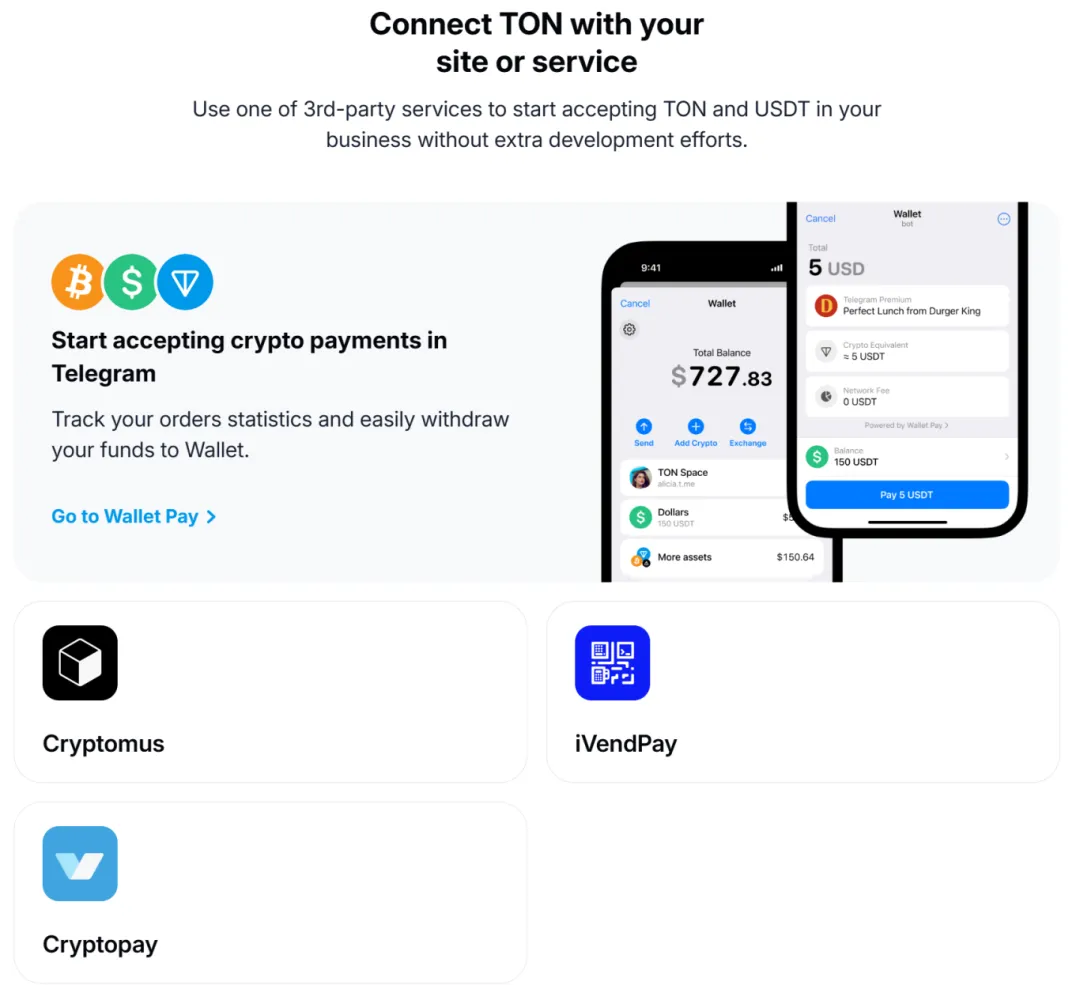
Of course, compared to WeChat Pay, TON’s payment ecosystem still faces risks. Chief among them is that Telegram’s emphasis on privacy and regulatory independence may prevent many real-world businesses from adopting TON payments due to compliance concerns. However, the TON Foundation is actively seeking solutions—one indication being that KYC is required to claim rewards from the USDT Farming Pool, suggesting TON’s cautious approach toward compliance.
In conclusion, CGV Research believes TON’s rise in the payments赛道 is no accident, but rather the result of its powerful user base, technological edge, and strategic ecosystem vision. Despite ongoing challenges such as regulation and user trust, TON’s innovative payment solutions and deep integration with Telegram demonstrate strong growth potential.
Looking ahead, as more high-quality applications emerge and user traffic converts into sustained engagement, TON is poised to secure a significant position in the global payments market, becoming a major force in blockchain-based payments.
Join TechFlow official community to stay tuned
Telegram:https://t.me/TechFlowDaily
X (Twitter):https://x.com/TechFlowPost
X (Twitter) EN:https://x.com/BlockFlow_News
 @CGVFOF