









After touching 70,000, it plunged straight down by 4,000 dollars—has the bull run just ended like this?
TechFlow Selected TechFlow Selected
After touching 70,000, it plunged straight down by 4,000 dollars—has the bull run just ended like this?
BTC, ETH, and altcoins at a crossroads?
 Navigating Web3 tides with focused insights
By Azuma, Odaily Planet Daily
Bitcoin has once again experienced a roller-coaster ride.
According to OKX market data, around 9:00 PM last night, BTC broke above 70,000 USDT for the first time in over a month, peaking at 70,050 USDT. However, just as the market began speculating whether this could signal a new all-time high, BTC suffered a sharp and significant pullback. As of 10:00 AM today, BTC briefly dipped below 66,000 USDT and is currently trading at 66,175.1 USDT, down 3.51% over the past 24 hours.
ETH’s situation differs slightly. Influenced by events such as the launch of ETH ETFs and outflows from Grayscale, ETH did not show strong momentum prior to BTC breaking 70,000 USDT. However, perhaps due to market anticipation of a potential turning point in inflows/outflows, ETH's recent correction has been relatively mild. As of 10:00 AM, ETH is trading at 3,299.2 USDT, still posting a slight 24-hour gain of 0.67%.
The altcoin market also warrants attention. Breaking from the previous pattern where “alts remain flat when BTC rises, and collapse violently when BTC falls,” most altcoins did not see major drawdowns during this significant BTC correction. The 24-hour跌幅 of most coins were smaller than BTC’s, with some including PEPE, AAVE, and LDO even recording positive gains.
Data from Alternative shows that while the Fear & Greed Index remains in "greedy" territory, it has declined notably from 74 to 67.
In derivatives, Coinglass data indicates that total liquidations across markets reached $197 million in the past 24 hours, with the vast majority being long positions—$140 million worth. By asset, BTC accounted for $87.14 million in liquidations, while ETH saw $51.58 million.

BTC: Pullback Expected, Institutions and Miners Remain Optimistic
Looking first at BTC, buoyed by positive sentiment from the Nashville Bitcoin Conference—especially unexpectedly favorable remarks from political figures like Trump—BTC maintained strong performance last week, particularly in the latter half.
Given this context, and with the conference now concluded, the market had already anticipated some potential pullback.
Bitfinex Alpha reported yesterday that implied volatility in Bitcoin options spiked during the Nashville event but has since declined, suggesting a period of short-term consolidation may be ahead.
However, early this morning around 7:30 AM, a small test transaction (0.02 BTC) was detected from the Mt. Gox address. Given that previous similar tests were followed by large-scale actual withdrawals, this reignited market fears and amplified the sell-off—the lowest point of today’s dip occurred around 8:15 AM, shortly after the news emerged.
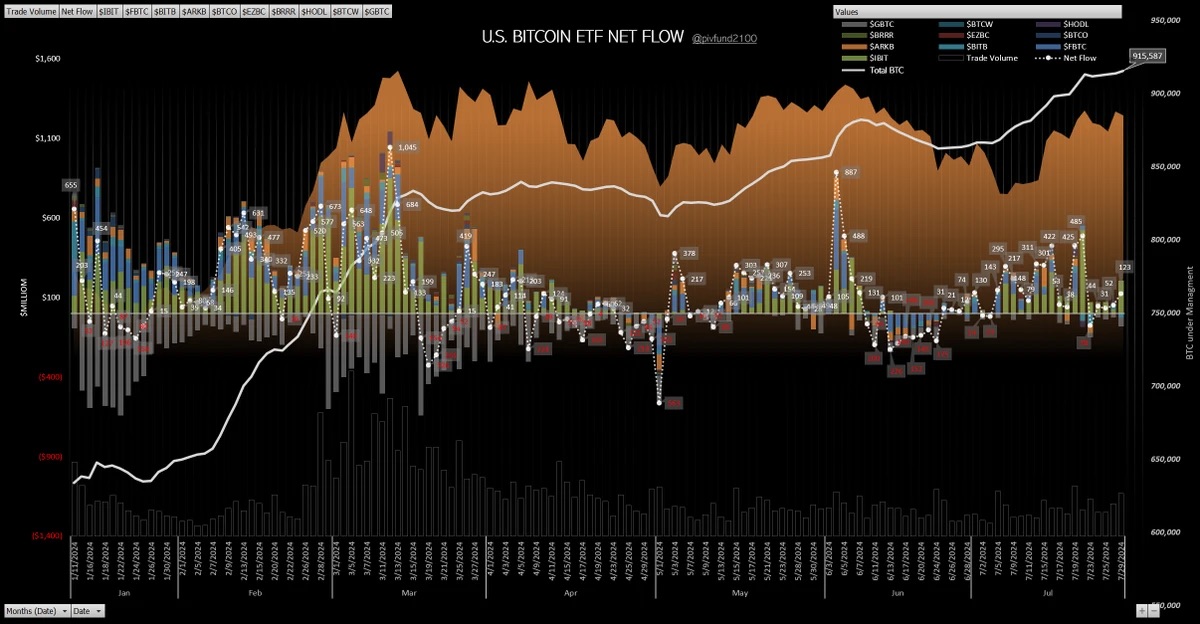
Yet ETF flow data suggests institutions remain relatively optimistic about BTC. According to Trader T, U.S. spot Bitcoin ETFs recorded a net inflow of $123.1 million yesterday. This means that over the past two weeks (excluding weekends), only one trading day saw net outflows, while more than ten others posted positive inflows.
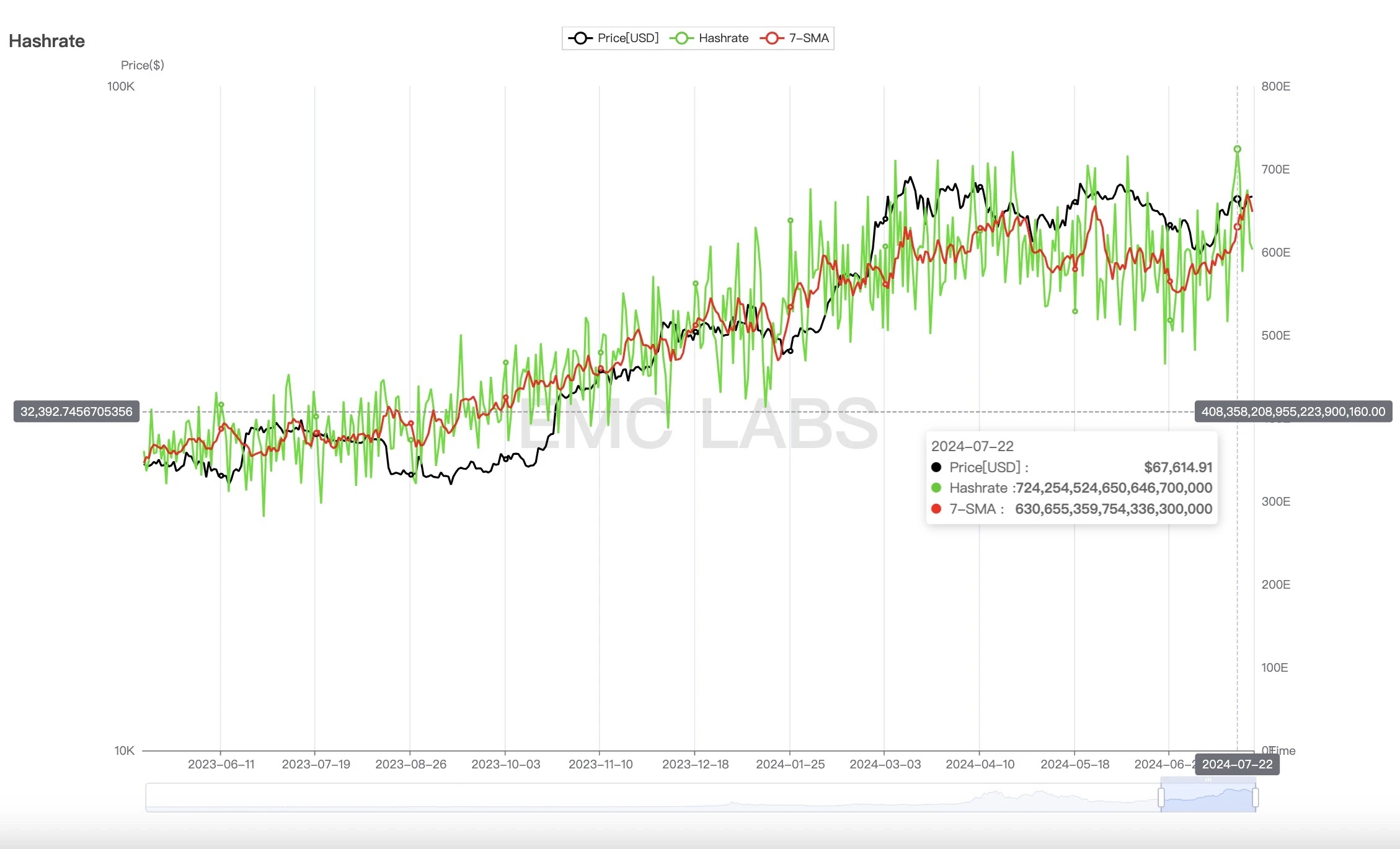
Additionally, research firm EMC Labs noted that recovering hash rate data reflects miner optimism. On July 20, Bitcoin network hash rate hit a record high of 724 EH/s, and the 7-day average is nearing all-time highs. This recovery in hash rate signals strong confidence among miners—one of the most crucial communities—and supports the case for BTC reaching new highs in the future.
ETH: Awaiting the Turning Point
Unlike BTC, ETH’s recent price action has been heavily influenced by the newly launched spot Ethereum ETFs.
Although eight ETFs—including BlackRock’s ETHA, Fidelity’s FETH, Bitwise’s ETHW, and Grayscale’s Mini ETH—have consistently seen net inflows, the massive outflows from Grayscale’s ETHE have placed hundreds of millions in net selling pressure on ETH, whose liquidity is inherently weaker than BTC’s.
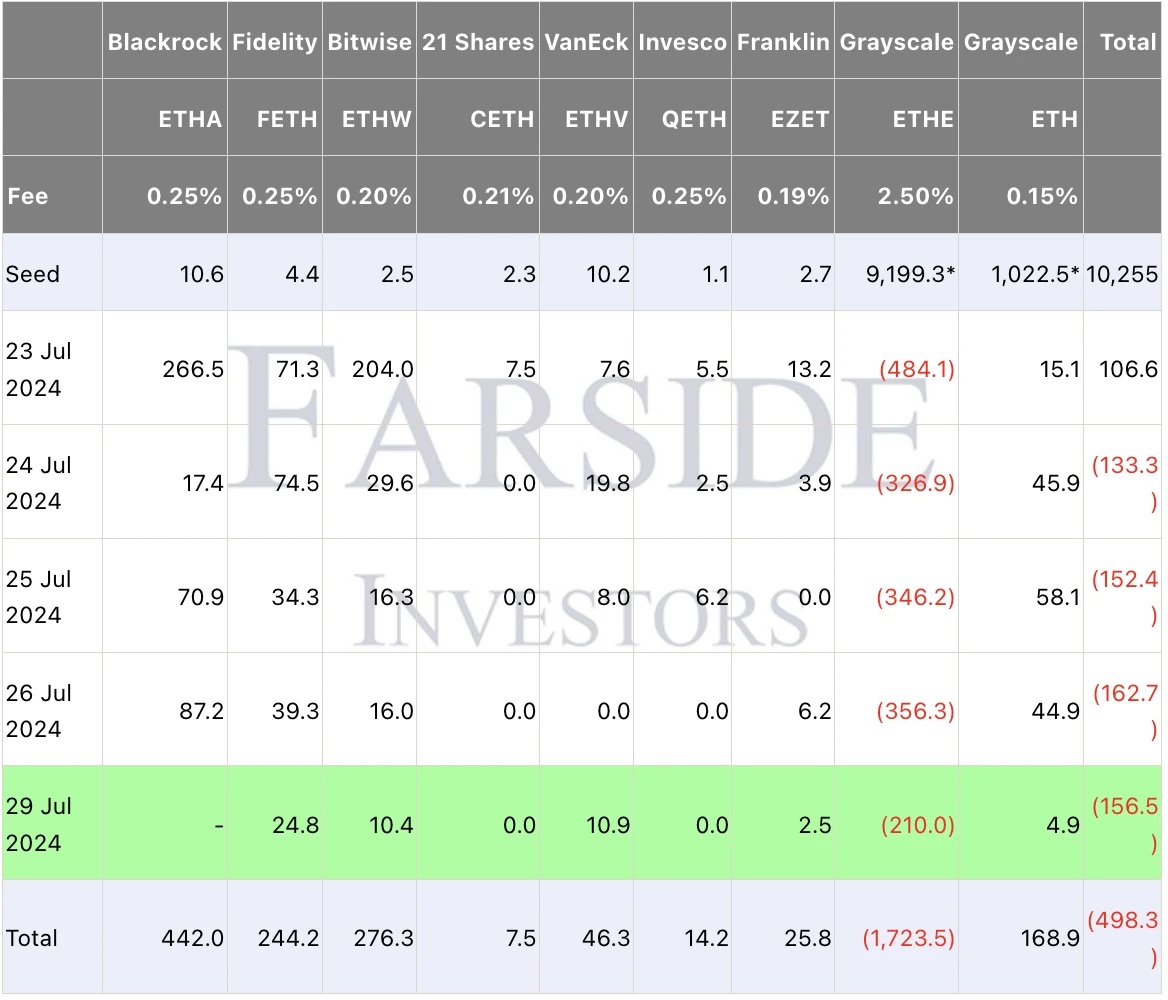
Farside Investors data shows that spot Ethereum ETFs saw $156.5 million in net outflows yesterday, totaling $498.3 million over the past five trading days—of which Grayscale accounted for $1.723 billion in outflows, while other ETFs combined saw $1.225 billion in inflows.
One cautiously optimistic note: ETHE has seen 19.7% outflow over the past five days. If we assume a final outflow of 50%, it would take approximately 17 more days to complete. But as ETHE outflows slow, inflows into other ETFs are expected to offset them.
Overall, ETHE’s outflow pace is much faster than GBTC’s was during its ETF transition. If ETH can mirror BTC’s post-ETF pattern of “falling first, then rising,” its turning point may arrive earlier than BTC’s did.
Altcoins: Will the Bull Market Return?
Previously, Odaily Planet Daily published several analyses on market liquidity and altcoin trends: “Data Deep Dive: ETFs Are Delaying the Real Bull Market,” “Times Have Changed: This Cycle’s Alt Season May Be Absent,” and “Can Altcoins Be Saved?”
Overall, apart from a few sectors like memes and AI, and select projects benefiting from ETF speculation such as SOL, the performance of most altcoins in this market cycle has been disastrous. Three main reasons explain this:
-
First, the approval of ETFs has altered the liquidity transmission mechanism. Previously, new capital flowed through the path of “stablecoins → BTC/ETH → alts.” Now, traditional-market capital prefers to invest directly in BTC via ETFs, cutting off the spillover to altcoins and causing severe liquidity shortages in the altcoin market.
-
Second, continuous large-scale unlocks of “VC tokens” have created persistent selling pressure, resulting in an oversupplied market. Upon closer inspection of certain altcoins’ circulating supply dynamics, you’ll find that while prices keep falling, circulating market caps continue to set new highs.
-
Third, high-profile new projects are draining the remaining market liquidity. io.net, ZKsync, LayerZero, Blast… a slew of highly promoted projects have launched consecutively, each with FDVs often in the billions, further straining altcoin market liquidity.
Nonetheless, despite these challenges, some top-tier figures remain optimistic about altcoins’ future.
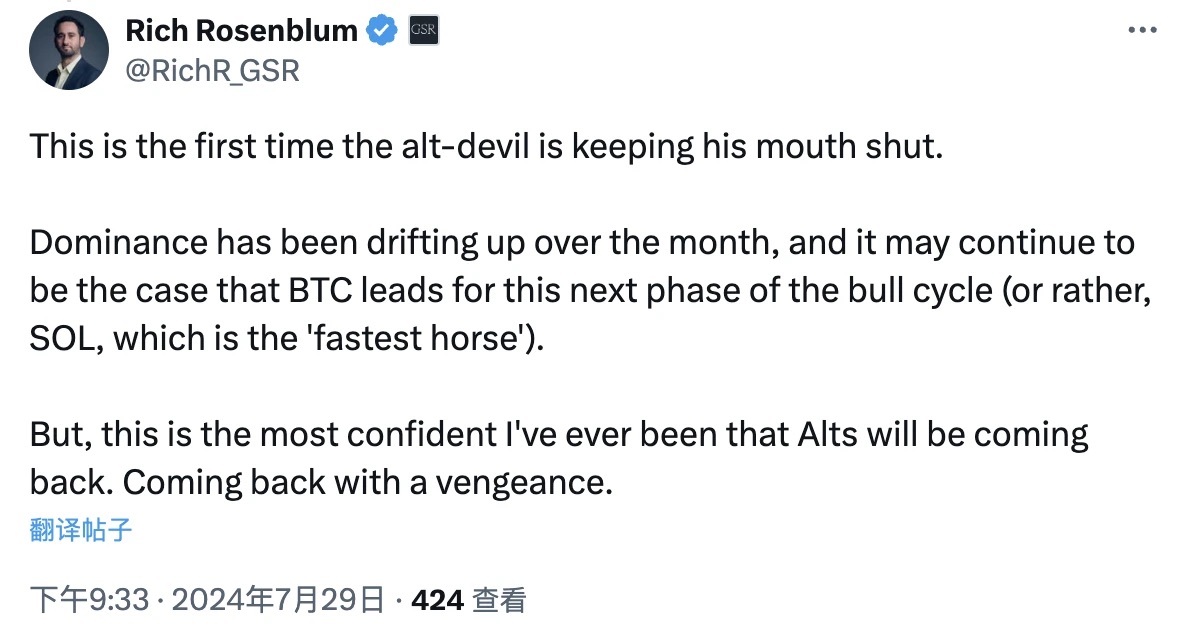
Rich Rosenblum, Co-CEO and Co-Founder of crypto market maker GSR, posted on X yesterday stating that altcoins will make a comeback—and a strong one. “This is the most confident I’ve ever been,” he said.
Given that the old pattern of “alts stagnant when BTC rises, alts crash when BTC falls” appears to be breaking, whether Rich’s prediction (what a fitting name…) will come true remains to be seen. We’ll keep watching.
Potential Variable: Macro Week
Notably, several macro events this week could potentially impact future market movements.
On Wednesday, July 31, at 11:00 AM Beijing time, the Bank of Japan will announce its interest rate decision and outlook report;
On Thursday, August 1, at 2:00 AM, the Federal Reserve will release its rate decision, followed by Chair Powell’s monetary policy press conference 30 minutes later;
Later that evening at 7:00 PM, the Bank of England will publish its interest rate decision, meeting minutes, and monetary policy report.
Adam, macro researcher at Greeks.live, commented that although market expectations are largely aligned, any surprise outcome could act as a bombshell.
Join TechFlow official community to stay tuned
Telegram:https://t.me/TechFlowDaily
X (Twitter):https://x.com/TechFlowPost
X (Twitter) EN:https://x.com/BlockFlow_News
 Odaily











