Attention as the Core: A Look at the Ecosystem Strategies of TON, Solana, and Base
TechFlow Selected TechFlow Selected
Attention as the Core: A Look at the Ecosystem Strategies of TON, Solana, and Base
In Web3, SocialFi and memes represent the attention economy, with TON, Solana, and Base leading the pack.
 Navigating Web3 tides with focused insights
Author: Zeke, YBB Capital Researcher
TL;DR
-
The current trajectory of Web3 development is shifting from competing for TVL and building DeFi ecosystems toward attention economics. In Web3, SocialFi and Memes are prime examples of attention economics, with TON, Solana, and Base standing out as leading ecosystems.
-
TON currently holds strong potential, driven by explosive growth in mini-games and Mini Apps, along with increasing interest from top-tier exchanges. Solana’s Blinks still face significant unresolved issues that hinder widespread adoption. Base, under Coinbase's stewardship, is steadily maturing.
-
The best economic model might be no economic model at all—once something becomes calculable, its lifecycle and ceiling become finite.
1. Embracing Attention Economics
Ethereum has completed its transformation from 0 to 1, yet the industry remains stuck in the paradox of scaling from 1 to N. As a result, most of our articles this year have focused on how foundational infrastructure can address modular shortcomings, largely overlooking discussions about applications and ecosystems. In our previous article, we mentioned that application scarcity stems from Layer2s not being robust enough to support the emergence of “super apps.” Beyond limitations in virtual machines and TPS caps, most Layer2s remain fixated on extracting value from the mainnet via incentives and DeFi ecosystems, aiming solely to rapidly dominate in TVL. This templated approach merely spawns a series of faster, cheaper, but less liquid versions of “Ethereum,” which offer users no meaningful differentiation in experience due to extreme homogenization.
In contrast to these “template chains,” emerging ecosystems like TON, Solana, and Base are fostering genuine on-chain prosperity by embracing attention economics. According to the definition, attention economics refers to an economic model that maximizes user or consumer attention, cultivating potential customer bases to achieve long-term commercial gains. In such an economy, the most critical resource isn't traditional financial capital or information itself—it's public attention. Only when people notice a product do they stand a chance of becoming consumers. One key method to capture attention is visual competition, which is why attention economics is also known as "eyeball economics."
In Web2, platforms like YouTube, Twitter, Google, and TikTok exemplify attention economics. Consider a simple example: have you ever paid to use these platforms? Most likely not. Yet, have you noticed them constantly pushing ads for products you like? That’s because someone is paying for your attention—this monetization of traffic into goods sustains internet giants valued in the trillions.
In Web3, SocialFi and Memes represent attention economics. We won’t delve deeply into Memes here; instead, let’s focus on today’s SocialFi landscape. Whether it’s Friend.tech or Solana’s Blinks, in my classification, both fall under SocialFi—even TON as a blockchain could be categorized as a social-type app chain. The form—be it project, component, or chain—is less important than the ultimate goal: converting public social media traffic from traditional Web2 platforms into private, monetizable flows. This aligns precisely with what I wrote over a year ago about ideal non-financial Web3 applications: they should “leech” from Web2 rather than rebuild heavy applications already proven ineffective in Web2.
2. TON
2.1 Architecture
TON was originally designed to enable seamless payments and run Mini Apps within Telegram, without consideration for traditional DeFi applications—this explains why its TVL lags far behind other major blockchains. Why build a dedicated chain instead of embedding mini-programs and payments like WeChat? Because Telegram’s global user base faces inconsistent monetary and regulatory environments, making blockchain an ideal source of trust. Here’s a brief overview of TON’s architecture:
-
Multi-chain structure: TON employs a multi-chain architecture comprising one Masterchain and multiple Workchains, enabling parallel processing of different transaction types and applications, significantly boosting throughput;
-
Masterchain: The core of the TON network, storing network configurations and final states of all Workchains, maintaining lists of active validators, their stakes, active Workchains, and associated Shardchains;
-
Workchains: Customizable blockchains optimized for specific transaction types or use cases, each supporting unique rules, consensus mechanisms, and tokenomics;
-
Shardchains: Each Workchain can be split into up to 2^60 Shardchains, enabling TON to handle massive concurrent transactions;
-
Dynamic sharding: Automatically splits or merges Shardchains based on network load to maintain optimal size and efficiency;
-
Hypercube routing: Enables efficient cross-Shardchain communication, ensuring smooth ecosystem-wide transactions;
-
Validator network: Uses Proof-of-Stake (PoS), where validators stake Toncoin to maintain the network and validate transactions;
-
TON DNS: A domain name system assigning human-readable names to accounts and smart contracts, improving usability;
-
TON Storage: A decentralized file storage solution built on BitTorrent-like technology;
-
TON Proxy: Offers decentralized VPN and TOR-like services to enhance privacy and censorship resistance;
-
TON Payments: A Lightning Network-like payment channel system for efficient micropayments;
-
TON Services: A platform for developers to deploy apps and smart contracts.
This complex architecture theoretically allows TON to scale infinitely, handling millions of transactions per second from billions of users while maintaining high speed, low fees, and decentralization—providing infrastructure for diverse applications. However, it also brings challenges related to centralization and complexity, aside from being inherently unfriendly to DeFi.
2.2 Mini-Games
Notcoin’s listing on Binance ignited a frenzy around Tap-to-Earn mini-games on TON. From a traffic distribution perspective, Tap-to-Earn has been extremely successful. Moreover, Binance Labs’ first investment after nearly six months of silence went into TON’s mini-game ecosystem. While this may primarily serve exchange user acquisition, Binance remains the industry’s biggest trendsetter. This signals Binance’s confidence that Notcoin won’t be the last hit.
So, back to the core question: are airdrops combined with mini-games sustainable? Most of us probably remember the viral WeChat mini-game “Sheep Me Once” from 2022. It guided players through an easy first level, then drastically increased difficulty in the second, creating frustration and fierce competitiveness fueled by social circles. To obtain power-ups or extra lives, users were pushed to share widely and watch ads. Combined with unique timing, this turned the game into a phenomenon, reportedly earning nearly 5 million RMB daily in ad revenue.
Simply put, a successful mini-game monetization path relies on addictive gameplay to retain users, then converts engagement into ad or in-app purchase revenue—the basic logic being “game → ads/purchases → monetization/exits.” But is this easily replicable in Web3? I believe it’s difficult and unsustainable. Currently, many teams are buying mini-game source codes, attempting to close the loop by combining airdrop incentives with traditional monetization—or even resorting to exchange referral codes for traffic distribution, hoping at best to get rich from tokens. In reality, most Tap-to-Earn games feel “homogenized, studio-driven, airdrop-focused, lacking stickiness, and dead upon token launch.” After being disproven, only a few quality projects will survive; most will fail to control Sybil attacks and never recoup costs.
From a retail investor’s standpoint, I still think there’s room to speculate cautiously. Entry cost is nearly zero. Personally, I believe Binance intends to leverage its influence to recreate several “STEPN”-like successes. Most TON projects align well with top exchanges’ preferences: low market cap, high user count. Notcoin was the only mid-sized project during this cycle listed on both OKX and Binance. Its aggressive post-listing price surge and Binance’s favorable stance toward TON (recently announcing Banana Gun airdrops for Binance holders) all echo the early days of STEPN. Of course, Binance’s ultimate goal is to pump BNB—sustainability doesn’t matter, as long as it “blows up.”
2.3 Mini Apps
Mini Apps remain one of my most favored directions—potentially a compelling step toward mass adoption for Web3. I won’t elaborate too much on their utility since WeChat already provides answers. Simply put, Mini Apps complement each other: compared to WeChat, they offer broader reach and greater flexibility. Imagine a small-to-medium e-commerce platform launching in multiple countries, needing to distribute subsidies. Using local social apps would incur huge marketing and time costs. With TON, tracking user task completion becomes more efficient, transparent, and significantly cheaper—this bottom-up advantage is exactly where blockchain shines.
2.4 One of Web3’s Best Abstraction Layers
Solana’s Meme Summer this year boosted not only its own ecosystem but also popularized TG Bots, with top bots achieving daily trading volumes exceeding $100 million. A common flaw among Web3 dApps is poor user accessibility, spawning numerous abstraction-layer projects. These often tout “chain invisibility,” yet ironically become more complex the more abstracted they get, failing to balance security and usability. In my view, only three projects truly excel in user-friendly on-chain access: OKX Web3 Wallet, UXUY, and TON.
The first two need little explanation—during the inscription boom, their superior mobile UX earned massive user favor and played a pivotal role in inscriptions' growth. TG Bots are special—they’re not official apps, but independently developed by projects, supporting sniper trades and transactions across major blockchains with operations faster and smoother than web interfaces. Their end-to-end mobile experience is exceptionally user-friendly. This opens vast possibilities—imagine bringing external DeFi, GameFi, or task platforms into Telegram via Mini Apps. Many projects are already exploring this space with decentralized solutions, potentially realizing true “chain invisibility” within Telegram in the near future.
3. Solana Blinks & Actions
3.1 Architecture
Technically speaking, Blinks and Actions aren’t particularly complex. Their development stems more from Solana recognizing the immense potential of attention economics during Meme Summer and the importance of lowering user barriers. Like TON, their goal is to treat social platforms as a “layer two.” Drawing from our prior research report, here’s an overview of their architecture:
Actions (Solana Actions)
Official definition: Solana Actions are standardized APIs that return transactions on the Solana blockchain, previewable, signable, and sendable across various contexts—including QR codes, buttons/widgets (UI elements), and websites.
Actions can be simply understood as pending transactions. More broadly, within Solana, Actions represent abstractions of transaction processing, covering tasks like transaction execution, contract invocation, and data manipulation. Practically, users can use Actions to send tokens or buy digital assets, while developers leverage them to call and execute smart contracts, implementing complex on-chain logic.
-
Solana processes these tasks via “Transactions,” each composed of multiple instructions executed between specific accounts. Through parallel processing and Gulf Stream protocol, transactions are forwarded early to validators, reducing confirmation latency. Fine-grained locking enables simultaneous processing of non-conflicting transactions, greatly increasing throughput;
-
Solana uses Runtime to execute transactions and smart contract instructions, ensuring correctness of inputs, outputs, and state changes. After initial execution, transactions await block confirmation; once agreed upon by most validators, they are finalized. The network handles thousands of transactions per second with sub-400ms finality. Pipeline and Gulf Stream further boost throughput and performance;
-
Actions aren’t limited to single tasks—they encompass transactions, contract executions, data processing, etc. Similar to other blockchains’ transactions or contract calls, Solana Actions offer unique advantages: efficient processing via optimized design enabling fast execution at scale; low latency thanks to high-performance architecture, supporting high-frequency apps; and flexibility, allowing execution of complex operations including contract calls, data reads/writes, etc.
Blinks (Blockchain Links)
Official definition: Blinks convert any Solana Action into a shareable, metadata-rich link. Blinks allow Action-compatible clients (browser wallet extensions, bots) to display enhanced functionality. On websites, Blinks instantly trigger transaction previews in wallets without redirecting to dApps; in Discord, bots expand Blinks into interactive button sets. Any web interface capable of displaying URLs can thus enable on-chain interactions.
In plain terms, Solana Blinks turn Solana Actions into shareable links (akin to HTTP), and when enabled in compatible wallets like Phantom, Backpack, or Solflare, transform websites and social media into venues for on-chain transactions—allowing any URL-enabled site to directly initiate Solana transactions.
The direct aim of Actions & Blinks is to “HTTP-link” Solana’s on-chain operations and share them directly on Web2 platforms like Twitter.
3.2 Application Examples
Excerpted from @starzqeth’s compilation of 33 use cases
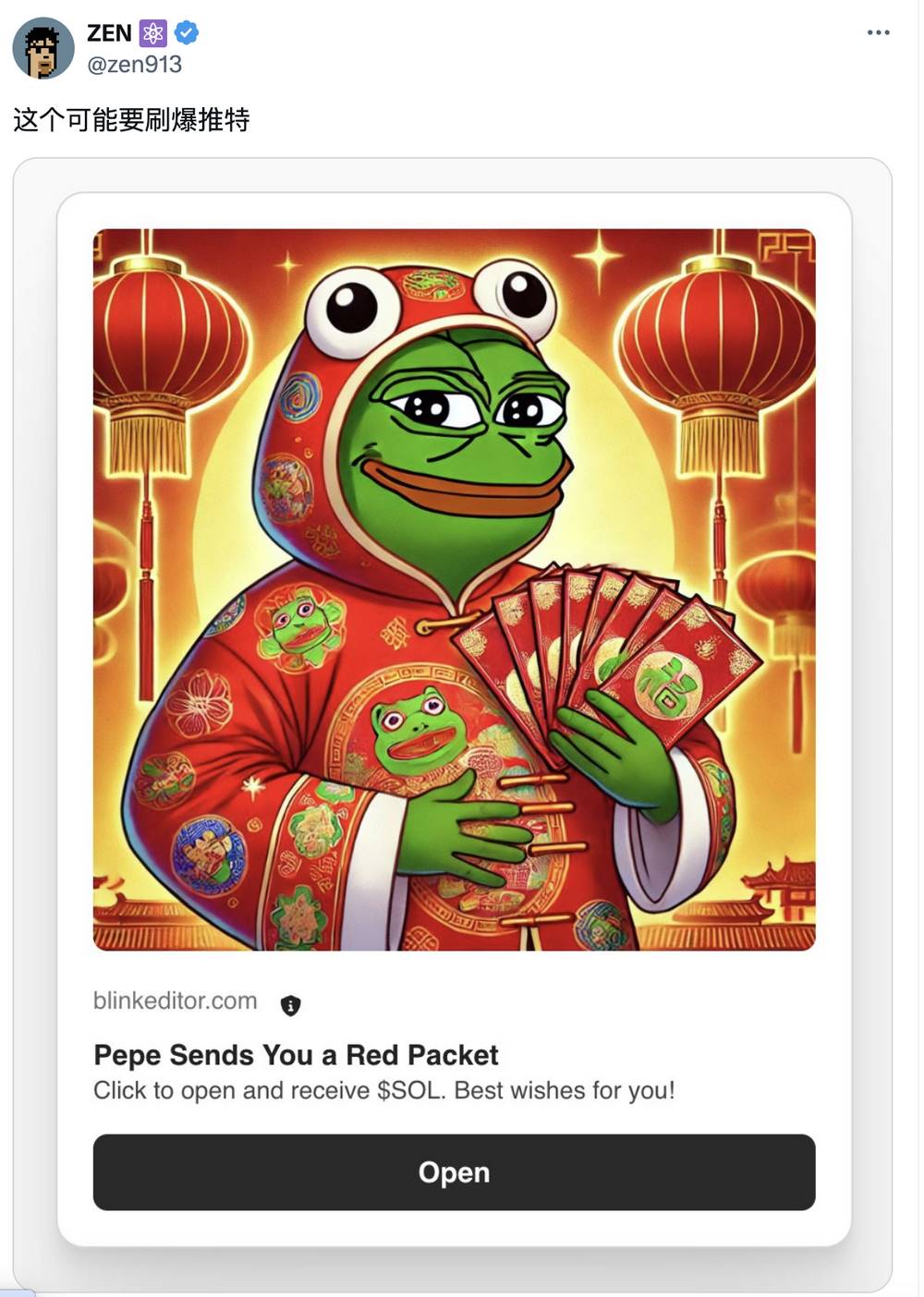
1. Sending红包 (red packets) on social media
Author: @zen913
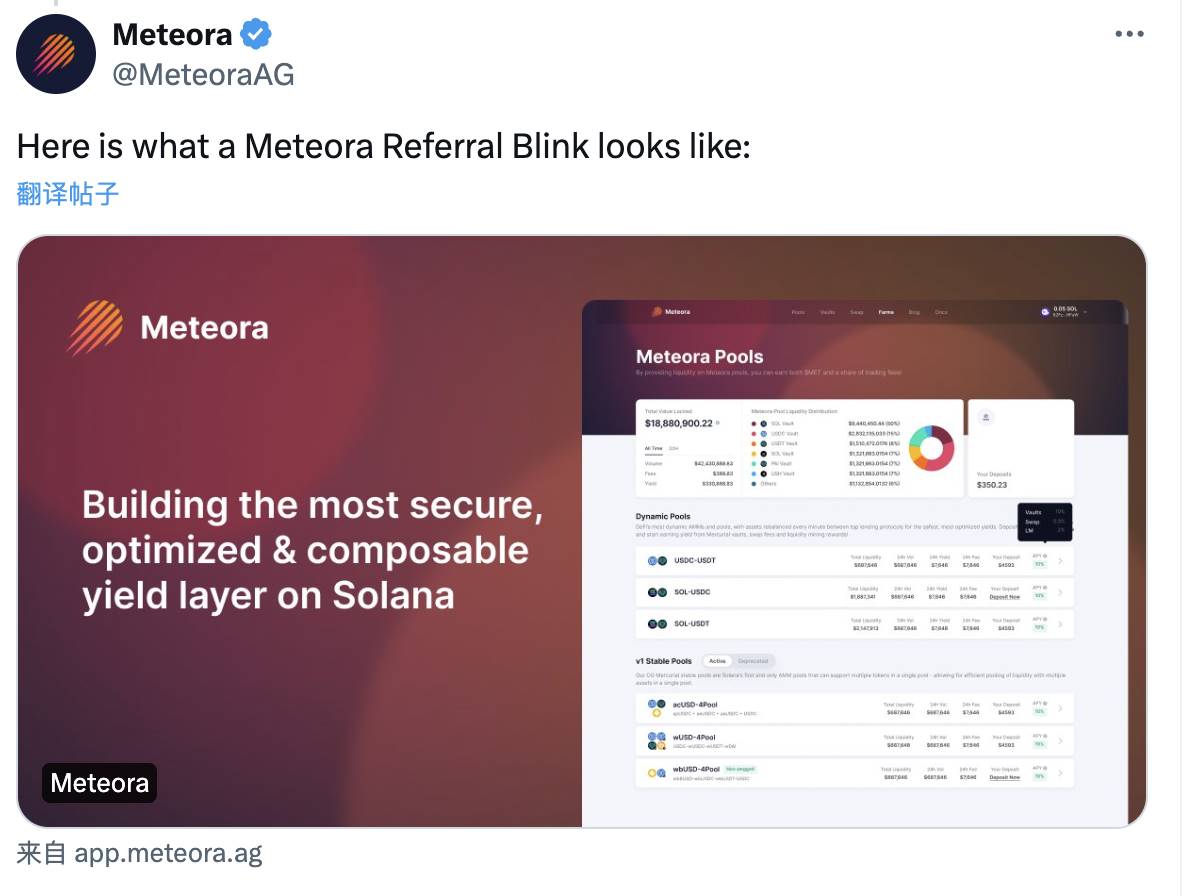
2. Promoting Memes via Blinks
Author: @MeteoraAG
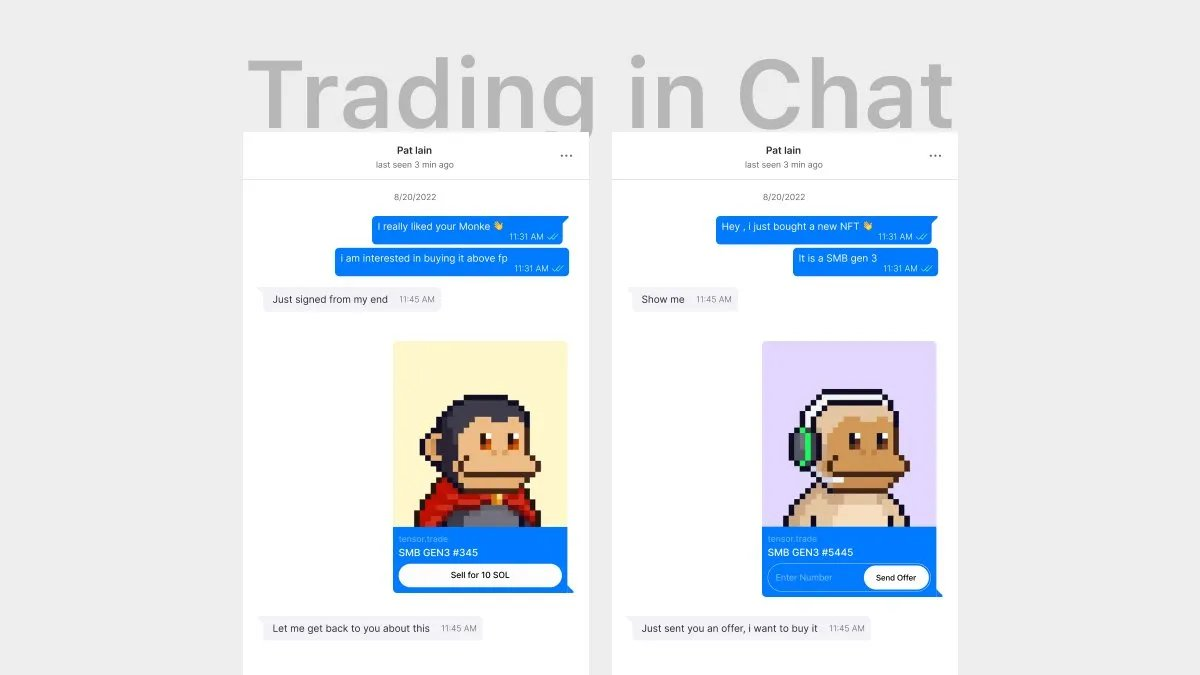
3. Trading in DMs
Author: ft.@tensor_hq
4. Tipping on social media
Author: @zen913
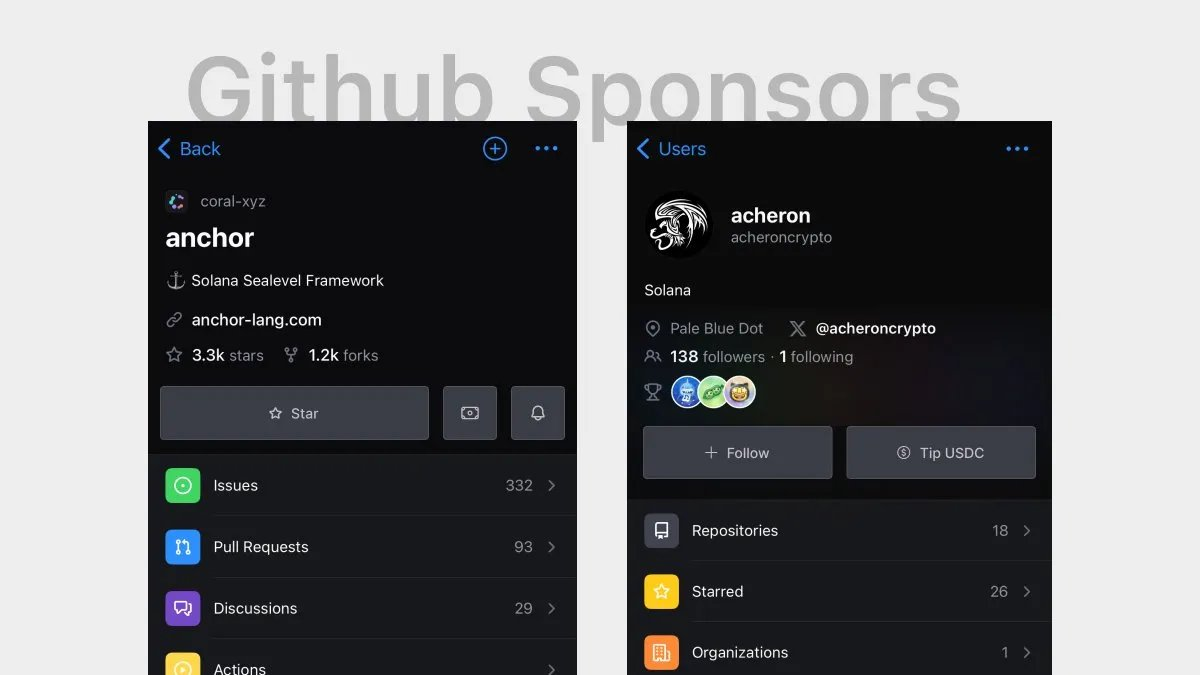
3.3 Lack of Security
Blinks look cool and have gained traction recently, but unfortunately, the actual user experience falls short. First, the feature isn’t very mobile-friendly. Second, every action requires redirecting to a detailed page, connecting a wallet, and signing—a process tightly coupled with wallets, multiplying risks. Would you dare sign a transaction from a link posted by a stranger?
Compared to TON, Blinks only offer wider reach and simplicity. In terms of user experience, they’re no match for the integrated TG+TON flow. Security-wise, it’s not just about decentralization—it heavily depends on wallet-level detection, which remains incomplete. Thus, Blinks currently feel more like an experiment, offering inspiration for other chains, but requiring significant security improvements.
4. Base
4.1 Flying Without a Token
Base’s architecture is likely familiar to most readers, so we’ll skip detailed explanation. Like TON, Base benefits from having a powerful parent. Its rise mirrors Solana’s recent trajectory—bootstrapped by Memes, not reliant on points farming, but propelled purely by wealth-generation narratives to surpass OP. Early momentum came from Friend.tech’s user rush, and after moving past it, Farcaster provided solid backing. Clearly, Coinbase knows exactly how to operate crypto projects.
4.2 Farcaster
Farcaster offers another take on SocialFi. Simply put, it’s an open social protocol framework allowing developers to build various social apps—similar to how email protocols support multiple clients. Its standout feature is interoperability: designed to seamlessly interact with other blockchain networks, enabling smooth cross-platform exchange of information and assets. This allows multiple social media dApps to be built atop Farcaster, such as the popular Twitter-like platform Warpcast.
4.3 Application Examples
Quoted from Wilson Lee, core contributor of the Biteye community
Warpcast
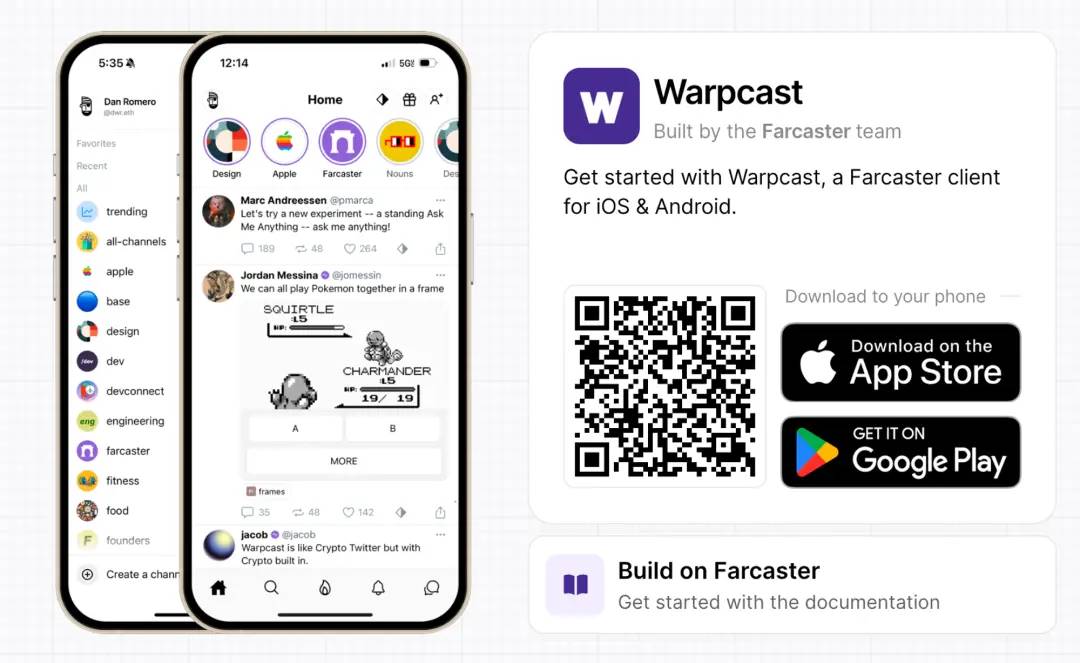
Warpcast is the flagship app under the Farcaster protocol and the first Farcaster client, developed over a year by Dan’s elite engineering team. Its architecture resembles traditional Web2 social apps, offering a smooth user experience and currently capturing 90% of Farcaster’s traffic.
Warpcast features a simple signup process, automatically generating a wallet-bound account. All Warpcast accounts link to a Farcaster ID, with content stored in Farcaster Hubs.
This design allows even non-crypto users to easily enter the on-chain world, dramatically lowering the learning curve.
For experienced users, they can connect their preferred crypto wallets. These features help Warpcast promote both user-friendliness and broader Farcaster ecosystem growth.
Jam
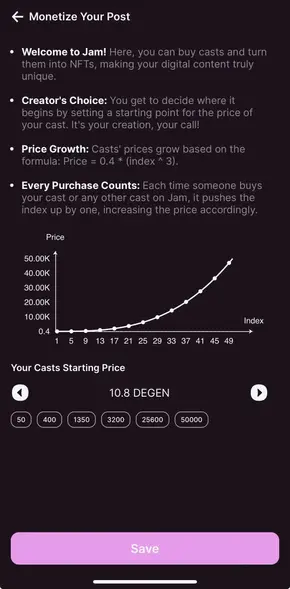
Jam is a creator economy platform built on Farcaster, transforming each user post on Warpcast into an NFT asset akin to Friend.tech Keys. Users can buy/sell individual posts, with prices determined by a Bonding Curve as shown below.
Clubcast
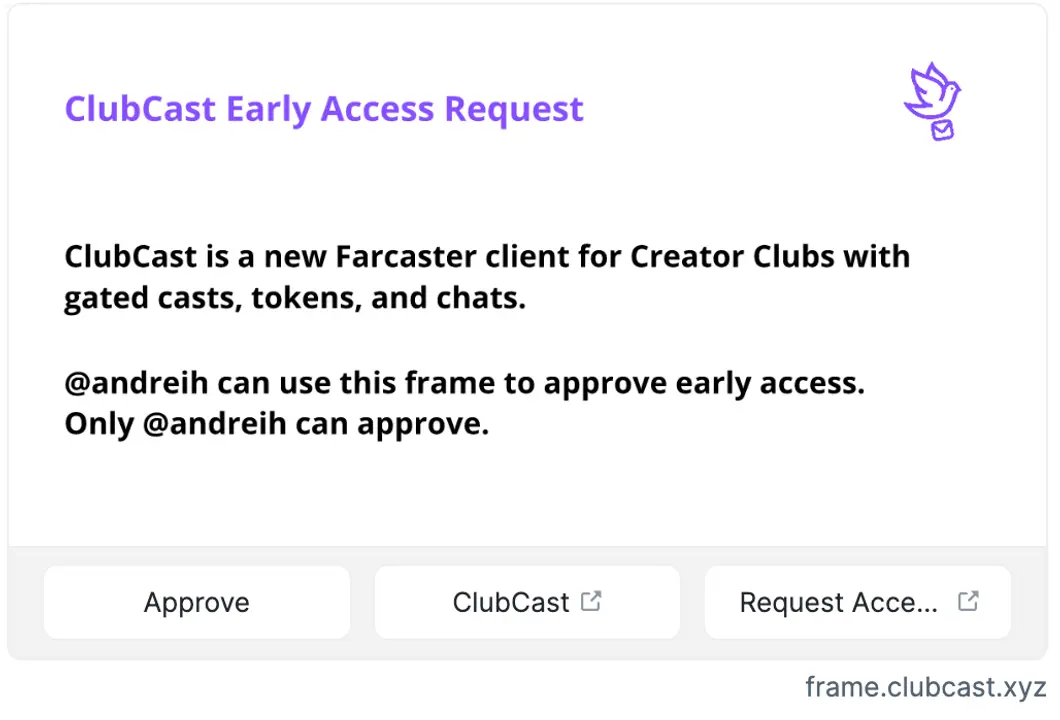
ClubCast is a Farcaster app similar to Zhihu Live, featuring Token-Gated Casts. Users must purchase a creator’s Club Token to unlock hidden content on clubcast.xyz or Frames. Currently, access requires developer permission.
4.4 The Best Economic Model Might Be No Economic Model
Base aims to strengthen itself by offering diverse SocialFi applications via Farcaster, differing from TON or Blinks, which mainly draw and convert users from Web2. Farcaster represents the most traditional Web3 social protocol, hosting lightweight Web2-enhancing apps alongside rebuilt heavy applications. Both require tighter integration with “Fi,” immediately raising questions about content valuation and economic design. Heavy apps additionally face content scarcity and user shortages.
We’ve already addressed the issue of heavy apps at the start. So how should we think about economic modeling? From Friend.tech to Pump.fun, perhaps the best economic model is no model—avoid pricing curves and let things evolve organically. Recall Friend.tech’s peak: endless debates surrounded its Key pricing mechanics. Truth is, once something becomes calculable, its lifespan and ceiling become bounded.
Join TechFlow official community to stay tuned
Telegram:https://t.me/TechFlowDaily
X (Twitter):https://x.com/TechFlowPost
X (Twitter) EN:https://x.com/BlockFlow_News
 @YBBCapital