








A comparison of the current state and outlook for cryptocurrency OTC trading regulation in Hong Kong, Singapore, and the United States
TechFlow Selected TechFlow Selected
A comparison of the current state and outlook for cryptocurrency OTC trading regulation in Hong Kong, Singapore, and the United States
Hong Kong, Singapore, and the United States, as global financial centers, demonstrate different strategies and advantages in regulating cryptocurrency and its OTC trading.
 Navigating Web3 tides with focused insights
Author: Bai Zhen
As of the latest data, centralized exchange (CEX) cryptocurrency trading volume reached $4.29 trillion in the first quarter of 2024, a significant increase compared to previous quarters. In contrast, the over-the-counter (OTC) market primarily serves institutional and high-net-worth individual investors. Although OTC activity is substantial, due to its more private and customized nature, it typically does not reach the trading volumes seen on CEXs. The lack of centralized reporting makes precise OTC trading volume figures harder to determine, but as the overall cryptocurrency market grows, the OTC market continues to expand.
OTC Trading vs Exchange Trading
In the field of cryptocurrency trading, OTC trading and exchange trading each have distinct characteristics, catering to different types of trading needs and user groups. They differ significantly in terms of liquidity, privacy, price slippage, flexibility, counterparty risk, security, regulation, ease of use, and typical users.
1. OTC Trading
OTC (over-the-counter) trading refers to transactions conducted directly between two parties without going through a centralized exchange, usually facilitated by an intermediary or OTC desk. The primary advantage of this method is its ability to handle much larger transaction sizes with minimal impact on market prices, while offering higher privacy and anonymity since trades are not publicly recorded. Additionally, OTC trading minimizes price slippage for large transactions through pre-negotiated pricing and provides flexible solutions, including customized trade sizes and specific settlement terms.
However, OTC trading also presents challenges. Since trades occur off-exchange, participants face higher counterparty default risk, and security depends heavily on the reputation and reliability of the OTC intermediary or desk. OTC trading is generally less regulated, offering greater freedom but fewer protections, and requires finding trustworthy intermediaries, which may make the process less user-friendly. Therefore, OTC trading is typically suited for institutional investors or high-net-worth individuals seeking to transfer large amounts of cryptocurrency.
2. Exchange Trading
In contrast, exchange trading occurs on centralized platforms where buy and sell orders are matched via an order book. This model offers high liquidity across various cryptocurrencies and accommodates trades of all sizes. Exchange trading is transparent and publicly recorded, enabling market visibility. While price slippage remains possible—especially when large orders must be filled across multiple price levels—the standardized environment of exchanges, with fixed rules and procedures, ensures regulatory compliance. With central platforms providing safeguards, counterparty risk is lower, and security measures enhance user protection, although exchanges can become targets for hackers. Exchange trading is typically regulated, offering additional investor protections but potentially imposing trading restrictions. User-friendly interfaces and added features such as market analytics tools and trading bots improve ease of use.
Nonetheless, exchange trading faces certain challenges. Platforms may be subject to regulatory limitations, restricting access for users in certain regions. Moreover, because exchanges must comply with strict KYC (Know Your Customer) and AML (Anti-Money Laundering) requirements, user privacy may be compromised. For some traders, fee structures are also a consideration, as they can increase trading costs. Overall, exchange trading is better suited for retail investors and traders of all sizes who value convenience and a standardized trading environment.
In summary, both OTC and exchange trading have their advantages and disadvantages. The choice between them largely depends on the trader’s specific needs and preferences. For those handling large transactions and prioritizing privacy and flexibility, OTC trading is an ideal option. For those seeking high liquidity, security, and a user-friendly interface, exchange trading is more appropriate. By understanding the differences between these two methods, traders can make more informed decisions to achieve optimal trading outcomes.
Below is a visual comparison.
Comparison of Cryptocurrency OTC Trading Regulatory Frameworks
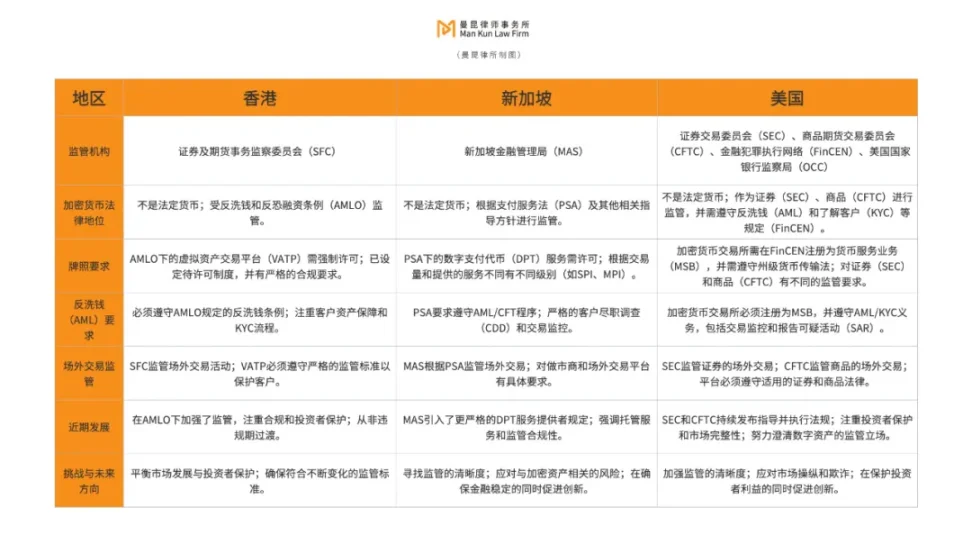
In terms of cryptocurrency regulation, Hong Kong, Singapore, and the United States each have distinct regulations and regulatory environments. Below is an overview of the regulatory frameworks in these three jurisdictions.
1. Hong Kong
Cryptocurrency regulation in Hong Kong is overseen by the Securities and Futures Commission (SFC), with key regulations including the Anti-Money Laundering and Counter-Terrorist Financing Ordinance (AMLO). Virtual Asset Trading Platforms (VATPs) in Hong Kong require mandatory licensing under a transitional licensing regime and must meet stringent compliance standards. Regarding anti-money laundering, Hong Kong enforces AMLO requirements, emphasizing customer asset protection and KYC procedures. The SFC regulates OTC activities, requiring VATPs to adhere to strict standards to protect clients. Recent developments include enhanced oversight under AMLO, focusing on compliance and investor protection, including intercepting funds from illegal channels. Going forward, Hong Kong faces the challenge of balancing market development with investor protection while ensuring its regulatory framework adapts to evolving market conditions.
Currently, currency exchange shops in Hong Kong are highly active, with many offering over-the-counter (OTC) services involving large transaction volumes. Customers can purchase or sell virtual assets in person using cash or other forms. Presently, nearly anyone can open an OTC virtual asset shop in Hong Kong, exposing a loophole in the current regulatory framework.
On February 8, 2024, Hong Kong's Financial Services and the Treasury Bureau (FSTB) launched a public consultation proposing a licensing regime for OTC virtual asset services. Under the proposal, OTC operators would need to apply to Hong Kong Customs for a two-year license. Once licensed, personnel engaged in virtual asset trading could only exchange virtual assets available on at least one approved Hong Kong trading platform. The FSTB plans to submit legislation on the OTC virtual asset licensing system to the Legislative Council as soon as possible.
-
Key requirements for OTC virtual asset business operators include:
-
For operating physical OTC virtual asset businesses: having suitable premises in Hong Kong;
-
For online OTC virtual asset businesses: having a management office, correspondence address, and location for storing books and records in Hong Kong;
-
Employing at least one qualified compliance officer;
-
Employing at least one qualified anti-money laundering reporting officer;
-
Maintaining an appropriate corporate structure with experienced and knowledgeable personnel;
-
Conducting business honestly, fairly, and diligently;
-
Implementing appropriate risk management measures, including AML/CFT policies and procedures;
-
Maintaining records of transactions and fund flows, and providing a complete list of wallets used in the business.
Under the proposal, licensed OTC virtual asset businesses from Hong Kong Customs would not be allowed to convert between virtual assets but could provide conversion services between virtual assets and fiat currencies. If a business wishes to conduct fiat-to-fiat conversions, it would also need a Money Service Operator (MSO) license in Hong Kong.
The proposal includes investor protection measures: OTC virtual asset businesses cannot offer retail investors virtual assets that are not tradable on SFC-licensed VATPs, nor can they offer virtual assets issued by stablecoin issuers not authorized by the Hong Kong Monetary Authority (HKMA). These restrictions do not apply to individuals qualifying as professional investors in Hong Kong.
After the proposal takes effect, existing OTC virtual asset businesses will have a six-month transition period. During this time, they may continue operations only if they submit a license application within the first three months of the transition period.
2. Singapore
Cryptocurrency regulation in Singapore is managed by the Monetary Authority of Singapore (MAS), primarily governed by the Payment Services Act (PSA). Platforms facilitating OTC cryptocurrency transactions may be deemed to provide cryptocurrency services and thus fall under PSA regulation. The following cryptocurrency-related services are currently defined as services provided by cryptocurrency service providers under the PSA:
-
Buying or selling cryptocurrency;
-
Establishing or operating a cryptocurrency exchange;
-
Participating in or providing financial services related to the issuance and/or sale of cryptocurrency;
-
Transferring or transmitting cryptocurrency from one cryptocurrency address to another;
-
Directing (or attempting to direct) any person to buy or sell cryptocurrency (without the provider having actual access to funds or DPTs).
If a company provides cryptocurrency services in Singapore, it must obtain one of two main licenses: (i) Standard Payment Institution license or (ii) Major Payment Institution license. For the Standard Payment Institution license, the threshold is defined as monthly average cryptocurrency transactions accepted, processed, or executed up to SGD 3 million within a calendar year. Conversely, companies planning to offer cryptocurrency services without transaction volume or capital limits must apply for a Major Payment Institution license. This means that if a company's monthly average total value of all cryptocurrency transactions exceeds SGD 3 million within a calendar year, it requires a Major Payment Institution license. Given that the PSA aims to safeguard payment services, the application process for a cryptocurrency service license can be lengthy and complex.
Regarding anti-money laundering, the PSA mandates compliance with AML/CFT procedures, rigorous customer due diligence, and transaction monitoring. MAS regulates OTC activities under the PSA, ensuring market makers and OTC platforms meet specific requirements. Recent developments include stricter regulations for DPT service providers, emphasizing jurisdictional compliance. Looking ahead, Singapore seeks to enhance regulatory clarity, manage risks associated with cryptocurrencies, and promote innovation simultaneously.
3. United States
Cryptocurrency regulation in the United States involves multiple agencies, including the Securities and Exchange Commission (SEC), Commodity Futures Trading Commission (CFTC), Financial Crimes Enforcement Network (FinCEN), and the Office of the Comptroller of the Currency (OCC).
Under their oversight, cryptocurrency exchanges and OTC dealers must comply with strict regulations and requirements.
First, cryptocurrency exchanges must register with FinCEN as Money Services Businesses (MSBs) and implement comprehensive anti-money laundering and Know Your Customer (KYC) measures, including customer identification, transaction monitoring, and Suspicious Activity Reports (SARs). These measures aim to prevent money laundering and terrorist financing and ensure platforms meet regulatory standards.
Second, the SEC oversees cryptocurrency transactions involving securities. If a cryptocurrency is classified as a security, the exchange must comply with SEC securities regulations, including registration and disclosure requirements. The CFTC regulates cryptocurrency transactions treated as commodities, such as Bitcoin and Ethereum futures contracts. Exchanges must follow relevant commodity futures regulations to ensure market transparency and fairness.
In recent years, the SEC and CFTC have continuously issued guidance and enforced regulations to strengthen oversight of the cryptocurrency market. These efforts focus not only on investor protection and market integrity but also on establishing a clear regulatory framework in the rapidly evolving digital asset landscape.
Regarding recent U.S. regulatory developments on virtual assets, California’s Digital Financial Assets Law (DFAL) will take effect on July 1, 2025. The DFAL will regulate "digital financial assets" and require companies engaging in "digital financial asset business activities" to obtain a license from the California Department of Financial Protection and Innovation (DFPI), with certain exceptions, similar to New York’s BitLicense. To obtain a BitLicense, applicants must submit a comprehensive application to the New York State Department of Financial Services, detailing business operations, compliance policies, AML/KYC procedures, cybersecurity measures, and financial status.
Once California’s DFAL takes effect, OTC cryptocurrency dealers operating in California—and companies involved in the following activities—will be required to obtain a license:
-
Exchanging or issuing digital financial assets: exchanging, transferring, or storing digital financial assets, or issuing redeemable digital financial assets.
-
Holding electronic precious metals: holding electronic precious metals or digital certificates representing ownership shares in precious metals on behalf of others, or issuing shares or digital certificates representing rights in precious metals.
-
Exchanging gaming currency/tokens: exchanging gaming currency or tokens either to obtain digital financial assets from game or app publishers or to acquire real-world currency.
With the DFAL, California will become the third U.S. state—after New York and Louisiana—to establish a licensing regime specifically for crypto assets.
Looking ahead, challenges for the U.S. include further enhancing regulatory clarity, effectively combating market manipulation and fraud, and promoting technological innovation and market growth while protecting investor interests. This will require regulators to continuously refine policies while remaining responsive to market changes, ensuring the U.S. maintains competitiveness and leadership in the global cryptocurrency market.
Overall, the similarities and differences among Hong Kong, Singapore, and the U.S. in cryptocurrency regulation are evident in areas such as regulatory authorities, legal frameworks, licensing requirements, AML obligations, OTC trading oversight, recent developments, and future challenges. Each region’s regulatory environment reflects distinct market demands and policy objectives.
Below is a visual comparison.
Outlook on Cryptocurrency OTC Trading
As previously discussed, Hong Kong, Singapore, and the United States—global financial hubs—each have unique approaches to regulating cryptocurrency and OTC trading. Below, we analyze the prospects and attractiveness of OTC trading in these three regions.
1. Hong Kong
Hong Kong, through the Securities and Futures Commission (SFC), adopts a proactive stance toward regulating cryptocurrency OTC trading, demonstrating strong commitment to this sector. The licensing regime introduced under the Anti-Money Laundering and Counter-Terrorist Financing Ordinance (AMLO) reflects Hong Kong’s dedication to investor protection and regulatory clarity. This system aims to ensure market participants operate within a regulated environment. However, strict compliance requirements and the transition from unregulated to regulated status may initially pose challenges, requiring market players to adapt. While complex, this process will ultimately help build a more stable and trustworthy market in the long run.
Hong Kong is actively positioning itself as a regulated hub for crypto activities, which could attract institutional investors seeking compliant platforms. By offering a regulated and transparent market environment, Hong Kong has the potential to become a major cryptocurrency trading hub in Asia, drawing more international and local investors.
2. Singapore
Singapore’s regulatory framework under the Payment Services Act (PSA) is continuously evolving, aiming to strengthen protections and impose stricter oversight on Digital Payment Token (DPT) service providers involved in OTC trading. The Monetary Authority of Singapore (MAS) demonstrates a cautious yet supportive attitude toward the crypto market, reflected in its rigorous licensing and compliance standards and recent emphasis on custodial responsibilities. These measures enhance market transparency and security and bolster investor confidence.
By combining strict regulatory oversight with efforts to promote innovation, Singapore becomes highly attractive to companies seeking to operate compliantly within a secure regulatory environment. Balancing regulatory rigor with innovation support, Singapore offers favorable conditions for cryptocurrency firms, positioning itself as a leader in financial technology innovation in the Asia-Pacific region.
3. United States
The U.S. OTC cryptocurrency environment is complex, with market participants facing stringent regulatory requirements due to dual oversight by the SEC and CFTC, along with FinCEN’s AML and KYC compliance obligations. Although there has been some progress in regulatory clarity regarding securities and commodities, strict requirements and occasional regulatory uncertainty may still present challenges for new market entrants.
Despite these challenges, the U.S. market remains attractive due to its deep liquidity and maturity. Once compliance hurdles are overcome, these attributes may draw larger institutional participants. The U.S.’s well-developed financial markets and innovative capacity maintain its significance in the global cryptocurrency landscape, attracting enterprises aiming to operate in large-scale, mature markets.
Overall, Singapore, with its clear regulatory framework, robust investor protections, and supportive stance toward financial technology innovation, is poised to attract a broader range of OTC cryptocurrency activities. Meanwhile, Hong Kong and the U.S. are advancing their respective regulatory and market development strategies. Despite facing challenges, each offers unique opportunities and environments for market participants. Understanding and adapting to the regulatory characteristics of these regions enables better strategic planning for global expansion.
Conclusion
As global acceptance of cryptocurrencies continues to grow, Hong Kong, Singapore, and the United States—key global financial centers—demonstrate distinct strategies and strengths in regulating cryptocurrencies and OTC trading. Market participants should select the most suitable jurisdiction based on their own needs and goals. In the ever-evolving global cryptocurrency landscape, understanding and adapting to regional regulatory dynamics is crucial for seizing opportunities and achieving sustainable growth.
Join TechFlow official community to stay tuned
Telegram:https://t.me/TechFlowDaily
X (Twitter):https://x.com/TechFlowPost
X (Twitter) EN:https://x.com/BlockFlow_News












