









How do Telegram mini-games make money?
TechFlow Selected TechFlow Selected
How do Telegram mini-games make money?
Will anyone actually top up for Telegram mini-games?
 Navigating Web3 tides with focused insights
By Jaleel Jia Liu
"The phrase 'TON ecosystem is on the verge of takeoff' has been repeated for three years now." This was a common joke recently about the TON chain. To many, Telegram's public blockchain TON once ranked among the top in crypto fundraising, but over the years it has resembled an airplane endlessly circling on a runway—never taking off.
But today, as if to prove the joke wrong, mini-games on Telegram have entered a flourishing phase.
"There are already over a hundred mini-games running on Telegram, and by the end of this month, more than 2,000 games are preparing to launch. Telegram probably didn’t expect such a sudden influx," said Zongyue (a pseudonym), excitedly.
In our previous article "China’s shelved indie game studios are being rescued by the TON chain," we explored the development of the Telegram mini-game market from the perspective of game developers. However, writing game code and providing technical services are entirely different from successfully operating and monetizing on TON.
How do project teams behind Telegram mini-games make money? Do people really pay for these Telegram games? With these questions in mind, I spoke with more game project founders.
Traffic Business: A Chinese Domination Zone
When discussing how Telegram mini-games earn money through hybrid monetization models, selling traffic ads is one key method.
Besides building their own projects in crypto, 30-year-old Zongyue is also a middle-aged man who loves gaming and considers himself deeply knowledgeable about the industry. He points out that most revenue from Telegram mini-games comes from advertising fees paid by other projects—not from player spending.
"Most of China's game market operates like this. For Chinese people with internet thinking, this is their stronghold." In fact, rather than saying Telegram mini-games are thriving, it might be more accurate to say the current Telegram traffic business is booming.
If you’re a newly established project team needing a platform to gain exposure and real traffic, what options do you have? One way could be reaching out to crypto media outlets like BlockBeats.
Another widely used approach in the past was leveraging mainstream Web3 task platforms. However, according to Zongyue, after testing through his traffic channels, these platforms now barely attract genuine users. "Basically only bot farms operate there; very few individual users engage with these task platforms anymore."
New projects need platforms to gain visibility and authentic traffic—and Telegram mini-games happen to provide exactly that.
Most Telegram mini-games share the same business model as those Web3 task platforms—earning primarily by hosting ads for other projects, essentially doing traffic arbitrage—which creates significant competition for traditional Web3 task platforms.
Zongyue notes: "Even if they previously had strong revenues and traffic, the rise of Telegram mini-games may lead to the obsolescence of traditional Web3 task platforms—unless they also dive into building bots to capture part of this market."
It's not just project teams—smart VC capital is also eyeing the goldmine of TON’s traffic and getting directly involved. Vertex Capital is one such example. After investing in projects, VCs don't just step back; most offer post-investment support including incubation and resource assistance.
To boost user engagement across its portfolio—especially for NFT and metaverse projects like HAPE and Meet48—Vertex Capital is developing a mini-game called Token Hunter on Telegram.
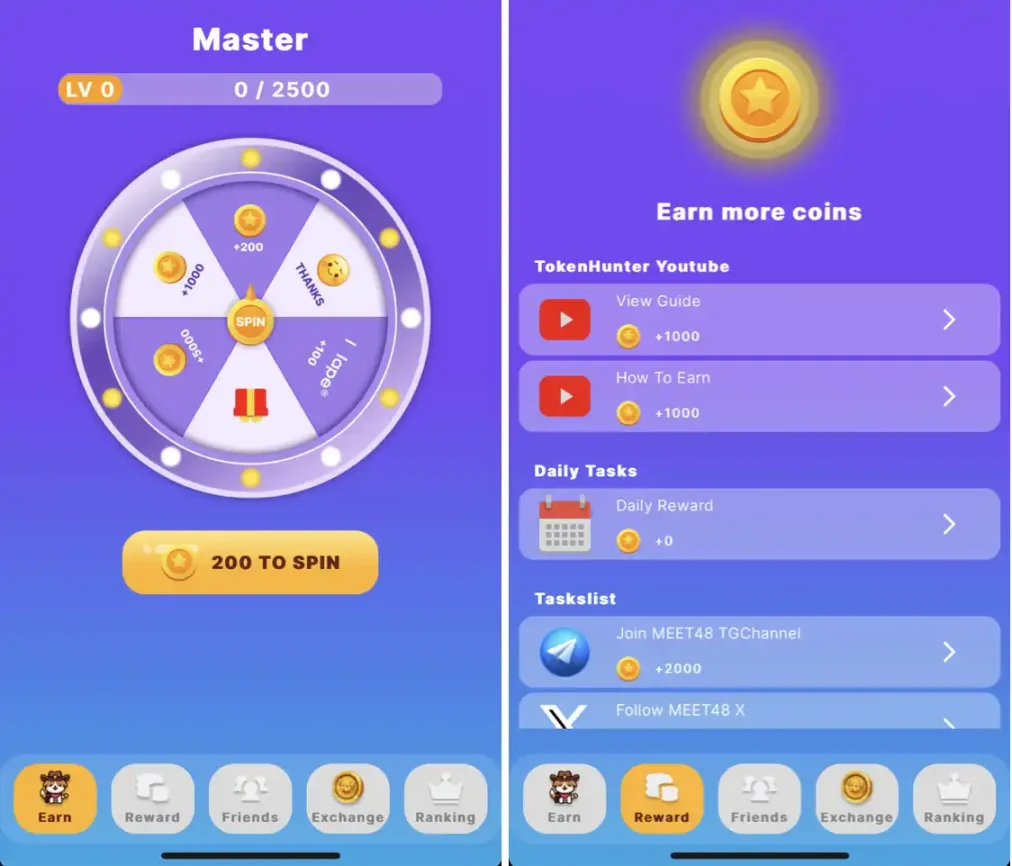
Token Hunter in-game test screenshot
Like many VCs, Vertex Capital sees great potential in the Telegram mini-game market. "Currently dominated by farming and airdrop games, technically Telegram mini-games are very similar to WeChat mini-games and can fully support high-quality titles."
While some say VCs struggle to get a foothold in the TON ecosystem, Vertex Capital found another entry point. Their goal is clear: the game doesn’t need deep mechanics, just simple and fun enough to welcome Web2 users, with easy development cycles and fast iteration. There seems to be no better channel than Telegram mini-games.
"Moreover, Telegram has lower compliance and review costs. The game market here could surpass even WeChat mini-games—potentially becoming a market with hundreds of millions of monthly active users and annual revenues in the billions," a representative from Vertex Capital told BlockBeats. Backed by Telegram’s massive user base, many new projects stand to gain huge pools of potential users.
Will People Actually Pay for Telegram Mini-Games?
Initially, I was skeptical about whether players would actually spend money on Telegram mini-games—but my conversation with Sleepy changed my mind.
"People assume all Telegram mini-game users are just farming rewards and airdrops, but that’s an information bubble and misconception," says Sleepy, founder of the NFT project Weirdo Ghost Gang ("Little Ghost"), launched at the end of 2021. It has become one of the most recognized Chinese-speaking Web3 NFT brands. Recently, they announced their own Telegram mini-game "OUTA," expected to launch in August.
Unlike teams solely relying on traffic arbitrage within Telegram mini-games, Sleepy wants to build a stronger IP experience for holders of Little Ghost NFTs—and he’s confident in the potential for in-game spending. "Other project teams we’ve spoken to also said the number of paying gamers far exceeded their expectations."
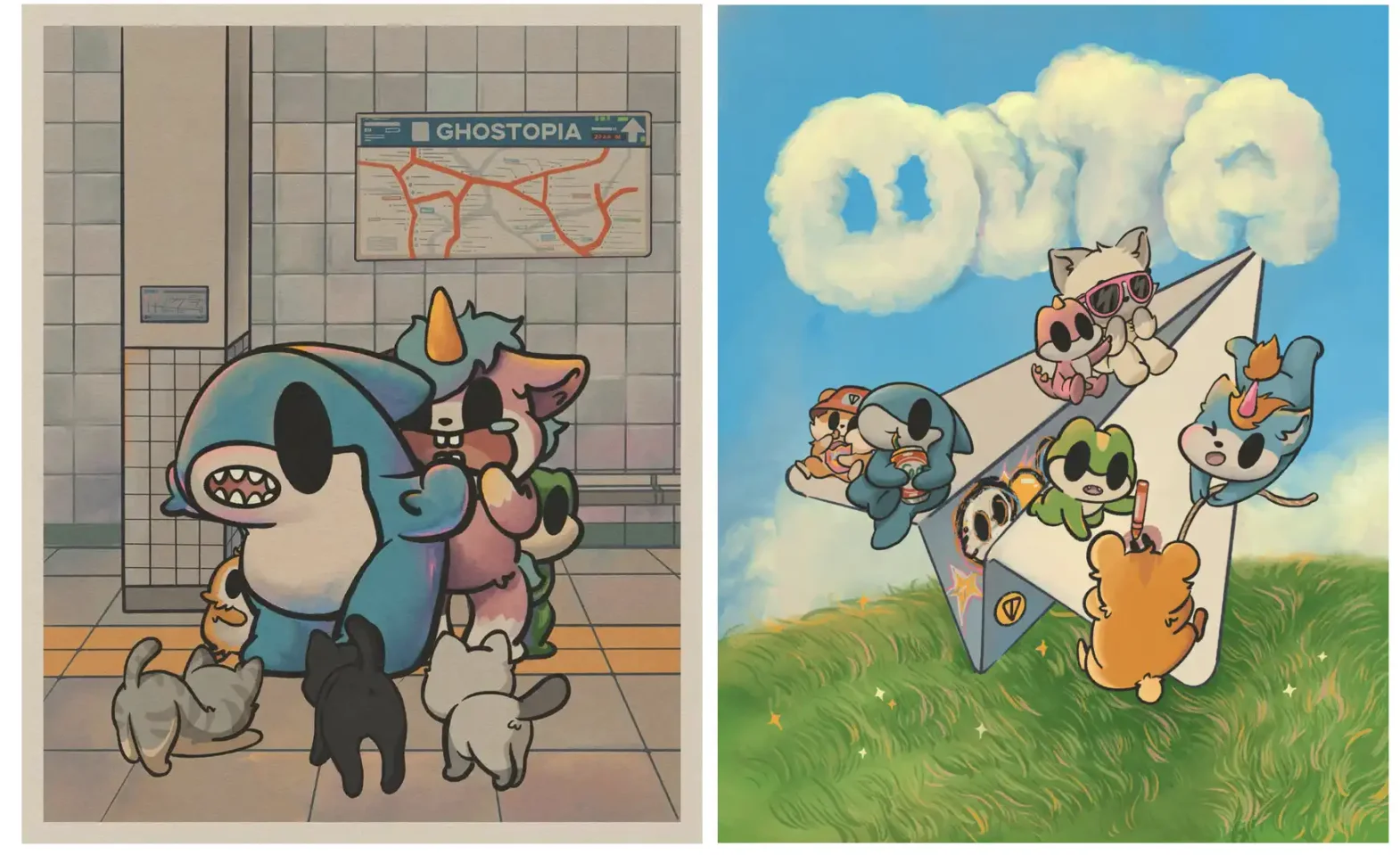
Official preview images of OUTA
For instance, Scarlett, an investor in Pluto—the publisher of Catizen—revealed that Catizen has already generated over $16 million in revenue through in-game purchases, with more than 500,000 paying users (according to Atomic Wallet). This shows that players are indeed willing to pay for virtual items and premium services.
"Besides Catizen, some leading projects earn up to $1.8 million per month via ads—a substantial income stream that helps stabilize the market and extend game longevity," said Jeremy, who currently runs two Telegram mini-games, QGame and PalMiner.
"The blockchain gaming industry has long struggled with sell-off pressure, and the NFT market has nearly collapsed. Many games disappeared due to dumping. But in-game spending channels can partially alleviate this sell-off pressure," Jeremy added. Before entering mini-games, he had prior experience launching NFT projects.
Jeremy emphasized that the original intention behind creating Telegram mini-games is to make them more engaging and enjoyable to attract Web2 users. When users spend based on actual gameplay enjoyment—not just chasing airdrops—it helps mitigate some of the downward pressure caused by token dumps.
Delving deeper into player spending behavior, Sleepy believes today’s Telegram mini-games allow better tiered management of players—something difficult under traditional blockchain game models. For example, users can be segmented into purely free players, light spenders, and heavy spenders. "There’s no hierarchy among these groups; all contribute to the game. But many projects try to convert light spenders into heavy ones—I think that’s hard because these user types are fundamentally different."
Traditional blockchain games often restrict participation from light spenders because many require purchasing expensive "shovels" to play—tools that can cost a fortune. In contrast, Web2 mobile game items are relatively cheap: a skin in Honor of Kings costs around $5, while many blockchain game assets may cost dozens or even hundreds of dollars—clearly deterring light spenders.
Mini-games, however, are better positioned to attract these light spenders. As seen in Zynga’s *Twisted Tangle*, small payments like $0.99 or $1.99 accumulate over time—turning small margins into large volumes through aggregation.
As someone who has personally spent over a thousand dollars on Telegram mini-games, Zongyue remains optimistic about their monetization prospects. "Sure, the gameplay isn’t perfect yet—let’s be honest, most people are still spending mainly for airdrops. But soon we’ll see more addictive mini-games emerging."
Hybrid Monetization Will Be the Future Norm
Today’s Telegram mini-games closely mirror WeChat mini-games—a widely accepted analogy. Therefore, current Telegram mini-games can largely adopt traditional mini-game monetization strategies.
A visible trend is that traditional mini-games are increasingly adopting hybrid monetization to diversify revenue streams—transforming single-channel income into multi-channel earnings.
Casual games that once relied solely on ads may suddenly evolve into successful pay-to-win formats. Zynga’s *Twisted Tangle* is a prime example: a puzzle game where tiny transactions—$0.99, $1.99 for ad removal or bundles—add up significantly. Thanks to this "small profits, large volume" strategy, in-app purchase revenue surged, achieving nearly $30 million in monthly revenue.
It's not limited to light casual games—hardcore titles are also exploring hybrid monetization. Many are now adding ads for non-paying players, recognizing that ads are just part of the business—nothing to be shy about.
In the gaming industry, especially in Web3, user acquisition for blockchain games is becoming increasingly difficult. Hybrid monetization thus becomes a crucial tool to convert non-payers into paying users. Telegram mini-games naturally possess this capability, combining ads and in-app purchases to significantly boost profitability.
This is evident in Telegram mini-games too: Notcoin generates over $300,000 monthly, while Catizen—one of the hottest TG games—has earned over $16 million in total, combining both ad revenue and player spending. Which leads to another question: with such impressive revenue, will these projects still issue tokens?
Token Launching: An Art Form
"They will launch tokens—most projects still plan to," Zongyue said firmly.
In Zongyue’s view, despite the strong revenues and broad traffic many Telegram mini-games currently enjoy, traffic-based businesses are structural and time-sensitive. Projects that avoid launching tokens are short-sighted.
Launching a token is also an art. "Many Telegram mini-games have delayed token launches—some may be negotiating terms with major exchanges, which involves strategy; others simply lack connections or understanding of listing procedures and are merely dragging things out, emotionally manipulating users."
In a recent podcast and article, Sleepy elaborated on his evolving views and strategy regarding token issuance. His attitude has clearly shifted. Initially, Sleepy and his team resisted launching a token, mainly due to compliance concerns and long-term implications for project sustainability. He believed tokens are a double-edged sword: while they can accelerate growth, improper use could cause rapid collapse.
They believed only infrastructure-type projects should launch tokens early, as their validation cycles are long and sustaining development without a token would be difficult. For consumer-facing, IP-driven, or application-based projects, launching a token too early could become a burden, requiring time to validate market acceptance.
After sustained development, Sleepy’s business model began proving viable, prompting them to consider using tokens to incentivize community members. They realized many Telegram users are willing to pay for content, and the number of players spending on games far exceeded expectations. This shifted their stance—launching a token at the right moment could further propel project growth.
An increasing number of project teams and VC investors are joining this ecosystem, signaling its immense potential. Despite ongoing challenges around gameplay quality and avoiding post-token-launch collapses, the solid revenue and massive traffic show that Telegram mini-games are gradually proving their market value.
Perhaps soon, we’ll witness a truly breakout Telegram mini-game on TON—one that might already be in sight, unnoticed by most.
Join TechFlow official community to stay tuned
Telegram:https://t.me/TechFlowDaily
X (Twitter):https://x.com/TechFlowPost
X (Twitter) EN:https://x.com/BlockFlow_News
 BlockBeats






