How can The Graph scale into an AI-driven Web3 infrastructure?
TechFlow Selected TechFlow Selected
How can The Graph scale into an AI-driven Web3 infrastructure?
How to make DApps more amenable to AI integration?
 Navigating Web3 tides with focused insights
Author: ChainFeeds Research
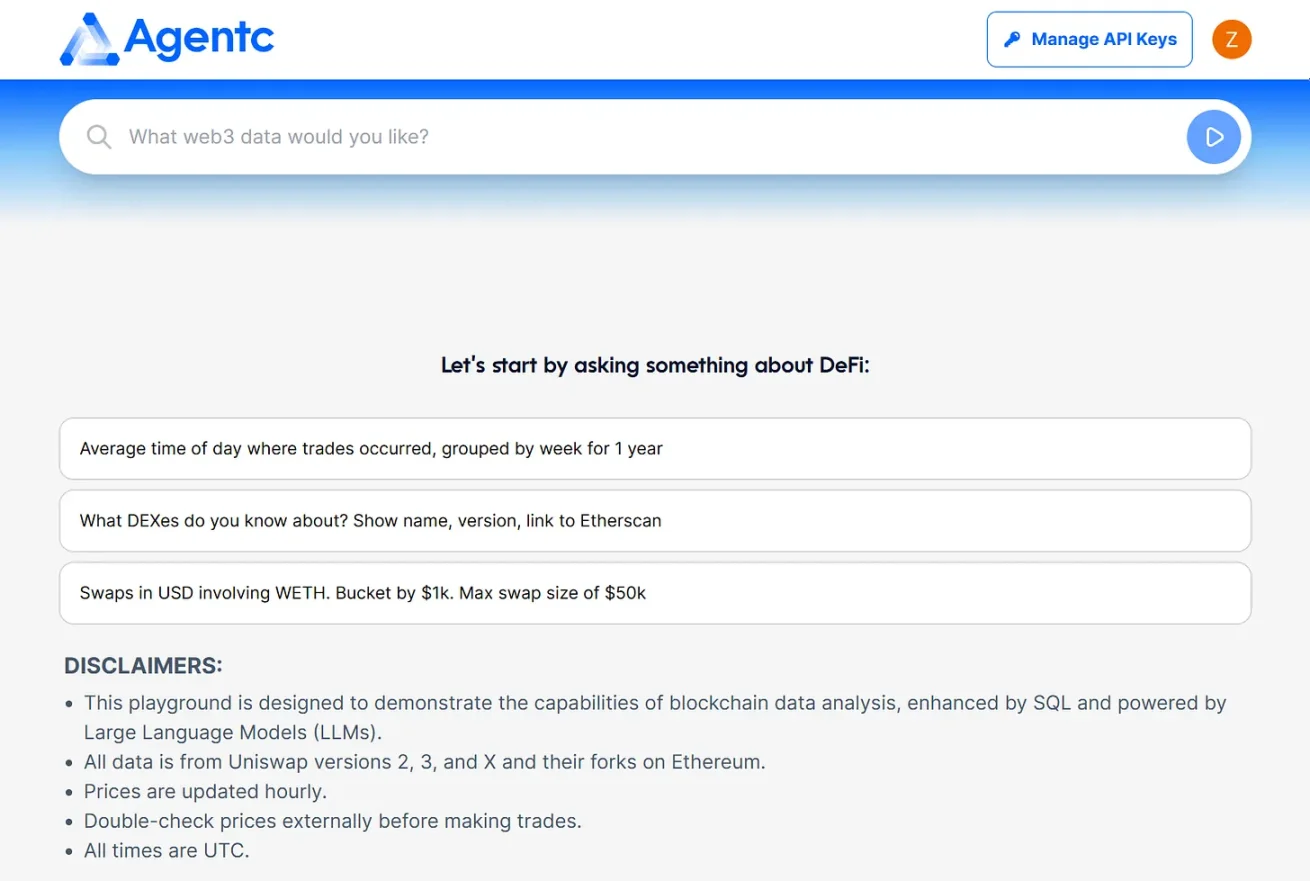
In 2022, OpenAI launched ChatGPT, powered by the GPT-3.5 model, initiating wave after wave of AI narratives. However, despite ChatGPT's ability to effectively handle queries in most cases, its performance may still be limited when specific domain knowledge or real-time data is required. For instance, when asked about Vitalik Buterin’s token transaction history over the past 18 months, it cannot provide reliable and detailed information. To address this, Semiotic Labs—the core development team behind The Graph—introduced Agentc, combining The Graph’s indexing software stack with OpenAI, enabling users to access cryptocurrency market trend analysis and transaction data queries.
When queried about Vitalik Buterin’s token transactions over the last 18 months, Agentc provides a significantly more comprehensive answer. Yet The Graph’s AI ambitions extend far beyond this. In its whitepaper titled "The Graph as AI Infrastructure," the project clarifies that its goal is not merely to launch a specific application, but rather to leverage its strengths as a decentralized data indexing protocol to empower developers building Web3-native AI applications. To support this vision, Semiotic Labs will open-source Agentc’s codebase, allowing developers to create AI dapps with similar functionality—such as NFT market trend analysis agents or DeFi trading assistant agents.
The Graph’s Decentralized AI Roadmap
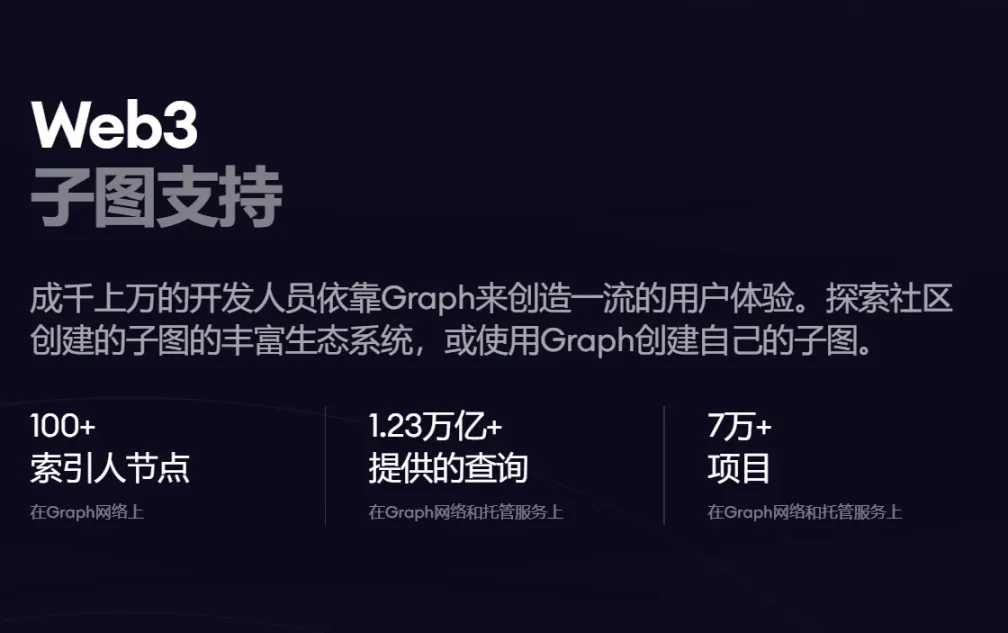
Launched in July 2018, The Graph is a decentralized protocol for indexing and querying blockchain data. Through this protocol, developers can use open APIs to create and publish data indexes known as subgraphs, enabling applications to efficiently retrieve on-chain data. To date, The Graph has supported over 50 blockchains, hosted more than 75,000 projects, and processed over 1.26 trillion queries.
The Graph’s ability to manage such vast amounts of data relies heavily on its core contributor teams, including Edge & Node, Streamingfast, Semiotic, The Guild, GraphOps, Messari, and Pinax. Among them, Streamingfast primarily provides cross-chain architecture technology for blockchain data streams, while Semiotic AI focuses on integrating AI and cryptography into The Graph. The Guild, GraphOps, Messari, and Pinax specialize in GraphQL development, indexing services, subgraph development, and data streaming solutions, respectively.
The Graph’s exploration of AI is not new. As early as March last year, The Graph Blog published an article outlining the potential of leveraging its data indexing capabilities for AI applications. In December, The Graph released a new roadmap titled "New Era," which included plans to integrate AI-assisted querying via large language models. With the recent release of its whitepaper, its AI strategy has become even clearer. The document introduces two AI services: Inference and Agent Service, allowing developers to directly integrate AI functionality into their application frontends—all powered by The Graph.
Inference Service: Supporting Multiple Open-Source AI Models
In traditional inference services, models perform predictions using centralized cloud computing resources. For example, when you ask ChatGPT a question, it performs inference and returns an answer. However, this centralized approach increases costs and introduces censorship risks. The Graph aims to solve this by building a decentralized model hosting marketplace, giving dApp developers greater flexibility in deploying and hosting AI models.
The Graph illustrates this with an example in its whitepaper: creating an app that helps Farcaster users predict whether their posts will receive many likes. First, The Graph’s subgraph service indexes comments and like counts from Farcaster posts. Then, a neural network is trained to predict whether new Farcaster comments will be liked, and this model is deployed on The Graph’s Inference Service. The resulting dApp can help users write posts more likely to gain popularity.
This approach enables developers to easily leverage The Graph’s infrastructure—hosting pre-trained models on The Graph network and integrating them into applications via APIs—so users can directly experience these features within dApps.
To offer developers greater choice and flexibility, The Graph’s Inference Service supports most existing popular models. According to the whitepaper, “in the MVP phase, The Graph’s Inference Service will support a curated set of popular open-source AI models, including Stable Diffusion, Stable Video Diffusion, LLaMA, Mixtral, Grok, and Whisper.” In the future, any sufficiently tested and indexed open model will be deployable on The Graph Inference Service. Additionally, to reduce technical complexity, The Graph provides user-friendly interfaces that simplify the entire process, enabling developers to easily upload and manage their AI models without worrying about infrastructure maintenance.
To further enhance model performance in specific application scenarios, The Graph also supports fine-tuning models on specific datasets. However, note that fine-tuning typically does not occur on The Graph itself. Developers must fine-tune models externally before deploying them using The Graph’s Inference Service. To incentivize developers to share their fine-tuned models, The Graph is developing incentive mechanisms—for example, fairly distributing query fees between model creators and indexers providing the models.
For verifying the execution of inference tasks, The Graph offers multiple methods: Trusted Authority, M-of-N Consensus, Interactive Fraud Proofs, and zk-SNARKs. Each method has trade-offs: Trusted Authority relies on trusted entities; M-of-N Consensus requires multiple indexers to validate results, increasing security but also computational and coordination overhead; Interactive Fraud Proofs are highly secure but unsuitable for applications requiring rapid responses; zk-SNARKs are technically complex and impractical for large models.
The Graph believes developers and users should have the freedom to choose the appropriate security level based on their needs. Therefore, it plans to support multiple verification methods within its Inference Service to accommodate different security requirements and use cases. For high-stakes applications involving financial transactions or critical business logic, higher-security methods like zk-SNARKs or M-of-N Consensus may be used. For low-risk or entertainment-focused apps, simpler and cheaper options like Trusted Authority or Interactive Fraud Proofs could suffice. Additionally, The Graph plans to explore privacy-enhancing technologies to improve model and user privacy.
Agent Service: Empowering Developers to Build Autonomous AI-Driven Applications
While the Inference Service mainly runs trained AI models for prediction, the Agent Service is more complex, requiring multiple components to work together so agents can perform a series of sophisticated, automated tasks. The value proposition of The Graph’s Agent Service is to integrate agent creation, hosting, and execution within The Graph ecosystem, powered by the indexer network.
Specifically, The Graph will provide a decentralized network supporting agent development and hosting. Once deployed on The Graph network, agents will receive execution support from The Graph indexers—including accessing indexed data and responding to on-chain events and other interaction requests.
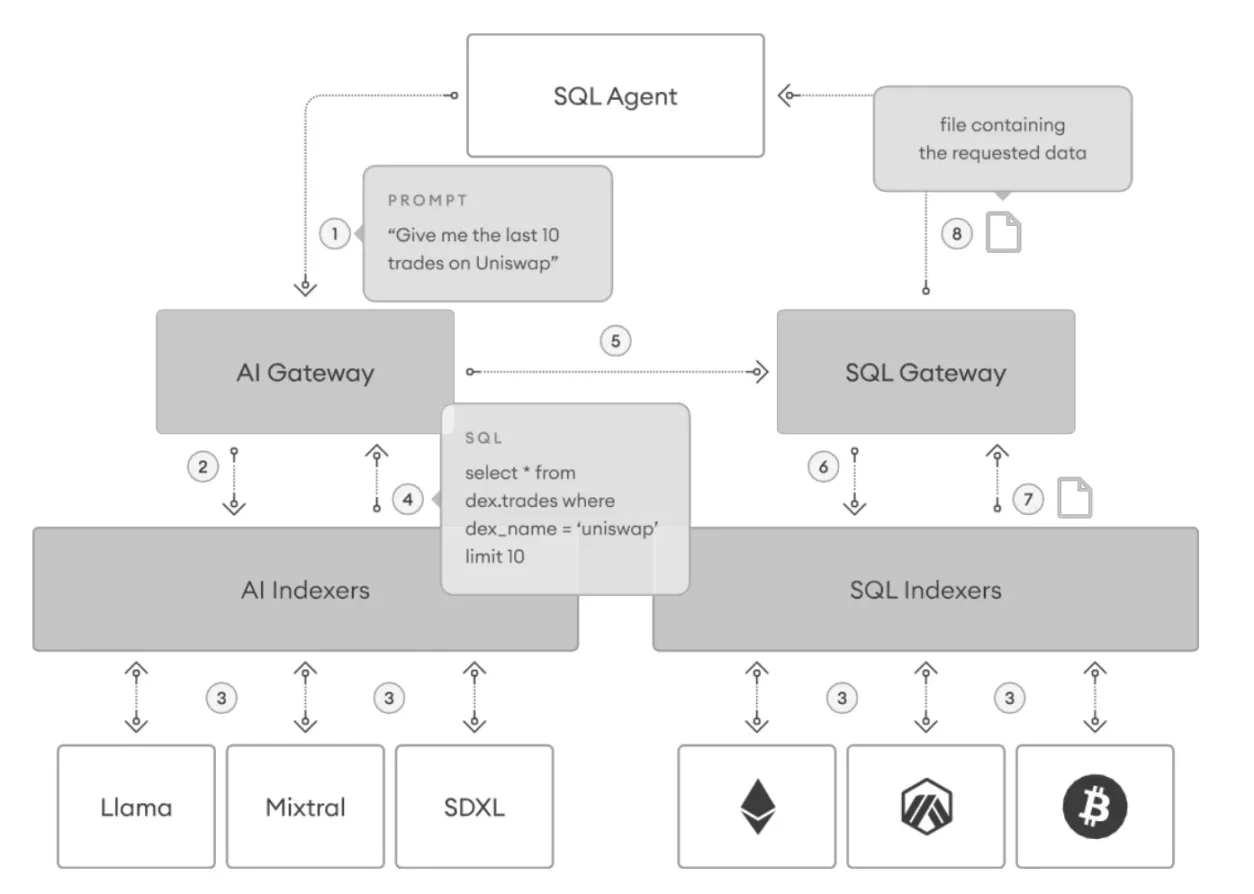
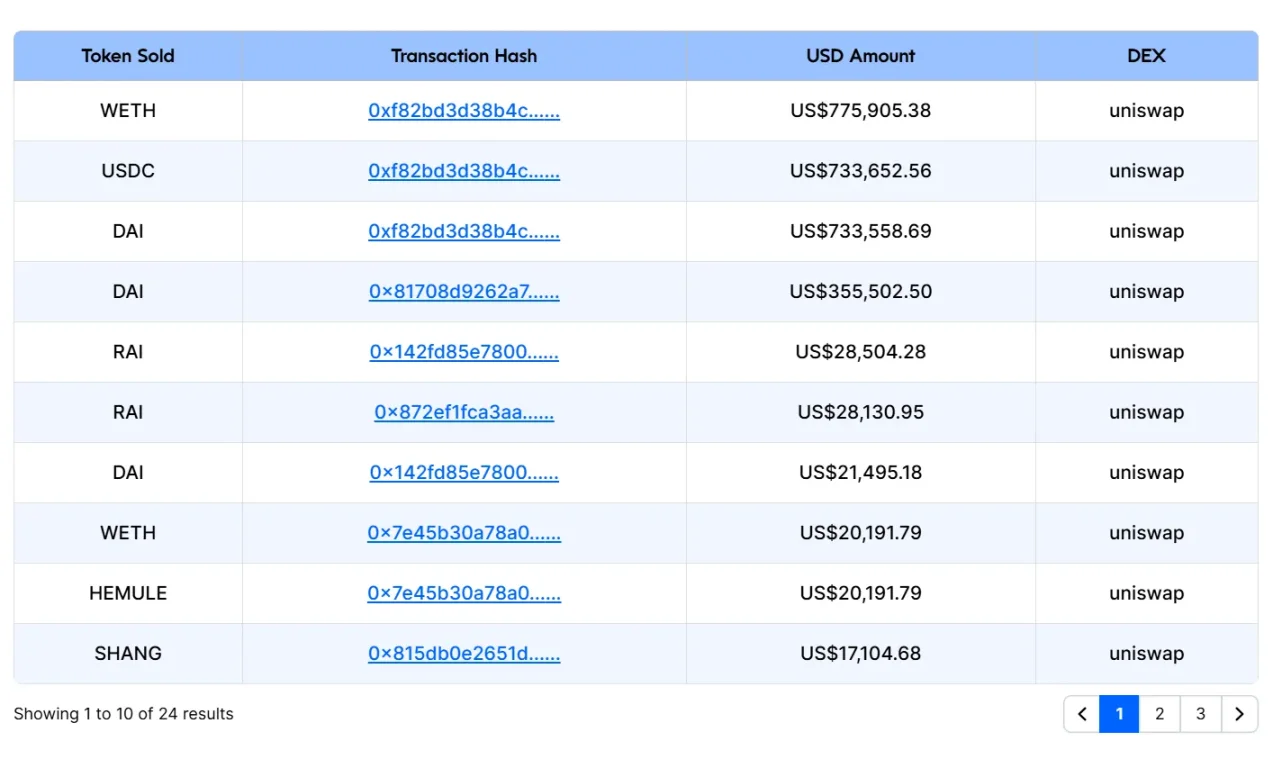
As mentioned earlier, Semiotic Labs—the core development team of The Graph—has already launched an early experimental agent product called Agentc, combining The Graph’s indexing software stack with OpenAI. Its primary function is to convert natural language inputs into SQL queries, allowing users to directly query real-time blockchain data and present results in an easy-to-understand format. Simply put, Agentc focuses on providing convenient cryptocurrency market trend analysis and transaction data queries. All its data comes from Ethereum-based Uniswap V2, Uniswap V3, Uniswap X, and their forks, with prices updated hourly.
Additionally, The Graph notes that the accuracy rate of the LLM models currently used is only 63.41%, leading to incorrect responses. To address this, The Graph is developing a new type of large language model called KGLLM (Knowledge Graph-enabled Large Language Models).
KGLLM leverages structured knowledge graph data provided by Geo, significantly reducing the probability of generating inaccurate information. Every claim in the Geo system is backed by on-chain timestamps and voting validation. By integrating Geo’s knowledge graph, agents can be applied across diverse scenarios—including medical regulations, political developments, and market analysis—enhancing both the versatility and accuracy of agent services. For example, KGLLM could use political data to advise DAOs on policy changes, ensuring recommendations are based on up-to-date and accurate information.
Additional advantages of KGLLM include:
-
Use of structured data: KGLLM uses structured external knowledge bases. Information is modeled as graphs in the knowledge base, making relationships between data points immediately clear and enabling more intuitive querying and understanding;
-
Relational data processing capability: KGLLM excels at handling relational data—for example, understanding relationships between people or between people and events. Using graph traversal algorithms, it can jump across multiple nodes in the knowledge graph (similar to navigating a map) to find relevant information, enabling KGLLM to identify the most pertinent answers;
-
Efficient information retrieval and generation: Through graph traversal algorithms, KGLLM extracts relationships and converts them into natural-language prompts understandable by the model. These clear instructions allow the KGLLM model to generate more accurate and contextually relevant responses.
Outlook
As the “Google of Web3,” The Graph leverages its strengths to address current AI services’ data scarcity issues, while simultaneously simplifying development workflows through integrated AI services. As more AI applications are developed and adopted, user experiences are expected to improve significantly. Going forward, The Graph’s development team will continue exploring the convergence of artificial intelligence and Web3. Furthermore, other teams within its ecosystem—such as Playgrounds Analytics and DappLooker—are also designing solutions related to agent services.
Join TechFlow official community to stay tuned
Telegram:https://t.me/TechFlowDaily
X (Twitter):https://x.com/TechFlowPost
X (Twitter) EN:https://x.com/BlockFlow_News
 @ChainFeedsxyz