
The Evolution and Impact of MEV in the PoS World
TechFlow Selected TechFlow Selected
The Evolution and Impact of MEV in the PoS World
This article will help readers understand the challenges and opportunities brought by MEV through in-depth technical analysis.
 Navigating Web3 tides with focused insights
By Bing Ventures
In the blockchain ecosystem, Maximal Extractable Value (MEV) has emerged as a significant area of research. It involves not only technical implementation but also market behavior and economic efficiency. With Ethereum's transition to Proof-of-Stake (PoS), the concept of MEV has undergone substantial evolution. Validators have now become key participants, capable not only of controlling transaction ordering but also of optimizing profits through various strategies. This shift compels us to re-examine the definition of MEV and its manifestations under different consensus mechanisms.
This article will provide an in-depth technical analysis to help you understand the challenges and opportunities presented by MEV.
The Evolution of MEV
Maximal Extractable Value (MEV) refers to the total value that miners or validators can extract from block production on a network, beyond standard block rewards and gas fees. In the context of Proof-of-Work (PoW), MEV was initially known as "Miner Extractable Value," involving miners leveraging their ability to choose transaction order and inclusion within blocks to maximize profit. This could include various strategies to manipulate transaction sequencing for financial gain.
With Ethereum’s shift to Proof-of-Stake in 2022, the concept of MEV has expanded and evolved. The current term—“Maximal Extractable Value”—reflects that value extraction is no longer limited to miners (now validators in PoS systems), but also includes other network participants. Validators in PoS systems, much like miners in PoW, control transaction ordering and influence which transactions are included in blocks.
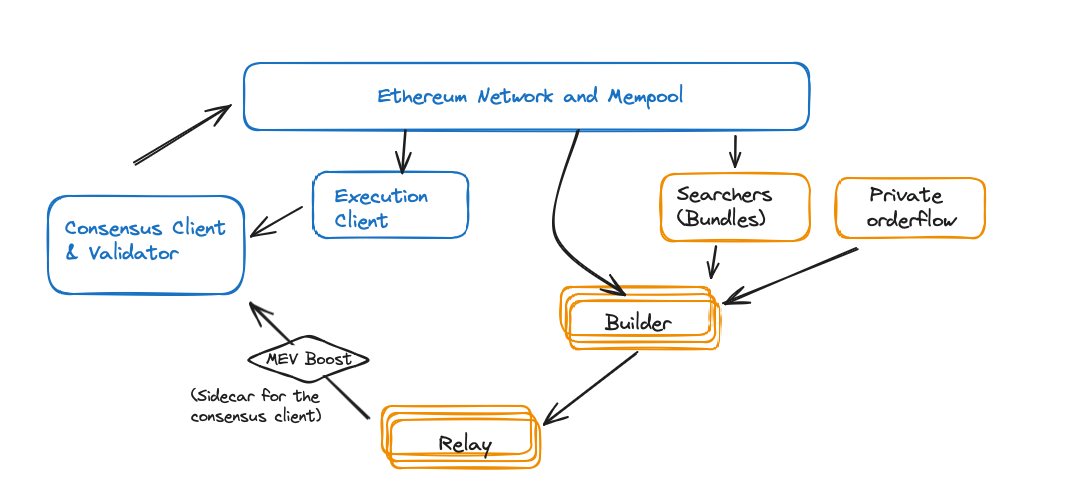
Key Participants in MEV
-
Validators / Miners: They hold exclusive authority over transaction ordering and inclusion, enabling them to directly extract MEV.
-
Searchers: Independent actors who use algorithms and bots to identify profitable MEV opportunities. They often pay high gas fees to validators for priority transaction inclusion, indirectly benefiting from MEV.
MEV Extraction Strategies
-
Front-running: This involves bots detecting profitable transactions in the mempool and placing their own transactions ahead with higher gas fees. For example, Flashbots provides a marketplace designed to make this process more transparent and fair by allowing users and miners to agree on transaction order in advance.
-
Sandwich Attacks: A more malicious strategy where bots place orders before and after large trades on decentralized exchanges (DEXs) to manipulate prices and profit from resulting slippage. This directly impacts the financial outcomes of the original trader.
-
DEX Arbitrage: Searchers exploit price differences of tokens across different DEXs. By buying low on one exchange and selling high on another, they help align prices and improve market efficiency.
-
Liquidations: In DeFi lending, borrowers must deposit cryptocurrency as collateral. If a borrower fails to repay, protocols allow anyone to liquidate the collateral and earn a liquidation fee. MEV searchers compete to identify eligible borrowers and claim these fees.
Market Size: New Changes After the Cancun Upgrade
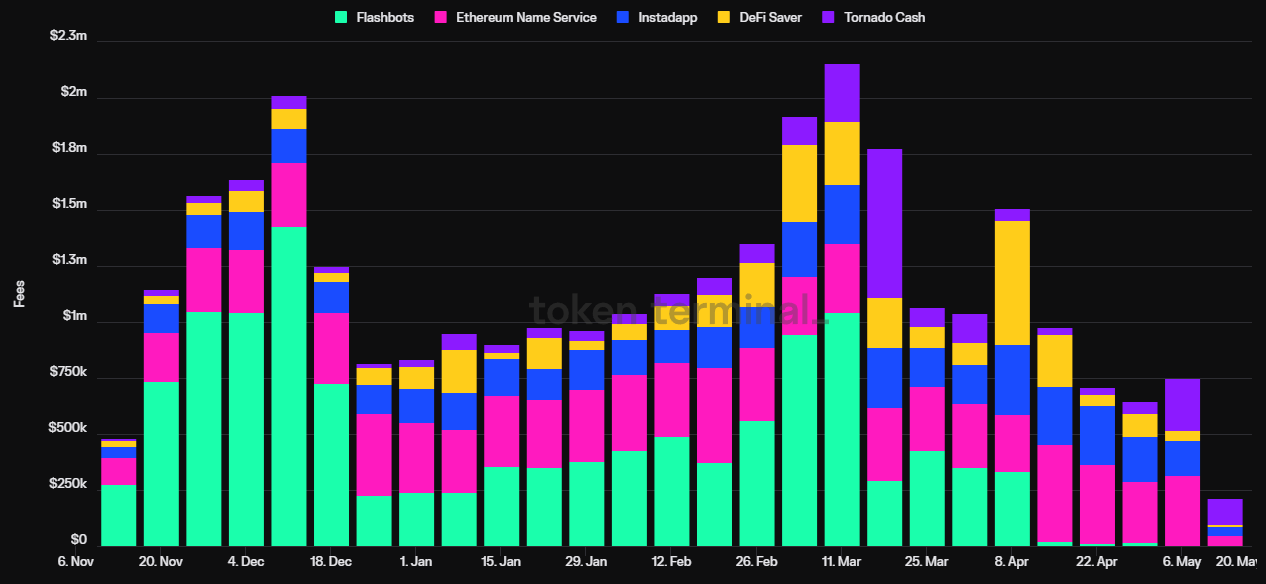
Flashbot, the leading player in the MEV space, offers a marketplace designed to enable more balanced and structured MEV operations by allowing users and miners to pre-agree on transaction sequences. Looking back at projects in the “infrastructure” category over the past six months, Flashbot demonstrated strong revenue performance until April, even recording $1.428M in a single week in December—outperforming all other projects in the sector—indicating that the MEV space once enjoyed exceptional profitability. However, following Ethereum’s Cancun Upgrade in March, Flashbot’s revenue dropped significantly. The reasons are as follows:
1. EIP-4844 (Proto-Danksharding):
-
Increased Transparency and Predictability: By introducing data blobs, the protocol changed how transaction data is handled, making large-scale data processing more efficient and predictable. This reduces MEV opportunities based on transaction delays or reordering.
-
Improved Network Efficiency and Lower Gas Fees: This EIP lowers gas costs for large data transactions by providing an efficient storage method. While this reduces the cost of big-data MEV strategies, increased transaction speed intensifies competition.
2. EIP-1559 (Fee Market Reform):
-
Increased Transparency and Predictability: Introducing base fees and priority fees improves the predictability and stability of network transaction costs, reducing MEV opportunities arising from gas fee manipulation.
3. EIP-2929 (Increased Gas Costs for Specific Opcodes):
-
Higher Execution Costs: By increasing gas costs for specific smart contract operations, this change may directly impact MEV strategies relying on complex smart contract interactions—such as multi-step arbitrage or contract calls—making them more expensive and less attractive.
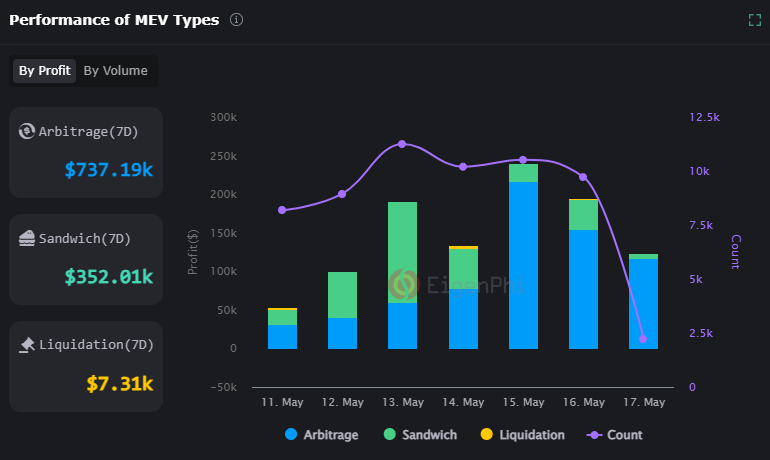
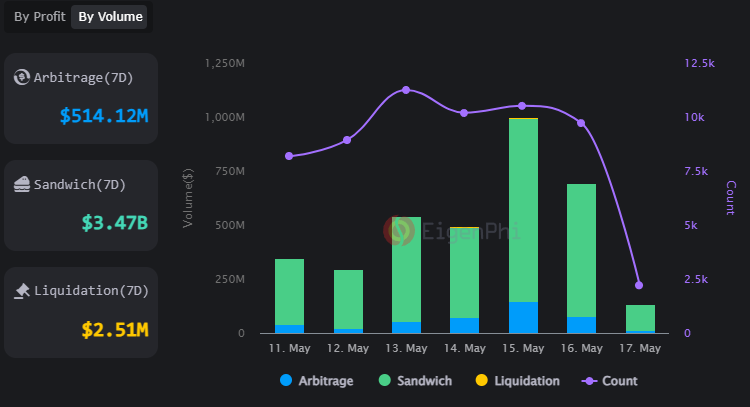
Source: EigenPhi MEV
From an industry perspective, in the 7 days ending May 17, profits from DEX arbitrage were approximately twice those from sandwich attacks. However, in terms of transaction volume, sandwich attacks far outpaced DEX arbitrage—about seven times higher. The profit-to-volume ratio for DEX arbitrage was around 14%, significantly higher than the 0.01% for sandwich attacks. Thus, DEX arbitrage emerges as the most profitable operation in the sector.
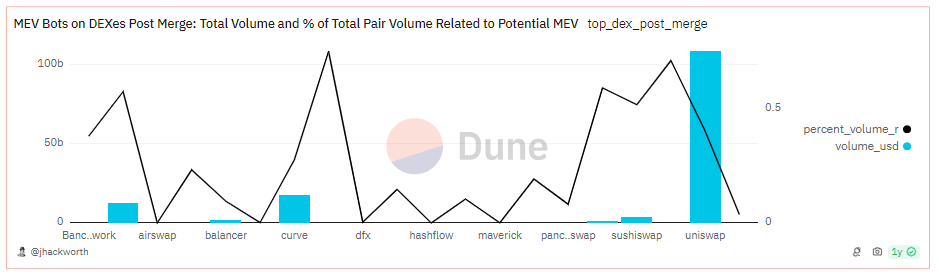
Source: jhackworth
Uniswap is the decentralized exchange with the highest volume of arbitrage transactions. Analyzing arbitrage activity within its liquidity pools provides valuable insights into the broader state of DEX arbitrage.

Source: OP Crypto
From an on-chain transaction perspective, MEV accounts for a remarkably significant share of Uniswap’s trading volume.
Industry Landscape: Key Players Across the Stack
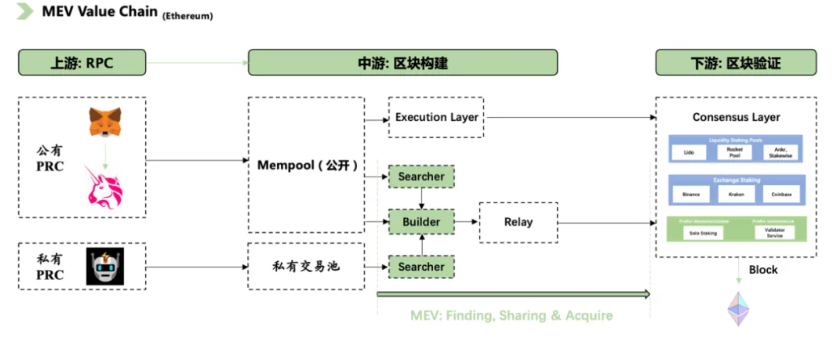
Source: OP Crypto
-
Upstream: Transaction signing and broadcasting.
-
Midstream: Transaction ordering and MEV opportunity discovery.
-
Downstream: Block proposal and validation, completing MEV extraction.
Upstream: Upstream primarily includes RPC providers responsible for signing transactions and broadcasting them locally across the network. These operations are typically submitted by users or other initiators and initially appear in the public mempool. The main task at this stage is generating and broadcasting transactions.
Midstream: Midstream handles block construction in either public or private environments. At this stage, block producers (e.g., validators and builders) select transactions from the mempool and order and bundle them according to preference. To maximize profits, block producers often prioritize transactions based on gas fees. Additionally, they actively seek MEV opportunities such as arbitrage, deciding how to allocate MEV profits—whether by copying searcher transactions, conducting censorship, executing trades themselves, or allowing searchers to compete for inclusion via adjusted fees. Key activities in the midstream phase include transaction ordering and discovering/exploiting MEV opportunities.
Downstream: Downstream is mainly responsible for proposing and validating new blocks, ensuring user transactions and MEV extractions are confirmed by network consensus and ultimately realizing MEV income. Validators play a crucial role here, originating from CEXs, liquid staking providers, institutional staking, or individual stakers. The core task downstream is packaging ordered transactions into blocks and achieving final confirmation through the network’s consensus mechanism, thereby completing the entire MEV extraction process.
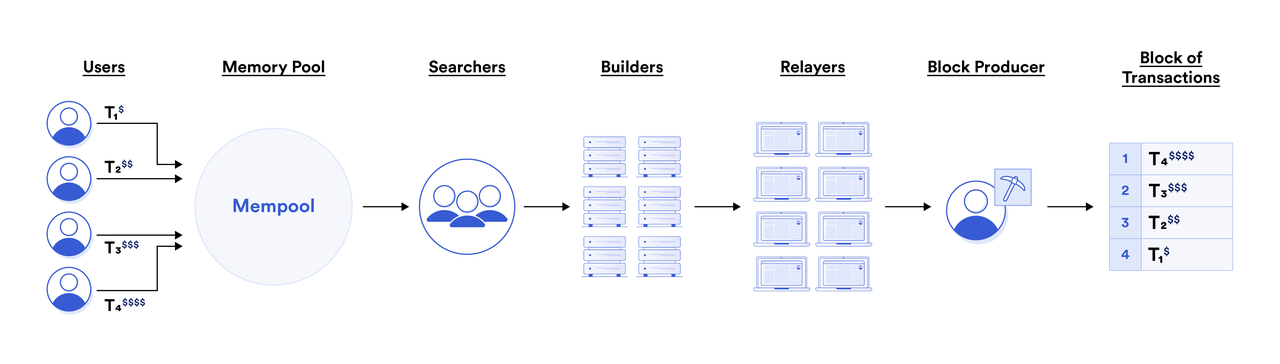
Source: ChainLink
Searchers
-
Write code, often using sophisticated proprietary algorithms, to detect MEV opportunities in the mempool.
-
Monitor both public transaction pools and private transaction pools operated by MEV projects.
-
Compete with other searchers by submitting “bundles” of transactions to block builders, along with their maximum willingness to pay in gas fees.
Block Builders
-
Compete in real-time markets to build blocks on behalf of validators.
-
Accept transactions from searchers, select the most profitable bundles, and send these blocks to relays via MEV tools (e.g., MEV Boost, Flashbots).
Relays
-
Act as intermediaries between block builders and proposers (validators), allowing validators to offer their block space.
Latest Industry Developments
Looking back over recent months, MEV has shown notable performance across various domains. For instance, Flashbots has demonstrated the potential of MEV in highly transparent and structured environments through its innovative market design. Although Ethereum’s Cancun upgrade led to reduced revenues for Flashbots, our analysis shows these changes stem largely from improved network efficiency and new protocol implementations—reflecting the dynamic nature of MEV strategies as they adapt and evolve.
In the future development of MEV, numerous new projects and technologies continue to emerge—such as Gnosis’s Agnostic Relay and Automata Network’s Conveyor—showcasing novel approaches to tackling MEV challenges under varying technological and market conditions. Moreover, SUAVE, through a cross-chain unified mempool, presents an innovative solution to cross-chain MEV issues, offering fresh perspectives for MEV research.
Gnosis

Agnostic Relay, developed by Gnosis, is an open-source tool serving as an MEV-Boost relay on the Ethereum network, allowing anyone to participate in block building and production. Its design and implementation rely on knowledge and experience from the Gnosis community and receive support and contributions from the Flashbots team.
-
Neutral Block Building/Production: Agnostic Relay ensures all submitted transactions are validated without filtering. This neutrality is crucial for maintaining decentralization and censorship resistance in blockchain networks.
-
Fork of Flashbots’ MEV-Boost Relay: Agnostic Relay is a fork of the Flashbots MEV-Boost Relay, incorporating deep technical expertise and active community support, ensuring reliability in both technology and practical application.
Automata
Automata Network is a modular proof layer that extends machine-level trust to Ethereum via TEE (Trusted Execution Environment) coprocessors. Ethereum acts as a global verifier anchoring a decentralized proof network across hardware and software components.
MEV Protection (Conveyor):
-
Conveyor prevents miners from reordering transactions by determining the sequence in which transactions are transmitted, thus preventing “sandwich attacks.” Like a conveyor belt, it properly orders transactions to protect users from malicious manipulation.
Governance Privacy (Witness):
-
Witness allows users to submit proposals and vote without revealing their identities, incentivizing token holders with zero-gas voting. Users can submit proposals via a simple interface and invite community members to vote; votes are sent through a privacy relay, and results are displayed according to the privacy level selected when the proposal was created.
Eden
Eden Network offers multiple products supporting the Ethereum ecosystem by reducing the negative impacts of MEV and providing tools and data to increase earnings for validators, builders, and searchers.
-
Eden RPC: A set of endpoints protecting Ethereum users from malicious MEV attacks (e.g., front-running and sandwich attacks). Offers a safer transaction environment, reducing extra costs users incur due to MEV.
-
Eden Relay: A suite of tools helping Ethereum validators and builders maximize income. Provides optimized block-building and proposal workflows to increase validator and builder revenues.
-
Eden Bundles: An endpoint allowing advanced MEV searchers to submit transaction bundles to the builder network. Enables more efficient MEV extraction, increasing revenue for both searchers and builders.
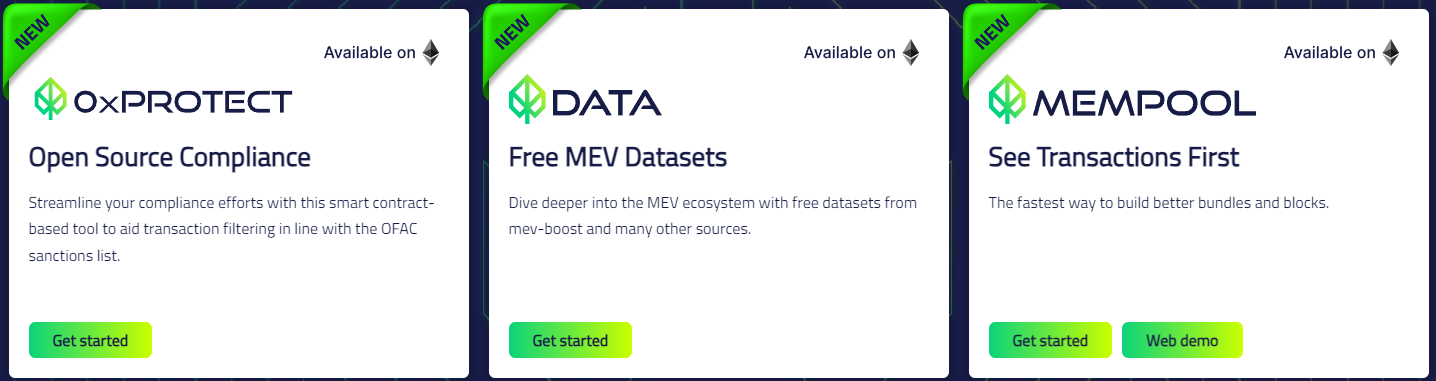
Eden has launched three product updates: 0xProtect, Eden Public Data, and Ethereum Mempool Streaming Service.
0xProtect:
-
Function: Maintains an on-chain OFAC sanctions list, enabling block producers to automatically filter transactions involving sanctioned wallet addresses.
-
Mechanism: Uses a smart contract registry to update and maintain the sanctions list in real time, ensuring compliance with OFAC requirements. Parties can access the registry directly to automatically filter non-compliant transactions.
-
Use Cases: MEV searchers, block builders, relays, and validators can use 0xProtect to ensure compliance and avoid legal and regulatory risks.
Eden Public Data:
Function: Provides a series of public datasets stored in BigQuery, supporting various data extraction and loading (ETL) processes.
Main Datasets:
-
MEV-Boost:
-
MEV-Boost Bids: Bid data from builders collected via relays in the MEV-Boost ecosystem.
-
MEV-Boost Payloads: Payload data collected from relays in the MEV-Boost ecosystem.
-
Flashbots:
-
Mempool Dumpster: Transactions detected from the Flashbots Mempool Dumpster.
-
MEV-Share: Transactions detected from Flashbots MEV-Share.
-
Gnosis:
-
MEV Blocker: Transactions detected from Gnosis MEV Blocker.
-
Ethereum Auxiliary:
-
Tags by Pubkey: Labels associated with Ethereum public keys.
Ethereum Mempool Streaming Service: Designed to provide real-time transaction data streams for block builders, MEV searchers, and dApps to optimize block and bundle construction.
1. Real-Time Data Stream:
-
Provides real-time transaction data feeds, allowing users immediate access to pending transactions in Ethereum’s public mempool.
2. Rich Data Points:
-
Offers thousands of transaction data points, including transaction hash, sender, recipient, amount, gas price, etc.
3. Optimized Block Construction:
-
Enables users to build better blocks and transaction bundles through real-time access and rich data points.
CoW Protocol

MEV Blocker, developed by CoW DAO, aims to protect Ethereum transactions by blocking front-running and sandwich attacks. The project uses an RPC endpoint to route transactions to a searcher mempool, where searchers bid for tracking opportunities and share profits with users.
RPC Endpoint:
-
Function: Provides an RPC endpoint to protect Ethereum transactions from front-running and sandwich attacks.
Searcher Mempool:
-
Function: Transactions are sent via the RPC endpoint to a searcher mempool, where searchers bid for the chance to track them.
Profit-Sharing Mechanism:
-
Function: After successfully tracking a transaction, searchers share the profits with users in a 90/10 split.
SUAVE (Flashbots)

SUAVE is a new model proposed by Flashbots aimed at addressing key issues in current MEV extraction, such as cross-chain MEV and builder centralization. SUAVE creates a layer-0 blockchain serving as a shared mempool across multiple blockchain networks, enabling cross-chain unification.
Preference Submission:
-
Function: Instead of submitting specific transactions, users submit “preferences” reflecting their goals, which can be set under various conditions with varying complexity.
Cross-Chain Unified Mempool:
-
Function: As a layer-0 blockchain, SUAVE creates a unified mempool spanning multiple blockchain networks. Through this cross-chain unified mempool, SUAVE effectively addresses cross-chain MEV problems, enhancing fairness and transparency in cross-chain transactions.
The Future of MEV: Integrating Technology and Ethics
The transparency of MEV extraction is both its strength and a potential risk. In the future, blockchain technology must find new balance between transparency and prevention of manipulation. We can adopt more advanced zero-knowledge proof (ZKP) techniques to keep transactions anonymous before validation while ensuring their legitimacy. This protects user privacy and prevents malicious manipulation, preserving network fairness.
Integration of Smart Contracts and Machine Learning
The integration of automated smart contracts with machine learning represents the future direction of MEV extraction. Smart contracts can analyze market data in real time and use machine learning algorithms to predict optimal trading strategies. This dynamic adjustment capability will significantly enhance the accuracy of MEV extraction. For example, by combining real-time market data, smart contracts can automatically adjust transaction order to maximize profit.
Potential and Challenges of Cross-Chain MEV
Cross-chain MEV extraction remains an underdeveloped field with immense potential. By developing new cross-chain protocols such as Cosmos and Solana, MEV extraction across different blockchain networks becomes possible. Such cross-chain solutions not only enhance the flexibility and applicability of MEV but also promote interoperability within the blockchain ecosystem. However, new challenges arise—such as security and efficiency of cross-chain transactions—that require innovative technical solutions.
The Rise of Dynamic MEV Markets
Future MEV markets will become more dynamic and complex. Leveraging AI and big data analytics, real-time market trends and transaction behaviors can be captured to dynamically adjust MEV extraction strategies. For instance, machine learning algorithms analyzing historical transaction data can forecast future market volatility and formulate more effective MEV strategies. The emergence of such dynamic markets will fundamentally transform the existing MEV ecosystem, making it smarter.
Optimizing Incentive Mechanisms
To attract more participants and sustain healthy network growth, we need to continuously refine economic incentive mechanisms. By introducing new reward models and distribution methods, every participant can fairly benefit from MEV. Additionally, exploring new business models—such as offering MEV protection services or developing MEV optimization tools—can increase overall ecosystem value and help maintain long-term network stability.
MEV is not merely a technical issue—it is a complex domain involving ethical considerations. While pursuing technological innovation, we must deeply consider its ethical implications. For example, when developing new technologies, we must ensure they do not create market inequities and uphold transparency and fairness in blockchain networks. In PoS systems, validators’ ability to extract MEV by controlling transaction order could lead to centralization and unfairness. To address this, we can explore new mechanisms such as dynamic validator selection and reputation-based reward systems. By introducing greater randomness and diversified incentives, we can ensure decentralization and fairness in the network.
Join TechFlow official community to stay tuned
Telegram:https://t.me/TechFlowDaily
X (Twitter):https://x.com/TechFlowPost
X (Twitter) EN:https://x.com/BlockFlow_News
 Bing Ventures