








History and cultural vitality are the lifeblood of crypto assets.
TechFlow Selected TechFlow Selected
History and cultural vitality are the lifeblood of crypto assets.
Ensuring your local assets truly become a store of value rather than just a flash in the pan largely depends on history and cultural vitality.
 Navigating Web3 tides with focused insights
Author: Guest Author
Translation: TechFlow

This opinion piece was written by Diario, co-founder and COO of NFT Price Floor, and Diario.
Hard Power vs. Soft Power
Most analyses on why a Layer 1 (L1) blockchain is superior to others and an ideal investment typically focus on technical aspects. These often describe innovative, breakthrough technological features believed to solve all the problems and challenges public blockchains have faced since their inception.
While technology is crucial, continuous improvements and discoveries in consensus design, cryptography, and distributed systems engineering (hard power) are indispensable for bringing this technology to everyone globally. However, it's important to remember that blockchains are not just technology.
In fact, blockchains rely on community trust (attention), rooted in shared values, culture, and ideally, a spirit of universal accessibility. They offer everyone the chance to participate in an open, optimistic history—one recorded in blocks and affirmed by the community. This is what we call the soft power of blockchains.
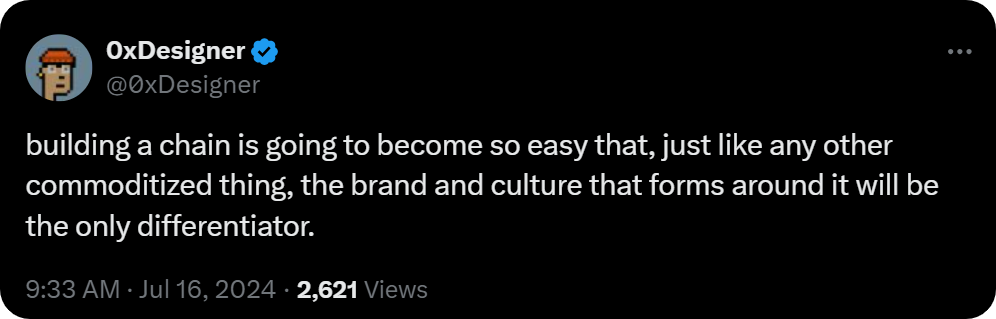
Via: 0xDesigner
Blockchains are the ultimate coordination tool—the final ledger through which humanity records its digital existence and history. Blockchains are technology, but far more than just technology. If you judge them solely by technical standards, evaluating only their technical traits while ignoring their soft power, you'll miss the bigger picture.
On History, Writing, and Accounting
As Yuval Noah Harari explains in Sapiens, humans came to dominate the world because they could cooperate in large numbers—thanks to our unique ability to believe in stories that exist purely in our imagination.
These stories, based on shared belief systems, and cultural artifacts recording different aspects of human existence, become history when combined and recorded.
So how do we record history? Through writing.

Thus, on one hand, history can be defined as the sum of shared stories that a human community collectively agrees are meaningful and valid. On the other, history and writing are deeply intertwined—because without a recording system, there can be no true history.
Add one more puzzle piece: the world’s earliest writing, cuneiform, originated from an ancient accounting system that used clay tokens to track goods like livestock and grain in early agricultural societies. Initially, these tokens represented various goods, with different shapes indicating different items or quantities—a cone, for example, representing a small amount of barley.
Around 3500 BCE, as cities emerged and economies grew more complex, token types expanded to about 300 distinct shapes to cover a broader range of urban-produced goods. Interestingly, the ultimate driving force behind the development of writing came from Mesopotamian society’s shared belief in the afterlife.
History, shared beliefs, recording systems, accounting mechanisms, tokens… Do these concepts sound familiar, anon?
Money and Moneyness as Shared Belief
According to Harari, humanity’s ability to coordinate at scale stems from our unique capacity to believe in things that exist purely in the imagination—gods, nations, money, laws.
In other words, vast cooperative systems like religions, trade networks, and political institutions are products of humanity’s distinctive fictional abilities.
Within this framework, money depends on shared belief as long as it functions as a system of mutual trust. From this perspective, Harari’s argument aligns directly with subjective theory of value (STV). This theory holds that the value of any good is not determined by its intrinsic properties, nor by the cumulative value of components or labor required to produce it, but rather by individuals or entities who buy or sell it.
Based on this concept, an item’s value can significantly increase from its creation, as it becomes more valuable or desirable within certain cultural contexts. Many factors can influence such changes—age, personal sentiment, rarity, etc. In short: cultural relevance.
But Why Does This Matter?
Subjective Theory of Value (STV) helps us understand all stores of value adopted throughout human history—salt, livestock, shells, gold, and crypto assets like Bitcoin and Ethereum.
Yet, only by understanding Harari’s argument about the pivotal role of shared belief in human history can we truly grasp the full power of STV and how it operates.
Like human history, successful currencies and stores of value are not merely products of initial shared belief—they are networked phenomena requiring ongoing attention!
Some might say there’s no fun without money. In the case of blockchains, you’d better make sure your favorite L1 has a native asset serving as a store of value before claiming superiority over others. If it isn’t good money, it won’t have strong economic security. It’s inevitable.
How do you ensure your native asset truly becomes a store of value rather than a fleeting trend?
The answer lies in historical and cultural vitality.
Blockchains as Digital Historical Ledgers
Remember, public blockchains like Ethereum and Bitcoin are shared, decentralized, immutable, and censorship-resistant ledgers for recording transactions and tracking assets.
In other words, once information is recorded on a blockchain, it’s extremely difficult to alter or delete. This trait is especially critical for preserving historical records, ensuring authenticity of files or transactions on-chain.
We greatly appreciate this ingenious system of trustless transaction and balance management. But what about the actual history being recorded? Isn’t that just as important as the underlying technology?
In my view, absolutely.
Ethereum’s native asset, ETH, derives its value from cryptographic-economic properties defined by protocol rules. Yet, as we’ve noted, none of this matters without a loyal and large community that sees value in using the network and storing wealth in its native asset.
The community’s shared belief in the network’s value forms a rich economic history recorded on the Ethereum blockchain—a public ledger. It is precisely this rich history and shared community culture that create a positive feedback loop reinforcing ETH’s value.
History is nothing more than the sum of shared stories deemed significant by a community and validated by social consensus. In the case of blockchains, their history reflects the social and economic relationships among community members.
These relationships should be measured not only quantitatively, but qualitatively—as reflections of the underlying culture:
-
Is it fair to compare the creation of CryptoPunks and its ripple effects (sparking entire industries) with the launch of a low-effort NFT collection (causing temporary hype)?
-
Can we equate the impact of Uniswap and other 0-to-1 DeFi breakthroughs with simple 1-to-N protocols offering incremental improvements (sometimes seemingly just excuses to sell tokens)?
Therefore, while it may be said that all L1s have their own histories recorded in blocks, unfortunately, not all blockchain histories are equal—and their impact on their respective native assets (especially in accumulating value and becoming stores of value over the long term) differs significantly.
Zooming Out
An L1’s value as a coordination tool and decentralized ledger lies in its ability to support economic systems and multiple communities. Yet, not all blockchains are alike. Properties like decentralization, censorship resistance, and trustlessness began as technical traits but ultimately evolved into core values (belief systems/shared narratives) that bind communities together.
Without steadfast belief in these values and ethos, and without a vibrant, creative community choosing the blockchain as a home for projects and wealth storage, it’s impossible to develop a rich and enduring history. Such shared history attracts new members and helps the network grow. It is precisely this history that provides intangible yet vital support to the asset: community trust and sustained attention.
Take Ethereum as an example: What if Vitalik hadn’t launched Ethereum via an ICO and established a foundation to steward it? What if he hadn’t implemented a proof-of-work phase to prevent excessive token concentration? What if he had acted dishonestly, failing to prioritize the network’s best interests? What if Ethereum hadn’t been chosen as the primary platform by Larva Labs, Hayden Adams, and many other founders?
Ethereum’s community and history would have been entirely different. The technology wasn’t the main issue—it’s upgradable, despite technical debt challenges. But history is irreproducible, irreplaceable, and indelible. Only through a rich and enduring history can a blockchain’s native asset truly command a premium!
Join TechFlow official community to stay tuned
Telegram:https://t.me/TechFlowDaily
X (Twitter):https://x.com/TechFlowPost
X (Twitter) EN:https://x.com/BlockFlow_News
 Bankless


