Exclusive Interview with Berachain Co-founder: The Last Fun Public Chain in Crypto, Taking the Grassroots Movement to the End
TechFlow Selected TechFlow Selected
Exclusive Interview with Berachain Co-founder: The Last Fun Public Chain in Crypto, Taking the Grassroots Movement to the End
"Technical barriers" are all paper tigers; "having people come to play at your place" is the key to survival.
 Navigating Web3 tides with focused insights
Interview: Jack, BlockBeats
Translation: Luccy, Ladyfinger, BlockBeats
After the era of Alt L1s led by the "Solunavax trio" came to an end, the "new public chain" sector became rather dull. On one hand, modular infrastructure like L2 and RaaS has matured, making chain creation relatively simple. On the other hand, large-scale new public chains have become highly homogenized in both ecosystem architecture and front-end experience—whitepapers are filled with novel jargon, yet even their names sound identical: "Xen," "Xen," "Xen."
Over the past year, teams and VCs have overly focused on so-called technical innovations of chains, constantly touting TPS and settlement speed while neglecting the fundamental issue of product-market fit (PMF). Amid community backlash against "VC coins" and high FDVs, the market is no longer willing to pay for these high-performance public chains. Many major projects have already turned into ghost chains.
In contrast, Solana and TON, which prioritize user engagement as their growth vector, are thriving. People happily lose money on pump.fun and tap themselves silly on Telegram mini-apps. You can see it in the price performance of SOL and TON—given a compelling reason, people will buy regardless of how expensive it gets. Thus, "VC coin" status isn't the root cause of new chains dying at birth; "technical barriers" are paper tigers. The real survival rule is "people come to play here," which is also the simplest way to assess a chain's potential. Applying this logic to today’s new public chains, only Berachain seems to pass the bar.
Recently, BlockBeats interviewed Berachain co-founder Smokey The Bera about their "rushed" logo design and how they plan to "spend" their $140 million in funding.
Grassroots Culture + High Valuation = ?
Berachain is an outlier from every angle: an abstract brand name, a half-hearted logo design, and even its consensus mechanism transformed into a DeFi game. Yet this chain, deeply rooted in grassroots culture, raised $140 million across Series A and B rounds over the past year at sky-high valuations. Without deeper understanding, Berachain might genuinely make you question whether the world is just one big sham operation.
However, Berachain actually carries pure degen DNA. It originated from a rebase NFT project called Bong Bears, then was jointly launched by several DeFi OGs, quickly attracting a wave of early DeFi investors. Despite embracing grassroots culture, Berachain is far from being a makeshift project in either capability or capital strength.
Interestingly, from the Bong Bears NFT to today’s Berachain, “liquidity” has consistently been the central theme in the team’s product development. Behind liquidity lies the design of gameplay, strategic interaction, and yield mechanics—the benchmark for products is no longer technical prowess but user profile and activity level.
BlockBeats: Before we begin, could you briefly introduce your background and why you decided to transition from investor to founder?
Smokey the Bera:
Most of my career has involved founding companies or allocating capital to them. Before becoming a venture capitalist, I was already a founder—in healthcare and biotech, quite different from crypto. But once you’ve been a founder in one field, doing so in another becomes much easier—you understand what it feels like. That made the transition smooth.
I think venture capital can be a good path in some ways. My first startup taught me a lot through trial and error, and the outcome was solid. Then I thought, working in VC would allow me to accumulate experiences I wouldn’t get focusing on a single product.
Now, I’ve drawn insights from both my prior founding experience and VC work—and ended up back as a founder, though not by strict design. As you mentioned, we initially saw Bong Bears as just a fun NFT experiment, but things evolved beyond expectations. At some point, we realized we needed to take it seriously.
In short, I enjoy exploring novel ideas. Being a VC helps with that, but as a founder, you can exert greater influence. So when rare opportunities arise, sometimes you just need to do it yourself.
BlockBeats: Back to Berachain—even with your institutional background and the project’s massive fundraising, it still gives off a casual, degen vibe unlike typical "VC projects." Is this atmosphere intentionally maintained?
Smokey the Bera:
Yes. Looking back at crypto projects over the past few years that truly built communities and ecosystems, there's a ripple effect: you first attract native crypto users or "on-chain degens," and then the influence spreads outward.
For us, being too formal would be ineffective given our team’s personality and the brand we built around BeraNFT. We don’t try to act like Sui or Aptos—even though we have a highly qualified team capable of competing fiercely with any organization. Still, despite minimal marketing budgets, our progress speaks for itself.
From a community-alignment standpoint, it's also fitting. As mentioned, Berachain started from the Bong Bears NFT project—a concept nearly impossible to present formally. But that informality became one of our strongest community assets: a grassroots, organic movement where people gather culturally, not driven by bot armies or manipulative user tasks, but by believers who enjoy joking around and socializing—a kind of "workplace hangout"—trying to create a collegial environment.
BlockBeats: In today’s market, people increasingly miss naturally grown "organic small-cap experiments"—exactly the vibe Berachain conveys. Yet you've also raised substantial VC capital. How do you balance maintaining an intimate, organic community feel with the pressure of large capital inflows and yield farmers expecting returns?
Smokey the Bera:
I think this requires a multi-faceted answer. There's a narrative that capital and community can't coexist, but I believe that's wrong. Capital can help grow a community, creating asymmetric opportunities and deals most groups couldn't access—especially now, as more individuals hold significant capital reserves.
Many low-FDV and early grassroots projects end up in worse positions within future communities because they’re forced to sell tokens on public markets or OTC desks. Our view is: we’d rather raise VC funds to gain leverage in the market, attract top talent, than sell later to the community. Every time Ethereum Foundation sells tokens, people say "Ethereum Foundation is dumping"—we don’t want that.
Another key point: when I explore new ecosystems—Arbitrum, Optimism, or other new L1s—in most cases, real wealth isn’t created by gas tokens used for staking or governance, but by projects launching their own tokens on-chain. Reviewing recent L1/L2 launches, most fail at enabling zero-to-one potential projects to conduct TGEs on their chains. They mostly offer generic forks of existing products, so people lose interest after one or two months. Look at Blast’s ecosystem: Orbit Protocol once had $500M TVL, now less than $3M FDV. When the market turns sour on L1/L2 tokens, people simply don’t want them, leading to common "pump & dump" outcomes.
If we truly want an ecosystem to thrive and retain community spirit, we need early, community-driven, tightly connected projects that genuinely offer opportunities. That’s why we focus pre-launch on building a native ecosystem—to avoid the common L1 problem of having nothing interesting to play with for the first 6–12 months. On Berachain, we expect a series of exciting new projects to TGE quickly, giving people chances to try new things and keep generating wealth effects.
We believe this achieves both: capital supporting runway for five-plus years, plus leveraging strategic opportunities within the ecosystem. We run an incubator to partner with top ecosystem teams, accelerating their development with resources. So far, 10 projects, 5 completed first-round incubation, two funded by Binance Labs and Polychain. This brings elite talent, sets high standards, and typically shortens a process that takes months or years. We treat this "treasury fund" as a means to serve the community, not extract value from it.
BlockBeats: With many VCs behind Berachain and an official accelerator inside the ecosystem, how do you ensure no "VC favorites" or "princelings" emerge, and instead foster organically grown projects?
Smokey the Bera:
To be honest, our foundation does have an incubation arm, but it handles fewer than 5% to 10% of total projects on Berachain. We prefer working closely with teams we find highly promising—especially first-time founders with great ideas but lacking marketing resources—providing guidance and experience. I don’t want to mislead anyone: we do incubate, but differently. We’re not just spawning generic infra projects—we focus on novel, unprecedented ideas.
A few things matter greatly based on our community interactions. First, showing genuine excitement about what you're building. For Berachain’s ecosystem, having a passionate community or highly active early group makes it easier for developers to notice you and see opportunity here.
We also have community members we’ve known for a long time—they’ve watched the project evolve and eventually felt inspired to build themselves. So, when community leaders shift from posting and trading to building, that’s crucial.
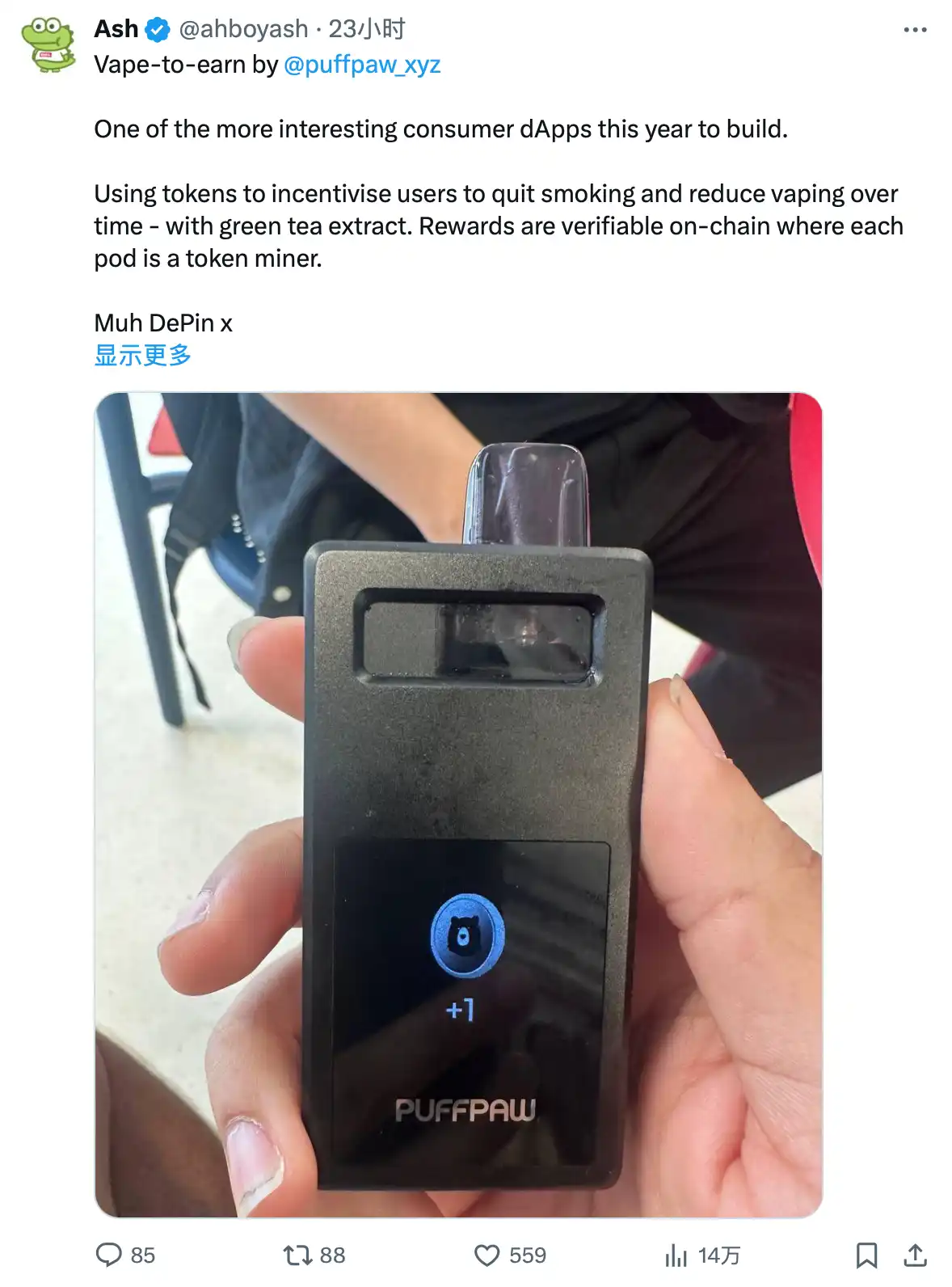
Second, I believe in a supportive culture—where the foundation or lab actively helps these projects.
I see many ecosystems either taking a completely hands-off approach—assuming apps will follow once infra is built—or just throwing large sums at people. I think both are flawed. Dumping money only attracts developers who can’t secure capital elsewhere in the short term, while full laissez-faire leaves no team feeling supported.
The best thing a foundation can do is demonstrate extensive effort and valuable time invested in ecosystem projects—collaborating on market strategy, tokenomics, or anything else—to ensure the best possible experience, effectively becoming an unofficial extension of their team.
The key is acting as their advisor, helping solve problems—not doing everything for them. Our role is guiding them onto the right path. It’s like the Chinese proverb “give a man a fish and you feed him for a day; teach a man to fish and you feed him for a lifetime.” A simple metaphor, yet perfectly captures our philosophy.
BlockBeats: So Berachain prepares everything for developers—liquidity for cold starts, community for user acquisition, incubator as mentor. In short, devs, just come on over.
Smokey the Bera:
I completely agree. The key is demonstrating our presence and willingness to invest time and energy. In this context, teams are our clients. Our job is ensuring they feel genuinely supported and immersed in a carefully curated, non-toxic ecosystem—one free of negativity and mutual belittlement, instead filled with fun, friendliness, and encouragement.
We have a developer chat group with about 400 members building different products on-chain. Though there’s plenty of copy-pasting and jokes, I actually love the vibe—it fits our ecosystem perfectly. When new teams join, they announce their plans, ask about potential partners, and learn what others are building. Such interactions have naturally sparked cool collaborations even before mainnet launch.
BlockBeats: How do you build a practical project? Right now, tokenized projects lack revenue, while self-sustaining ones don’t consider issuing tokens.
Smokey the Bera:
That’s true—often, token issuance becomes the final act of a project’s life. I firmly believe the best projects achieve broad adoption without a token, then use the token to further boost that adoption.
Of course, easier said than done. To reach that state, you need an exceptional product or unique service. Only when users can’t get what you offer elsewhere will you see deep adoption; otherwise, they’ll just chase ways to earn more of your token.
Regarding building good projects, I believe innovation must be purposeful, combined with strong communication, deep UX thinking, and product insight. Crypto has a terrible tendency to build castles in the air around complex tech or terms people can’t grasp—technologies that end up serving little real purpose, however cool they seem in theory. A product-first mindset gets you much further.
Take Berachain: my biggest concern is how to effectively educate people about Proof of Liquidity (POL) and how it differs from previous applications. Yes, it’s technically powerful—but we want the system to feel like familiar tools while offering unprecedented new functions. That’s what many great projects do: enable new actions with clear demand, delivered in non-intimidating ways.
For example, token launchpads exist everywhere, but Pump.fun added bonding curves—an element people recognize and aren’t afraid of. Meanwhile, newer attention-grabbing projects like Expomets on BeraChain encourage leveraged long/short bets on low-cap meme coins and altcoins. Among crypto’s clearest product-market fits, leveraged gambling on junk coins is definitely one. So building truly suitable products for your audience is critical. Too many stay stuck in theoretical constructs, unaware they’re building things nobody actually needs.
BlockBeats: Based on this methodology, is building a "casino" or "leveraged market" the best choice for entrepreneurs?
Smokey the Bera:
I don’t think it’s the best choice. More accurately, it’s a project achieving certain balance between product and market demand. But distribution strategy remains key—and in crypto, that’s a challenge few teams master well.
When Doing Experiments, Go Big
Compared to most new public chains, Berachain genuinely innovates at the consensus layer. Berachain’s POL (Proof of Liquidity) uses three tokens: BERA, governance token BGT, and stablecoin HONEY. BERA, the native token, pays gas and earns block rewards; BGT is a non-transferable governance token whose holders influence block reward allocation; HONEY is a native stablecoin minted via collateralization.
Users deposit assets into the ecosystem to receive BERA, then pair it with HONEY in an LP to provide initial protocol liquidity, earning BGT emissions. Besides LP staking, whitelisted projects can also qualify for BGT. Staking BGT grants share of network fee income and influence over emission volume and direction—e.g., allocating more to Project A, less to Project B.
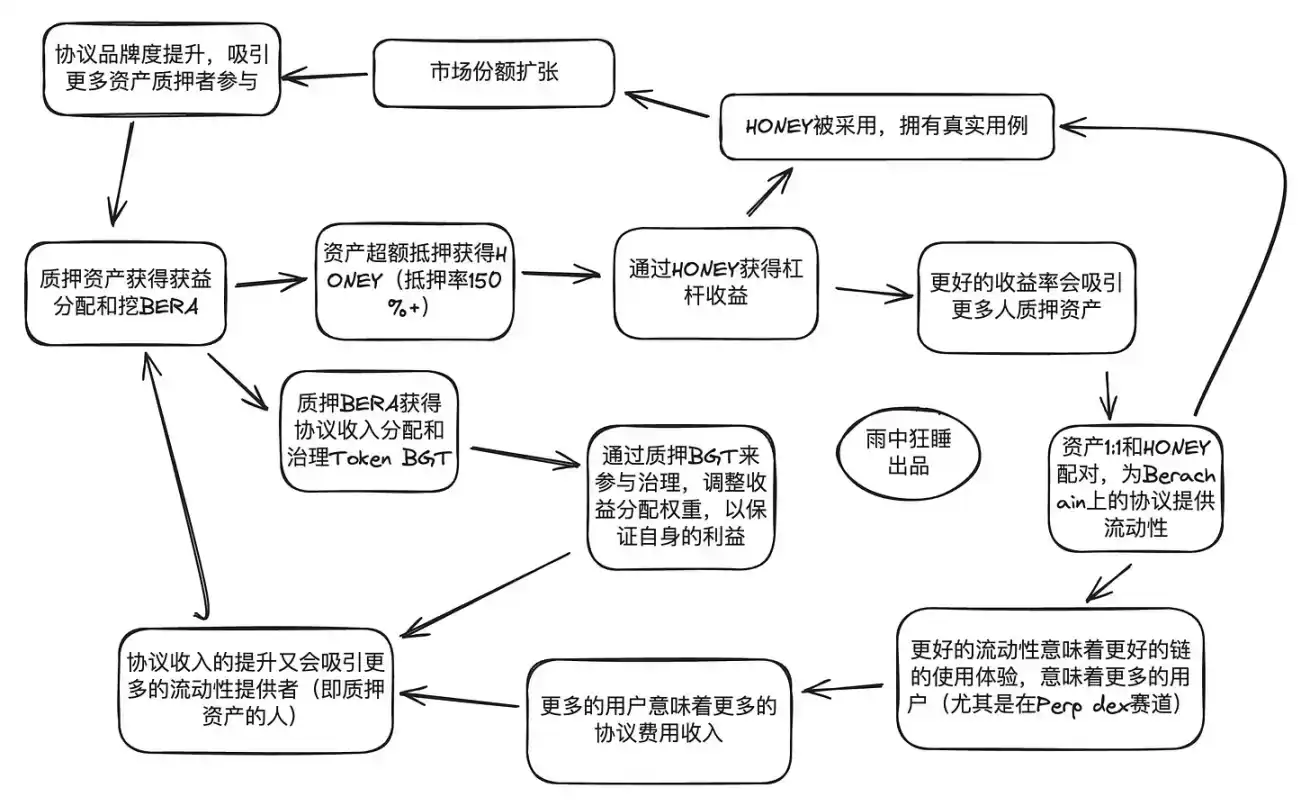
To earn more BGT, projects engage in various forms of "bribery" toward BGT stakers. As participants evolve from liquidity providers to project builders, such bribery strategies multiply. In essence, Berachain transforms itself into a massive Curve.
BlockBeats: So Berachain’s biggest advantage is starting with abundant capital to bootstrap ecosystem liquidity. The key is having a gamified mechanism driving circulation of this capital among projects and users.
Smokey the Bera:
Yes. The best ecosystems create walled gardens—environments where users can maximize capital utility without leaving for external services.
For Berachain, this will be the first chain where you can truly "have your cake and eat it too." You can participate in LPs and simultaneously engage in social and governance activities across diverse apps like DeFi, NFTs, and GameFi. By gaining whitelist status or voting, you can help select specific projects as part of POL, qualifying them to earn native yields on-chain. This means earning project governance tokens while also receiving native staking rewards on Berachain—plus amplified influence over network incentive distribution.
So we aim to minimize opportunity costs and build an ecosystem that efficiently attracts external capital while being somewhat self-contained—preventing massive outflows that destabilize the ecosystem and hinder development of more complex products.
BlockBeats: Blast may have faced this exact issue—most users withdrew funds immediately after airdrop distribution.
Smokey the Bera:
Exactly. In any ecosystem, incentive design and community stability are vital. If a community is too transactional or over-engineered, lasting impact is hard to achieve—reflecting current realities.
Conversely, ecosystems that stand the test of time usually maintain meaningful interaction mechanisms, uniting communities through distinct culture or methods. Solana excels here. Another odd case: Tron. Nobody talks about Tron, yet it holds massive capital, hosts USDT issuance, and once users enter, they rarely leave. That’s an interesting mental model.
BlockBeats: Back to Berachain’s POL consensus. It somewhat revives OHM’s “protocol owns liquidity” concept—giving protocols/ecosystems autonomous control over liquidity. It also adopts Curve-like “bribery” mechanics, giving it a gamified feel. This cycle, people generally distrust or ignore “DeFi experiments,” especially after Curve’s recent founder liquidation incident. Yet you chose to amplify this experiment to the public chain level. Why?
Smokey the Bera:
There are subtle differences here. You can view it as a DeFi ecosystem, or simply as a liquidity mechanism. In crypto, all projects depend on liquidity to some degree—whether providing liquidity pools for their tokens on DEXs or bootstrapping protocol usage. Ultimately, all operate with some DeFi-related technology.
Many GameFi projects have fee and reward accumulation systems. Projects like Fantasy Top and Pump.fun rely entirely on DeFi-powered bonding curves. In fact, the areas generating the most usage and revenue in DeFi or crypto remain DeFi projects—even if less visible now, as people don’t openly discuss them like before. But if you know Ethena, Jito, Pendle, and Pump.fund, they’re all DeFi projects.
While DeFi is an obvious go-to for proving liquidity, it can extend to any domain—supporting gaming and social projects, enabling any value exchange and liquidity flow. So it’s actually a highly flexible tool for the future. DeFi has a clear initial use case, but we’re seeing more "exotic" applications powered by it.
Actually, Berachain’s mechanism isn’t close to the protocol-owns-liquidity model. It helps bootstrap protocol liquidity but is more like direct liquidity steering by validators or LPs. Ultimately, each validator sets thresholds (gauges), and users choose validators based on how they allocate block rewards.
Thus, users are incentivized to collaborate with validators who, upon winning blocks, channel those rewards into pools where they provide liquidity—boosting their own returns. These pools also feature "bribery incentives," which users hope to capture via validator wins.
But Curve has been very successful in many ways, so if you want foundational insight, Berachain can be seen as "Curve at the chain level," since you can directly and quickly route incentives not just to a DEX pool, but to any protocol on-chain.
BlockBeats: If Berachain is the “public chain version” of Curve’s experiment, what are the key mechanistic differences?
Smokey the Bera:
The biggest difference lies in validator protocol logic. On Curve, you earn CRV emissions via farming and LP mining, then typically lock them for a period to get veCRV—the lock duration and amount affect CRV mining yield.
Berachain doesn’t have this. Reward generation varies per validator, each setting their own threshold (gauge). When a validator wins a block, they can choose BGT emission destinations—e.g., 50% to Pool A, 25% to App B, 25% to App C. The overall APY and incentive weights are derived from weighted averages of BGT delegation to validators. If one validator has 1,000 BGT delegated and another only 100, even with identical 50%-50% allocations, the former earns more from both pools due to higher weight.
Another interesting layer: we overlap somewhat with projects like Convex. Protocols can directly partner with validators to cold-start their liquidity—similar to past Curve Wars—but here, rewards come from L1 emissions. Unlike veTokens relying solely on lockups, BGT earns fees from network operations and creates deflationary pressure.
So you hold an asset that accumulates value over time, incentivizing long-term holding. Validators can directly cooperate with protocols—for example, saying: "Give me your X token, and I’ll direct my Y emissions to your pool or protocol." This diversifies validator income—a bit like early-stage VC with near-zero cost.
On the flip side, this mechanism serves as an incentive distribution tool for ecosystem protocols. Users often delegate BGT to validators supporting protocols they like or want exposure to—e.g., "I’ll delegate to this validator because they incentivize X protocol, and I want X protocol exposure." I think this level of choice and strategy exceeds what I’ve seen in Curve’s ecosystem, especially since validators set rules per trading pair, greatly increasing complexity across layers.
BlockBeats: In past DeFi experiments, everyone struggled with token sell pressure—leading to ve(3,3) and other veToken models. How will Berachain handle BGT emissions?
Smokey the Bera:
The most important point is we don’t rely on lockup mechanisms to solve this. I understand the value and logic of lockups—they make sense theoretically—but I also think they often lead to unhealthier pent-up selling pressure, making eventual dumps more severe.
So we deliberately avoid veToken models. On Berachain, you can easily unbond or undelegate from a validator—no 21-day exit period like Cosmos, but a queue similar to ETH. If you want a good token, you must build a good project. Not a novel insight, but many try to bypass building quality projects by artificially enhancing token scarcity—that’s not the real solution.
You must find a compelling use case or method to make your token useful and effectively build an ecosystem around it. That’s exactly what we’re doing with Berachain.
Users earn BGT from native chain emissions. BGT is soulbound and non-transferable, unable to be sold on public markets. You face two choices: delegate BGT to a validator to compound rewards—including new protocol incentives, network fees—and gain influence over on-chain incentive allocation and governance. Or, burn BGT to receive BERA tokens and speculate using BERA’s liquidity and ecosystem value.
Berachain embeds users’ token usage choice into the L1’s foundation. You can opt for long-termism, stacking BGT to earn heavy incentives and shape ecosystem direction. Or you can instantly unlock liquidity, forming LPs elsewhere on-chain. This freedom to choose is actually healthy for allowing diverse exploration of the ecosystem.
Currently, many project designers overlook token demand design. Our goal is ensuring the token has real utility. Most attempts to delay or evade token sell pressure via complex lockups or other means often push people to circumvent limits—through strange OTC or derivatives markets—which rarely ends well.
Final Questions
On June 13, Berachain launched Testnet V2, introducing BeaconKit and increasing validator count to over 200—making Berachain the first L1 to achieve "EVM Identical" (EVM consistency). In fact, the Berachain team has technical competence—they just realized that in crypto, marketing technical superiority to end users almost never works.
BlockBeats: Let’s briefly touch on tech. Berachain V2 introduced "EVM Identical"—how is it different from "EVM Compatible"? Who noticeably feels this difference?
Smokey the Bera:
The main difference is developer experience. While many chains claim EVM compatibility, they’re often not fully consistent—creating hurdles when migrating apps from mainnet to other ecosystems. Usually, developers must maintain a Geth fork or similar library and adapt to specific consensus mechanisms.
As far as we know, Berachain is the first L1 to build a fully EVM-identical environment. This means you can run execution clients like Reth, Nethermind, Aragon, or Geth without issues—they provide the exact same execution environment as Ethereum. Thus, any new EIP integrates seamlessly, and extensibility is identical. If developers want to build an L2 on their chain, they can do so exactly as on Ethereum—a feat typically difficult in other L1 ecosystems.
Objectively, this also reduces our workload significantly. Maintaining a large research or engineering team becomes less critical—when comparing actual forks to this environment, we benefit indirectly from any contributions to the ETH mainnet. From a developer tools perspective, this is hugely beneficial for building broad infrastructure, L2s, and scaling solutions. Overall, I see this as a reliable, powerful enabler.
BlockBeats: Many ZK Rollups that were highly anticipated last year now seem stuck. Has Berachain learned any "avoidance lessons" from them?
Smokey the Bera:
No, we haven’t really seen value there. They’re seen as cool hacker experiments, but in practice, especially during product development, developers face more problems than solutions. The friction is huge—so many voices compete for attention, urging you to pick Chain A or Chain B. If you encounter many obstacles exploring a new chain ecosystem, it’s easier to quit and say, "I don’t want to build here." So our goal is minimizing developer friction, ensuring smooth entry and usage of our ecosystem.
BlockBeats: If Berachain succeeds massively, older or newer players may imitate your mechanism. What will Berachain do then?
Smokey the Bera:
I don’t think technology itself is a competitive advantage. We strongly support open-source software, though every codebase hides unknown details. Ultimately, tech isn’t the core determinant of success. It’s a basic threshold—if performance falls short, users won’t adopt. What matters is combining tech performance with distribution strategy to build community and ecosystem.
I’m sure if someone claims their project is an "enhanced Berachain" or forks/copies our model, that’s fine. In fact, I welcome such competition and imitation. Just as Uniswap and Velodrome get forked across blockchains, those forks often add value to the original. I hope Berachain has a similar positive impact—even with multiple forks, we remain optimistic.
I believe simple tech replication cannot clone a project’s soul—its community culture and values. Sounds idealistic, but I think it’s grounded in truth.
BlockBeats: Final question—if Berachain scales into enterprise applications, will you consider retiring the current "grassroots brand" name and logo?
Smokey the Bera:
We recognize different users have different needs. As I said, we’re building and scaling a company. Many team members have rich professional backgrounds in traditional sectors, so we’re comfortable in formal business settings. Several members are public—for example, Adam, head of business development, previously ran AWS’s high-profile startup program, managing thousands of top accounts, later leading BD at Thirdweb. This lets us showcase past achievements and professionalism while working on Berachain.
Our supporters include traditional institutions and individuals like GoldenTree and Stephen Tannenbaum, along with co-lead investors like Rrevan Howard Digital from more conventional fields. Though the project may remain anonymous, strong corporate backing exists. We plan to expand in this direction, though specifics remain undisclosed for now.
Brands evolve, but enterprises care more about performance—whether we’re good enough to build things from scratch. As projects enter late-stage execution, people focus less on branding and more on tangible results.
We’re also seeing BeraChain’s brand adapt to contexts. For instance, an L2 built on BeraChain recently closed a major funding round. The team has deep gaming experience and will onboard tens of millions of users. Through such branches, we can show Berachain’s different faces tailored to consumer, gaming, or other use cases. We’re committed to staying true to our roots while making content more accessible to average users—regardless of their familiarity with crypto or blockchain.
Join TechFlow official community to stay tuned
Telegram:https://t.me/TechFlowDaily
X (Twitter):https://x.com/TechFlowPost
X (Twitter) EN:https://x.com/BlockFlow_News
 BlockBeats