








Detailed Explanation of the Jupiter H2 Plan and Recent Updates
TechFlow Selected TechFlow Selected
Detailed Explanation of the Jupiter H2 Plan and Recent Updates
Based on liquidity aggregation, leveraging Solana's on-chain trading volume to boost the development of LFG Launchpad is more suitable for the current market development stage.
 Navigating Web3 tides with focused insights
Author: Fu How, Odaily Planet Daily
Today, Meow, co-founder of Jupiter, discussed the H2 (second half) plans in a video, stating that the team will conduct experiments across multiple areas to drive Jupiter's development in key verticals such as Jupiter Product, LFG Launchpad, Trial WGs, Crucial J4J Votes, and GUM.
In addition, Jupiter today released four updates to optimize LFG, which Sanctum will leverage when launching its token next week:
-
MinOutput: A new method enabling users to perform swaps at launch with a guaranteed minimum output;
-
Alpha Vault in LFG UI: Allows depositors to be the first to swap within the pool;
-
Dynamic Airdrops: Teams can add custom rewards—for example, the longer users wait to claim, the greater their airdrop;
-
Airdrop Vesting: Teams can customize vesting parameters for airdrop recipients.
As a core DeFi player in the Solana ecosystem, Jupiter is deeply intertwined with Solana’s prosperity. How exactly will Jupiter evolve? Can it learn from the experiences and pitfalls of Ethereum's earlier DeFi leaders? And what kind of future awaits? Odaily Planet Daily expands on the key points raised by Jupiter today.
Jupiter’s Past Achievements and Product Pillars
In the video, Jupiter co-founder Meow stated that the so-called H2 plan involves deepening and expanding existing functionalities to further Jupiter’s growth in focused verticals.
Jupiter’s current business primarily consists of liquidity aggregation, limit orders, DCA (dollar-cost averaging), Perps trading, and the LFG Launchpad.
Much of Jupiter’s recognition stems from its liquidity aggregation. As the leading aggregator on Solana, Jupiter accounts for roughly half of all on-chain trading volume—most Solana trades flow through it.
The chart below shows trading share distribution on Solana over the past six months:
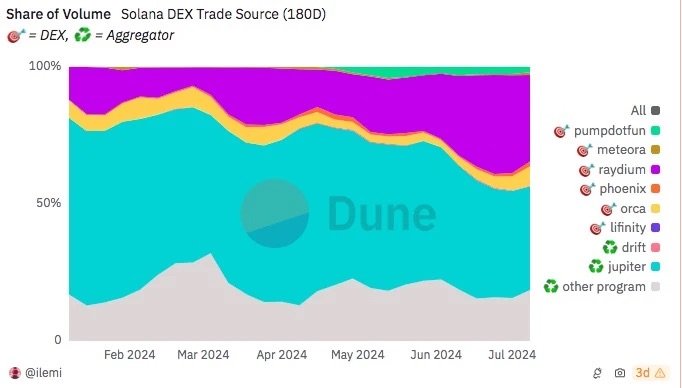
This chart underscores Jupiter’s critical role in Solana’s DeFi landscape. With meme-driven activity fueling Solana’s sustained high transaction volume, Jupiter naturally dominates the aggregator space.
Why has Jupiter grown so rapidly on Solana, whereas similar aggregators like 1inch and Uniswap on Ethereum have achieved less impressive results? The answer lies in network differences. Liquidity aggregation relies on combining depth from various DEX LPs to reduce slippage for users, but differing underlying network conditions have limited its effectiveness on Ethereum.
Secondly, while features like limit orders, DCA strategies, and Perps trading are somewhat overshadowed by liquidity aggregation, they enrich Jupiter’s ability to meet diverse user needs.
Finally, the emergence and rising prominence of the LFG Launchpad have significantly boosted Jupiter’s growth. Since early this year, three rounds have been completed: Round One featured Zeus Network, Round Two was Sanctum, and Round Three deBridge.
Key Points of Jupiter’s H2 Plan and Recent Optimizations
Having briefly reviewed Jupiter’s current status, let’s return to the beginning: what specific areas will Meow’s mentioned H2 plan experiment with?
-
Jupiter Product: As the name suggests, this focuses on enhancing Jupiter’s core product suite—particularly liquidity aggregation and expansion into new trading modes;
-
LFG Launchpad: As a successful experimental product, ongoing refinement of its rules and framework will continue;
-
Trial WGs: Experimental working groups on Jupiter—for instance, community-proposed initiatives like promoting Jupiter on Reddit. These action teams receive funding via community votes and shape Jupiter’s future;
-
Crucial J4J Votes: Critical governance proposals, representing the pursuit of decentralization common to all major projects;
-
GUM: Short for Giant Unified Market, aiming to integrate meme coins, real-world assets, stocks, and forex into Jupiter on Solana, enabling seamless cross-asset trading.
Today, Jupiter also announced several upgrades. Below is an explanation of these four initiatives:
MinOutput:
-
Flexible pricing: Users can set a minimum acceptable price, ensuring trades aren’t executed below expectations due to market volatility.
-
Risk reduction: In volatile markets, setting a minimum price ensures trades settle within expected ranges, minimizing potential losses.
-
Improved user experience: Users no longer need to worry about fluctuating quotes mid-trade, increasing transaction certainty and confidence.
Alpha Vault:
-
Priority access: Depositors gain the chance to be the first to swap in a pool, enjoying front-runner advantages.
-
Lock-up period: In exchange for this benefit, Alpha Vault participants must accept a lock-up period, discouraging short-term speculation.
-
Liquidity management: This approach enhances transparency and user experience while improving efficiency in liquidity management, contributing to market stability.
Dynamic Airdrops:
-
Holding incentives: By linking reward size to claim delay, users are encouraged to hold tokens longer, reducing immediate sell-offs.
-
Customizable rewards: Projects can design tailored incentive mechanisms, making airdrops more flexible and appealing, boosting participation.
-
Long-term engagement: To maximize airdrop benefits, users are incentivized to maintain long-term holdings, fostering a stable user base and market environment.
Airdrop Vesting:
-
Long-term alignment: Custom vesting parameters ensure recipients’ interests align with the project’s long-term goals.
-
Reduced short-term speculation: Vesting prevents recipients from dumping tokens immediately after receiving them.
-
Market stability: Gradual token unlocking avoids sudden sell pressure, helping maintain price stability.
Conclusion
As Solana’s leading DeFi platform, Jupiter already commands massive traffic. However, effectively converting this traffic into high retention and strong user stickiness remains a central challenge—not just for Jupiter, but for all DeFi projects.
By aggressively developing the LFG Launchpad, Jupiter has demonstrated how a DeFi product can evolve beyond being merely a utility tool into becoming a primary platform for new token launches centered around trading.
In this new cycle, Jupiter has the potential to leverage its dominant on-chain trading share to retain users directly within its ecosystem—a strategic shift distinct from prior DeFi projects. Calling it the "light of Solana DeFi" is not an exaggeration.
Join TechFlow official community to stay tuned
Telegram:https://t.me/TechFlowDaily
X (Twitter):https://x.com/TechFlowPost
X (Twitter) EN:https://x.com/BlockFlow_News
 Odaily






