








Where Did the Crypto Funds Go? Understanding Key Events That Shape Cryptocurrency Market Cycles
TechFlow Selected TechFlow Selected
Where Did the Crypto Funds Go? Understanding Key Events That Shape Cryptocurrency Market Cycles
Setting aside the negative factors, we should focus more on long-term development trends.
 Navigating Web3 tides with focused insights
After two painful months of decline, the market welcomed a broad cooldown in U.S. CPI data yesterday, pushing Bitcoin to rebound above $59,000. However, Germany’s ongoing Bitcoin sell-off—dumping approximately 10,627 BTC worth $616 million in just 16 hours—wiped out all gains driven by CPI expectations.
TL;DR
• The crypto market cycle is influenced by four key factors: macroeconomic conditions, technological infrastructure breakthroughs, regulatory clarity, and Bitcoin’s halving cycle. We are currently in a pivotal phase marked by global rate cuts, Bitcoin’s halving, clearer regulations, and increasing mainstream attention.
• Since last year, strong performance from major AI companies has somewhat overshadowed the crypto market, drawing significant investor capital toward AI-related equities. “Perhaps the market peaked not because crypto is weak, but because AI is more attractive.”
• Key bearish pressures still exist: potential recession following U.S. rate cuts, Bitcoin selling pressure from German and U.S. governments as well as Mt. Gox, and profit-taking after the approval of Ethereum spot ETFs. How much of this remains?
• The quadrennial UEFA Euro tournament coincides once again with Bitcoin’s halving. The overlap between football gamblers and crypto speculators is significant. Will these yield-chasing investors shifting funds between the two arenas drain liquidity from crypto markets?
• Beyond short-term headwinds, long-term trends remain promising: potential pro-crypto policies under a Trump presidency, steady growth in stablecoin supply enhancing market liquidity, continuous institutional accumulation of Bitcoin, active venture capital investment, and growing on-chain user base. We should focus on these fundamentals rather than obsess over short-term price swings.
How Much More Selling Pressure Remains?
As of July 12, Germany holds only about 9,094 BTC left to sell. They plan to continue dumping over the next week, likely completing their entire sale within this week. This could trigger sharp short-term drops in BTC under extreme scenarios, but the market can absorb such selling pressure.
Meanwhile, Mt. Gox and the U.S. government have yet to move their combined $1–3 billion worth of Bitcoin. Adding Germany’s already sold $2.36 billion, total market selling pressure could reach $4–7 billion—partly explaining why the market has struggled to rise. Yet this doesn’t mean the bull run is over. According to Bitwise’s Q2 report, several positive indicators support continued long-term growth: Bitcoin ETFs saw record inflows exceeding $2.4 billion last quarter; active wallet counts for Bitcoin and Ethereum rose 26% and 34% respectively last month, with users holding over 1 BTC surpassing 1 million for the first time; average open interest in regulated Bitcoin futures hit a new high of $9.8 billion (up nearly 400% YoY), signaling sustained institutional interest; stablecoin AUM and transaction volumes continue rising steadily; VCs invested $3.194 billion last quarter, up 28% QoQ. The launch of Ethereum spot ETFs will further boost confidence, alongside the upcoming U.S. election. These data points and events confirm that the crypto bull market still has room to grow.
Another crucial but overlooked catalyst: if FTX receives approval to repay creditors $16 billion, it could provide a powerful boost to the crypto market. Key dates include the customer voting deadline on August 16 and the judge’s final decision on October 7. If approved, these funds would flow back into the market between Q4 2024 and Q1 2025—aligning perfectly with other tailwinds like rate cuts and the U.S. election outcome. Given most FTX customers are crypto enthusiasts, this $16 billion could directly re-enter crypto markets, becoming a major driver of price appreciation.
U.S. Economic Data Cools Down – Rate Cuts Incoming
As expected, yesterday's release of U.S. June unadjusted CPI showed an annual rate of 3.0%, below the forecasted 3.1% and the lowest since June 2023. Core CPI came in at 3.3%, also below the 3.4% estimate—the lowest since April 2021. With both headline and core CPI falling, Bitcoin briefly rallied to $59,000. However, traders may have front-run the positive data, limiting the upside. Combined with Germany’s relentless BTC sales, Bitcoin erased all gains by early today. Let’s examine the CPI details:
1. Food inflation has steadily declined from a 2020 peak of 11% to around 2%, now at a relatively low level.
2. Energy: Gasoline prices dropped 3.8% MoM, following a 3.6% decline in May. This sustained fall significantly contributed to lower-than-expected inflation. The broader energy index—including natural gas, electricity, and heating oil—fell 2% in June.
3. Core CPI, excluding volatile food and energy, has reached a four-year low.
4. Goods inflation slows further, with continued declines in new and used car prices.
5. Services inflation is at its best level in years: Housing prices rose only 0.2% MoM in June, rents up 0.3%, and owner’s equivalent rent also up 0.3%—the smallest increases since August 2021. Entertainment and education services also slowed sharply, showing minimal growth.
A September rate cut by the Fed is now all but certain. Powell recently stated the Fed does not require inflation to fall below 2% before cutting rates. According to the CME FedWatch Tool, after the latest CPI print, there’s a 93.3% chance rates stay unchanged in August, while odds of a 25-basis-point cut in September jumped to 86.4%. Traders now expect two rate cuts in 2024, with a 25% chance of a third cut later this year.
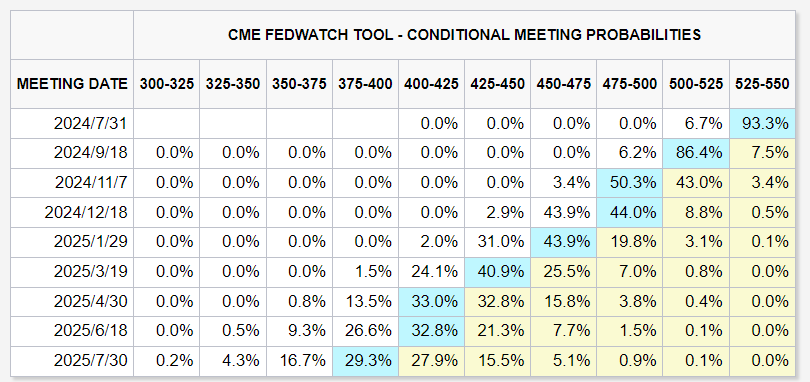
CME FedWatch Tool
Rate cuts increase market liquidity, benefiting risk assets—but come with risks of economic recession. Interest rates are expected to trend lower this year. Deposit levels, monetary policy shifts, and overall economic conditions remain critical for market liquidity.
Latest on Ethereum ETF Approval
ETF listing involves two steps. First, issuers must file Form 19b-4 by May. Multiple firms have submitted applications for spot Ethereum ETFs, and the SEC has already approved eight via a unified order (from BlackRock, Fidelity, Grayscale, Bitwise, VanEck, Ark, Invesco Galaxy, and Franklin Templeton). Second is the S-1 registration form, which has no fixed deadline. Several issuers have filed S-1 forms awaiting SEC review. After revisions were resubmitted by July 8 following initial SEC feedback, another round of filings may be needed before trading begins. The exact launch timing depends on SEC processing speed. Once approved, spot Ethereum ETFs can begin trading immediately.
On Launch Timing:
• Nate Geraci, President of The ETF Store, said on July 8 that revised S-1 submissions closed on that day. It's unclear how fast the SEC will act, but he expects spot Ethereum ETFs could launch next week or within two weeks.
• Bloomberg analyst Eric Balchunas commented: “No one really knows why the SEC is taking so long. With few comments, approval should be quick—unless one ‘problem’ issuer is slowing things down, or it’s just summer laziness/vacations.”
• Bloomberg’s James Seyffart previously estimated the ETF could go live late this week or during the week of July 15. Historically, this process takes up to three months, but approvals can happen as quickly as one day.
The progress of S-1 approvals is a key focus for investors tracking Ethereum ETF developments. Once cleared, these ETFs could launch imminently—signs point to this month. However, the SEC has historically been cautious with crypto ETFs, so uncertainty remains.
If spot Ethereum ETFs are approved, they will open a direct investment channel into ETH, creating major ripple effects across the crypto market:
1. **Increased Institutional Participation**
ETFs are favored by institutional investors due to better risk management, diversification benefits, ease of trading, superior liquidity, and lower fees compared to actively managed funds. Approval would open the floodgates for more institutional capital into Ethereum and the broader crypto market.
2. **Enhanced Market Depth**
As regulated, standardized instruments, ETFs offer greater transparency and security, boosting investor confidence. Their introduction will increase spot market volume and counterparties, improving overall liquidity.
3. **Stimulated Derivatives Market**
More institutions entering crypto often participate in derivatives like futures and options. An ETH ETF provides a direct exposure tool, increasing hedging and arbitrage demand. This incentivizes exchanges and product providers to innovate, launching new financial instruments and enriching market offerings.
4. **Ecosystem Growth**
As the second-largest cryptocurrency, a spot ETH ETF won’t just boost derivative demand—it will revitalize the entire Ethereum ecosystem, driving higher activity in DeFi, NFTs, and other on-chain applications. Even though some users lost motivation to use L2 rollups after major airdrops, renewed demand for derivatives could re-energize stagnant ecosystem growth.
The industry awaits the SEC’s final decision. Once S-1 forms are approved, Ethereum ETFs can officially trade on U.S. exchanges, unleashing a wave of passive investment. Gemini estimates net inflows could reach up to $5 billion within six months. Such passive buying often drives rapid price appreciation. VanEck’s digital asset research head Matthew Sigel is optimistic that over $6 trillion could flow into crypto over the next two decades.
Currently, the ETH/BTC ratio is near multi-year lows, suggesting substantial upside potential for Ethereum relative to Bitcoin—and significant momentum ahead.
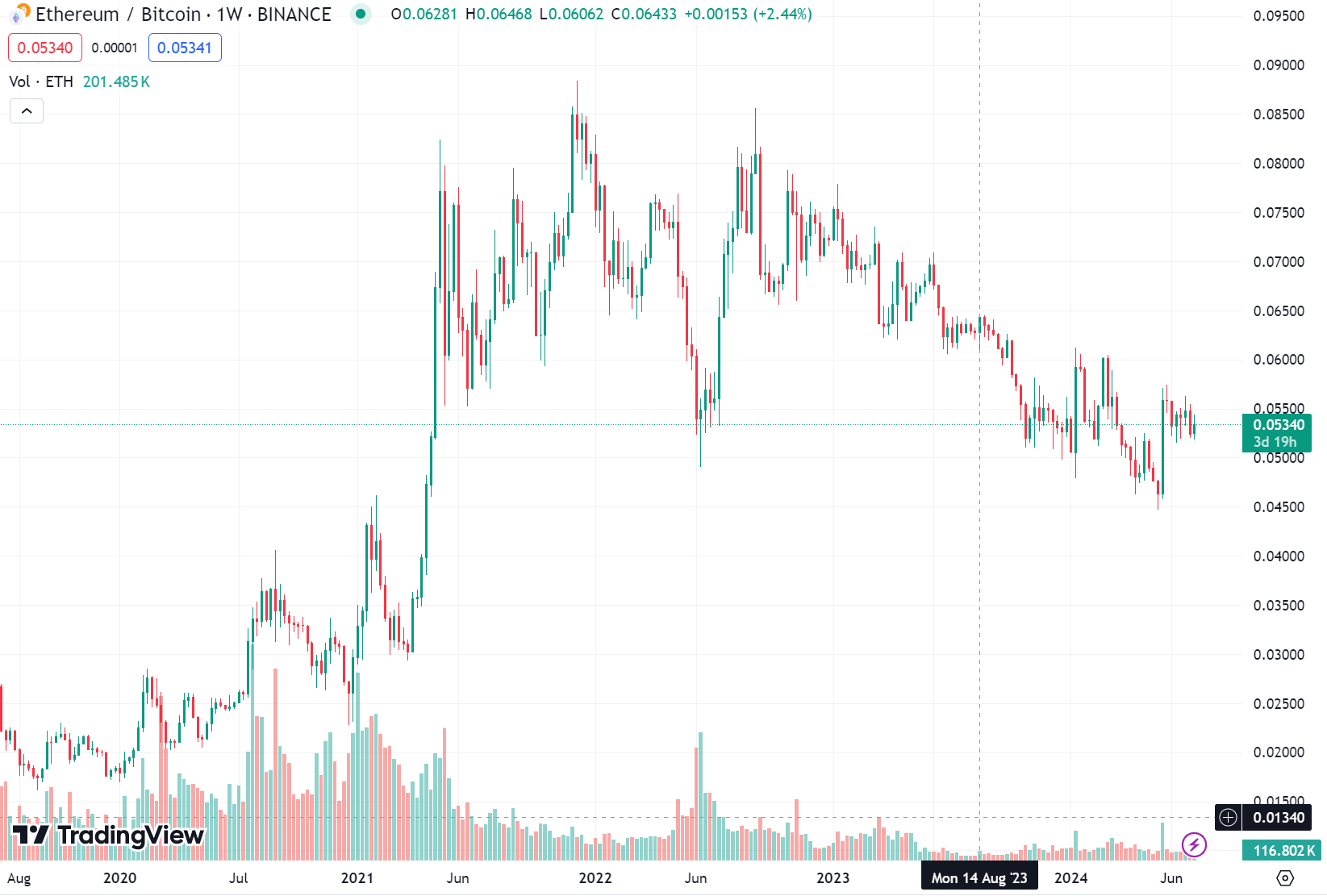
If the ETH/BTC ratio returns to its 3-year median, ETH could gain nearly 20%. If it reaches the 3-year high near 0.087, ETH could surge ~55%, potentially hitting new highs. Either way, Ethereum is clearly undervalued against Bitcoin right now. The launch of a spot ETH ETF will benefit the entire crypto market, attracting more capital and fueling broader bullish momentum.
A New Twist in the U.S. Election: Could Obama Make a Comeback?
The 2024 U.S. election is heating up, with internal divisions emerging within the Democratic Party over whether Biden should seek re-election. On one hand, frontrunner Donald Trump remains highly competitive. Younger voters increasingly disengage from traditional party politics, expressing views through social media instead—a challenge for conventional politicians. Trump thrives in online political discourse, frequently posting on social platforms. Compared to Biden’s concerning health, Trump enjoys stronger popularity and maintains robust momentum.
On the other hand, Democrats lack a strong candidate capable of challenging Trump. Interestingly, however, there appears to be a contingency plan. Party leaders are closely monitoring Biden’s health, worried he might not make it through the campaign. Should anything happen, former President Obama could step in as a backup.
Due to constitutional term limits, Obama cannot run as president again. But he could join Biden’s ticket as vice-presidential candidate, then assume the presidency if Biden becomes unable to serve. In fact, Obama seems prepared: Biden regularly consults him on campaign strategy and personal matters, and Obama advises senior White House officials and Biden’s campaign team. Beyond behind-the-scenes support, Obama is expected to appear publicly at campaign events.
Earlier this year, Biden co-hosted a rare dialogue event in Manhattan with Obama and former President Clinton—an effort by Democratic leadership to unify the party and secure Biden’s re-election.
Meanwhile, the Republican Party, in its official 2024 platform, supports several pro-digital asset policies.
|
According to the official document released by Trump’s campaign, the GOP’s “Make America Great Again” agenda vows to end the “illegal and un-American crackdown” on the U.S. crypto industry. It promises to “defend the right to mine Bitcoin,” allow holders to self-custody their tokens, and oppose the creation of a central bank digital currency (CBDC). The document states: “We will defend the right to transact without government surveillance and control.” |
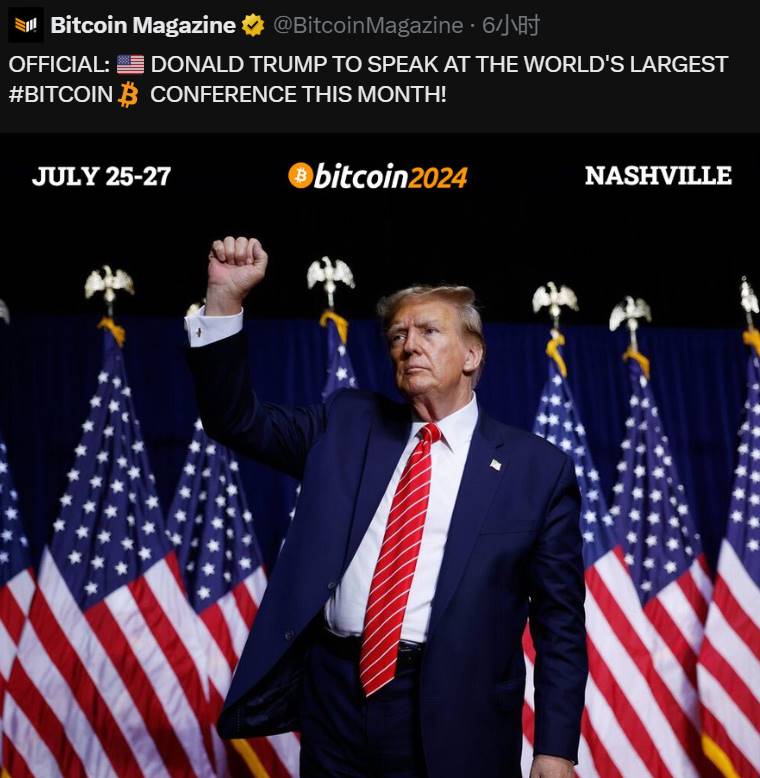
Trump himself has repeatedly voiced support for Bitcoin as a corporate asset. He has officially confirmed attendance at the upcoming Bitcoin Conference from July 25–27, where he will deliver a keynote speech—likely the first time a former U.S. president speaks at a crypto event of this scale. His pro-crypto stance has earned him additional attention and votes: polls suggest around 13% of voters who initially weren’t planning to vote Republican now view Trump more favorably because of his crypto positions.
Currently, crypto prediction market Polymarket gives Biden a 21% chance of winning versus Trump’s 62%. In the widely watched New York Times and Siena College poll, Trump leads Biden 49% to 43% among likely voters—a 6-point advantage. Biden’s position is far from secure. As reported by TIME, his approval ratings remain low compared to previous presidents seeking re-election. Concerns over his age are a primary factor behind the shifting sentiment.
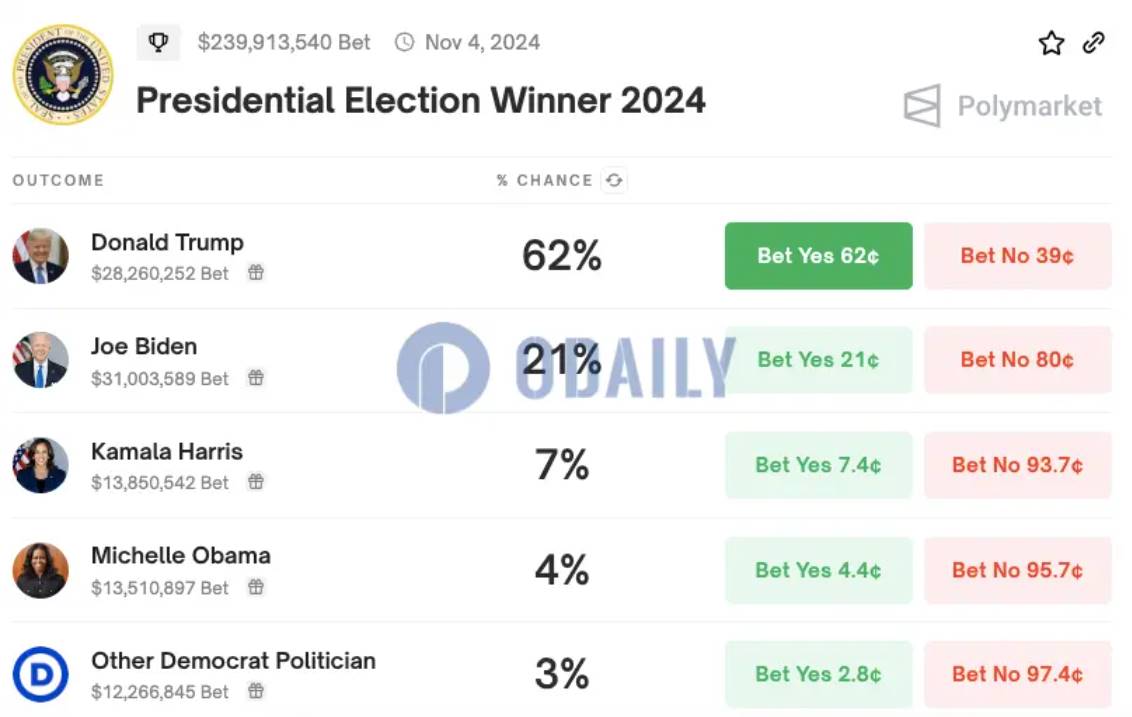
Polymarket prediction results
Liquidity Drained by Euro 2024—How Much Will Flow Back?
The UEFA European Championship shares a deep connection with the crypto world—every four years, the tournament coincides with Bitcoin’s halving cycle. Moreover, the demographic of speculative crypto traders overlaps significantly with football bettors. Traffic analysis of Rollbit, a blockchain-based gambling site, shows a clear surge in visits from regions like Brazil, Australia, and Mexico since the start of Euro 2024 in June. Notably, the top websites visited by Rollbit’s audience are DexScreener and Stake.com—evidence that some crypto market capital may have shifted toward sports betting, contributing to downward price pressure.
Another crypto casino and sportsbook platform, Stake.com, recorded a staggering 124 million visits during the Euro 2024 period—an increase of 31.38% MoM—indicating rising engagement in gambling during the tournament. Top traffic sources to Stake.com come from India, Canada, and Argentina.
|
According to the Asian Racing Federation, the number of gambling sites accepting the top five cryptocurrencies—BTC, ETH, Tether, BNB, and Solana—has grown from 648 in 2020 to 811 in 2024, a 25% increase. Among Hong Kong’s top 20 illegal gambling sites, 12 now accept crypto bets. |
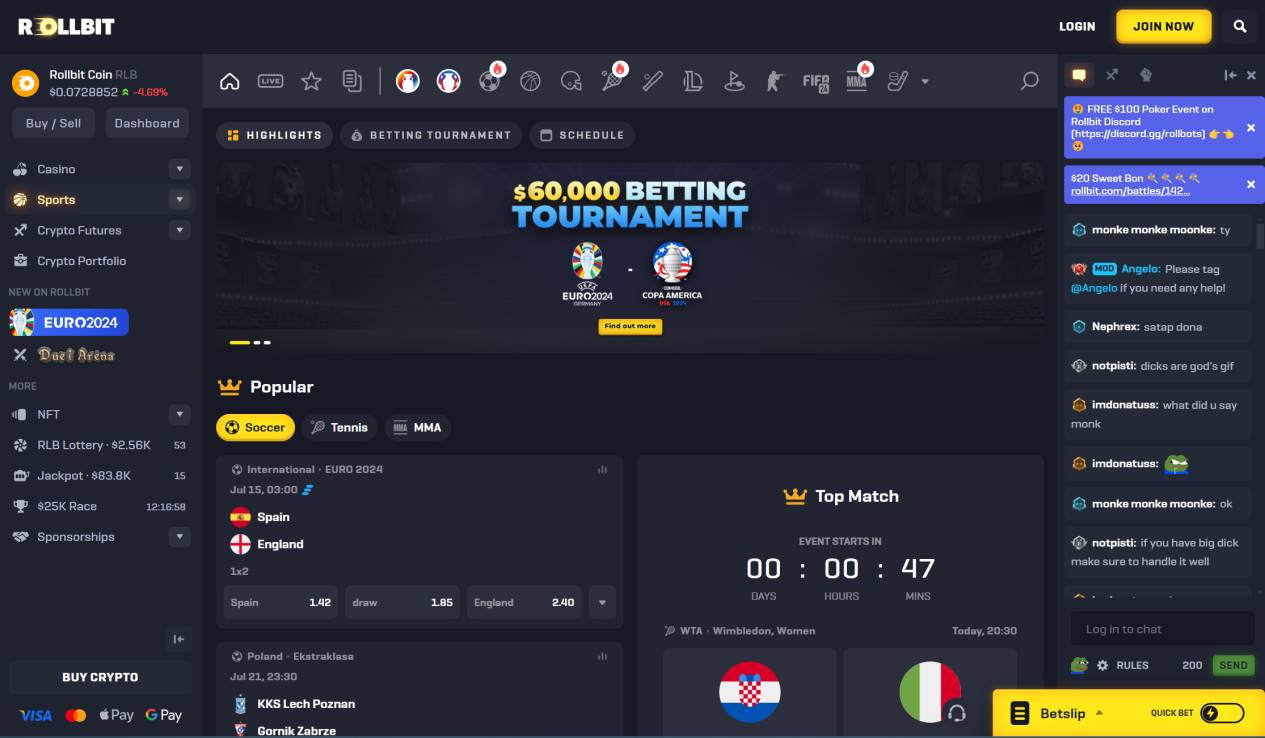
Rollbit’s Euro 2024 betting interface
Euro 2024 concludes on July 12. While no direct data confirms exactly how much capital flowed from crypto into football betting, we can reasonably expect that once the tournament ends, traders and speculators drawn to football will refocus on crypto markets, and sidelined funds will likely return to crypto investments.
REFERENCE
1. https://bitwiseinvestments.com/crypto-market-insights/crypto-market-review-q2-2024
2. https://www.techflowpost.com/article/detail_18932.html
3. https://www.odaily.news/post/5196467
4. https://www.odaily.news/newsflash/379211
5. https://www.odaily.news/newsflash/373192
6. https://www.cnfin.com/hs-lb/detail/20240712/4074644_1.html
Join TechFlow official community to stay tuned
Telegram:https://t.me/TechFlowDaily
X (Twitter):https://x.com/TechFlowPost
X (Twitter) EN:https://x.com/BlockFlow_News
 @XTexchange











