








97% of ARB holders suffer losses as massive token unlock sparks backlash; Arbitrum's ecosystem subsidy strategy criticized as unwise
TechFlow Selected TechFlow Selected
97% of ARB holders suffer losses as massive token unlock sparks backlash; Arbitrum's ecosystem subsidy strategy criticized as unwise
Although Arbitrum still holds a leading position in many metrics among various L2s, its ecosystem data is undoubtedly subsidized by a generous distribution model.
 Navigating Web3 tides with focused insights
Author: Nancy, PANews
Arbitrum is undoubtedly one of the top-performing Layer 2 projects in terms of data metrics. However, its persistently declining token price remains a significant weakness—even though its circulating market cap has more than doubled since launch.
Nearly $2.6 Billion Unlocked in 4 Months; 97% of Holders in Loss
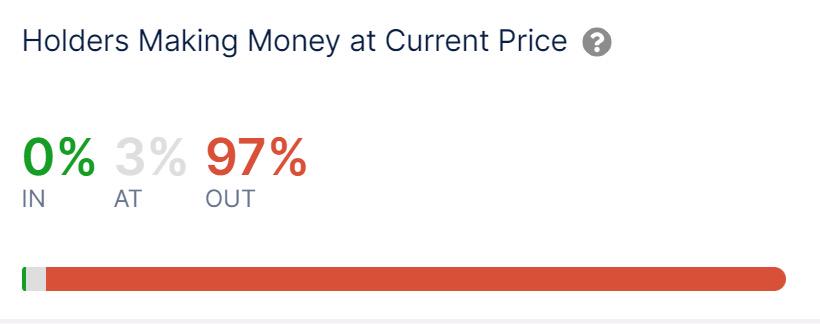
Compared to its initial circulating market cap of $1.02 billion at launch, Arbitrum’s ARB token now has a circulating market cap exceeding $2.3 billion. Yet holders remain trapped in continuous losses. According to IntoTheBlock data, ARB's price performance has been weak, with as high as 97% of ARB holders currently underwater. Only 3% are breaking even at current prices, and virtually no holders are profitable.
According to CoinGecko, ARB reached an all-time high of $2.26 in January this year—up 67.4% from its March 2023 listing price—but then entered a prolonged downtrend, recently hitting new lows. The current price is down 69% from its peak. In contrast, its circulating market cap has only declined by about 30% from its high. Meanwhile, its competitor OP achieved a maximum increase of 235% from its initial listing price, and although it is now down over 65.6% from its peak, its market cap has dropped 61.2% from its high.
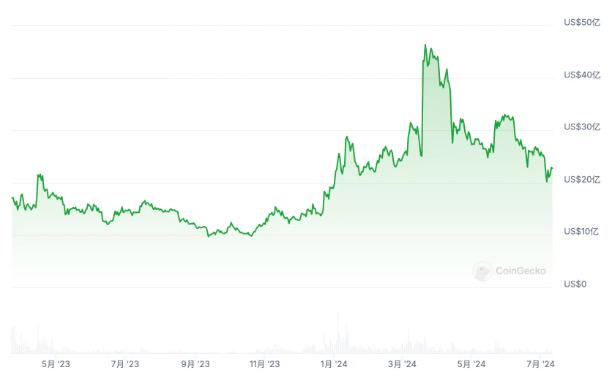
Arbitrum Circulating Market Cap
ARB’s prolonged bearish trend is directly linked to large-scale token unlocks. Starting in March, substantial amounts of ARB tokens began unlocking for the team and investors. According to PANews’ analysis, over 1.38 billion ARB tokens—valued at over $2.59 billion—have already been unlocked since March.
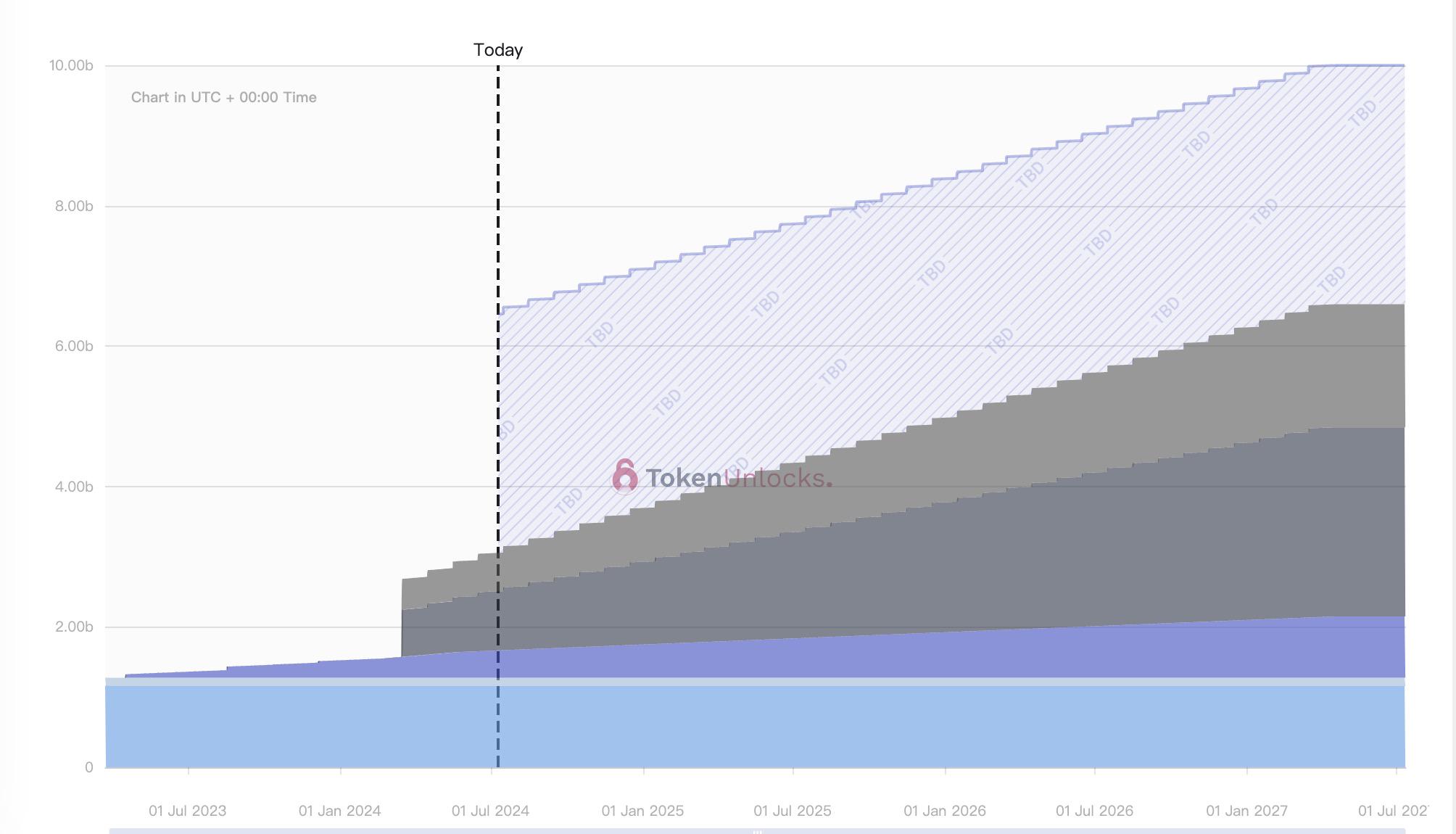
Moreover, Arbitrum faces additional monthly unlocks on the 16th of each month. Starting in July, unlocks from the Arbitrum DAO Treasury will begin, amounting to a value of up to $2.41 billion, with approximately 400% more supply expected to be released by March 2027. According to Token Unlocks data, as of July 10, only 31% of ARB tokens have been unlocked so far.
If market liquidity continues to decline, these massive ongoing unlocks will likely push the token price even lower. For example, crypto analytics platform DYOR recently noted that given current liquidity levels, if investment institutions sell just 5% of their monthly unlocked allocations, assets like ARB could fall between 30% and 70% in price.
Strong Metrics Remain, But Ecosystem Subsidies May Not Rescue Price
Despite lackluster price performance, Arbitrum still holds a leading position among L2s based on key data metrics.
Latest data from Dune Analytics shows that as of July 10, Arbitrum has accumulated over 317.5 million created accounts and surpassed 800 million total transactions. The total value bridged (TVB) on Arbitrum has exceeded 3 million ETH, with around 737,000 bridging addresses. Additionally, L2BEAT data indicates Arbitrum One maintains the top spot with a TVL of $16.12 billion, capturing 40.1% of the market share. Growthepie reports that stablecoin market cap on Arbitrum has surpassed $4.07 billion—the highest among L2s—with a year-on-year increase of 116%, outperforming Base, OP Mainnet, and ZkSync Era. Over the past six months, Arbitrum also recorded a 205% growth rate in active addresses, surpassing ZkSync and OP Mainnet.
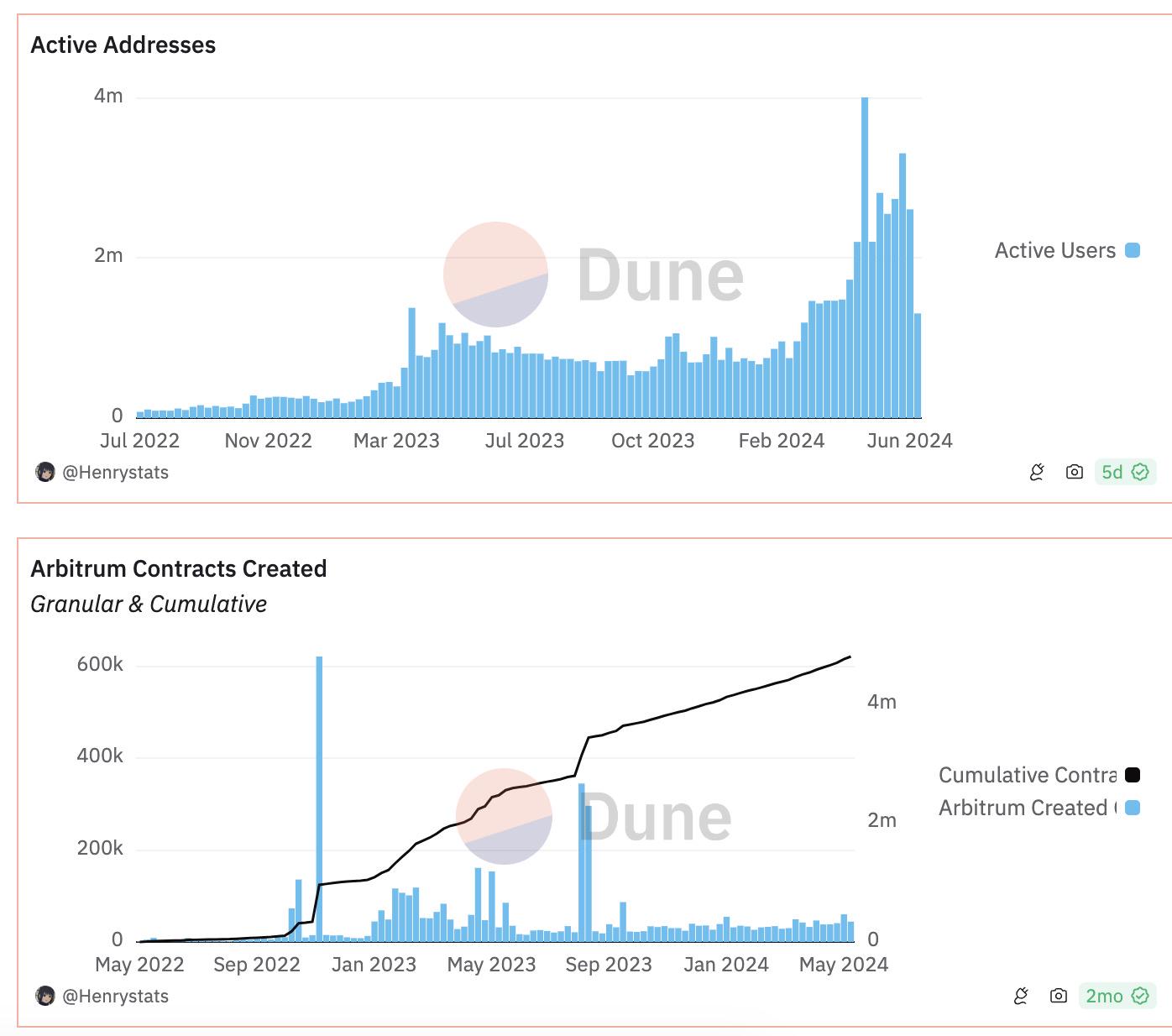
These strong ecosystem figures have largely been fueled by aggressive subsidy programs.
Arbitrum has long relied on subsidies to accelerate ecosystem growth. For instance, in gaming, in June Arbitrum approved a proposal allocating 225 million ARB tokens to fund game development on its chain, aiming to establish itself as a leader in blockchain gaming, with funds distributed over three years. For RWA (Real World Assets), Arbitrum plans to allocate 35 million ARB tokens to support RWA initiatives, targeting 1% annual financial diversification through RWA ecosystem growth, which has already received over 99% community voting approval.
At the same time, Arbitrum has widely distributed grants to various projects. In 2023 alone, it awarded approximately $10.6 million in grants to over 50 projects. That year, it also launched a short-term incentive program to distribute up to 50 million ARB tokens from the DAO treasury to active protocols on Arbitrum, receiving applications from 106 projects for the first round. This year, funding support continues: Open Campus recently announced it received a grant from the Arbitrum Foundation to launch EDU Chain, the first Layer 3 blockchain designed specifically for education; Pendle announced it received a 1 million ARB grant from Arbitrum’s STIP program; Synthetix introduced a liquidity incentives program offering 2 million ARB rewards to attract liquidity providers, stablecoin liquidity, and Perps trading activity on Arbitrum; Curve Finance reported receiving over 237,000 ARB donations from Arbitrum to incentivize liquidity pools on the Arbitrum chain.
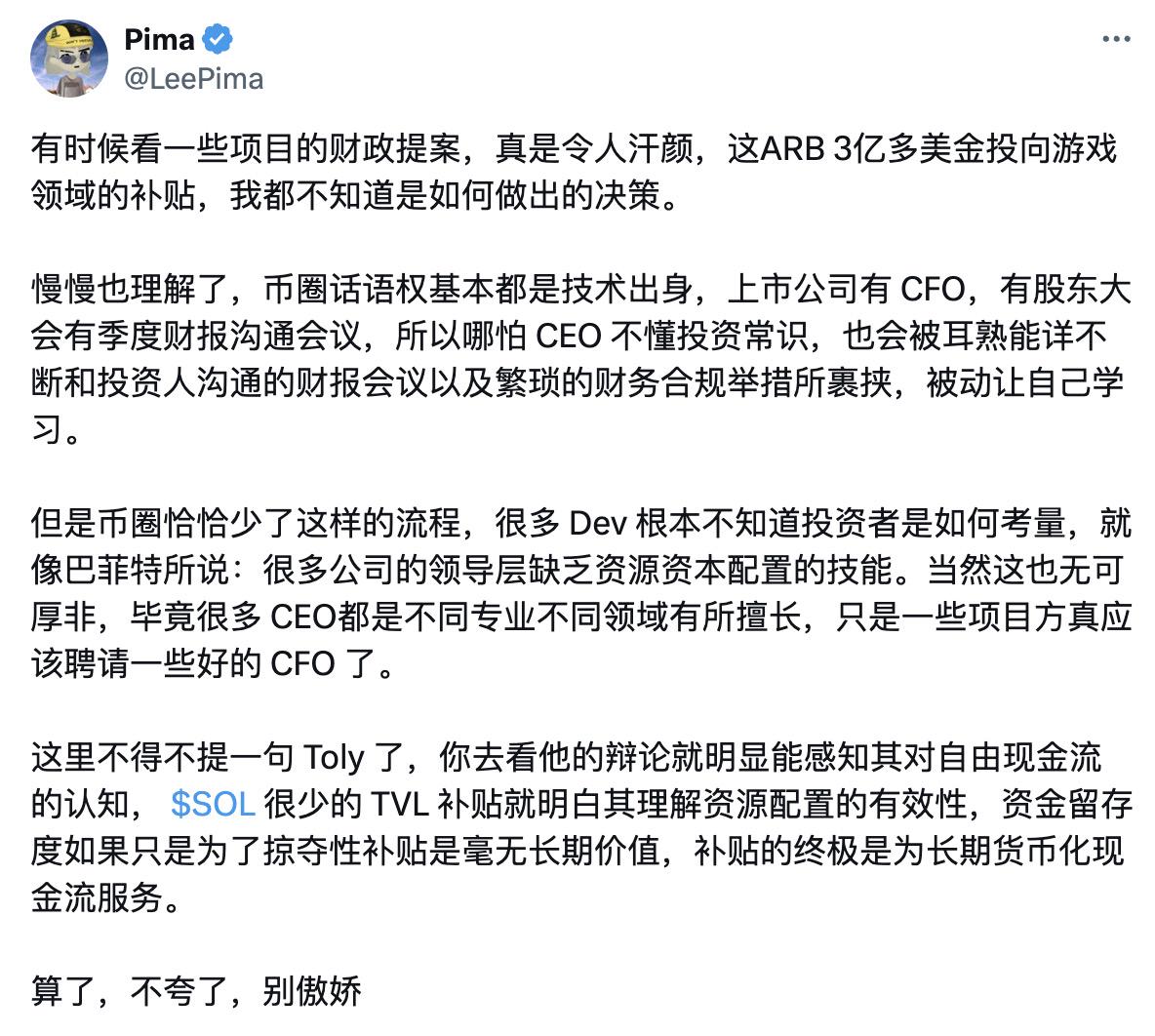
However, Arbitrum’s strategy of building its ecosystem through token subsidies has sparked criticism. Within the community, many argue this approach fails to add real value to the token while increasing selling pressure. For example, Pima, co-founder of Continue Capital, pointed out that many project leaders lack proper capital allocation skills, and retaining funds solely for predatory subsidies creates no long-term value. Subsidies should ultimately serve long-term monetization and cash flow generation. Influencer BITWU.ETH stated that Arb exemplifies the “low circulation, high emissions” subsidy model, resulting in “growing market cap but volatile token trends.” In essence, this model continuously sacrifices the secondary market, favoring traders over long-term holders. These tokens are no longer undervalued opportunities—major players have already priced them in. Future returns are limited to beta gains, not alpha.
Additionally, Arbitrum DAO is considering adopting tech-industry-style acquisitions to expand its ecosystem. In May, Arbitrum DAO approved a pilot acquisition program proposed by Bernard Schmid, founding partner of Areta, lasting eight weeks. Marketing firms, business developers, infrastructure providers, stablecoin issuers, and zero-knowledge technology companies are seen as attractive acquisition targets. If successful, Schmid plans to propose establishing a dedicated M&A division with a funding pool of $100 million to $250 million to identify and acquire strategic targets within two years. DeepDAO data shows Arbitrum’s treasury holds assets worth $2.6 billion, with 97.4% consisting of ARB tokens—a decline of over 65.7% from its peak value.
Notably, Arbitrum is also iterating on product design and governance to improve developer and user experience. For example, in April, the Arbitrum Foundation proposed changes to the Arbitrum expansion plan to allow deployment of new Orbit chains on any blockchain. At the end of last month, the foundation proposed a new transaction sequencing mechanism called Timeboost to enhance network efficiency and fairness. Arbitrum also announced upcoming integration of zero-knowledge proofs with Stylus MultiVM functionality.
Among governance proposals, the most directly impactful to the token is the new ARB staking reward proposal, which suggests using 50% of sequencer fees to reward stakers. This aims to strengthen the DAO’s economic security and reduce risks of treasury attacks. DeFi researcher @DefiIgnas commented that under this plan, allocating 50% of future residual sequencer fees to ARB stakers—assuming annual fees of 12,000 ETH and an ARB price of $1—would yield a 7% APY. Such a revenue-sharing mechanism is considered a smart move for ARB, especially amid its current downtrend.
Currently, facing immense unlock pressure, Arbitrum’s subsidy-driven ecosystem strategy has yet to significantly boost ARB’s price. As debates intensify around low-circulation, high-FDV models, Arbitrum faces growing challenges ahead.
Join TechFlow official community to stay tuned
Telegram:https://t.me/TechFlowDaily
X (Twitter):https://x.com/TechFlowPost
X (Twitter) EN:https://x.com/BlockFlow_News
 PANews











