








Movement: Bringing Move to EVM, Reshaping Ethereum's Ecosystem Security
TechFlow Selected TechFlow Selected
Movement: Bringing Move to EVM, Reshaping Ethereum's Ecosystem Security
Movement is committed to connecting the security and high-performance advantages of the Move language with the liquidity and large user base of the EVM ecosystem, achieving a synergistic integration of strengths.
 Navigating Web3 tides with focused insights
By TechFlow
Are you tired of the current L1/L2 narratives?
According to data from L2BEAT, as of July 10, there are already 61 Ethereum L2 chains in the crypto market, with another 79 waiting to launch.
However, most L2s have become technically homogeneous and lack innovation. Under the traditional EVM model, frequent hacker attacks have turned many new chains into playgrounds for hackers.
Is there an L2 that balances speed and security?
Movement has stepped forward, aiming to bring the Move language into the EVM ecosystem to solve long-standing security issues plaguing the EVM ecosystem.
In April 2024, Movement Labs announced a $38 million Series A funding round led by Polychain Capital, with participation from Hack VC, Placeholder, OKX Ventures, dao5, Aptos Labs, and others. In May, Binance Labs announced a strategic investment in Movement.
Among the numerous Ethereum L2s, what makes Movement different?
Bringing Move to the EVM Ecosystem
Movement represents a movement—bringing the Move language into the EVM ecosystem.
Why Move?
A security practitioner in the Move ecosystem once told me that the technical potential of Move is greatly underestimated, especially in terms of security.
Developed by Facebook (now META), Move is a new smart contract language designed specifically for digital assets from the ground up.
Compared to programming languages commonly used in the Ethereum ecosystem like Solidity, Move emphasizes “security” and “high performance” in its design philosophy.
Without relying on L2s, Move reduces blockchain transaction storage and computational costs through an optimization technique called "module packaging." Module packaging bundles multiple smart contracts into a single module to reduce storage and indexing costs and improves execution speed by minimizing bytecode execution steps. This allows Move-based blockchains to achieve TPS exceeding tens of thousands—and even scale up to 100,000.
Security remains a major challenge across the entire Ethereum ecosystem. In 2023, losses from on-chain hacking attacks reached over $7 billion—largely due to inherent vulnerabilities in Solidity.
For example, in dynamically-typed languages like Solidity, malicious users can exploit dynamic calls by crafting malicious contracts to invoke project functions and carry out attacks. In contrast, Move uses static calling—where program A determines the target of program B before runtime and does not change it during execution—resolving the risks associated with dynamic calling and enhancing network stability.
Move’s design prioritizes security, aiming to prevent many common Web3 user exploits such as re-entrancy vulnerabilities, poison tokens, and spoofed token approvals.
This was precisely the founding vision of Movement Labs in 2022: to address widespread smart contract vulnerabilities in the Ethereum ecosystem while introducing a novel execution environment designed for over 30,000 transactions per second (TPS).
Yet, in the real-world crypto market, technological superiority alone isn't enough to shift the balance.
Most high-performance public chains branded as “Ethereum killers” have eventually faded into obscurity. A successful L1 needs more than just security and performance—it must build an ecosystem: users, developers, applications, assets, liquidity… Otherwise, it becomes nothing more than a beautifully decorated ghost town.
This is where Ethereum’s strength and moat lie.
So, is there a way to connect Move’s security and performance advantages with Ethereum’s vast user base and liquidity?
That’s exactly what Movement aims to do—introduce the Move language into the EVM ecosystem, bridging Move’s security and performance with EVM’s liquidity and massive user base, combining their respective strengths.
For instance, using the Movement SDK, developers don’t need to write Move code at all; they can automatically convert Solidity scripts into opcodes readable by Move, deploy them on M2, and gain interoperability compatible with Ethereum and other EVM networks.
Movement builds a bridge between Move and EVM, and constructs a thriving city in the middle—where Ethereum’s users and capital converge, forming a safer and more efficient blockchain city-state.
Two Flagship Products: M1 + M2
According to the official documentation, Movement Labs is currently developing two blockchain architectures: M1 and M2.
M1 is a community-first blockchain network offering high TPS, instant finality, and modular customization via Move.
As previously announced, M1 focuses on modularity and will evolve from an initial Move-EVM blockchain into a decentralized sequencer, providing technical support for M2 and other rollups built on the Move Stack.
Additionally, in M1’s economic model, all transaction fees are distributed to staked validator nodes, creating a flywheel effect that incentivizes more validators to join the network for better rewards.
Overall, M1 currently plays the role of a “shared sequencer” and “consensus layer” component within the broader Movement ecosystem and beyond.
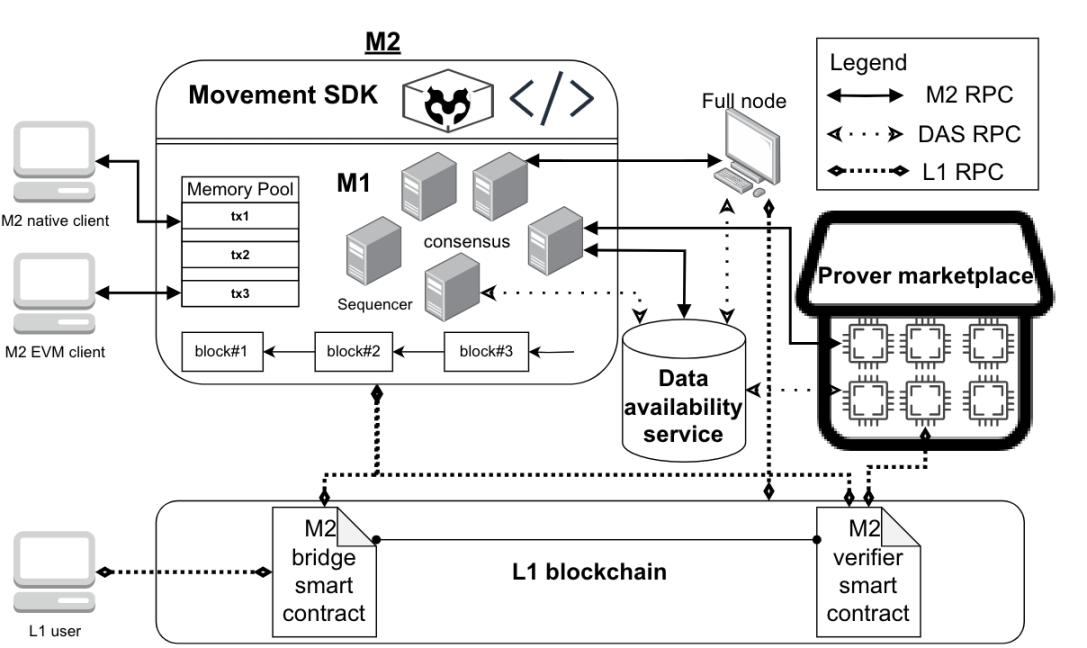
M2 is the mainnet within the current Movement ecosystem—an Ethereum L2 based on M1 and ZK-Rollup technology that combines Move’s security and performance advantages while integrating EVM compatibility so that Ethereum-compatible DApps can run seamlessly on M2.
At the consensus layer, M2 adopts Snowman consensus powered by the shared sequencer M1; for data availability, M2 integrates Celestia; and at the execution layer, it uses MoveVM.
The full on-chain flow works as follows: Transactions on M2 are ordered via the M1 sequencer network, then batched and sent back to Ethereum. Validity proofs are finalized through the Prover Marketplace’s zk-provers network, the resulting ZK proofs are posted on Ethereum, and detailed transaction data is published on Celestia—ensuring state synchronization between both chains. Using Blobstream technology, Celestia’s modular data availability layer can also be bridged to Ethereum.
Moreover, one of M2’s key features is its EVM parallelization capability. By converting EVM bytecode into Move bytecode and executing it in parallel, M2 achieves high throughput and low latency for EVM transactions.
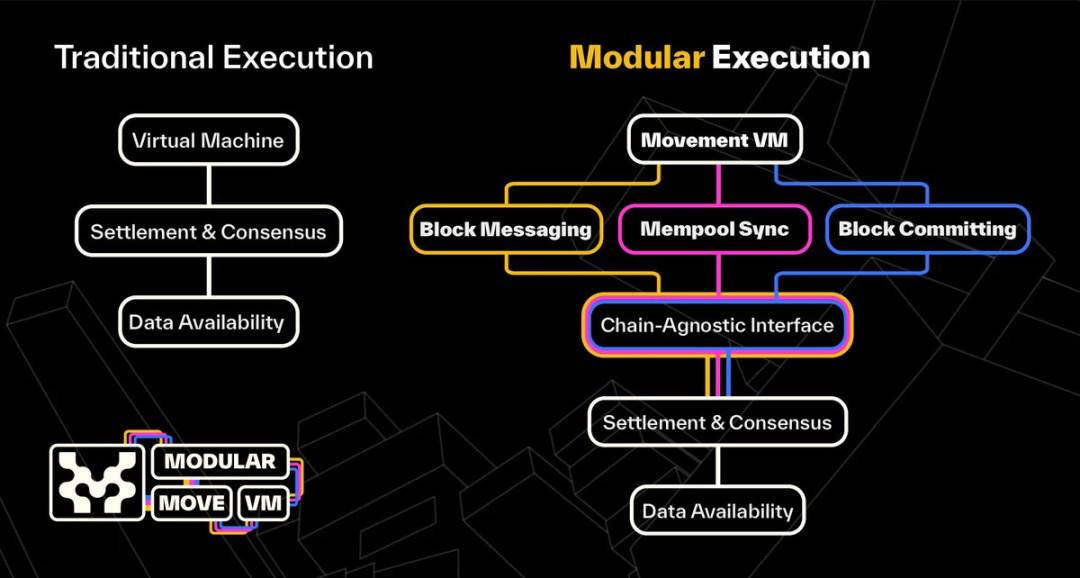
In summary, M1 handles consensus and transaction ordering, M2 manages Solidity-to-Move conversion and transaction execution, while Celestia and Ethereum ensure final data availability and state security.
Movement SDK: The MOVE-EVM Bridge
The true engine behind M2—the core development tool that brings Move into the EVM world—is the Movement SDK.
This modular framework combines the security and resource management strengths of MoveVM with the flexibility and adaptability of Solidity, enabling developers to build and deploy Move-based infrastructure and applications in any distributed environment.
The Movement SDK primarily consists of three core components: MoveVM, Fractal, and custom Adaptors for the sequencer network and DA services.
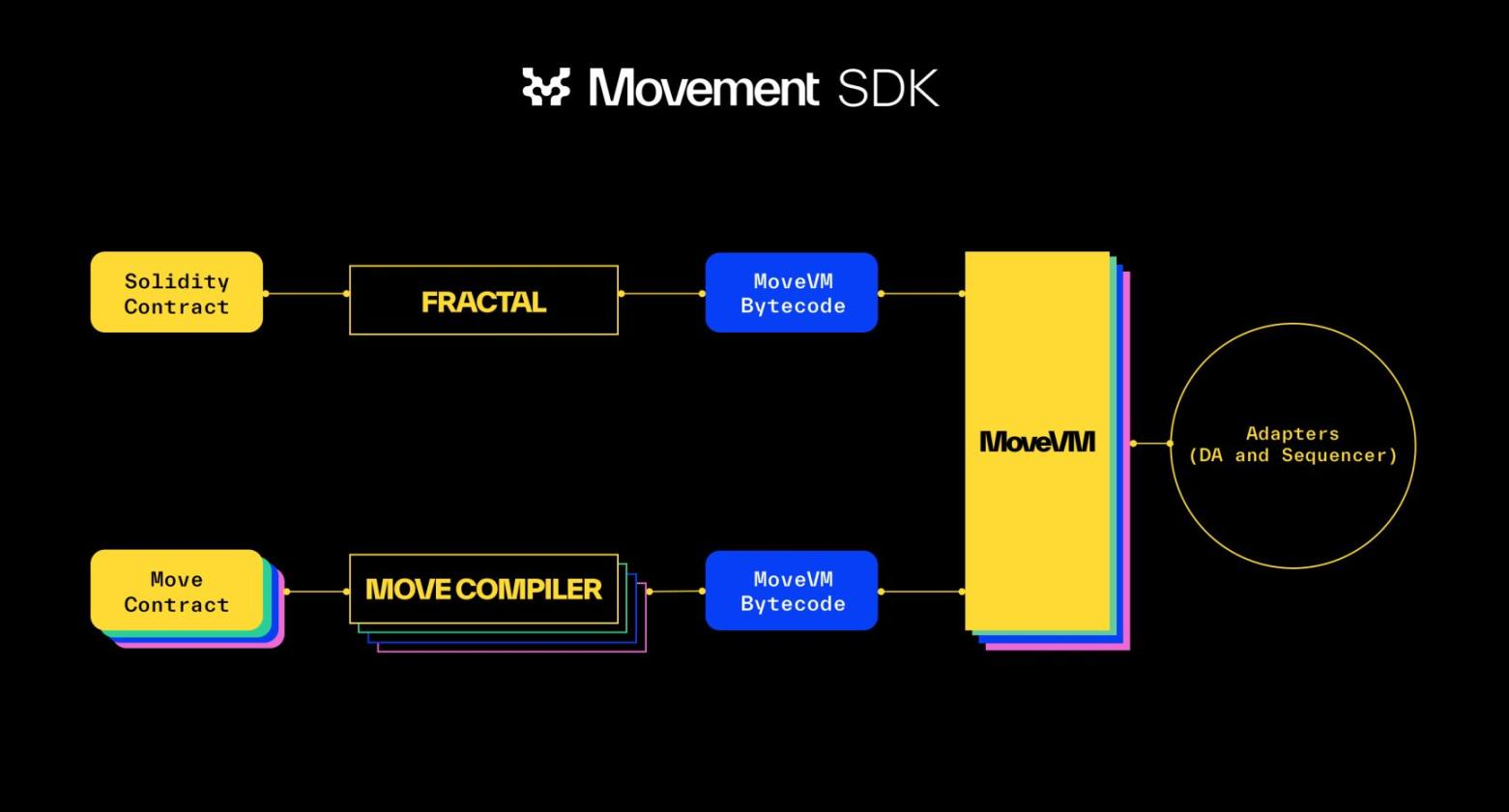
MoveVM is the core execution engine of the Movement SDK, providing a resource-oriented and strictly controlled environment for running smart contracts.
Here's a little-known fact: despite both being Move-based, Sui Move and Aptos Move are independent blockchain systems, each with their own virtual machines (VMs) and toolkits. Their differences are significant and continue to grow with new feature releases—almost resembling entirely different programming languages.
Previously, no project attempted to bridge this gap. Movement’s modular MoveVM is a versatile virtual machine designed to be fully compatible with the Ethereum Virtual Machine (EVM) and other Move ecosystems. It already supports deploying Aptos and EVM code and will soon support the Sui ecosystem as well.
This means developers won’t need to learn new programming languages—they can quickly deploy decentralized applications (DApps) from the Aptos, SUI, and Ethereum EVM ecosystems onto new platforms, easily achieving multi-chain deployment.
Fractal is a compiler that allows developers to seamlessly deploy existing Solidity smart contracts onto MoveVM. This bridging function not only provides Solidity developers with a more secure and efficient execution environment but also preserves the original logic and functionality of their Solidity contracts.
Custom Adaptors are the third core component of the Movement SDK, designed to enable seamless integration with sequencer networks and Data Availability (DA) services, ensuring secure connectivity with various blockchain networks and services.
Team and Funding
The two co-founders of Movement Labs are Rushi Manche and Cooper Scanlon. Rushi is 21 years old, Cooper is 24, and both attended Vanderbilt University.

Rushi began programming at age 14, initially working in database and system security engineering. He founded Ensemble, an AI-powered exam prep platform offering free study materials for high school students.
Later, he shifted focus to cryptocurrency, becoming a Solidity developer. During college, he worked as a freelancer and collaborated closely with several Cosmos protocols, building a decentralized file storage system within the Cosmos ecosystem.
In 2022, Rushi joined Aptos as a software engineer, directly contributing to Move-based smart contract development and making significant contributions to the ecosystem’s core DEX. This experience solidified his belief in Move’s immense potential.
Cooper Scanlon is the other co-founder of Movement Labs. Before founding the company, he built and audited the first yield aggregator written in Move.
In November 2022, Rushi and Cooper—both Vanderbilt alumni—decided to drop out of school and co-found Movement Labs.
In September 2023, Movement Labs announced a $3.4 million Pre-Seed round led by Varys Capital, dao5, Blizzard The Avalanche Fund, Borderless Capital, and its Wormhole-focused cross-chain fund, with participation from Colony, Interop Ventures, Elixir Capital, BENQI, George Lampeth of dao5, Calvin Liu of Eigenlayer, Smokey The Bera of Berachain, Anurag Arjun of Avail, CoinFlipCanada of GMX, and the co-founder of Ankr.
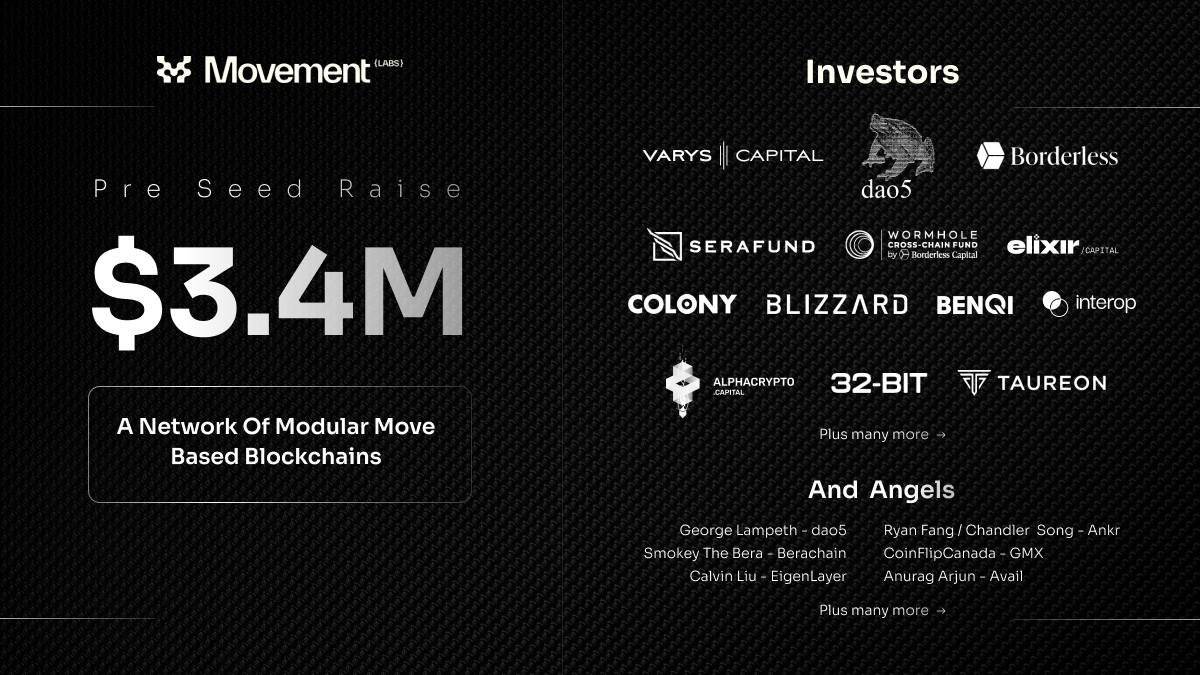
From this list of investors, it’s clear that many funds and projects from the Avalanche ecosystem supported Movement Labs early on. Its first flagship product, M1, was built on the Avalanche Subnet tech stack.
In April 2024, Movement Labs completed a $38 million Series A round led by Polychain Capital, with additional investments from Hack VC, Placeholder, Archetype, Maven 11, Robot Ventures, Figment Capital, Nomad Capital, Bankless Ventures, OKX Ventures, dao5, and Aptos Labs.
In May 2024, Binance Labs announced its investment in Movement Labs, though the amount remains undisclosed.
Conclusion
Overall, amid the monotonous landscape of Ethereum L2s, Movement Labs has attracted significant attention due to its unique innovation and strong investor backing. However, as an emerging L2 project, Movement Labs’ ecosystem still requires further maturation—particularly in areas such as completeness of developer tools, depth of documentation, and developer support systems.
A great city-state needs not only strong walls and fast roads but also sound institutions and fertile ground for equal opportunity and growth. Only then can it attract more people and capital to collectively build a thriving digital economy.
Join TechFlow official community to stay tuned
Telegram:https://t.me/TechFlowDaily
X (Twitter):https://x.com/TechFlowPost
X (Twitter) EN:https://x.com/BlockFlow_News
 深潮TechFlow


