Afraid of being PUAed? How积分economics became a standard playbook for crypto projects?
TechFlow Selected TechFlow Selected
Afraid of being PUAed? How积分economics became a standard playbook for crypto projects?
The key to a successful points program lies in striking a balance between transparency and flexibility, and closely aligning the points program with overall project goals and user needs.
 Navigating Web3 tides with focused insights
Author: Kenton
Translation: TechFlow
In Web3, a new era of digital loyalty driven by innovative points systems is emerging. Since Blur launched its groundbreaking points program in 2022, teams have rushed to adopt this new incentive mechanism and leverage its advantages. Each new points program pushes the boundaries of incentive design, uncovering novel reward mechanisms and motivating behaviors. By 2024, we've seen a diverse ecosystem of points programs flourish, with each project adding its unique flavor to the evolving points meta. This rapid development has created a rich landscape of reward mechanisms and targeted behaviors, offering unprecedented opportunities for user activation and retention. However, for newcomers, understanding the complexities of "points economics" can be a daunting task. That’s about to change.
Through conversations with points issuers and analysis of over 20 points programs, this guide will reveal the benefits, drawbacks, and practical applications of points economics for both new and experienced issuers.
Part one introduces the fundamentals of points, while part two provides a comprehensive overview of points economics in Web3.
Ready to level up your incentive strategy? Let's begin.
Part One: Points 101
What Are Points?
At their core, points are digital reward units whose value lies in their utility or convertibility into tangible benefits—be it exclusive access, product discounts, or direct monetary value. Projects strategically deploy points programs not only to foster loyalty but also to drive product adoption, amplify network effects, and shape user behavior in ways that accelerate product growth.
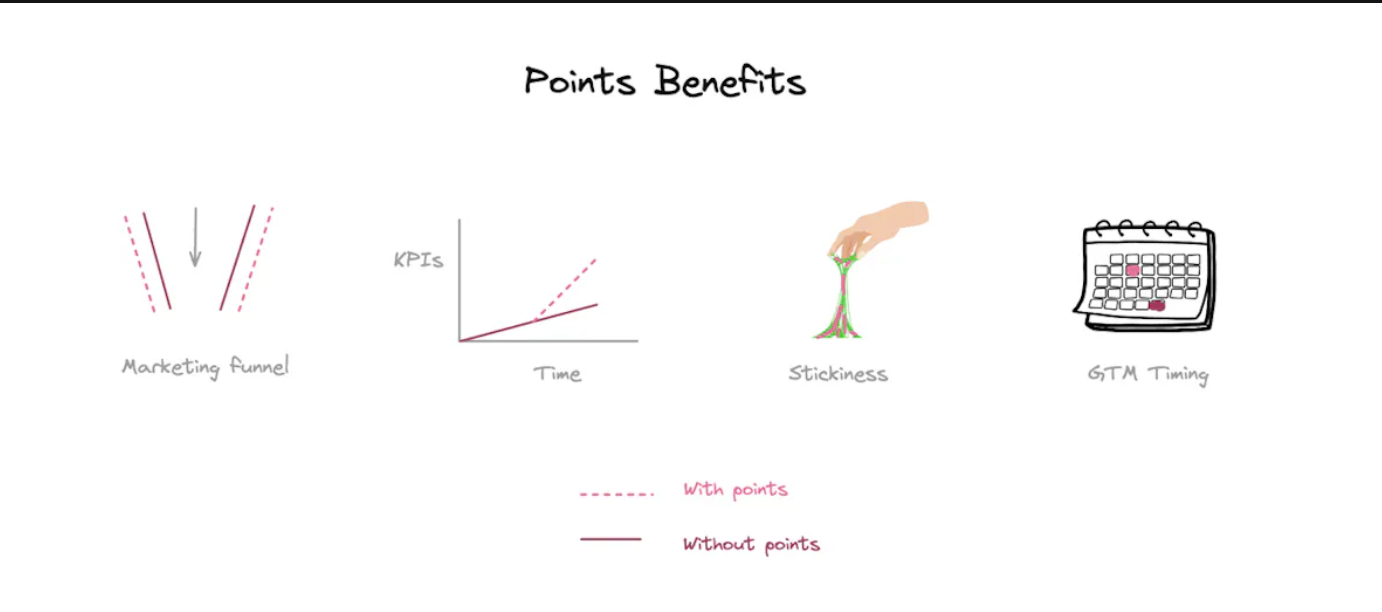
Points programs establish a mutually beneficial relationship between brands and users. Companies gain loyalty, growth, and data through points programs, while users are rewarded for repeated usage. Well-designed points programs not only drive long-term engagement but also deepen emotional connections with users—critical for competitive advantage.
Overall, whether Web2 or Web3 companies or projects, can benefit from points programs in the following ways:
-
Marketing - When combined with referral programs, points can expand marketing channels.
-
Growth - Since points provide added value, they effectively lower the real price of a product or service, improving conversion rates across marketing funnels and driving growth in core KPIs such as active user count.
-
Stickiness/Loyalty - Points programs can increase product stickiness, thereby increasing user lifetime value (LTV) and reducing churn. Research shows loyal members spend on average 27% more, so when average LTV exceeds the cost of loyalty membership, product stickiness is achieved.
-
Market Entry Timing - Dynamic points programs can help launch products with network effects, such as social media platforms and financial markets. By rewarding early adopters, companies can improve user experience (UX) before the product reaches critical mass.
Users also gain the following benefits from points programs:
-
Incentive Value - This value can take the form of discounts, free products, exclusive access and privileges, and cash rewards.
-
Brand Affinity - Effective loyalty programs offer more than transactional rewards; they make customers feel valued and create an emotional connection with the brand. The pinnacle of loyalty is when customers develop a psychological attachment to the brand.
Part Two: Protocol Points Economics
Traditional Points Programs
While points programs have existed in Web2 for decades, their adoption in Web3 introduces new dynamics and opportunities. In Web2, we’re familiar with airline loyalty programs like Delta SkyMiles and credit card rewards like Chase Ultimate Rewards. These programs have successfully driven customer retention and spending, generating billions of dollars annually—sometimes even more revenue than the company's core business! However, Web3 takes the concept of points to a whole new level.
The Web3 Points Revolution
The first Web3 project to introduce points was Blur, which triggered a chain reaction across the crypto space in 2022. Many projects followed suit, some achieving impressive scale.
For example, if Eigenlayer’s $18B TVL has a capital cost of 10% APR, its points program distributes $1.8 billion worth of points annually. Other notable programs include Ethena, LRT programs (EtherFi, Swell, Kelp), and Blast.
Unique Advantages for Web3 Projects
Beyond universal benefits, Web3 projects gain several unique advantages from points programs:
-
Early Incentives - Projects can launch points programs faster than tokens, allowing immediate user incentives and growth from day one. Tokens require careful design, allocation planning, and timing considerations, which may be difficult to prioritize during protocol launch. Tokens are products and should not be rushed.
-
Token Conversion Potential - Points can be designed to potentially convert into tokens in the future, adding implied monetary value. This allows teams to effectively "borrow" liquidity from future token generation events (TGEs) to fund current incentives.
-
Enhanced Flexibility - Points programs give teams flexibility to adjust TGE timelines, airdrop allocations, and incentive structures without impacting growth. This enables more effective market entry strategies. Additionally, compared to incentive programs requiring governance approval, teams can freely adjust points programs. While token governance is the end goal, team flexibility in early stages can be a competitive advantage.
-
Market Timing - Tokens perform better when launched in bull markets. Points programs allow projects to build momentum and community during bear markets, preparing for successful token launches when market conditions improve.
Notably, these benefits aren't limited to pre-TGE scenarios. Projects like Ethena and EtherFi have continued to reap similar benefits through second-season points programs post-token launch.
Points Program Design
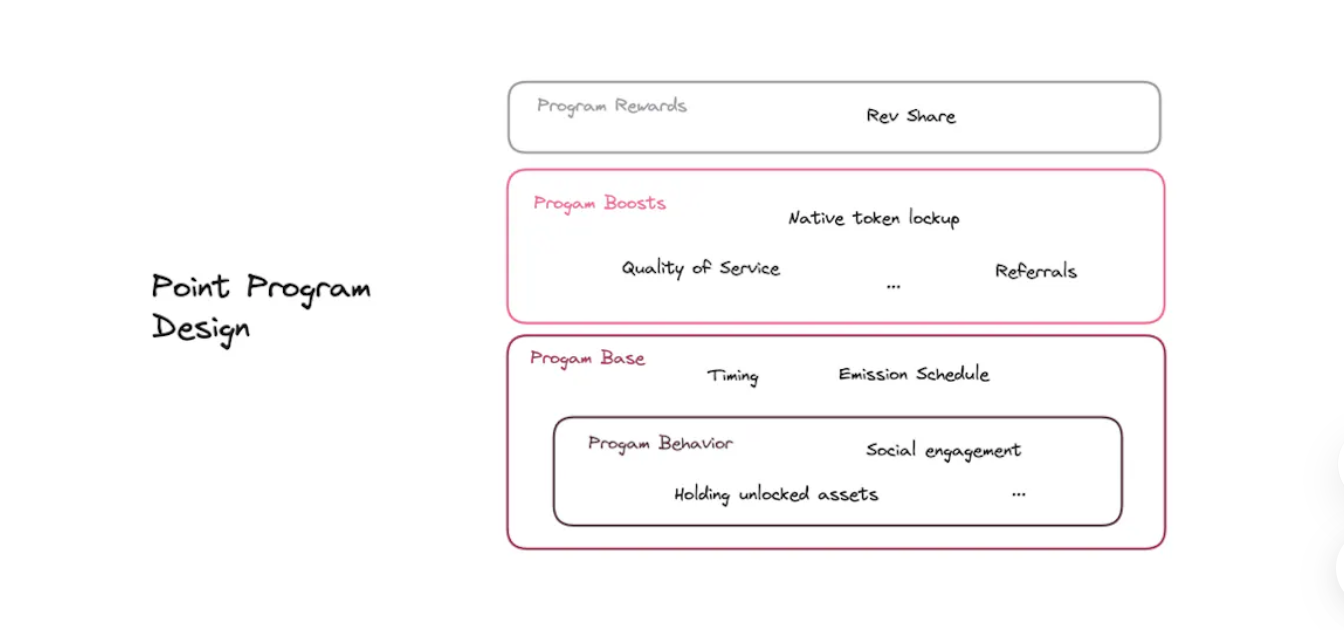
Web3 points programs have evolved into various sophisticated mechanisms, often combining multiple approaches. The most effective programs incorporate actions, bases, and boosts, with some beginning to experiment with program rewards. Let’s dive deeper into each.
Programmed Actions
Programmed actions detail user behaviors and activities that earn points, such as depositing on an L2 or trading on a new AMM (Automated Market Maker). These include:
-
Holding Unlocked Assets - Assets users can freely deposit and withdraw (e.g., LRTs, Pendle YTs, Ethena’s sUSDe collateral deposits on Morpho)
-
Holding Locked Assets - Assets users must wait a period before withdrawal (e.g., locked Ethena USDe, native restaking on Eigenlayer, Karak, and Symbiotic)
-
Providing Liquidity - Similar to unlocked assets, but carries passive risk of selling deposited assets (e.g., Thruster LP positions staked in Hyperlock)
-
Social Engagement - Likes, retweets, comments, follows
Program Base
The program base includes core details of the points program, such as distribution schedules, timelines, and airdrop sizes. Most points programs are divided into seasons lasting 3–6 months, each with unique base terms.
-
Distribution Schedule - Describes frequency and quantity of point accrual
-
Discrete Rewards - One-time point allocations for specific actions. Used to kickstart behaviors and marketing. Examples include Blur’s one-time reward for listing NFTs within 14 days, Lyra’s one-time reward for attending Twitter/X Spaces, and Napier’s social engagement and referral rewards.
-
Continuous Rewards
-
Fixed Supply Distribution - Total points supply fixed either across the entire program (e.g., Hyperliquid) or per period/season (e.g., Morpho*). While both reduce user dilution, fixed total supply offers greater certainty, whereas fixed period supply gives teams more flexibility in scheduling. Teams often use fixed supply bases to provide additional assurance to users.
-
Variable Distribution - (e.g., Eigenlayer, all major LRTs, Ethena, etc.). Total supply is variable and adjusts based on TVL (Total Value Locked). Points are calculated daily based on dollar or ETH participation, and variable schedules dynamically dilute early depositors’ share. While expected airdrop rewards (in USD) attract new deposits, users must proportionally increase participation to avoid dilution as total deposits grow. Teams favor this approach because it simplifies operational complexity in ensuring fair point distribution. To reduce dilution for earliest users and create urgency, teams release declining accrual rate schedules (e.g., 25 points/day in July, 20 points/day in August, etc.).
-
-
-
Distribution Duration - Length of time points are distributed
-
Defined vs. Ambiguous - Most projects set fixed program or season durations (e.g., 6 months), while others give ranges (e.g., 3–6 months). For greater flexibility, some teams opt for ambiguous timelines, though this may impact growth.
-
Conditional - Some programs or seasons are designed to end early upon reaching key milestones. If expected season airdrop allocation is fixed, this increases participation urgency. For example, Ethena set a $1B TVL milestone in Season 1 and achieved it in just seven weeks.
-
*Although Morpho uses non-transferable $MOPRHO tokens as incentives, it operates similarly to a points issuer.
Program Boosts
Program boosts are the primary tools teams use to reward specific user behaviors, giving users higher relative point shares. Here are various boost mechanisms:
-
Quality-of-Service Boosts - Projects can boost one user group (e.g., traders) by incentivizing another (e.g., liquidity providers) to deliver better “service quality.” For systems where “service” can be differentiated, like Univ3 pools, projects can allocate points based on users’ contribution to product UX (e.g., liquidity). For example, Blur rewards liquidity providers who place bids closer to NFT floor prices, while Merkl’s incentives favor Univ3 LPs who offer competitive quotes and earn more trading fees.
-
Referrals - Earn a portion (e.g., 10%) of points from referred users. Helps marketing and attracts power users or high-volume traders. Risk of sybil attacks since users may refer their own addresses. Some projects require referral codes to access apps, creating extra marketing buzz, though this may reduce conversion. Examples include Ethena and Blackbird.
-
Multi-Level Referral Rewards - An extension of simple referral systems. Users earn not only from direct referrals (first layer) but also from referrals made by those they referred (second layer). Aims to encourage users to refer those likely to actively refer others. Sybil attack risk remains. Examples include Blur and Blast.
-
Base Volume Boosts - Projects add multiplier boosts to attract and nurture power users. The idea is your base point accrual rate increases with usage volume, accelerating rewards at the same activity level. May under-compensate casual users, making them harder to attract. Example: Aevo offers base volume boosts for traders.
-
Launch Boosts - Projects use launch boosts to attract liquidity and bootstrap new markets before network effects kick in. Launch boosts usually have expiration dates but may have other thresholds. For example, some LRT projects (like EtherFi) offer double launch boosts to LPs for two weeks whenever initializing a new Pendle market.
-
Loyalty Boosts - Extra points for users loyal to a product (i.e., proving use of Product A over B). Especially effective for network-effect-dependent products; as competitors’ networks shrink, the product’s relative value rises. Blur used this boost to rapidly capture market share from OpenSea after launch. More effective with NFTs due to scarcity, especially when series owners typically hold only one unit, forcing allegiance decisions. For fungible tokens, users can split balances across addresses to avoid pressure.
-
Random Reward Boosts - Drawing from Skinner Box experiments, some projects increase engagement through randomness in reward size or timing. Blur’s Care Package system uses loyalty scores to determine rarity luck when awarding care packages. While users don’t know absolute reward size, they understand relative quantities between packages. Similarly, Aevo uses a “lucky” volume boost system—any trade might receive a volume multiplier, amplifying that trade’s rewards. Both use tiered systems where highest boosts are granted least frequently (e.g., 1% chance of 25x boost).
-
Leaderboard Boosts - To encourage competition, projects offer leaderboard boosts to top 100 point earners. Concentrates points among top users, potentially driving higher absolute KPIs due to rivalry. Though not heavily promoted, Blur used this boost in Season 3.
-
Native Token Locking Boosts - Projects with native tokens offer boosts to point earners who demonstrate long-term commitment. As this may reduce circulating supply, teams should expect increased token volatility. Examples include Ethena’s $ENA, Safe, and $SAFE.
-
Total Value Locked (TVL) Boosts - Projects incentivize users to promote and market by rewarding points boosts based on TVL growth. For example, 3Jane’s AMPL-style points program rebalances point ownership based on TVL changes, while Overload promises increased airdrop allocation upon hitting certain TVL milestones.
-
Team Boosts - Incentivizes social pressure and coordination for group-wide boosts. AnimeChain was the first project to try this, using Squads groups to share boosts with others.
-
Locking Boosts - Beyond a declining base schedule (rewarding past stickiness and aiming to get users involved early), some projects now experiment with boosts rewarding future stickiness. For example, EtherFi offered 1–2x StakeRank boosts in Season 2, and Hourglass offers 1–4x boosts for liquidity locked over different durations.
Program Rewards
Finally, program rewards are additional direct benefits beyond expected airdrops. Speculation around future airdrops drives most points demand, but some projects are experimenting with providing extra utility to points holders, such as Rainbow Wallet’s ETH yield sharing.
While this area is currently small, I believe more teams will experiment with rewards for points holders, borrowing Web2 mechanisms like product fee discounts, event access, and other perks.
Putting It All Together
The flexibility of these building blocks makes points program design highly creative. Once a team defines its goals (e.g., user acquisition, product improvement, marketing, etc.), it can combine multiple modules sequentially or in parallel for maximum impact. Here are some innovative use cases beyond the traditional “deposit to boost TVL” strategy:
-
Ethena’s strategy rewards USDe holders with points and enhances yields for sUSDe holders.
-
Napier’s strategy incentivizes social engagement and holding assets from other projects to strengthen partnerships and expand marketing reach.
-
Blur’s go-to-market (GTM) strategy leveraged various points mechanisms across multiple airdrops to rapidly establish supply and demand in the NFT market and quickly capture market share upon public launch. Using random boost care packages, their advanced strategy was:
-
User Acquisition - Airdrop 0 rewarded private alpha testers to attract the most active NFT traders
-
Supply Bootstrapping - Airdrop 1 rewarded existing NFT traders for new listings
-
Building Supply from Loyal Users - Airdrop 2 was larger than Airdrop 1, rewarding more listings and boosting loyal listers who moved liquidity from other NFT marketplaces to Blur
-
Stimulating Demand - Airdrop 3 rewarded competitive bidding to incentivize trading volume
-
After designing their points program and GTM strategy, projects shift focus to implementation. Point accrual calculations, data pipelines, price feeds, and point data storage are all components of the backend infrastructure. Once the backend is complete, projects focus on user-facing implementation, typically a public dashboard showing user point balances and leaderboards. Many projects build implementations from scratch, while others outsource to developers and infrastructure providers.
Next, when preparing for TGE and initial airdrop, projects explore how to distribute tokens to points holders. While this article doesn’t cover specific airdrop mechanics, teams should consider factors like airdropping tokens vs. options, fixed vs. dynamic allocations, linear vs. nonlinear distributions, vesting periods, lockups, sybil resistance, and distribution execution. For further reading, check out this post for updates.
Criticisms and Limitations of Points Programs
While points programs have proven effective, they face criticism. Points programs are entirely centralized incentive mechanisms. Point accrual calculations, data storage, program timelines, and criteria are often opaque to users and typically stored off-chain. Therefore, points issuers must maximize transparency to build trust with users. If users don’t trust the program’s terms, they won’t value the points or engage actively.
Due to legal reasons, teams usually cannot disclose upcoming airdrops or allocations to points holders before token launch, but they can compensate through clear communication, timely disclosure of adjustments, and swift error resolution. EtherFi’s handling of calculation errors serves as a good example.
Other public criticisms—such as ungenerous allocations to points holders and sybil-vulnerable airdrop designs—are actually issues with airdrop planning, not points programs. Points are merely tools to incentivize and record user shares. Airdrop terms determine how, when, and how much points holders are rewarded.
Take Eigenlayer: User dissatisfaction wasn’t about point balances but the conversion ratio from points to airdrop and undisclosed claiming criteria. Depositing for 11 months yielded only 5% at TGE, leaving points holders feeling exploited, with returns far below market averages. Additionally, many points holders were unexpectedly geo-blocked from claiming their $EIGEN. While teams have full discretion over token allocation, they could have avoided this by geo-blocking the product earlier. Blast faced similar backlash—not over point balances. Blast airdropped 7% to points holders and required partial 6-month lockups for top 1000 wallets. For a program under six months, this aligns closely with other seasons (e.g., Ethena, EtherFi, etc.).
While not a critique of program design, points fatigue is becoming an increasingly visible issue in the ecosystem, evident in public forums and private discussions with DeFi whales. Understanding points value requires time and effort. For every new program, users must build an initial model and continuously update assumptions to ensure optimal capital or behavioral return. As new points programs flood the ecosystem, users struggle to keep up, leading to fatigue and sluggish migration between programs. For instance, imagine choosing between earning 1,000 units of Points A daily versus 2 million units of Points B daily—which is more valuable? Is the more valuable one still worth the capital risk? The answer isn’t immediately clear. Projects that fail to clearly differentiate their points program from others will see reduced impact.
A final important and subtle side effect of points systems is that they may mask product-market fit (PMF). Points are excellent bootstrapping tools but risk hiding organic interest, which is crucial for finding PMF. Even after PMF is validated, teams must build sufficient organic appeal to find sustainability for their product or service before tightening incentives. Variant’s Mason Nystrom calls this the “hot start problem.” For teams yet to validate PMF, I recommend validating PMF in a closed alpha before introducing points. For teams that have validated PMF, it’s trickier, but Mason suggests teams “take extra steps to ensure token rewards are tied to organic usage and drive meaningful metrics like engagement and retention.”
Future Outlook
Looking ahead, I expect points programs to continue evolving to address pressing issues like program transparency and points fatigue.
To enhance transparency around total points supply, allocation logic, and accrual history, future points programs—or parts of them—will move on-chain. On-chain examples include 3Jane’s AMPLOL and Frax’s FXLT points. Another software provider offering on-chain points management infrastructure is Stack.
Addressing points fatigue is a more complex challenge. While private chats and CT discussions often focus on differentiating program design, the key to reducing fatigue may lie in enabling users to quickly and confidently assess points value. This ability would significantly simplify comparisons across various points opportunities, making participation decisions simpler and less confusing. While not part of points program design, secondary markets (like Whales Market) could help users price points and reduce fatigue, although current illiquidity makes it hard to support most exit strategies. As these markets mature, however, they may play a vital role in price discovery, offering exit paths, and creating more dynamic points economies.
Conclusion
Points have become powerful tools in the Web3 ecosystem, offering benefits beyond traditional loyalty programs. They enable projects to reward loyal power users, bootstrap network effects, and optimize market entry strategies in more predictable ways. This leads to more effective product development and ultimately delivers greater value to end users.
As this space matures, I expect continued innovation in points program design and implementation. Success will hinge on balancing transparency with flexibility and tightly aligning points programs with overall project goals and user needs.
For builders and projects in Web3, understanding and leveraging well-designed points programs may be a key factor in achieving sustainable growth. As we move forward, points may continue to serve as foundational components of crypto incentive structures, shaping the landscape of DeFi and beyond.
Join TechFlow official community to stay tuned
Telegram:https://t.me/TechFlowDaily
X (Twitter):https://x.com/TechFlowPost
X (Twitter) EN:https://x.com/BlockFlow_News
 @KentonPrescott