10x Research points the way again: first watch 60,000, then 50,000
TechFlow Selected TechFlow Selected
10x Research points the way again: first watch 60,000, then 50,000
The real dawn will begin to emerge in August.
 Navigating Web3 tides with focused insights
Author: 10x Research
Translation: Azuma, Odaily Planet Daily
Six issuers of spot Ethereum ETFs have submitted updated S-1 forms, signaling that the U.S. Securities and Exchange Commission (SEC) could approve spot Ethereum ETFs at any moment. Meanwhile, cryptocurrencies appear to be rebounding this week—a move we anticipated in our weekend report—driven by market expectations of weaker-than-expected CPI data to be released on Thursday in the U.S.
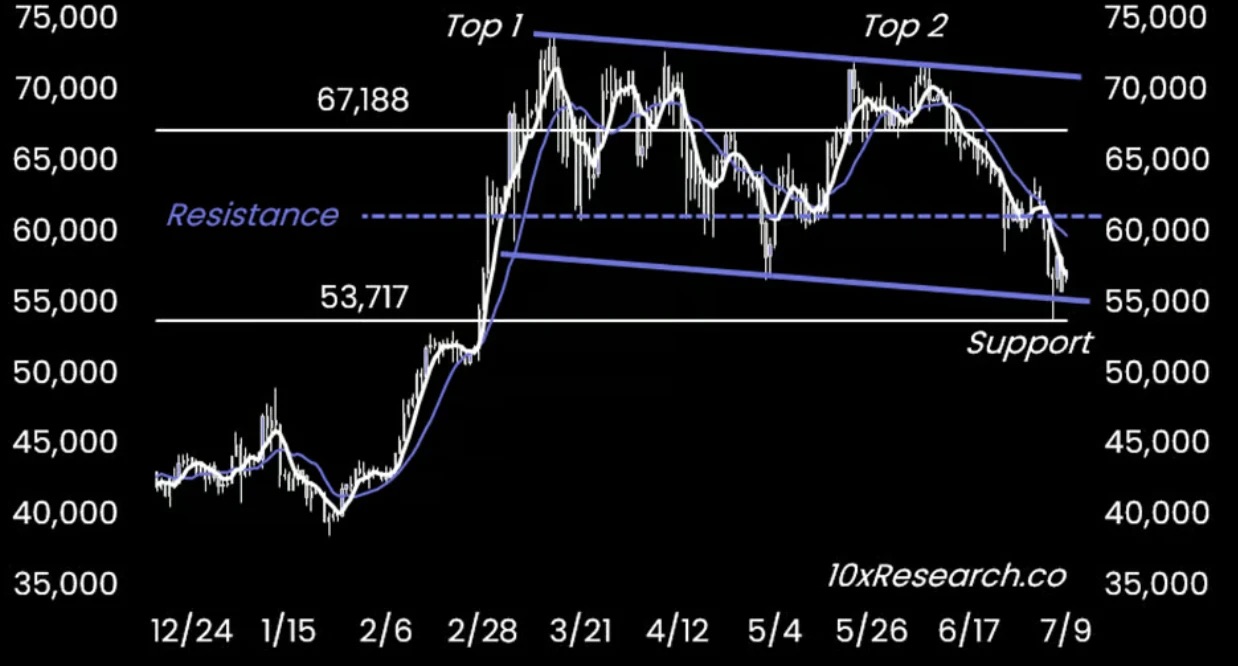
Oversold indicators suggest the market is anticipating a modest rebound, implying a short-term reversal in price action. Currently, two out of three reversal indicators have generated bullish signals, while the RSI (Relative Strength Index) stands at 38%, indicating bears may need to pause and wait for Bitcoin to face resistance in the $60,000–$62,000 range before prices turn downward again.
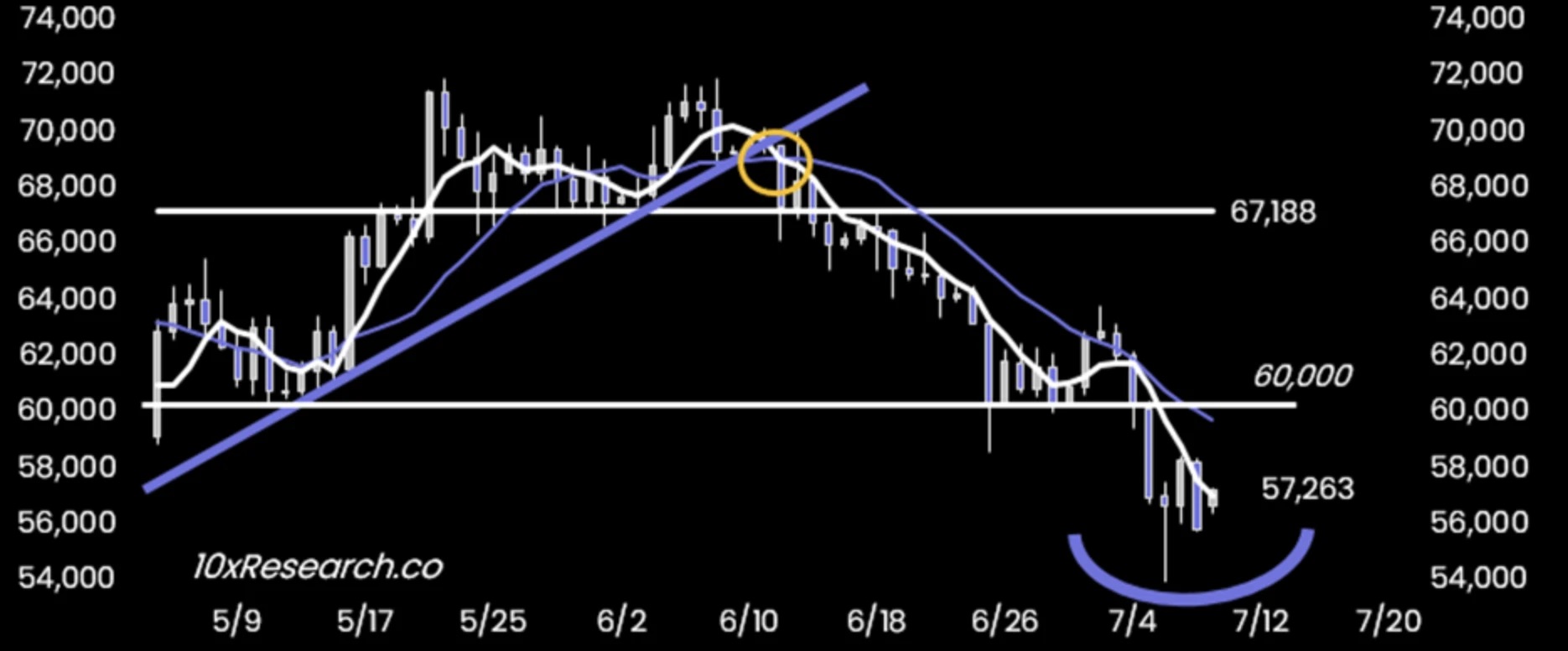
From a technical perspective, the $55,000–$56,000 range is forming a support zone. However, given that the medium-term technical structure has deteriorated, we expect this rally to be short-lived. Notably, the recent trend of Bitcoin declining during Asian trading hours and performing relatively better during European and U.S. sessions continues.
Despite Bitcoin’s 20% price drop over the past 30 days, futures traders’ positioning has remained relatively bullish since the surge in anticipation of spot Ethereum ETF approval around May 20. Since then, Bitcoin’s open interest has risen from 260,000 BTC to a peak of 305,000 BTC, currently standing at 277,000 BTC—even as the price fell from $66,000 to $57,000. A similar pattern is seen with Ethereum: though its price has largely held steady around $3,068, open interest has increased from 2.6 million ETH to 3.1 million ETH.
Since May 24, the Grayscale Ethereum Trust’s net asset value (NAV) discount has narrowed sharply to just -1.5%, down significantly from its peak of -60% in December 2022, primarily due to growing expectations of an imminent spot Ethereum ETF approval. With approximately $9 billion in assets under management, the conversion of this ETN into an ETF would allow investors to redeem their shares freely.
Once spot Ethereum ETFs begin trading, redemptions from Grayscale could create significant selling pressure, similar to what occurred with Grayscale Bitcoin Trust (GBTC) in January 2024. Since the launch of spot Bitcoin ETFs, GBTC’s assets under management have declined by 47%. As such, outflows from Grayscale could potentially offset inflows into the other five ETF issuers.
Therefore, although ETH’s current price resembles levels seen when the SEC signaled willingness to approve, there could still be a potential “sell-the-news” scenario upon S-1 approval. For ETH, while open interest in the futures market reflects strong bullish sentiment, potential Grayscale outflows could once again impact market dynamics.
A similar pattern exists with Bitcoin: ahead of CPI data releases, inflows into spot ETFs tend to precede the event. After Bitcoin ETFs recorded $143 million in net inflows last week, Monday saw another $295 million in net inflows. This echoes the consecutive 20-day, $4 billion total inflow observed around May and June CPI releases. However, it's worth noting that following the June CPI release, Bitcoin ETFs experienced $1.2 billion in net outflows.
Markets anticipate the CPI data due July 11 will fall to 3.1%, aligning with our outlook and reinforcing hopes for a rebound. A 0.2% month-on-month decline in core CPI could still influence Bitcoin’s price trajectory. Nevertheless, potential selling pressures from the German government, Mt. Gox, and the upcoming Bitgo distribution must not be overlooked.
Recent news about "FTX creditors potentially receiving around $16 billion in compensation" has drawn significant market attention. However, many FTX claims have already been acquired by professional bankruptcy investment firms focused solely on recovery yields and arbitrage opportunities, which are unlikely to reinvest recovered dollars back into the crypto market. We estimate that between $3.2 billion and $5 billion could eventually re-enter the market. Moreover, Bitcoin was priced at around $16,800 during FTX’s collapse in November 2022, compared to $57,000 today—making the current pullback far less attractive as a buying opportunity for FTX creditors.
The voting deadline for FTX customers to approve the bankruptcy repayment plan is August 16, with a related hearing scheduled for October 7, when Judge Dorsey will consider whether to approve the proposal. Notably, international creditors may face withholding taxes as high as 30% on final payouts.
In summary, we expect Bitcoin to likely rebound first toward $60,000 before falling again toward $50,000, after which the market will enter a more complex trading environment. At that point, we anticipate the market will psychologically absorb selling pressures from the German government and Mt. Gox, clearing the way for renewed bullish momentum driven by events such as shifting expectations around FTX repayments in mid-August and the upcoming U.S. elections’ potential impact on Bitcoin.
Join TechFlow official community to stay tuned
Telegram:https://t.me/TechFlowDaily
X (Twitter):https://x.com/TechFlowPost
X (Twitter) EN:https://x.com/BlockFlow_News