








Cryptocurrency: A Revolutionary Feast for Optimists, Where Even the Grassroots Can Defy the Odds
TechFlow Selected TechFlow Selected
Cryptocurrency: A Revolutionary Feast for Optimists, Where Even the Grassroots Can Defy the Odds
It is precisely this chaotic, noisy, and often misdirected technological revolution that stems from people's intense desire to take autonomous control of their own affairs.
 Navigating Web3 tides with focused insights
Text: Matti
Translation: Bitpush News Yanan
Opinions on cryptocurrency vary widely: some see it as a geek's luxury, others as a symbol of monetary anarchism, and still others dismiss it as the delusion of madmen—along with countless other labels. Today’s crypto industry has long surpassed the original libertarian dreams of Satoshi Nakamoto and a handful of cypherpunk computer scientists. Cryptocurrency has moved past its startup phase, and its ideology has become increasingly diverse.
Ironically, our biggest enemies aren’t the skeptics who oppose us—the “no-coiners”—but those who dare challenge our own “bag holdings.” Bitcoin maximalists despise Ethereum fans, who in turn look down on Solana supporters. I’m not exaggerating; often it’s the loudest voices that belong to the most intolerant minorities. The most visible conflict isn’t between crypto believers and outsiders—it’s among different factions within crypto itself.
Speaking of conflict may sound pessimistic, but it reveals how this subculture mirrors past (and present) religious wars. If cryptocurrency is a religion, it’s one centered on revolution in money, finance, and commerce. In this faith, deities are replaceable, narratives are flexible, and financial expectations are scalable. Crypto believers have replaced “We believe in God” with “We believe in our coin.”
Optimism
The optimism I speak of refers to an individual’s deep recognition of their power to reshape the world—and their willingness to embrace that power, drawing strength from their inherent wildness and primal energy.
Optimists love trying new things and face risks and challenges head-on. They cherish freedom and scorn tyranny. Yet when optimists express disdain, they also actively join movements of resistance. They step forward because they understand that “when people can hate without risk, their ignorance becomes easily inflamed, and motives arise naturally.”
Optimists don’t crave power; they know they’re often wrong, yet persist anyway. They seize opportunities to explore, create, and rebuild the world according to their ideals. Optimists understand that ever-expanding knowledge is the string of life—enabling future generations to play new melodies through cycles of destruction and creation.
Optimists know resources aren’t constraints but fertile ground for opportunity. They believe ideas can animate resources, transforming surroundings into fuel for progress. For them, change is essential—a necessary force driving advancement.
So what connects this optimism to crypto speculation? At its core lies a vision: a world where governments don’t control money, and currencies are free to evolve, would be a better world. It is precisely this belief that sparked the birth and growth of cryptocurrency.
It’s not that governments are inherently evil—they simply tend toward corruption. Not due to human nature, but because long-standing institutions inevitably face power struggles. Over time, they turn inward, serving only themselves. Why? Because such institutions grow dogmatic and rigid, falling out of sync with the world, gradually losing touch with and relevance to the public. Yet these institutions rarely accept decline—they fight to maintain existence and significance. Eventually, the world begins serving them, while they no longer truly serve the world. To survive, they may abuse power—even at the expense of the communities they govern.
Early cryptocurrency, exemplified by Bitcoin, aimed to weaken power—not through monopolized violence, but via immutable code in the cloud. This might sound like a foolish dream, yet it achieved tremendous success. Today, this optimistic experiment is worth trillions of dollars, and Bitcoin’s meaning has far exceeded its original scope.
Cryptocurrency
Crypto markets are extremely volatile—higher surges often lead to steeper crashes. Financial markets follow natural laws, just as the human psyche oscillates. The crypto market never sleeps; something new always happens.
Experts and scammers alike debate memecoins endlessly, with no consensus. Some even surrender entirely to price action, losing all objectivity. They can’t tell whether venture-backed tokens launched at insane valuations will soar or crash.
Investors chase trends, jumping from one narrative to another—backing projects doomed to fail, impossible to execute, or irrelevant even if successful. Most end up at zero—the damned zero! Yet this isn’t necessarily bad.
The medium is the message. Memecoins and cryptocurrencies are both media. Human behavior simply manifests in new ways through new technologies. Hitting zero is just part of the game.
Zero is fine, because cryptocurrency remains the world’s most hopeful technological movement. Every cultural and technological revolution brings exploitation—that’s what makes it revolutionary. Such upheaval creates information asymmetry, which people quickly (and wrongly) exploit for personal gain.
But ultimately, people in crypto are hands-on—struggling with governance (albeit poorly), building new internet infrastructures, trusted neutral payment channels, novel physical systems for cutting-edge applications, funding research projects that struggle elsewhere, turning culture into currency, accumulating generational wealth before 1,000 users adopt a product, creating gambling venues as alternatives to traditional finance, attempting to build new cities, and pushing the limits of life. Most attempts may fail or go astray—but that’s exactly what shows crypto’s great spirit.
The world of crypto resembles a fusion of the Wild West and Las Vegas. You might get rich overnight—or be scammed into ruin by fraudsters. It’s a place where dreams come true, land awaits claiming, and fortunes are gambled freely.
Pessimists and Optimists
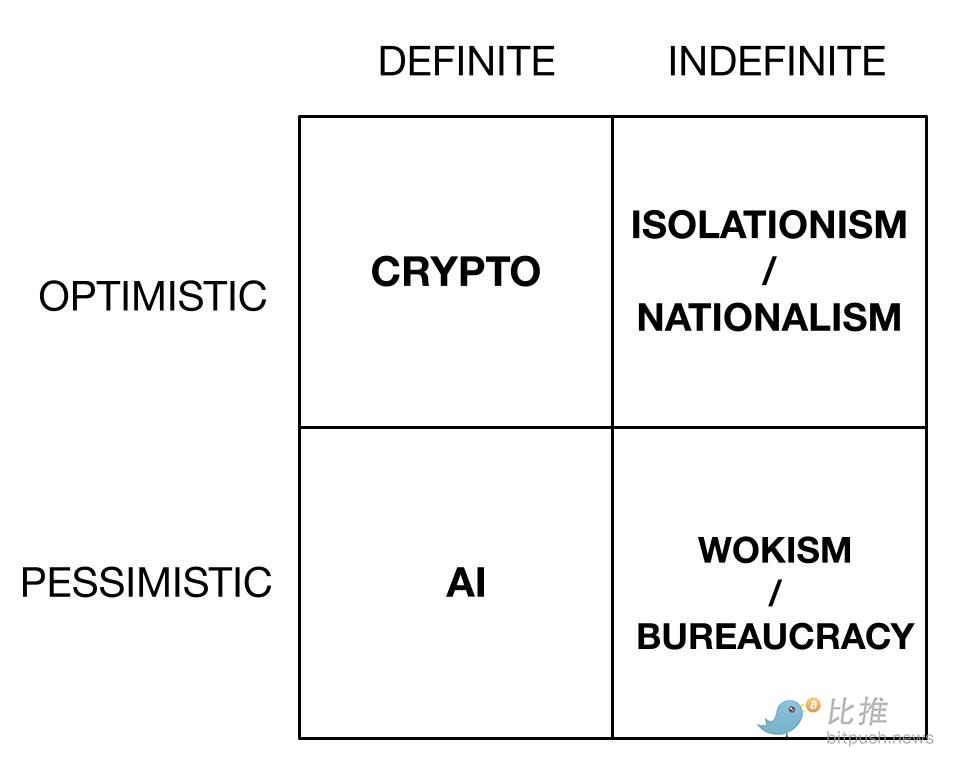
For years, I’ve kept in mind Peter Thiel’s simplified 2×2 framework of optimism and pessimism. He cleverly illustrated it with the saying: “When you have a hammer, everything looks like a nail.” Thiel further distinguished between definite and indefinite forms of pessimism and optimism.
He wrote: “If you regard the future as something determined, it’s meaningful to anticipate it and work hard to shape it. But if you expect the future to be random and uncertain, you might abandon any attempt to steer it.”
Indefinite pessimists “merely react to events as they happen, hoping things won’t get worse. They can’t predict whether inevitable decline comes fast or slow, catastrophically or gradually. All they can do is wait for it.”
Definite pessimists “obsess over ways things could deteriorate further. They believe the future is predictable, and since it’s bleak, they must prepare.”
Indefinite optimists envision a better future but don’t know how to achieve it. Ultimately, definite optimists not only see a better future but make plans and work to realize it. This is my simplified version of the dominant Twitter narrative:
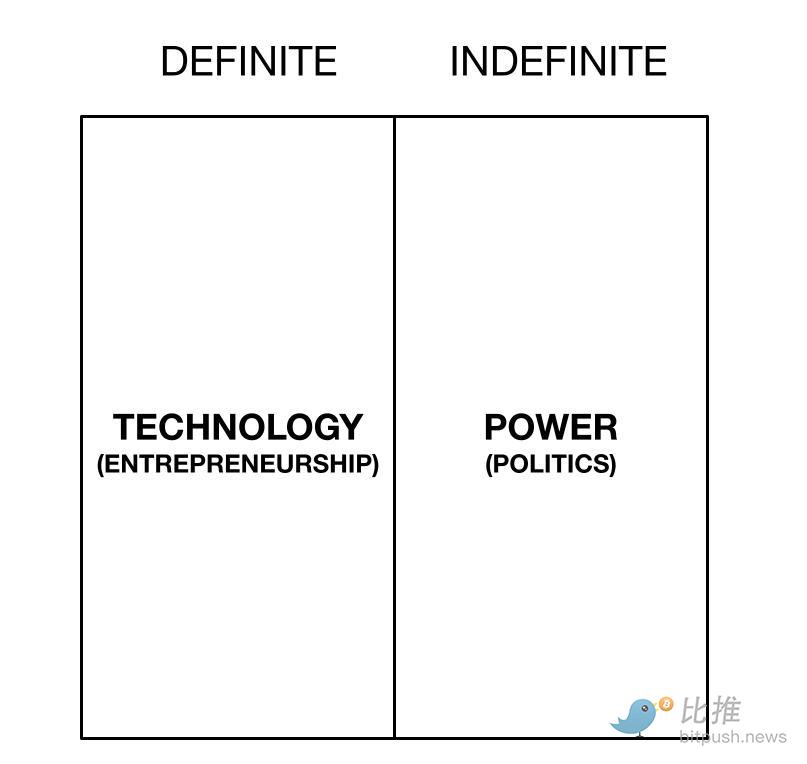
I view the line between politics and technology as a vertical divide between “definite” and “indefinite.” That’s because politics isn’t fundamentally about creating wealth, but about governance and distribution. Even at its best, politics is merely an enabler of technology and entrepreneurship. By nature, politics cannot create the future. Technology does. It’s the foundation of societal development, the network enabling human communication.
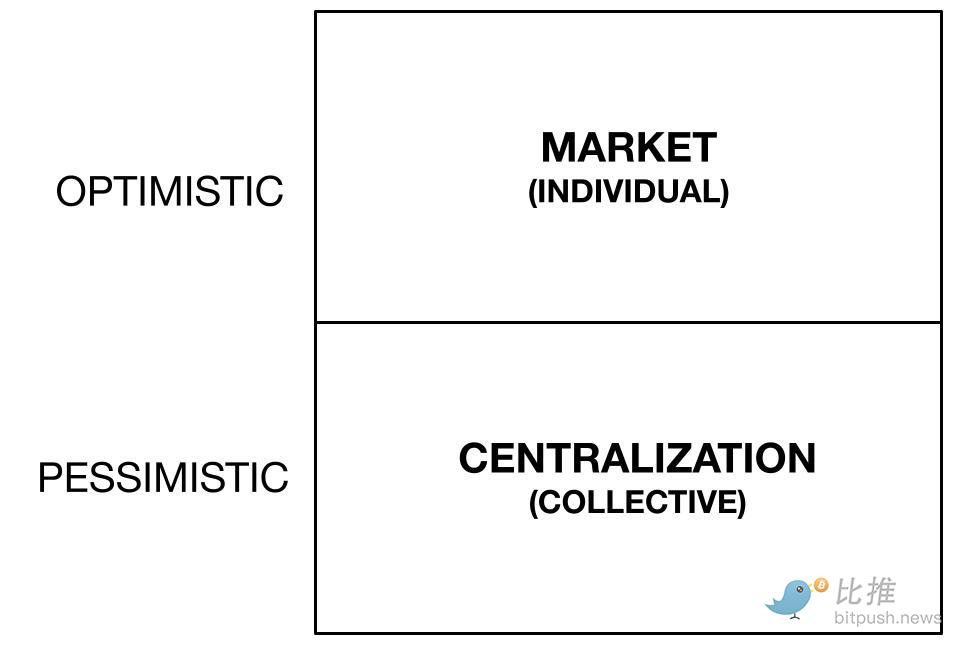
The horizontal divide lies between individual and collective roles. Optimists emphasize individuals as the basis of change, favoring decentralization and bottom-up transformation for robust development. Pessimists, believing the world is fragile, rely on top-down control, trusting only those in power to solve problems and prevent further deterioration.
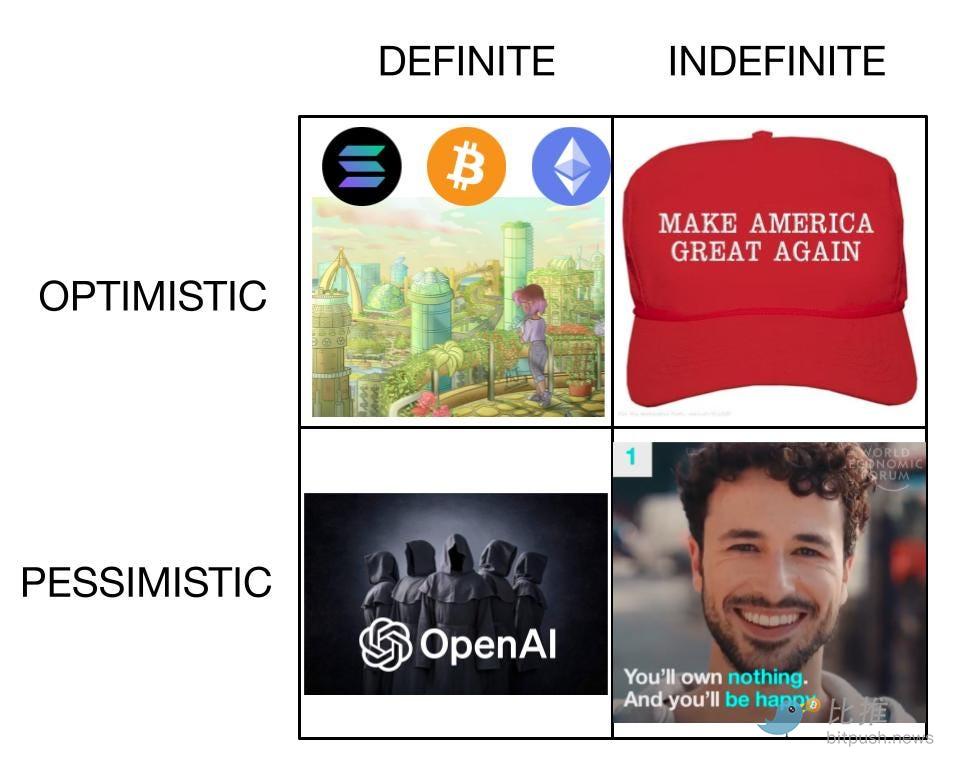
Let’s begin with the definite AI pessimist narrative. It’s called “definite” because it rests on a specific technological paradigm. Why pessimistic? Because its core idea is that machines are greater than humans themselves. This is essentially a new interpretation of God—revealed through chatbots conversing with mortals. In this story, centralized algorithms rule everything, and we are completely subject to the technology.
Our fate is either annihilation by this superior being or researching how to align our values with AI. Here, AI is less “artificial intelligence” and more “Abrahamic explanation.” Humans become passive subjects—powerless, unable to resist, forced to submit and pray we aren’t crushed by this overwhelming force.
Another kind of pessimist—the indefinite pessimist—sees themselves as clear-eyed. They believe all innovation has ended; now we can only redistribute. Power is central here. They advocate leveraging power to shift it from the powerful to the powerless. They claim there’s no alternative—capitalism has failed, so we must freeze human ambition and govern society with the cold hand of bureaucracy, forcing ourselves to endure inconveniences like paper straws.
Humans are the culprits, nature the victim. The poor suffer too, becoming victims. Winners are clearly the perpetrators. To fix this, apparently the only way is to make everyone equally suffer. But what’s the point? Chasing superficial diversity and ideological conformity is futile. And the rules set by indefinite pessimists don’t apply to themselves—they see themselves as saviors. The world is already broken; we shouldn’t waste energy pursuing so-called progress. In this twisted logic, the only “progress” is equalizing suffering.
Then come the indefinite optimists, stirring again. They say: “Hey, this isn’t how we solve things—we should rethink and find solutions.” But how? Reversing course clearly isn’t the answer, and the path forward is full of unknowns. Embrace nationalism? Sure, it strengthens cultural cohesion, but excessive patriotism can turn into a machine of destruction.
Indefinite optimists reject globalism’s homogeneity and meaningless over-bureaucratization, yet feel bewildered by real transformations brought by new technology. They feel threatened, their minds closing off. They don’t know how to embrace technology—especially when it underpins society.
Ban social media? What’s the difference from banning the printing press? Reform is already underway; suppressing it backfires. So how do we take control and strive to build the specific future we envision?
Definite Crypto Optimism
After spending time in crypto, you realize it’s a complete mess—utter chaos. Yet this very disorder, noise, and often misguided technological revolution stems from a strong desire for self-determination.
Finance is the first target, because markets are the core mechanism for resource allocation. Change their structure, and you redirect value toward areas older incumbents fear to tread—they’re content with the status quo. But crypto is different. It craves change, going beyond protest. It builds actively and takes risks. Its goal isn’t to occupy Wall Street, but to liberate it.
Crypto embodies solarpunk—financial freedom, decentralized cities, and funding scientific experiments. It’s like a mischievous child, seemingly innocent, yet this decentralized, trustworthy, corruption-free, politically neutral money is driving a real technological revolution. It enables capital to flow freely, ignoring alarmist political rhetoric. Does the tyranny of KYC and anti-money laundering policies truly make the world safer—or is it the opposite?
Crypto has created a new asset class, making wealth mobile. Faced with soaring housing prices, many give up—but crypto offers a new path, bypassing bureaucratic barriers that block young people from owning wealth and getting ahead. It rejects the idea of being “happy with nothing,” craving everything—even if the process is painful. Crucially, the pain is endured by choice.
Yes, we’ve launched seemingly worthless NFTs and sold overvalued tokens to clueless retail investors, talking endlessly as if it could save our lives. We’ve funded utterly useless projects. But ultimately, that’s what revolution is. No one promised it would be a beautiful revolution.
We’ve built digital worlds, established new rules, started new games. It’s imperfect, but we carry a mission: embracing individuals, exploring novel financial and commercial methods. These attempts may seem strange, but we have a clear vision—to understand money as a force for transformation.
We move slowly but steadily, each step marked by achievements. Bitcoin, Ethereum, ICOs, Uniswap, Solana… what’s next? Bio.xyz? HairDAO? Most projects fail at the frontier of exploration, but a few survive and profoundly impact the globe. We accept this asymmetric outcome and march forward bravely.
Indeed, crypto is the true frontier. Here, you don’t need stacks of credentials—just a few lines of code can launch your journey. Bad ideas might moon (then vanish), but good ones get a chance. We need more such innovations.
So if you haven’t joined crypto yet, why not step into this circus of clowns, scammers, and pilgrims? There’s a chance to earn massive wealth—or lose everything. We’ll invest in ventures that seem miserable, painful, yet full of potential.
We always need newcomers to help us through tough times. We can’t rely on divine grace—we’re resolute indefinite optimists. We need fresh ideas and bold execution to sustain the planet’s most definite, optimistic movement.
Older incumbents won’t buy Bitcoin and Ethereum ETFs. We need ordinary people willing to explore the frontier, seek inspiration, overcome obstacles, and push forward—this spirit is what drives crypto forward.
Join TechFlow official community to stay tuned
Telegram:https://t.me/TechFlowDaily
X (Twitter):https://x.com/TechFlowPost
X (Twitter) EN:https://x.com/BlockFlow_News
 @mattigags


