









IRS Finalizes New Rules: Cryptocurrency and Stablecoin Transactions Must Be Reported — Explained: Gross Proceeds and Basis Reporting
TechFlow Selected TechFlow Selected
IRS Finalizes New Rules: Cryptocurrency and Stablecoin Transactions Must Be Reported — Explained: Gross Proceeds and Basis Reporting
Under this bill, the U.S. Department of the Treasury and the Internal Revenue Service (IRS) drafted and issued new regulations for reporting digital asset transactions.
 Navigating Web3 tides with focused insights
By Aiying Ai
In recent years, digital assets have sparked a surge of interest in financial markets. From cryptocurrencies like Bitcoin and Ethereum to stablecoins such as USDT, and non-fungible tokens (NFTs), these new types of assets have not only attracted a large number of investors but also triggered global technological innovation and regulatory discussions.
However, the rapid rise of digital assets has also brought many challenges. Due to their anonymity and cross-border mobility, tax authorities face unprecedented difficulties in tracking and reporting these transactions. In many cases, tax opacity and compliance issues have become major headaches for regulators. With U.S. federal finances under significant strain in recent years, the $4.6 billion fine imposed on Binance exemplifies enforcement efforts—though a federal judge recently dismissed some SEC lawsuits against Binance and its founder Changpeng Zhao, other allegations—including those related to ICO offerings, ongoing sales of BNB, BNB Vault, staking services, unregistered securities, and fraud—are still permitted to proceed. Yet penalizing a single company offers only marginal relief to broader fiscal needs. To generate greater revenue, Congress passed the Infrastructure Investment and Jobs Act in 2021, which included amendments to the Internal Revenue Code, particularly regarding reporting requirements for digital asset transactions. Under this law, the U.S. Department of the Treasury and the IRS drafted and issued new regulations mandating that financial institutions and brokers report detailed information about digital asset transactions, including gross proceeds and adjusted basis.
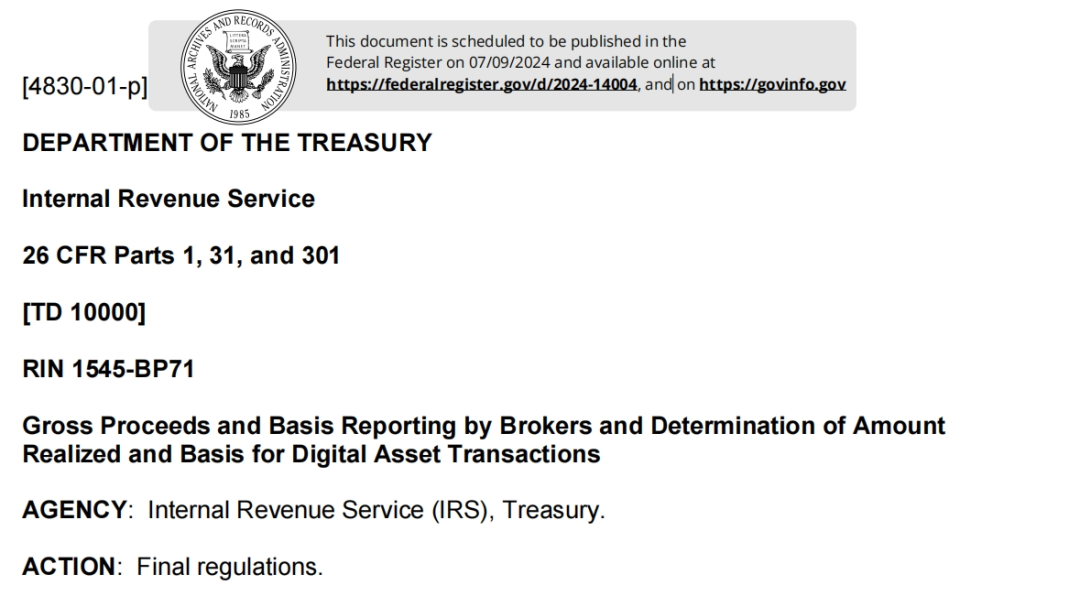
Aiying Ai breaks down the entire report into three clear sections to help you understand the key components of this revised legislation:
I. Definition of Digital Assets
1. Scope of Definition
Under the new regulations, “digital asset” is broadly defined as any representation of value recorded on a cryptographically secured distributed ledger (such as blockchain). This includes, but is not limited to, the following types:
-
Cryptocurrencies: Such as Bitcoin and Ethereum—currently the most widely recognized digital assets, primarily used for payments and investments.
-
Stablecoins: Including USDT and USDC, typically pegged to fiat currencies (e.g., USD) to maintain stable value, commonly used in trading and payments.
-
Non-Fungible Tokens (NFTs): Such as digital art and collectibles—each NFT represents a unique asset and is indivisible or non-interchangeable, widely applied in fields like art, music, and gaming.
The rules regarding unhosted wallets and associated unhosted software have not been finalized. The IRS has indicated these tools may be classified as brokers; specific guidelines will be determined at a later date.
Moreover, the definition of digital assets is not limited to the above categories—any asset recorded using similar technology could fall under this scope. This means all digital representations of value, whether transacted on-chain or off-chain, are subject to reporting requirements (with certain exemptions discussed below).
II. Reporting Requirements
1. Key Requirements
The new regulations require brokers and financial institutions to report detailed information for each digital asset transaction, specifically the gross proceeds (how much was earned from the sale) and the adjusted basis (the original purchase cost, adjusted accordingly, to determine capital gain or loss).
2. Required Information
To comply with the regulations, brokers and financial institutions must report the following details:
-
Transaction Date: The exact date when the transaction occurred.
-
Transaction Amount: The total sale amount—the price received upon selling the asset.
-
Asset Type: The type of digital asset involved in the transaction, such as Bitcoin, Ethereum, USDT, or NFTs.
-
Adjusted Basis: The initial purchase price of the digital asset, adjusted for certain factors, used to calculate net gains or losses.
-
Counterparty Information: Relevant details of both buyer and seller to ensure transparency and traceability of transactions.
3. Exemptions
Special Provisions for Stablecoins and NFTs
-
Stablecoins: Stablecoins like USDT and USDC, which are typically pegged to fiat currencies such as the U.S. dollar and maintain relatively stable values, are subject to reporting. However, to reduce the burden on brokers, certain types of stablecoin transactions may qualify for simplified reporting methods. For example, frequent small-value transactions can be reported in aggregate rather than individually.
-
NFTs: Non-fungible tokens represent unique digital assets such as digital artworks and collectibles. Most NFT transactions require reporting, but the regulations recognize that low-value NFT trades may have simplified reporting obligations or even exemptions. For instance, buying or selling low-value digital collectibles may not require the same level of detailed reporting as high-value transactions.
Closed-Loop Assets
"Closed-loop assets" refer to virtual assets that can only be used within a specific system and cannot be exchanged for fiat currency. The following are some exceptions:
-
In-game Currency: Virtual currencies that can only be used within a specific game or platform and cannot be converted into fiat money (e.g., USD) are generally excluded from reporting. For example, in-game gold earned and spent solely within a single game does not need to be reported.
-
Internal Company Points: Similarly, loyalty points issued by a company that can only be redeemed within the company’s ecosystem and cannot be converted into external fiat currency do not fall under digital asset reporting requirements.
Overall, the revised legislation aims to increase transparency in digital asset transactions and ensure proper tax compliance. While the government clearly wants to collect more revenue, the regulations do include some practical considerations to ease taxpayer burdens—for example, exempting certain small-value transactions from reporting to avoid overwhelming users.
III. Implementation Timeline
1. Effective Dates
The new digital asset reporting regulations will take effect 60 days after official publication in the Federal Register. Therefore, the exact effective date depends on when the rule is formally published. Additionally, different provisions may have staggered effective dates based on their specific requirements. The implementation occurs in three phases:
-
After December 31, 2023: This marks the initial effective date of the regulation, indicating that all relevant reports and statements must comply with the new rules starting from this point.
-
Operational Compliance by 2025: By 2025, all affected institutions must fully meet operational compliance requirements, including system upgrades, staff training, and full implementation of reporting procedures.
-
Cost Basis Tracking by 2026: Starting in 2026, institutions must track and report the cost basis (original purchase price and applicable adjustments) of transactions. This likely involves stricter and more precise tracking to ensure accurate tax reporting for all transactions.
2. Preparation Steps
To ensure smooth compliance once the regulations take effect, industry participants and institutions should prepare in advance by taking the following steps:
-
Update Systems and Processes: Ensure your trading platforms and backend systems can record and report all required data, including transaction dates, amounts, asset types, etc. System upgrades or replacements may be necessary.
-
Train Employees: Educate all relevant staff on the specifics of the new regulations and reporting procedures. This includes front-line and back-office personnel who must know what information to collect and submit.
-
Review and Adjust Policies: Audit existing compliance policies and procedures to ensure alignment with the new rules. Revise internal policies where necessary to meet updated reporting standards.
-
Communicate with Customers: Inform customers about changes due to the new regulations, clarify what information they need to provide, and ensure they understand their new obligations.
-
Establish a Compliance Team: If not already in place, consider forming a dedicated compliance team responsible for overseeing and managing all aspects of digital asset transaction reporting to ensure adherence and mitigate legal risks.
-
Test Reporting Procedures: Before the regulations take full effect, conduct simulation tests to verify that all systems and workflows function correctly. This includes trial runs of reporting processes to confirm accuracy and completeness of data capture.
By completing these preparations, industry players and institutions can ensure full readiness before the new rules come into force, enabling seamless compliance and avoiding legal exposure. This not only reduces regulatory risk but also helps organizations remain competitive and compliant in an evolving regulatory landscape.
Aiying Ai Summary
Overall, these new digital asset transaction reporting regulations will significantly impact financial markets and tax compliance. They will make investors more cautious during trades, push exchanges to upgrade systems, and enhance market transparency—but will also raise compliance costs.
Notably, the definition of “digital asset” in the bill is overly broad. Almost every NFT and stablecoin transaction must now be reported, even converting USDC into USD must be reported to the IRS—even if the gain or loss is just a few cents. Such stringent policies may discourage users from using centralized exchanges and instead drive activity toward decentralized finance (DeFi), potentially undermining the very goals of increased transparency and tax collection.
Join TechFlow official community to stay tuned
Telegram:https://t.me/TechFlowDaily
X (Twitter):https://x.com/TechFlowPost
X (Twitter) EN:https://x.com/BlockFlow_News
 Aiying Compliance











