









Mt. Gox selling pressure eased, analysts say risk of further decline is limited
TechFlow Selected TechFlow Selected
Mt. Gox selling pressure eased, analysts say risk of further decline is limited
The cryptocurrency market is experiencing typical post-halving volatility, compounded by the usual "summer doldrums."
 Navigating Web3 tides with focused insights
By Mary Liu, TechFlow
Trader selling pressure eased on Tuesday as the crypto market staged a broad-based rebound.
After hitting a low of $58,433 late Monday, Bitcoin climbed back above $61,000 during Tuesday's morning session and rose above the $62,000 support level by midday. At the time of writing, BTC was trading at $62,086, up 3.4% over the past 24 hours.
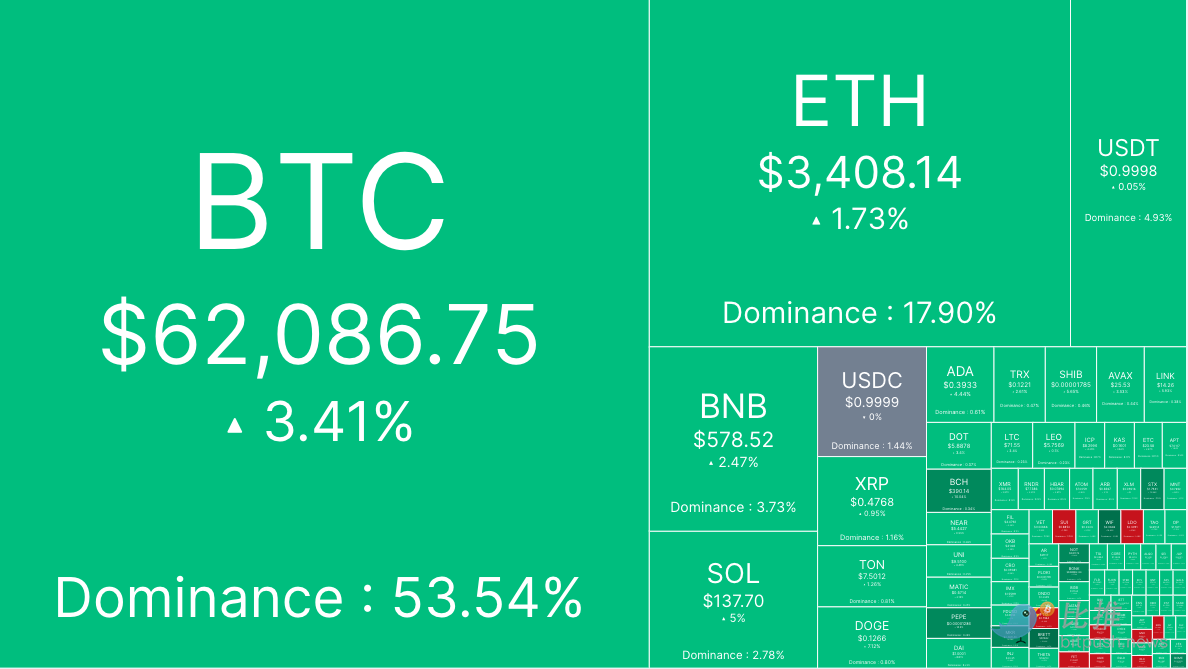
Altcoins benefited from Bitcoin’s recovery, with all but eight of the top 200 cryptocurrencies by market cap posting gains.
The biggest gainer was Brett (BRETT), surging 26% to $0.1672, followed by dog wif hat (WIF) up 23.8%, and Dog (DOG) rising 22.1%. The largest decliners were Lido DAO (LIDO), down 1.9%, Tellor (TRB) off 1.8%, and Curve DAO Token (CRV) down 1.2%.
The total cryptocurrency market capitalization currently stands at $2.29 trillion, with Bitcoin’s market dominance at 53.5%.
Roots of Recent Weakness
While many believe potential selling pressure from Mt. Gox is behind the market pullback, some analysts argue that Mt. Gox’s impact on the market has been limited. Instead, several analysts suggest the crypto market is simply undergoing a typical post-halving consolidation phase combined with seasonal "summer doldrums."
Analysts at ETC Group examined recent crypto weakness, pointing to multiple factors affecting market sentiment, including reduced inflows into major cryptocurrencies, increased selling pressure from Bitcoin whales and miners, and heightened macro risks.
Data from TechFlow shows Bitcoin has fallen more than 20% from its March all-time high, while other altcoins have suffered even greater losses—global altcoin market capitalization excluding Ethereum has declined an average of 32.6% from recent peaks. Overall, capital inflows into crypto assets have significantly slowed compared to levels seen after the U.S. launch of spot Bitcoin ETFs.
Slowing inflows into Bitcoin and crypto ETFs have weighed on the market. Multiple analysts note that positive net inflows were the primary driver behind price increases in the first quarter of 2024.
"On-chain inflows into major crypto assets like Bitcoin and Ethereum have dropped from around $100 billion per month in March to just $20 billion per month since April," said ETC Group analysts. "This aligns with the current pause in the bull run and is one reason the market has failed to reach new highs."
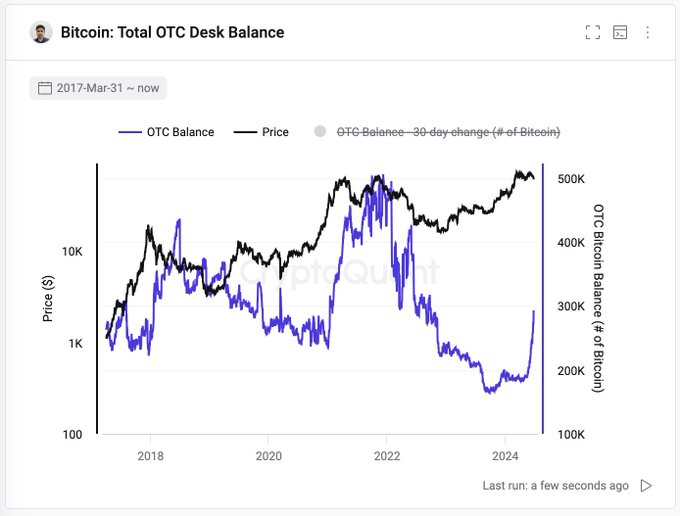
Data released by CryptoQuant shows that 103,000 Bitcoin have been added to over-the-counter (OTC) desk wallets over the past six weeks. Rising OTC wallet balances alongside falling prices indicate these sell orders have yet to find buyers.
Lucas Kiely, Chief Investment Officer at Yield App, said in a report: "BTC and the broader crypto market are currently proving that the old adage 'sell in May and go away' still holds, as prices remain subdued. Moreover, macro factors have been, and likely will continue to be, the biggest drivers of Bitcoin’s price movements."
Kiely added, "U.S. inflation is slowing but remains well above the Fed’s 2% target, meaning that despite this being an election year, the Fed may delay rate cuts until inflation is fully under control—as it should. Neither traditional nor digital asset markets are fond of this scenario—and they’ve shown it."
Regarding the upcoming approval of ETH ETFs, Kiely stated: "Market enthusiasm is muted. Ethereum does not attract the same level of demand or attention as Bitcoin. Approval of an ETF or ETH investment fund may not drive ETH prices higher, but instead could become a drag adding further downward pressure."
Analysts warn: "Persistently下调 global growth expectations, coupled with rising risks of a U.S. recession, may continue to challenge Bitcoin and other crypto assets in the near term. Notably, changes in global growth expectations have been the dominant macro driver over recent months, accounting for over 80% of Bitcoin’s performance volatility over the past six months."
"Be fearful when others are greedy, and greedy when others are fearful"
However, ETC Group analysts say the recent price decline may have already shaken out traders who lacked strong conviction in Bitcoin and the crypto market’s long-term outlook, suggesting prices may have bottomed.
They noted: "Wall Street wisdom holds that retail investors are most bullish at market tops and most bearish at bottoms. In theory, excessive bullishness signals a market top, while extreme bearishness signals a bottom. Indeed, similar behavioral patterns can be observed in the crypto asset market."
Analysts added: "We believe multiple indicators show positioning imbalances and bearish sentiment, with 'weak hands' largely having exited the market. Given all these metrics, we see short-term risk/reward becoming increasingly asymmetric, with limited downside risk remaining. Therefore, we view the current market downturn as a good opportunity to increase exposure to Bitcoin and crypto assets ahead of major events expected in the coming months."
Join TechFlow official community to stay tuned
Telegram:https://t.me/TechFlowDaily
X (Twitter):https://x.com/TechFlowPost
X (Twitter) EN:https://x.com/BlockFlow_News
 比推 BitpushNews











