Pantera Capital: Solana, the "Mac OS" operating system of blockchains
TechFlow Selected TechFlow Selected
Pantera Capital: Solana, the "Mac OS" operating system of blockchains
Solana's overall design and relentless focus on optimization offer clear advantages in user experience, developer agility, and security.
 Navigating Web3 tides with focused insights
Authors: FRANKLIN BI, COSMO JIANG, ERIC WALLACH
Translated by: TechFlow
How many blockchains will exist? This is a question we often hear, but a better one is: how many blockchains must exist? In other words, what is the minimum number of blockchains needed to realize the full potential of the technology? To answer this, we should focus on the foundation of the blockchain ecosystem: developers.
The "customers" of blockchains are developers. Developers build applications and protocols that drive demand for on-chain bandwidth (i.e., blockspace). Developer preferences and cultural norms will profoundly shape the evolutionary path of cryptocurrency.
Historically, developer-facing technologies tend to consolidate around a few dominant players—typically two or three oligopolies—each catering to different developer preferences. We've seen this pattern in operating systems (Windows, macOS, Linux), gaming consoles (Sony, Microsoft, Nintendo), and mobile platforms (Apple, Android). As technology cycles mature, 70–90% of the market often consolidates around the leading players. Eventually, the market approaches equilibrium—unless a new breakthrough disrupts and resets the process.
A similar pattern is emerging in the blockchain ecosystem.
The Rise of Solana
Historically, Ethereum has dominated blockchain developer activity, with around 70–80% of blockchain developers building on Ethereum or EVM-compatible chains. But Ethereum’s dominance appears to be giving way to a multipolar model.
Solana has significantly increased its market share over the past year. This shift resembles Microsoft's early dominance in desktop computing, which was eventually challenged by Apple’s vertically integrated approach. Today, Solana stands as a major contender shaping the future of blockchain development.
Solana’s holistic architecture follows a product roadmap focused on optimizing every component of its blockchain, much like Apple’s vertical integration of hardware and software stacks in macOS. This approach offers several advantages:
-
Seamless user experience: By eliminating the need to bridge across multiple chains, Solana delivers a smooth and intuitive experience for both developers and end users.
-
Faster innovation: Solana’s streamlined architecture enables more efficient product upgrades and faster iteration cycles.
-
Enhanced security: By minimizing dependencies and failure points, Solana’s single-chain design can offer greater security and stability—similar to how Apple’s tight control over its ecosystem enhances reliability.
Real-World Applications on Solana
Solana’s architectural strengths enable use cases and user experiences that may be more challenging on modular blockchains like Ethereum and Cosmos. These features are especially valuable for content distribution, DePIN (decentralized physical infrastructure networks), and CLOBs (central limit order books).
A prominent example leveraging Solana’s capabilities is DRiP, a platform where users can receive music, art, videos, and other collectibles directly from creators at no cost. To date, DRiP has delivered 168.95 million collectibles to 2.27 million wallets. Its success largely stems from the ability to distribute millions of NFTs globally for free—a feat only feasible on Solana. The platform’s seamless and instant user experience is powered by Solana’s high-performance blockchain, enabling fast and low-cost transactions, along with Metaplex’s compressed NFT standard, which reduces NFT minting costs to just a few cents.
Another application showcasing Solana’s strengths is Hivemapper, a decentralized mapping network that uses dashcams, drones, and other sensors to create highly accurate, up-to-date maps. The project leverages Solana’s high-speed, low-cost transactions to process vast amounts of data generated by contributors and reward their participation. Solana’s scalability and efficiency allow Hivemapper to build a decentralized alternative to traditional mapping services, with disruptive potential across transportation, logistics, and urban planning.
Solana’s high-performance blockchain also enables capital-efficient financial markets. For instance, Phoenix is a Solana-based decentralized exchange built on a chain-native CLOB (central limit order book). By harnessing Solana’s capacity for 4,000 transactions per second, 400-millisecond block times, and low fees, this approach unlocks a trading experience comparable to Nasdaq or the Chicago Mercantile Exchange. Similarly, MarginFi is a Solana-based lending protocol that enables borrowing against long-tail, volatile assets through faster and more predictable collateral management. Solana’s speed and low fees are critical to MarginFi’s efficient liquidations, helping minimize bad debt exposure to other market participants—a feature particularly valuable during financial crises like those seen on Wall Street.
These are just a few examples of compelling applications made possible by Solana’s holistic architecture. As more developers recognize the benefits of building on Solana, we can expect an increasing number of innovative projects to leverage its high-performance blockchain.
Strong Fundamental Growth
Solana’s case is unfolding in real time, with key fundamentals such as user growth and transaction fees accelerating rapidly. Solana has become a primary destination for retail users and memecoin traders, taking over the NFT dominance Ethereum held in the previous cycle.
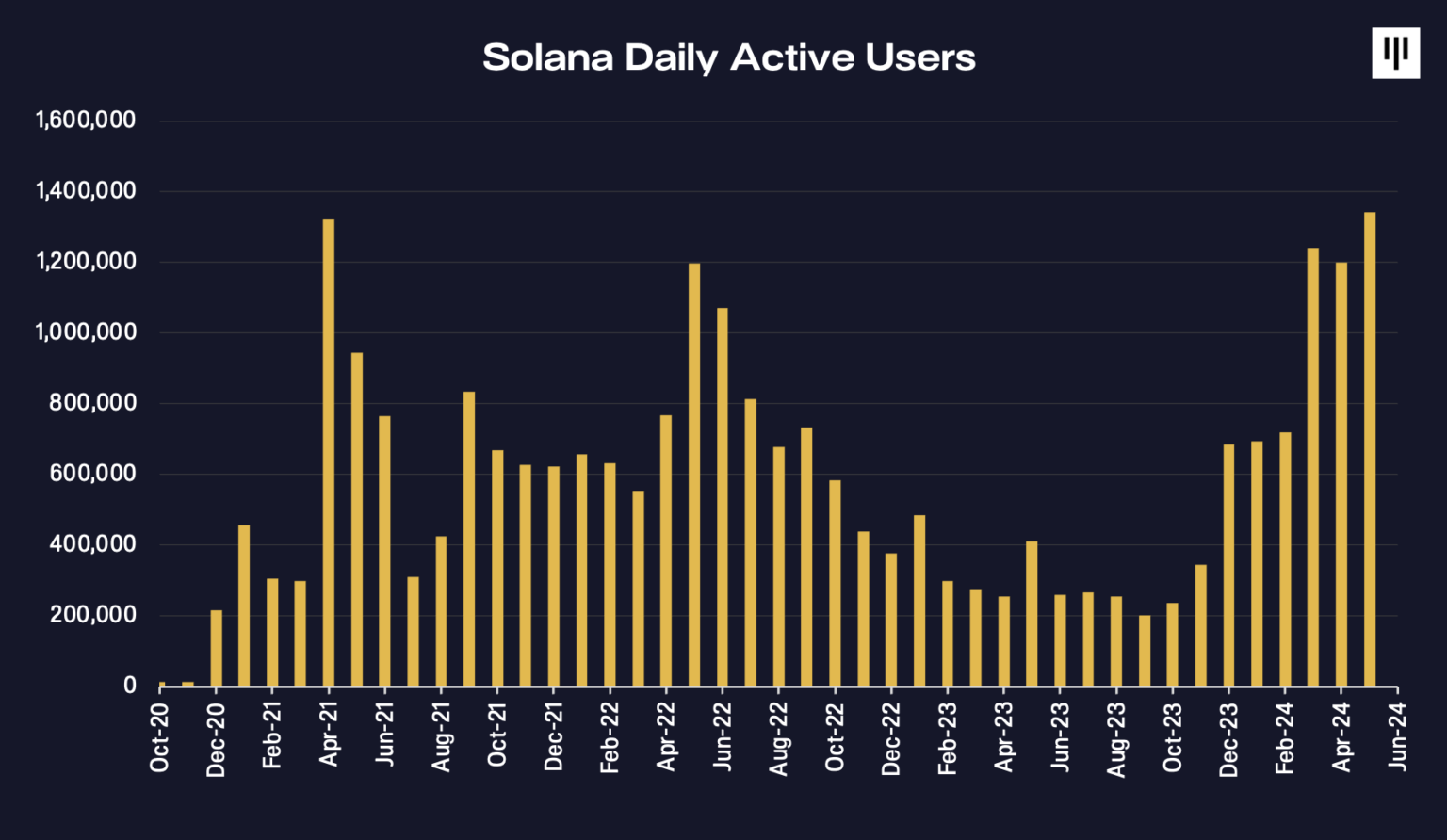
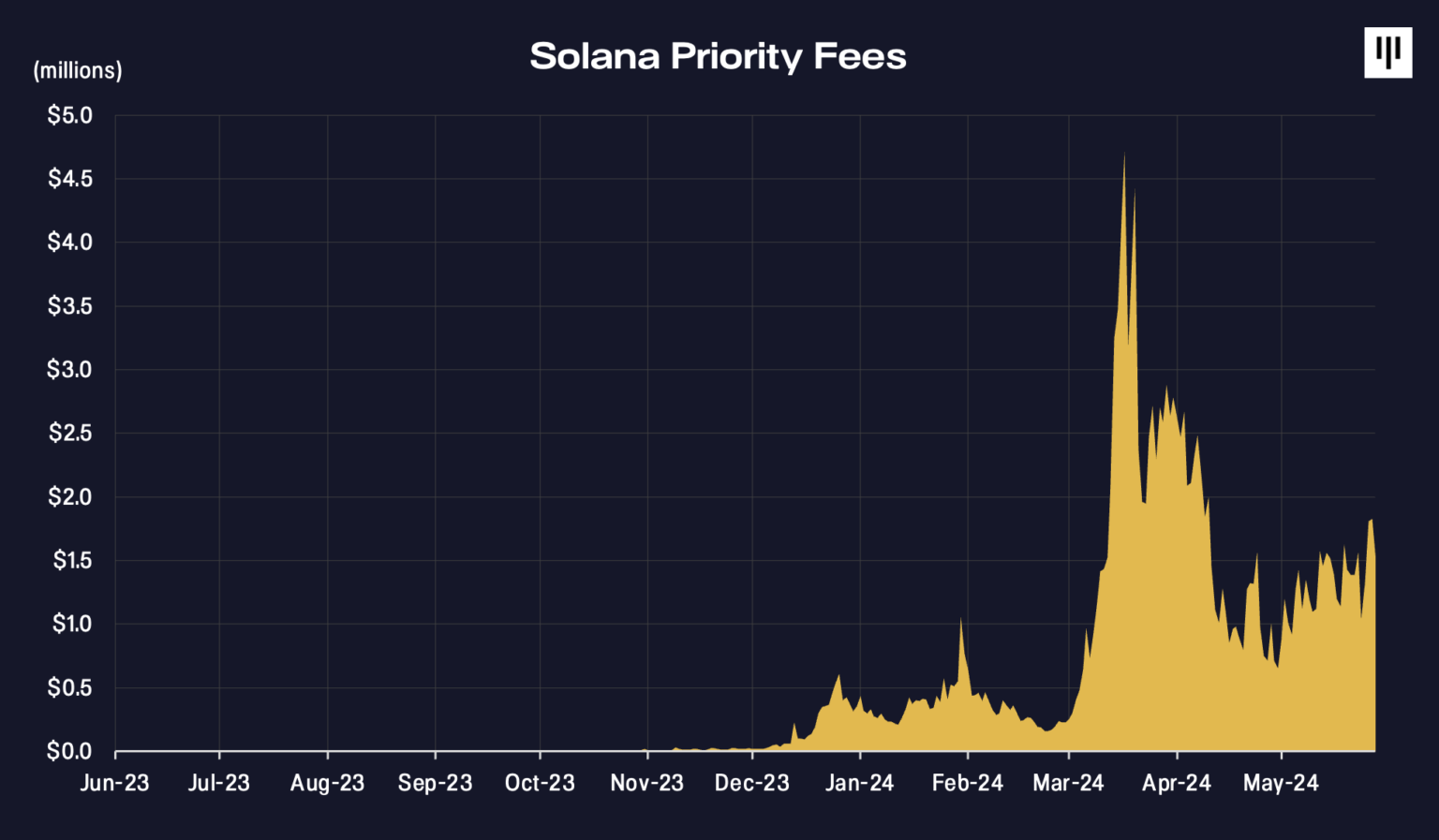
Unique active addresses on Solana surged from just 14,000 in October 2020 and a low of 202,000 in October 2023 to nearly 100,000, demonstrating explosive growth in platform engagement. Meanwhile, priority fees on the network skyrocketed from under $100,000 per month in mid-2023 to a record high of over $60 million in March 2024, underscoring the intensity of demand for Solana’s blockspace.
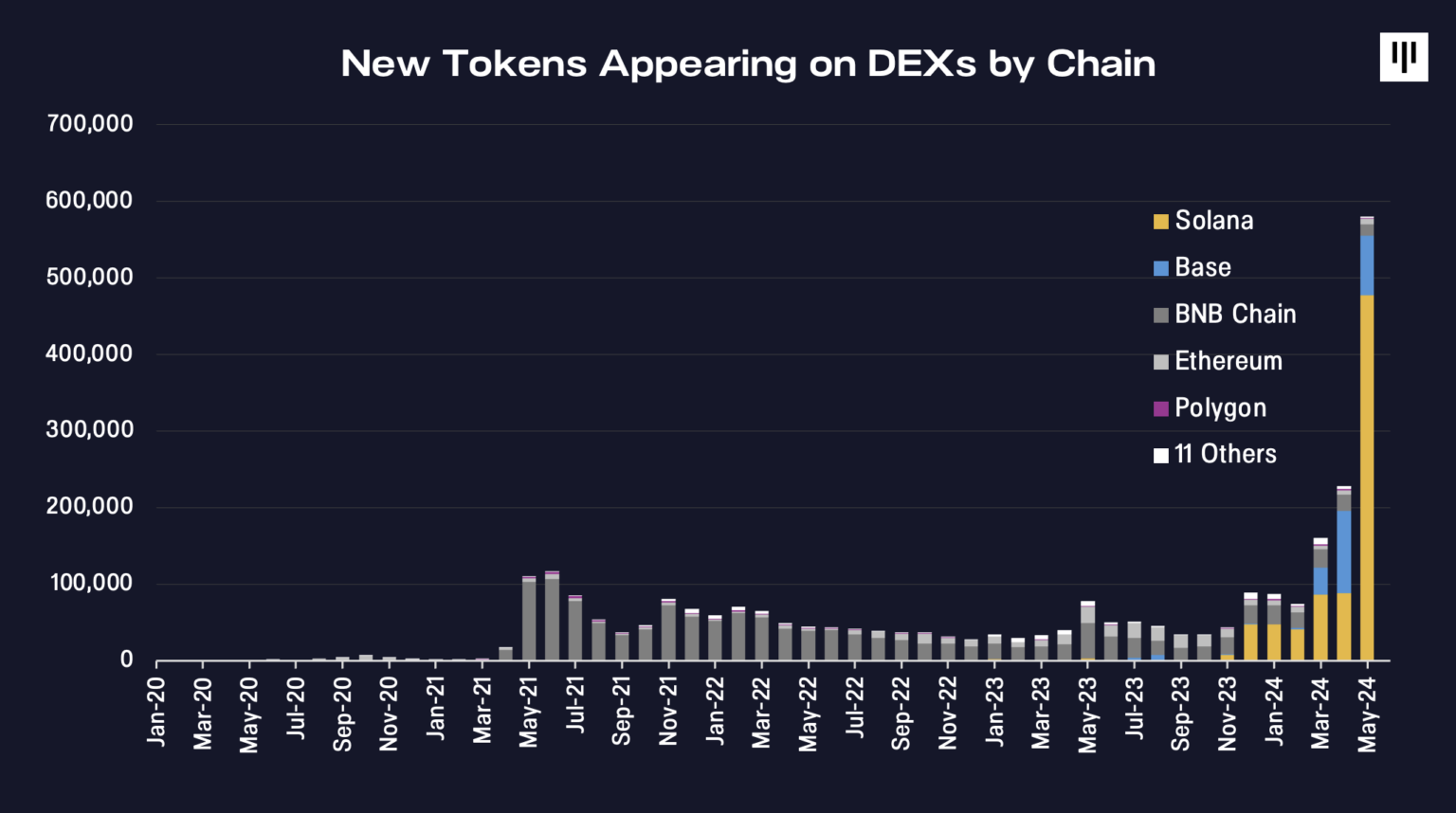
One of the clearest signs of Solana’s surging retail adoption is the explosive growth of new tokens in its ecosystem. Starting in January 2024, Solana saw a massive influx of new tokens, far outpacing other chains like BNB, Ethereum, and Polygon. By May 2024, Solana accounted for 85% of all new tokens launching on DEXs, a significant increase from 50% a year earlier. This token surge reflects strong retail usage, driven largely by memecoin activity.
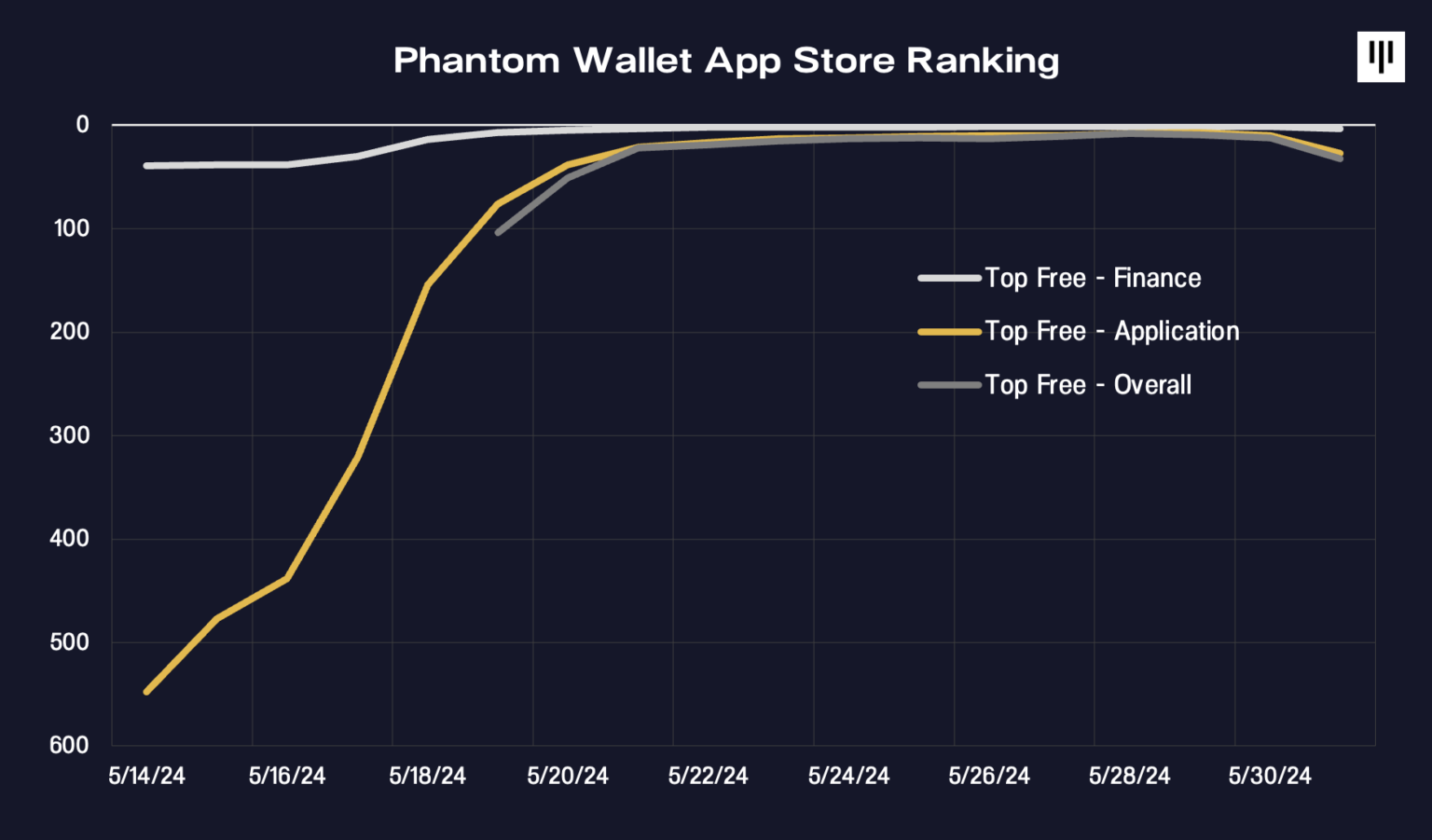
Another indicator of retail momentum is Phantom, Solana’s leading wallet, dominating rankings in the iOS App Store. From late May to early June, Phantom consistently ranked #1 in the finance category. More impressively, it topped the overall free apps chart, surpassing popular social media, entertainment, and gaming apps. For a crypto wallet to become the most downloaded app across the entire U.S. App Store is a remarkable achievement, signaling massive mainstream adoption of Solana. This retail surge is closely tied to the memecoin trading frenzy on Solana DEXs.
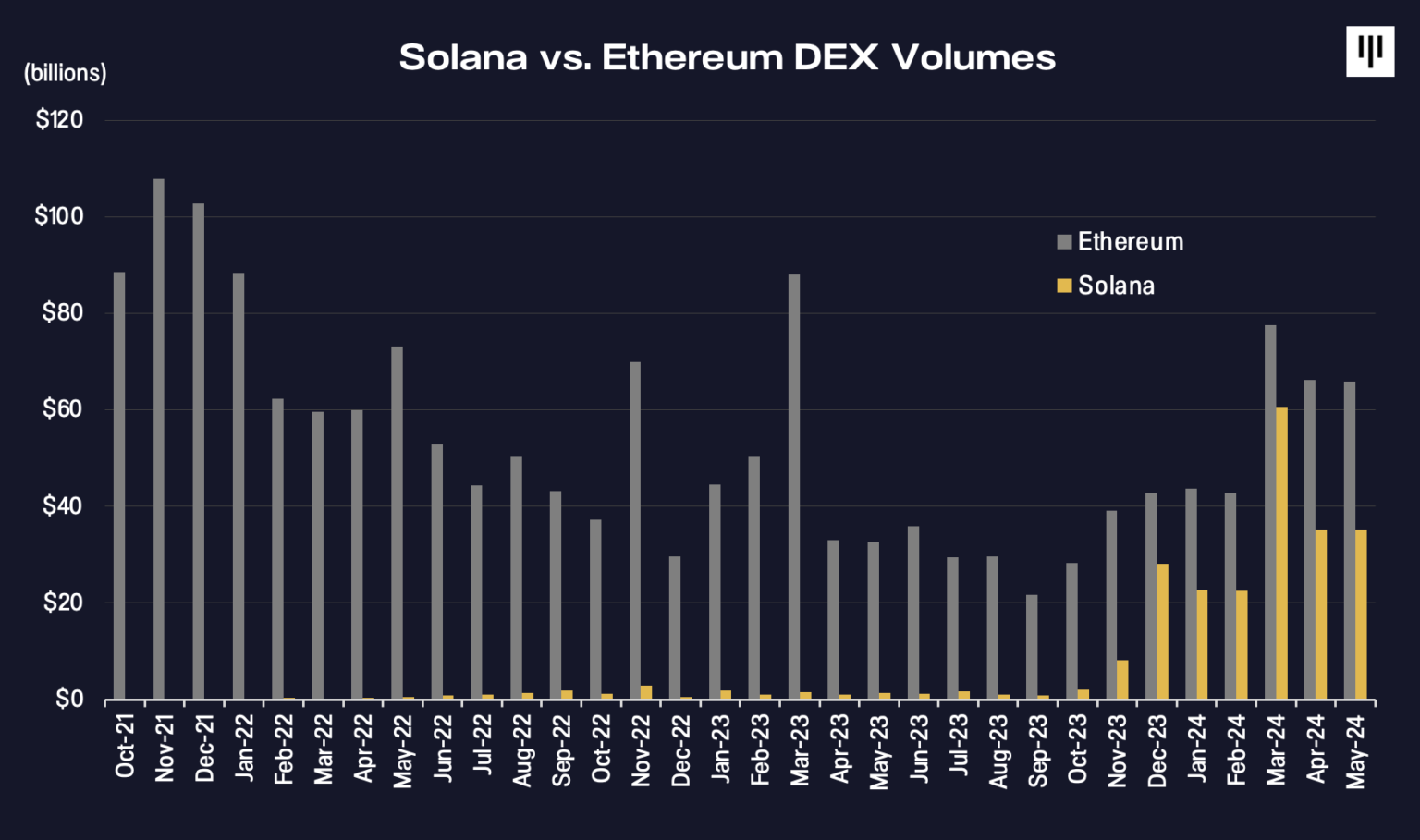
Speaking of DEXs, Solana’s share of decentralized exchange trading volume surged from nearly 0% in early 2021 to over 24% in May 2024. The pace of growth is staggering—Solana captured over 60% of incremental DEX volume in May 2024 alone. This highlights the immense momentum behind Solana’s DEX ecosystem and demonstrates how its high-performance architecture enables rapid market share gains from competitors.
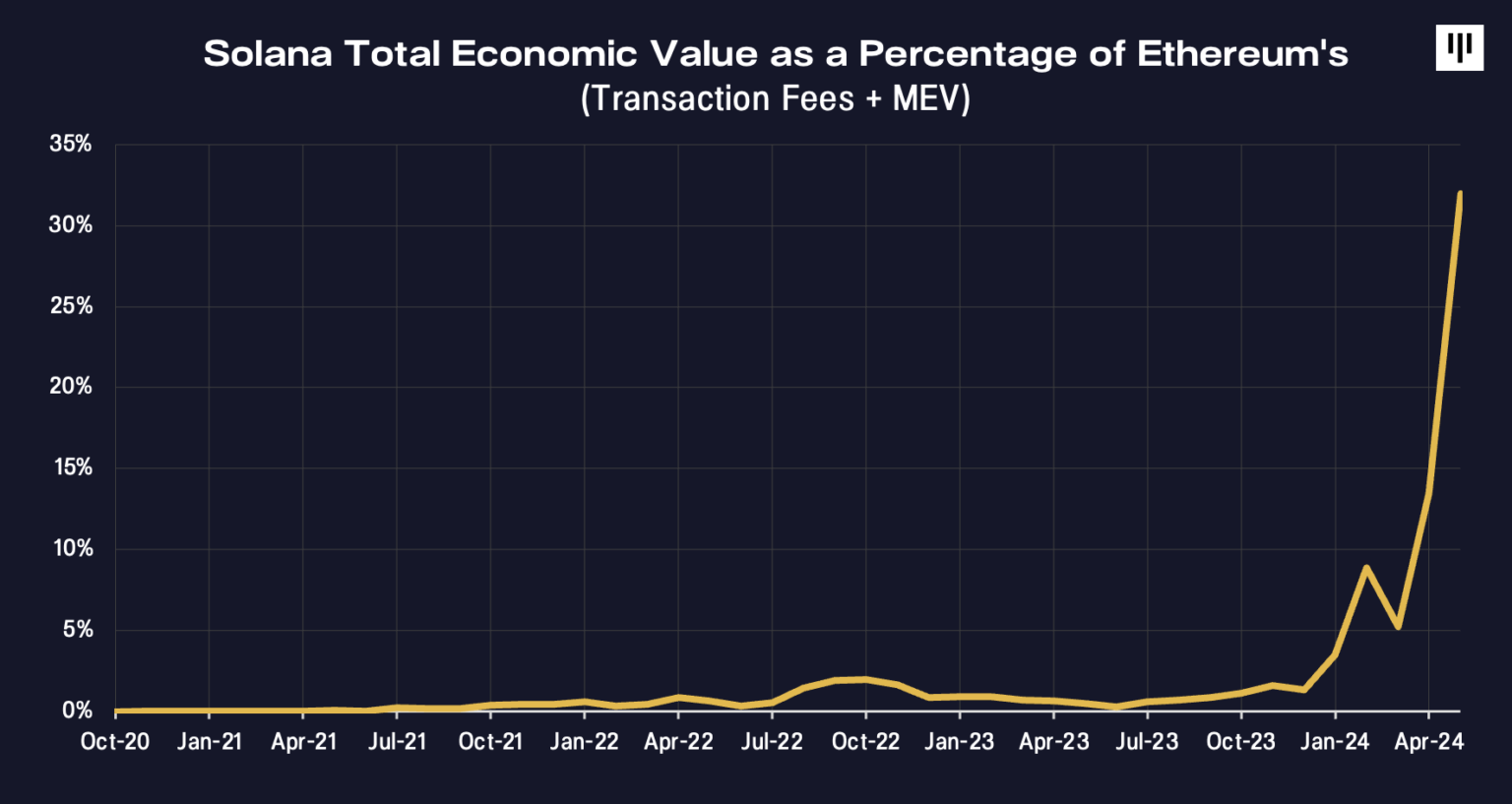
Critically, Solana’s surging user activity and DEX volumes are generating tangible economic value for SOL holders. Total value captured via transaction fees and MEV (maximum extractable value) has grown to rival Ethereum’s levels. This underscores how rising adoption creates a powerful flywheel effect—more usage drives higher fees, which in turn attract more validators, enhancing decentralization and network security.
Taken together, Solana’s expanding retail base, record-breaking token launches, dominant DEX growth, and soaring staking rewards form a compelling fundamental case. Solana’s architectural advantages position it to capture a disproportionate share of new demand entering the blockchain space, accelerating its rise as a top competitor to Ethereum. With fundamentals firing on all cylinders, Solana appears well-positioned to sustain its upward trajectory.
Conclusion
Solana’s holistic design and relentless focus on optimization deliver clear advantages in user experience, developer agility, and security. As the blockchain industry matures, these strengths position Solana to thrive and gain market share from competing ecosystems.
While challenges remain, Solana’s fundamentals are exceptionally strong. Retail adoption is surging, developers are flocking to build groundbreaking applications, and value capture is accelerating. As its ecosystem continues to grow and mature, Solana’s architectural advantages and vibrant community point to a bright future.
Join the official TechFlow community:
Telegram subscription group:
Twitter/X official account:
Twitter/X English account:
Join TechFlow official community to stay tuned
Telegram:https://t.me/TechFlowDaily
X (Twitter):https://x.com/TechFlowPost
X (Twitter) EN:https://x.com/BlockFlow_News
 Pantera Capital