








Experience of the Farcaster Ecosystem and Perspectives on Web3 Social
TechFlow Selected TechFlow Selected
Experience of the Farcaster Ecosystem and Perspectives on Web3 Social
Web3 social platforms, while emphasizing decentralization and censorship resistance, must ultimately center around trading to meet the core needs of Web3 users.
 Navigating Web3 tides with focused insights
Author: Evie
As the $1 billion valuation ceiling in the social赛道 and backed by top-tier investors such as a16z and Paradigm, how is the social protocol Farcaster doing now? Are its ecosystem apps actually playable? What innovations exist within the ecosystem?
With these questions in mind, I recently explored over 50 Farcaster ecosystem applications. Here’s what I found:
1️⃣ My exploration experience in the Farcaster ecosystem
2️⃣ Thoughts and visions on Web3 Social
3️⃣ Essential data dashboards for exploring the Farcaster ecosystem
🎩 My Farcaster Ecosystem Exploration Experience
1️⃣ My biggest takeaway is "interconnectivity": one identity works across all clients. Although each client has different focuses, the content I follow remains connected—giving me a familiar experience no matter where I go, without needing to rebuild my account from scratch.
2️⃣ Farcaster is quite open: users can add “action” widgets that appear next to every post—for example, showing how much $DEGEN a post has received in tips.
Additionally, “Frame” mini-apps can be embedded directly into posts, allowing users to access various services—like gaming, minting NFTs, claiming airdrops, subscribing to newsletters, shopping, or voting—without leaving the Farcaster client. In the future, even one-click swaps and other on-chain functions could be added. This greatly enhances the extensibility of Farcaster clients, diversifies app functionality, and creates a smoother user experience.
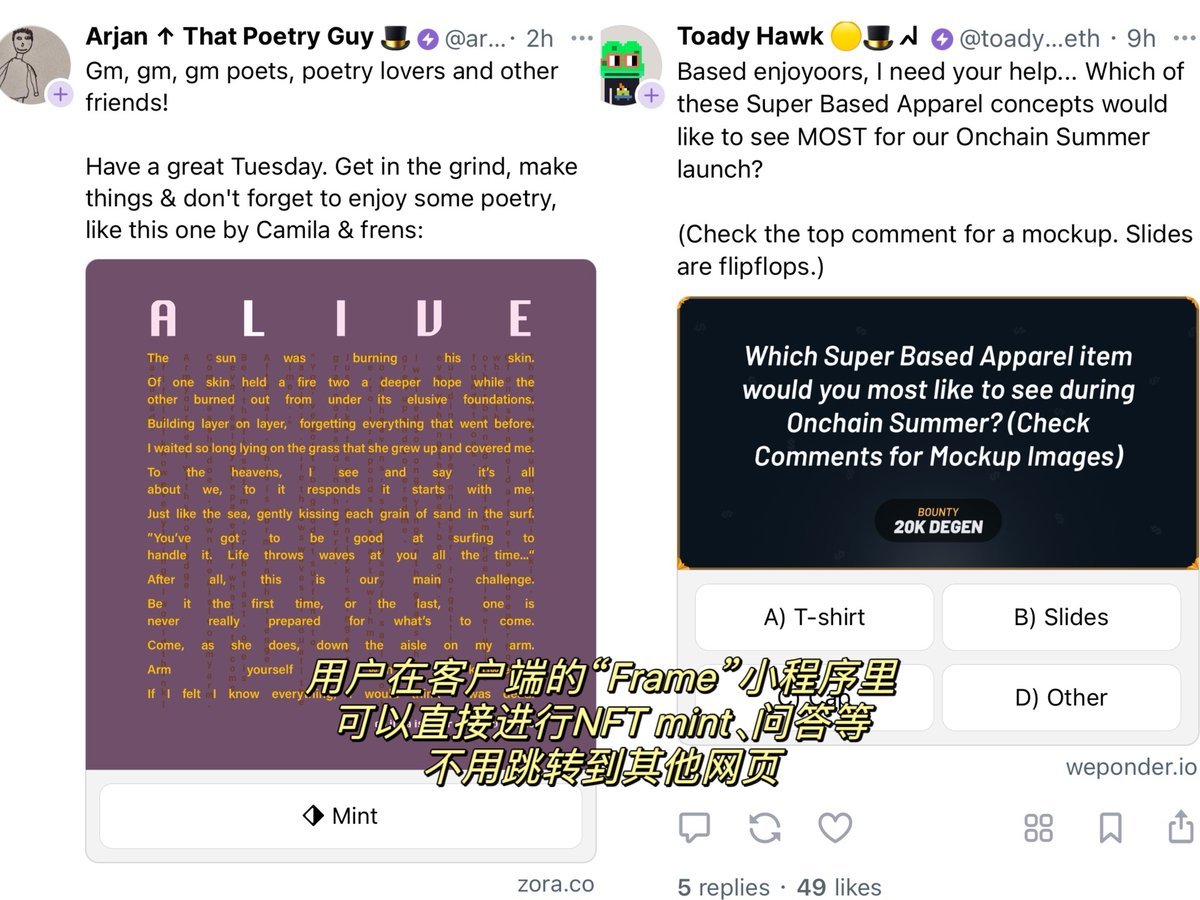
3️⃣ Tokens across the Farcaster ecosystem are interoperable, making "consumption" more convenient. For instance, $DEGEN can be used on clients like @perl_xyz and @Jamfrens for tipping or trading social assets. This is especially beneficial for new clients that haven't launched their own tokens yet—they can use an existing token like $DEGEN as a circulating currency. These shared tokens also help build consensus across the ecosystem.
(By the way, the official Farcaster client @warpcast_'s “Warps” (Joy Beans)—$warps—are still centralized and off-chain. The team has clarified they won’t represent future financial benefits. So, could $DEGEN or another token potentially gain pricing power within the Farcaster ecosystem? Could we reach a point where users adopt "$DEGEN as base unit" as a common standard?)
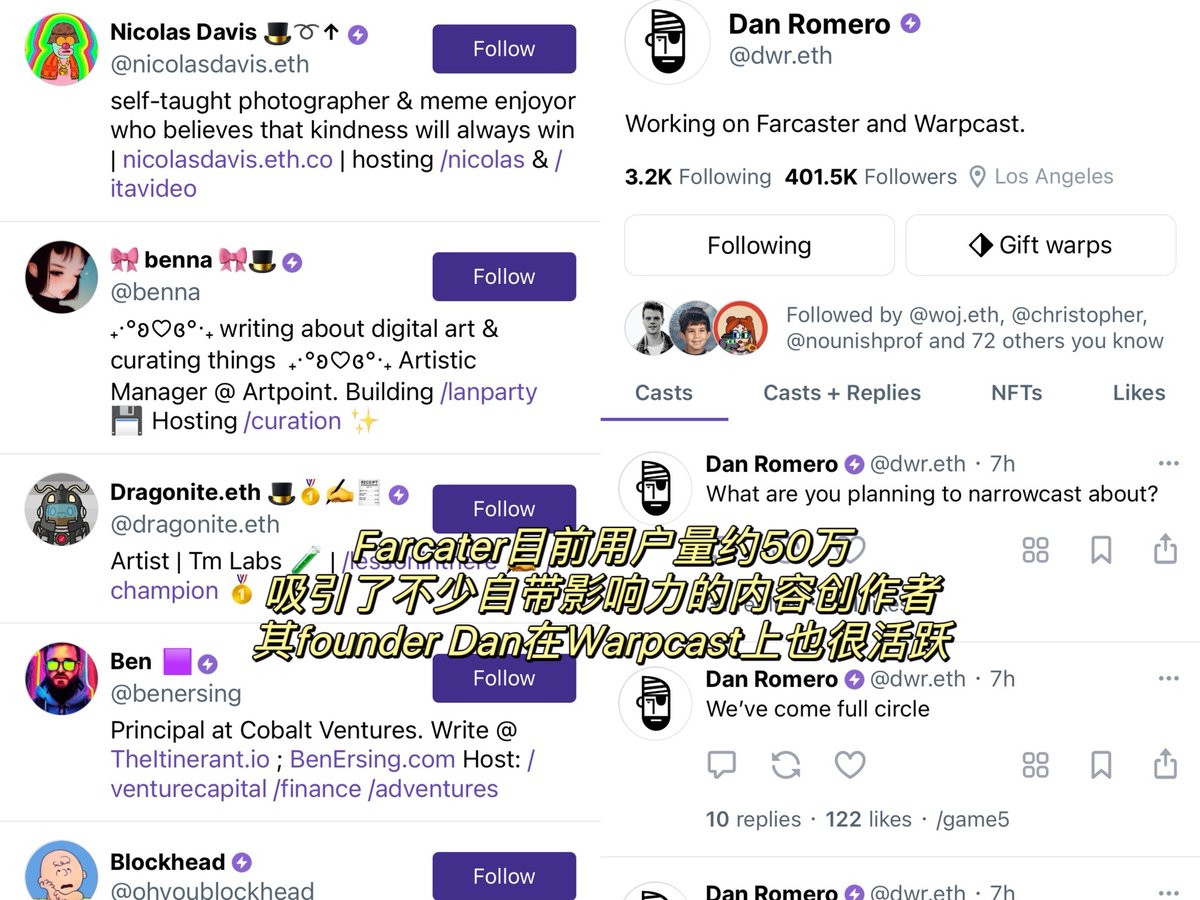
4️⃣ Content is more vertically segmented and higher in quality: users can follow specific channels such as meme, founders, fitness, etc. On average, content quality on Warpcast exceeds that of Twitter, largely due to the high caliber of early adopters.
For regular users, it's hard to sustain content creation during a platform’s early stages when there's little visibility. As a result, most OG users who joined early already had influence. I noticed many prominent figures who rarely tweet are very active on Warpcast—including Farcaster founder @dwr.
🎩 Additional Thoughts on Web3 Social
1️⃣ Most users don’t care about underlying architecture—they care whether something is useful, fun, and meets their needs. Even for foundational protocols, having a strong application layer is essential to demonstrate value to users. That’s why the Farcaster team spent over a year building their official client, Warpcast. Similarly, @TakoProtocol is building both social infrastructure and top-level apps like @Jamfrens.
2️⃣ Web3 social isn’t just about decentralization and censorship resistance. To truly meet Web3 user demands, the core must revolve around trading—such as @friendtech’s key-buying mechanism, or @interfacedapp’s focus on on-chain activity of followed accounts, allowing users to see what tokens someone bought and then swap directly within the app. Ultimately, it comes down to enabling users to earn money and create wealth. During the $DEGEN hype cycle, posting volume on Farcaster surged significantly.
3️⃣ Combining social with memecoins and DeFi will unlock even more innovative use cases. For example, on @alfafrens, you can stake on a particular user and share in their earnings. For user acquisition, initial points or airdrops could be distributed based directly on a user’s on-chain and off-chain engagement levels.
4️⃣ Channels within Farcaster clients serve as excellent tools for community building, especially when combined with incentives to drive UGC and enriched through Frame mini-apps. For instance, when $DEGEN first gained traction, users posting about $DEGEN in the Degen channel earned airdrop points; the more interactions a user received, the more they could tip others; and the more popular a post was, the more tips the author received.
5️⃣ How open will the Farcaster ecosystem ultimately become? As mentioned earlier, Farcaster as a base-layer protocol attracts developers to build on top—an approach that feels far more open and welcoming than Friend.tech. However, clients represent a part of the ecosystem with relatively high potential for capturing commercial value, and currently, the vast majority of traffic and feature innovation is concentrated within Warpcast, Farcaster’s own client. Going forward, how will Farcaster avoid monopolizing traffic and product features while actively supporting broader ecosystem diversity? I’m genuinely curious about the team’s upcoming strategy here.
🎩 Essential Data Dashboards for Exploring the Farcaster Ecosystem
Farcaster ecosystem projects: https://decaster.xyz
Farcaster overall metrics: https://farcaster.network
Dune dashboard:
https://dune.com/pixelhack/farcaster
Meme coin data: https://farcaster.in
Top users: https://fc.hot100.xyz
Join TechFlow official community to stay tuned
Telegram:https://t.me/TechFlowDaily
X (Twitter):https://x.com/TechFlowPost
X (Twitter) EN:https://x.com/BlockFlow_News
 @0xEvieYang






