








Web3 Gaming Dead? Active Projects Still Retain Over 40% of Users After 7 Days
TechFlow Selected TechFlow Selected
Web3 Gaming Dead? Active Projects Still Retain Over 40% of Users After 7 Days
Blockchain doesn't need to revolutionize gaming—just improve it.
 Navigating Web3 tides with focused insights
Author: Footprint Analytics
Compiled by: TechFlow
There has been recent debate about whether blockchain gaming is dead, with compelling arguments on both sides. Let's analyze this from a data-driven perspective.
Active Games
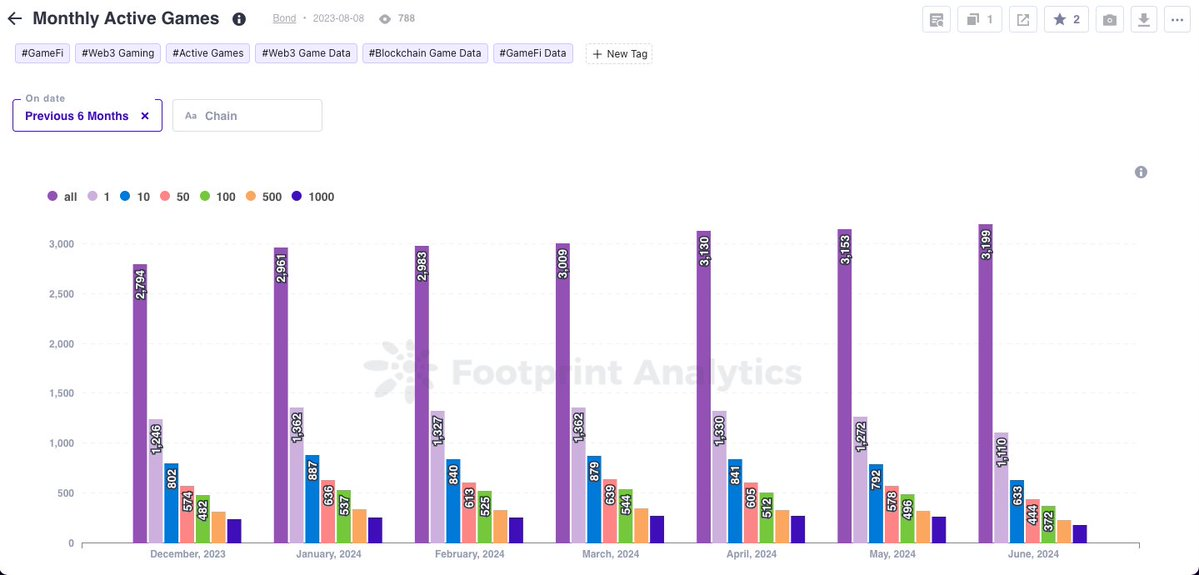
As of May, the Footprint platform tracked 3,153 games, of which 263 had monthly active users (MAU) exceeding 1,000—representing 8.2% of the total. This number drops significantly if the threshold is raised to 10,000 MAU. It’s important to note that these figures only include on-chain users. Many games allow players to participate without wallet logins while still incorporating Web3 elements. Currently, this off-chain data is difficult to obtain, potentially affecting accurate player counts.
Daily Active Users and Transaction Volume
In May, Web3 gaming saw a 9.6% increase in daily active users (DAU), reaching 3.3 million. However, transaction volume dropped sharply compared to April, decreasing by $390 million. While growing DAU is a positive sign, it should ideally be accompanied by rising transaction volume. Transaction volume serves as a key indicator of how engaging a game is—specifically, whether it motivates players to spend. When users play without contributing value, they are more inclined toward extraction rather than investment. The correlation between average playtime and transaction volume in May warrants further investigation.
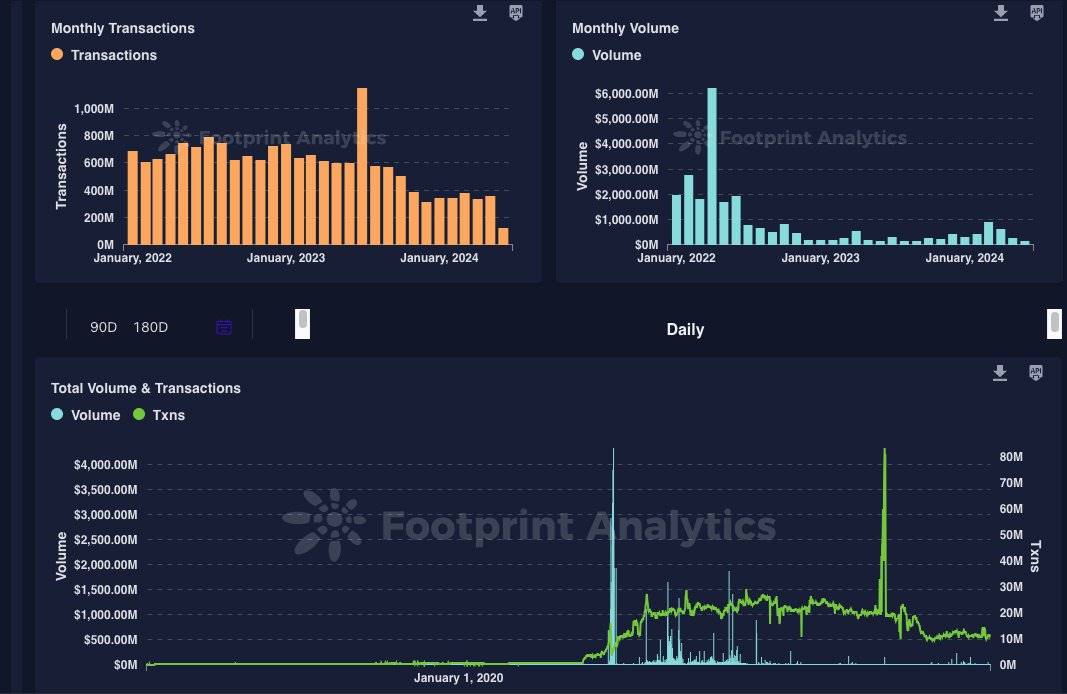
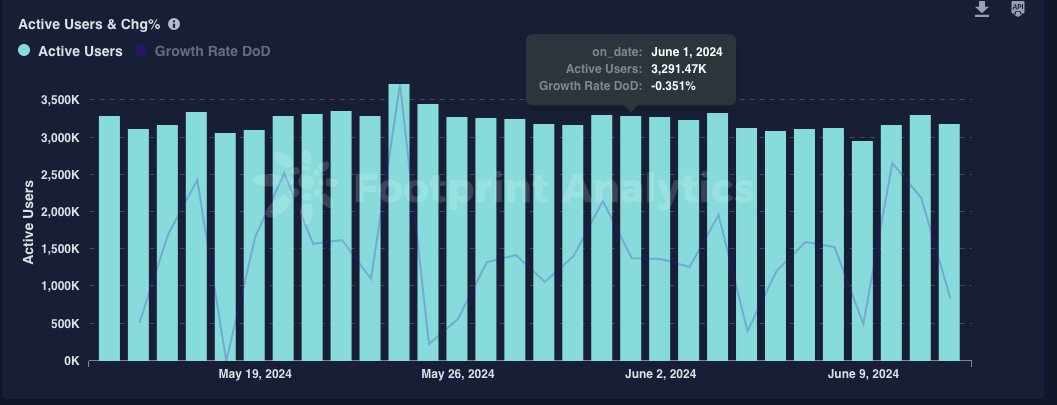
Why New User Growth Is High But Transaction Volume Remains Low
The widespread adoption of the "play-to-airdrop" model in recent games is likely the primary driver behind this trend. While effective in the short term, this approach may harm projects over time. Using incentives to boost user retention can improve metrics temporarily, but without solid gameplay fundamentals, token dumping after the airdrop ends could trigger an irreversible death spiral—similar to what happens with single-token economic models.
Retention Rates
Retention rate is one of the best indicators of how engaging a game truly is. In traditional Web2 gaming, standard benchmarks are: Day 1: 30–40%; Day 7: 20%; Day 30: 5–10%. Achieving these benchmarks is more challenging in Web3, yet some games have demonstrated exceptional Day 7 retention. Below are examples of games with over 50,000 daily active users:
-
@ApeironNFT: 86,987 DAU; Day 7 retention: 79.3%
-
@StarryNift: 73,146 DAU; Day 7 retention: 70.8%
-
@pixels_online: 900,569 DAU; Day 7 retention: 65.6%
-
@AxieInfinity: 63,385 DAU; Day 7 retention: 42.1%
-
@NineChronicles: 83,360 DAU; Day 7 retention: 40% (Note: Nine Chronicles operates on its own chain, not indexed by Footprint)
Based on the retention data above, claiming that Web3 gaming is dead is inaccurate. Without considering other metrics, one might even conclude that Web3 games outperform traditional benchmarks in terms of user retention.
Current Barriers to Adoption
-
Speculation: Hype around potential profits often overshadows the actual enjoyment of gameplay.
-
User Experience/UI: Current Web3 games suffer from lengthy registration processes, complex, unintuitive, and unattractive interfaces.
-
Time: Due to limited resources, games are often released before being fully polished. Compared to traditional standards, Web3 game development takes longer, and many promising titles have yet to launch.
Conclusion
At this stage, saying Web3 gaming is dead is both right and wrong. Games inherently have short lifespans, and this is especially evident in Web3, as shown by the contrast between active and inactive games. Web3 gaming recently hit an all-time high in daily active users—but are these the kind of users the industry truly wants? Retention rates are high for a select few games, but many lack sufficient DAU to meaningfully measure this metric. Ultimately, many of the early challenges facing Web3 gaming remain visible today, but these issues will resolve over time. Additionally, mini-games on platforms like Telegram offer strong examples of efficiently onboarding new users. Blockchain doesn’t need to revolutionize gaming—it just needs to improve it.
Web3 gaming is not dead. Web3 gaming is under construction…
Join TechFlow official community to stay tuned
Telegram:https://t.me/TechFlowDaily
X (Twitter):https://x.com/TechFlowPost
X (Twitter) EN:https://x.com/BlockFlow_News
 Footprint Analytics












