Sui Bridge is now live on testnet—participate in the incentive program to win 100,000 SUI tokens
TechFlow Selected TechFlow Selected
Sui Bridge is now live on testnet—participate in the incentive program to win 100,000 SUI tokens
As a native bridging protocol, the Sui Bridge is secured by Sui validators, ensuring a high degree of trustworthiness and reliability.
 Navigating Web3 tides with focused insights
Sui Bridge is now officially live on testnet!
As a native bridging protocol built specifically for transferring assets and data on the Sui blockchain, Sui Bridge aims to enhance interoperability between Sui and Ethereum. It enables users to securely and easily transfer ETH, wBTC, USDC, and USDT between Ethereum and Sui, serving as a critical component of Sui's infrastructure. Leveraging Sui network’s unique capabilities—high transaction speed, low costs, and decentralized architecture—Sui Bridge provides a new gateway into the Sui ecosystem.
As the Sui ecosystem grows, diverse, secure, and reliable bridging options become essential components of a healthy DeFi environment. Sui Bridge facilitates cross-chain interoperability, enabling assets and data to move seamlessly across networks. This enhances liquidity and expands the utility of digital assets, allowing users easier access to various blockchain activities such as DeFi and gaming.
Security of Sui Bridge
As a native bridge protocol, Sui Bridge is secured by Sui validators, ensuring a high degree of trust and reliability. Unlike third-party bridges that rely on external validators, Sui Bridge leverages the inherent security infrastructure of the Sui blockchain itself. This native security model means the bridge benefits from the same robust protection mechanisms that safeguard the Sui network.
Testnet Incentive Program
With the launch of Sui Bridge, we are introducing an incentive program designed to improve user experience and ensure system security and reliability. We encourage broad participation in testing Sui Bridge to help identify potential bugs and allow us to fix them promptly. Contributors who actively participate in testing will be eligible for a total reward of 100,000 SUI tokens.
To qualify for the incentive program, users must interact with the Sui Bridge Web interface on testnet and successfully complete the full two-way asset transfer process, including claiming bridged assets on both ends. This allows us to track qualifying interactions and accurately distribute rewards. Participation through methods other than the web interface—such as direct function calls—will render addresses ineligible for rewards. Please refer to the official guidelines for additional eligibility requirements.
Through this test program, we encourage participants to thoroughly explore the entire bridging workflow and welcome feedback to help us continuously optimize and deliver better service.
Before reporting an issue, users should check Sui Discord and review discussions in the sui-bridge-specific channel. To report a new issue, please use the dedicated Sui Bridge forum. Issue submissions should generally include a video demonstrating how to reproduce the problem, along with relevant transaction hashes or digests. Verified reports will be rewarded upon conclusion of the program.
Additionally, to streamline the process, we have created a comprehensive FAQ addressing common misconceptions and known issues. Participants are encouraged to consult the FAQ before submitting any reports. Moderators will assist in reviewing submitted videos to ensure accuracy and relevance. While high-quality reports are encouraged, please note that low-quality or spam submissions may negatively impact reward eligibility.
Bug Bounty Program
In conjunction with the testnet incentive program, we are expanding the Sui Bug Bounty Program to include Sui Bridge.
We invite the community to help us identify and fix potential vulnerabilities. Contributions ranging from critical issues—such as permanent loss of user funds—to medium-severity issues like bridge node crashes—are all vital to ensuring and enhancing the security and reliability of Sui Bridge. Join us in strengthening Sui Bridge’s security and user experience. Please refer to the official documentation for further eligibility criteria.
User Guide
Currently, the Sui Bridge Web interface operates on the Sui testnet and the Ethereum Sepolia testnet.
Most wallets allow users to switch between networks in the same way as the Sui Bridge Web interface—by selecting the appropriate network from a tab or dropdown menu.
Users must request testnet tokens from faucets specific to each network. Multiple faucet options are available on both Sepolia and Sui testnets. For example, Google Cloud offers an Ethereum Sepolia testnet faucet, while the Sui Wallet provides a simple one-click process to claim testnet SUI for both mobile and browser extension versions.
Additional methods for obtaining testnet SUI tokens are listed in the Sui documentation—please refer to it for more information.
The Sui Bridge on testnet supports five types of tokens:
The following steps outline how to bridge assets from Ethereum Sepolia to Sui testnet and then back to Ethereum Sepolia. Each round-trip bridge counts as a complete test case eligible for rewards.
1. Access the Sui Bridge testnet web interface.
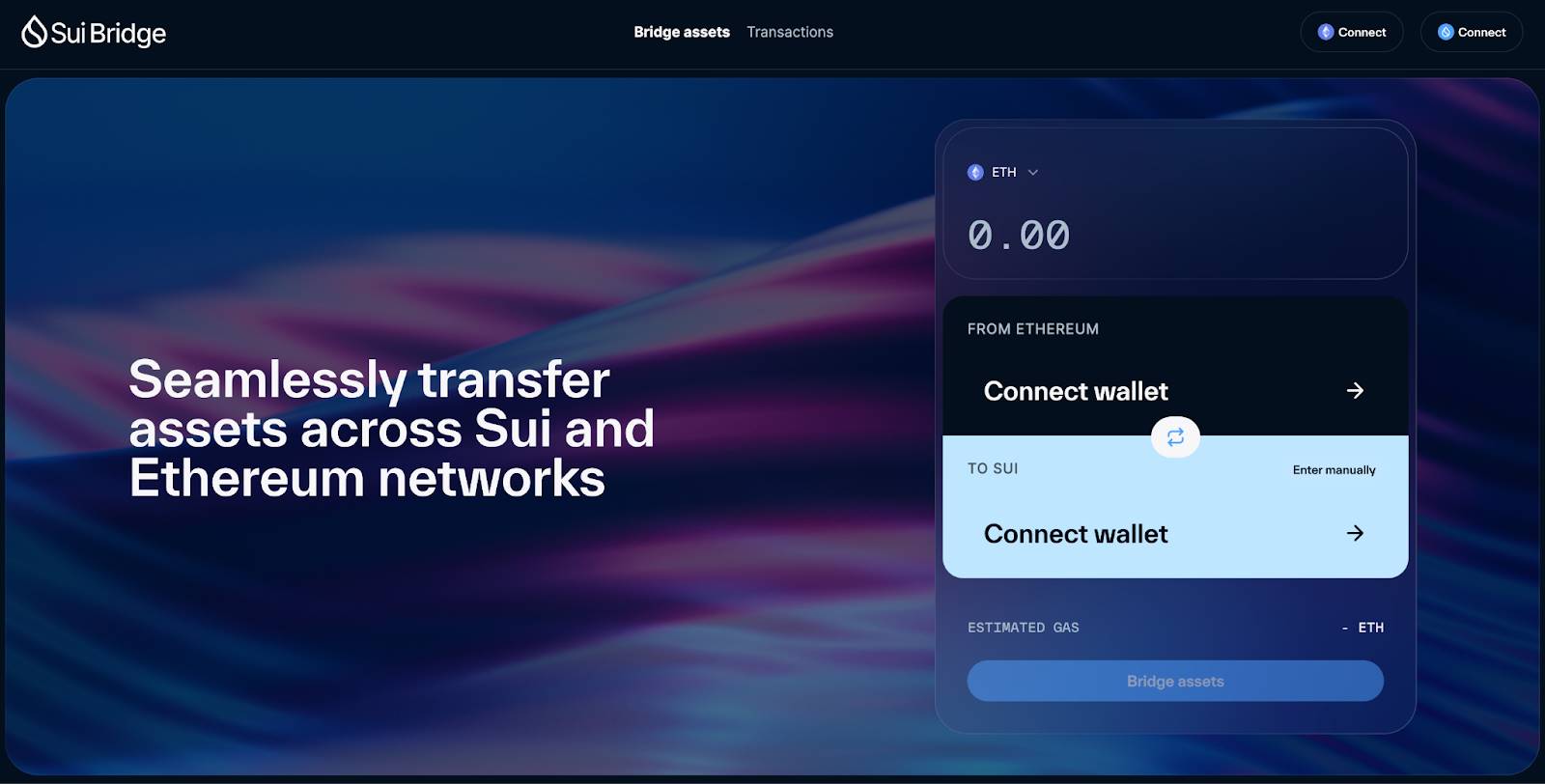
2. Connect your Ethereum and Sui wallets. For the destination chain, you may also manually enter an address by clicking "Enter manually".
3. Obtain or mint test tokens from a faucet or token contract:
-
For Native Sepolia Ethereum, use the link provided above.
-
For Wrapped ETH, go to "Contract" on Etherscan, click "Write Contract", then "Connect to Web3", and execute a "deposit" transaction to wrap native Sepolia Ethereum into WETH.
-
For WBTC, USDC, or USDT on Etherscan, go to "Contract", click "Write Contract", then "Connect to Web3", and write a mint transaction to obtain tokens.
-
Note: WBTC has 8 decimal places, so an amount of 1000000 equals 0.01 WBTC. USDC and USDT have 6 decimal places.
-
4. Now let’s test bridging tokens from Ethereum Sepolia to Sui testnet. Select a token and enter the amount to bridge, then click "Bridge assets". The interface may require approval of ERC20 token allowance.
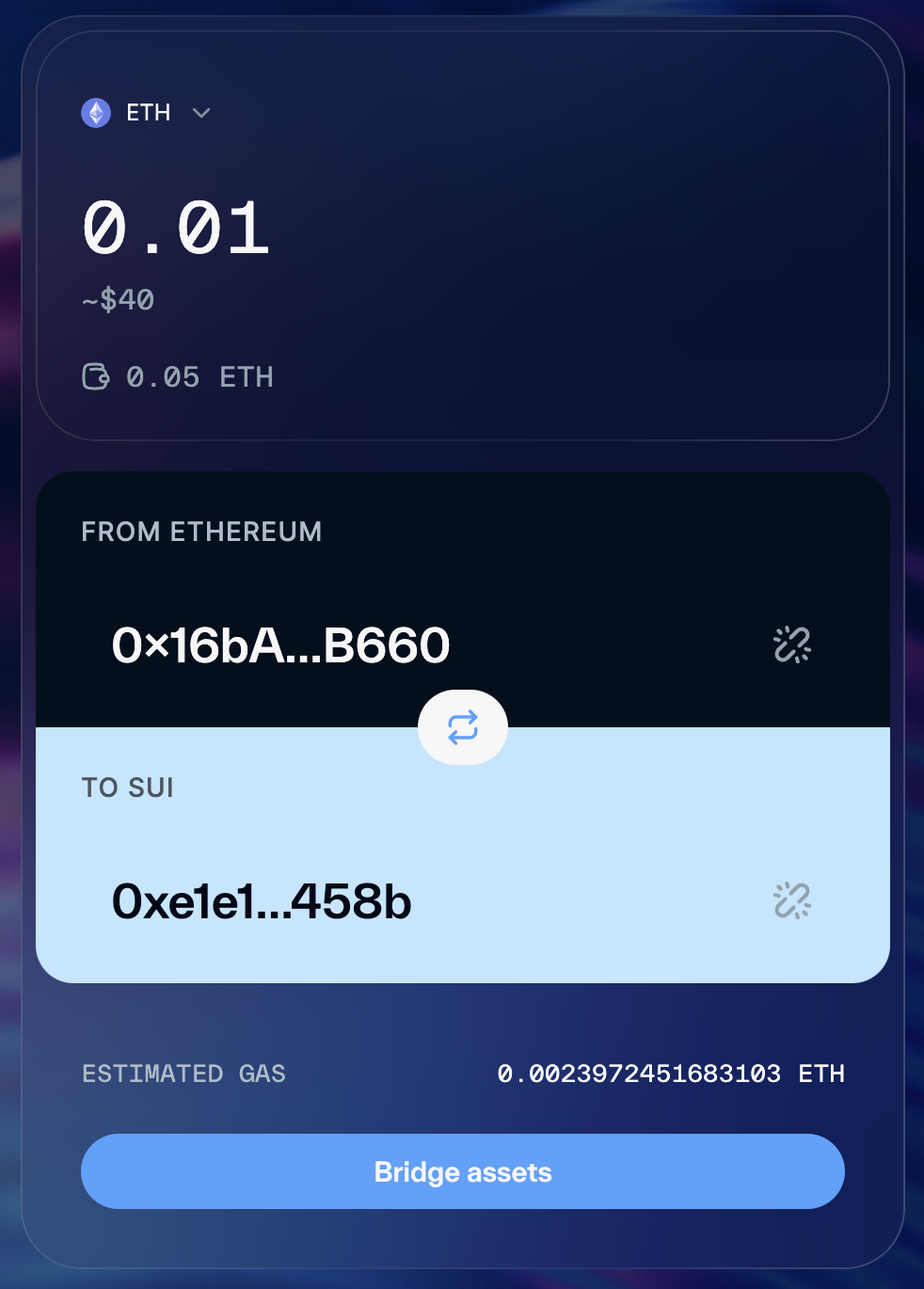
5. After approving the transaction from your wallet, you’ll return to the transaction details page to track the bridge progress. Transfers from Sepolia to Sui testnet typically take about 10 minutes to complete.
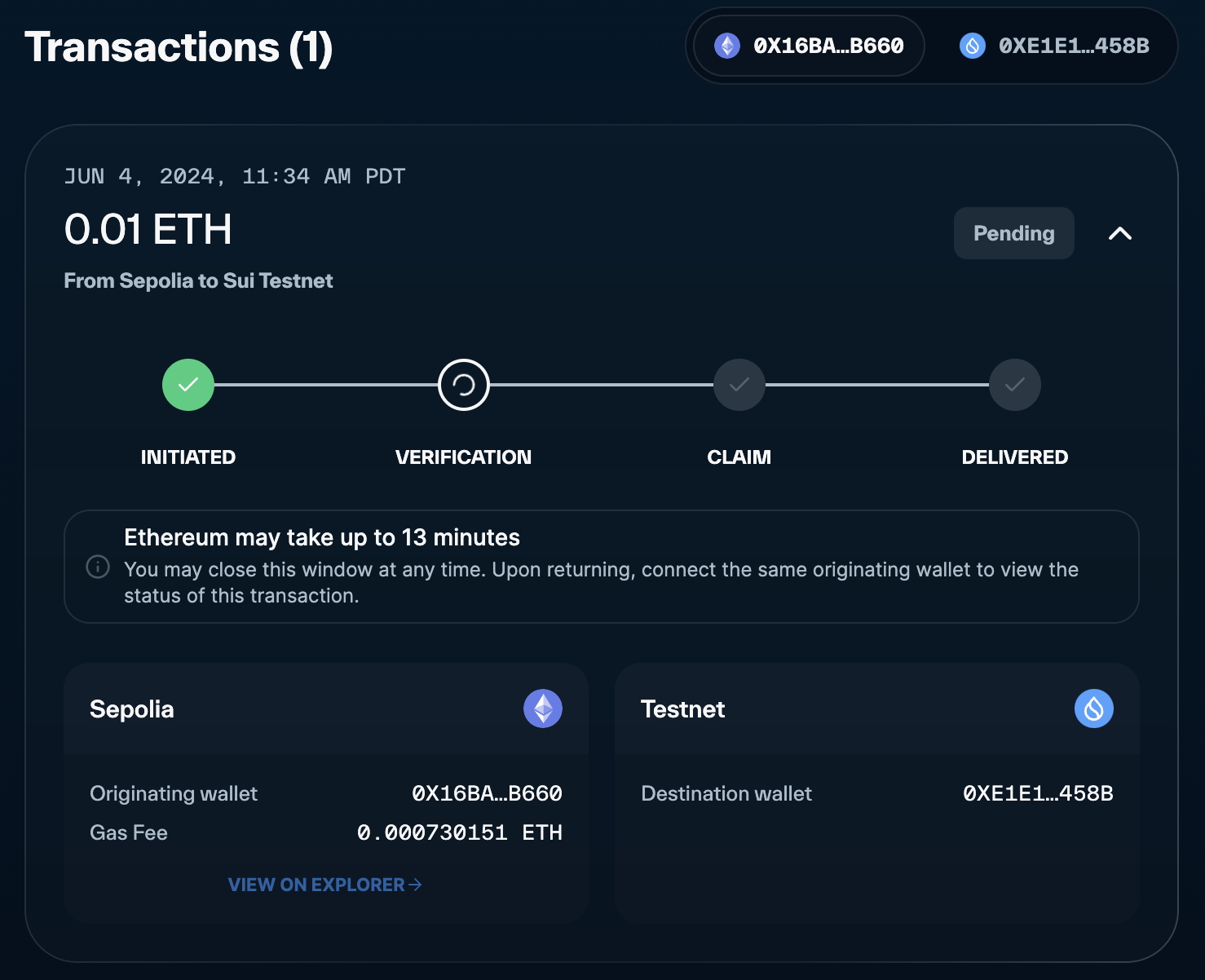
6. After finalization on Ethereum, in most cases, the bridged tokens will be automatically sent to the recipient address on Sui testnet without requiring manual claiming. In certain special cases, recipients may need to wait and manually claim via the user interface. During the incentive period, we may intentionally introduce such scenarios to test this behavior.
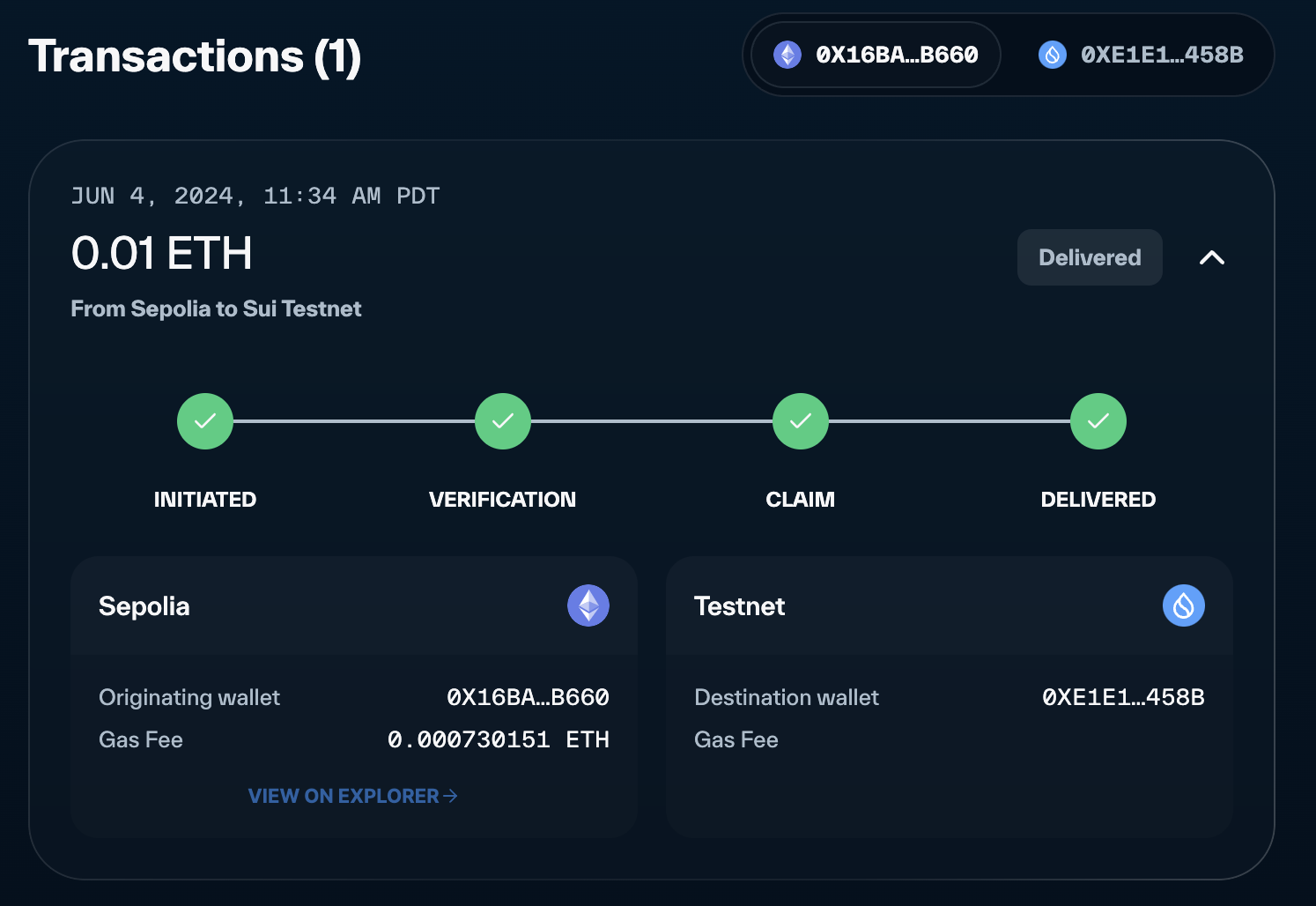
7. Now let’s test bridging back from Sui testnet to Ethereum Sepolia.
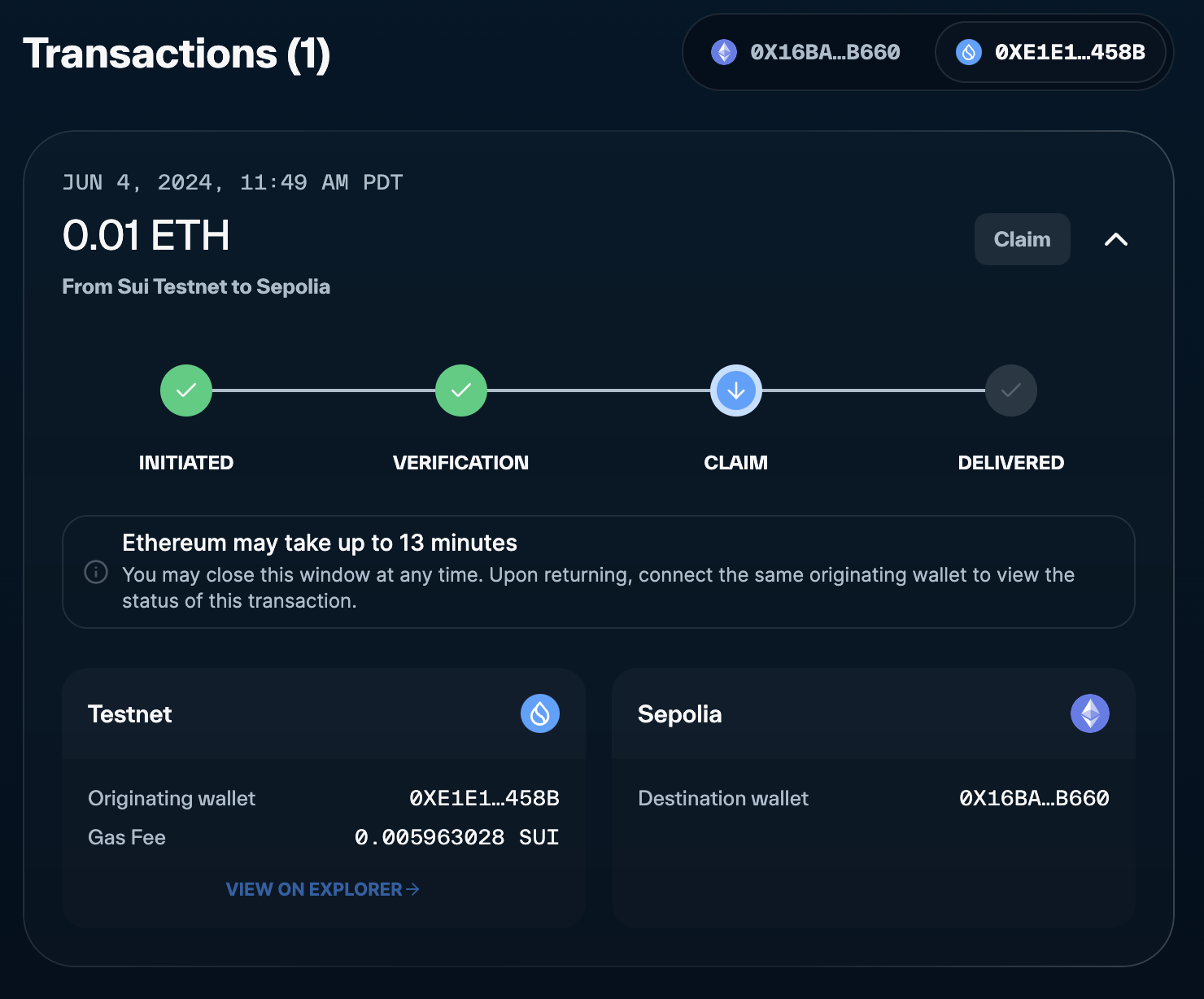
Click the toggle button in the middle of the list to reverse the transfer direction. Select the asset that just arrived at your Sui testnet address (amount doesn’t matter), initiate the bridge back, and submit the transaction. Then, users can immediately claim the asset on Ethereum Sepolia via the "Claim" button on the second transaction interface.
In certain special cases, recipients may need to wait extra time before claiming tokens. During the incentive campaign, we may deliberately increase such scenarios to test this functionality.
Get Ready, Join the Test!
By participating in the Sui Bridge testnet, users not only help us build a safer and more efficient bridge but also gain smooth transition experience ahead of the mainnet launch. We’re excited to see active community involvement and look forward to your valuable feedback.
Join us today in testing Sui Bridge and stay tuned for its upcoming mainnet release!
Note: This content is for general educational and informational purposes only and should not be construed as advice to buy, sell, or hold any asset, investment, or financial product, nor does it constitute financial, legal, or tax advice.
Join TechFlow official community to stay tuned
Telegram:https://t.me/TechFlowDaily
X (Twitter):https://x.com/TechFlowPost
X (Twitter) EN:https://x.com/BlockFlow_News
 Sui Network