Inside Hyperliquid: Points Program and Meme-Backed Derivatives DEX
TechFlow Selected TechFlow Selected
Inside Hyperliquid: Points Program and Meme-Backed Derivatives DEX
Hyperliquid's vision is to develop an open financial system on-chain.
 Navigating Web3 tides with focused insights
Author: SWASTIK GARG
Translation: TechFlow
In today's reading, we will dive deep into Hyperliquid, covering the following topics:
-
The state of perpetual exchanges
-
The Hyperliquid chain
-
Hyperliquid Improvement Proposals (HIPs)
-
Overview of the points program
-
$PURR - Memecoin
-
Analysis of success factors
-
Data statistics
Perpetual contract trading has always been a highly successful product in the crypto market. Centralized exchanges process around $150 billion in daily volume, highlighting widespread adoption of perpetuals. In the decentralized perpetual market, according to Defillama, daily volume is approximately $7–8 billion, representing about 5% of centralized exchange volume.
Recently, especially this year, we've observed higher trading volumes compared to previous cycles. In the on-chain world, this began with dYdX during DeFi Summer, followed by Perpetual Protocol and GMX in 2022. Initially, many believed that decentralized exchanges (DEXs) had fully matured, but starting mid-2023, a shift occurred—new perpetual DEXs have taken leading positions among the top five. Among them, Hyperliquid contributes over 10% of on-chain perpetual daily trading volume.
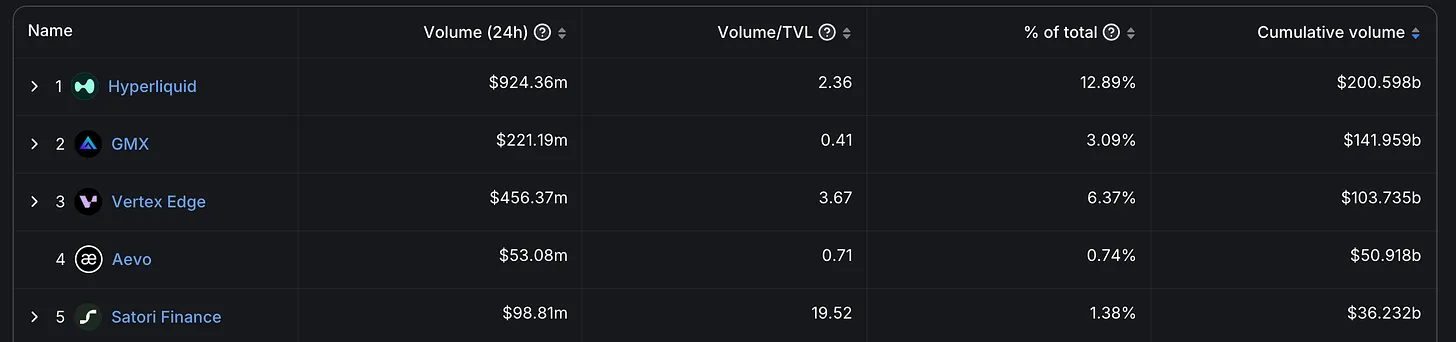
Decentralized Perpetual Exchanges (Perpetual DEXs) support perpetual swaps, a type of derivative. A perpetual swap is a crypto-native concept derived from traditional futures contracts, with several modifications. Essentially, it allows users to speculate on asset prices without holding the underlying equity.
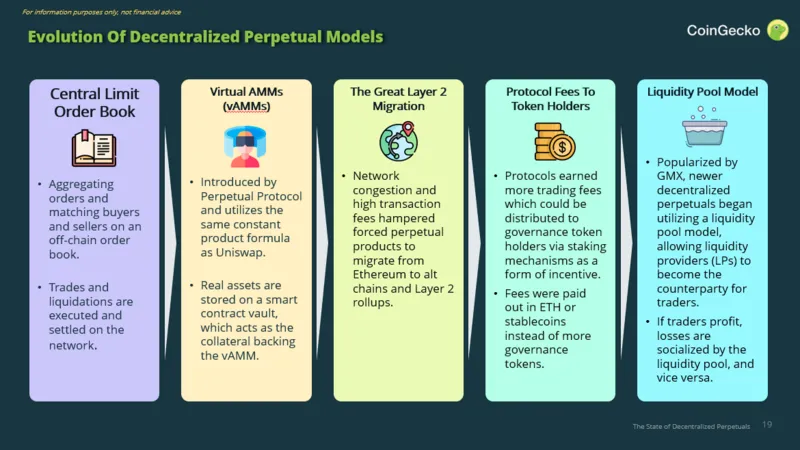
As shown in the chart above, the perpetual space has evolved significantly. This cycle, the app-chain theory has gained more attention.
Current Landscape of Decentralized Perpetual Exchanges
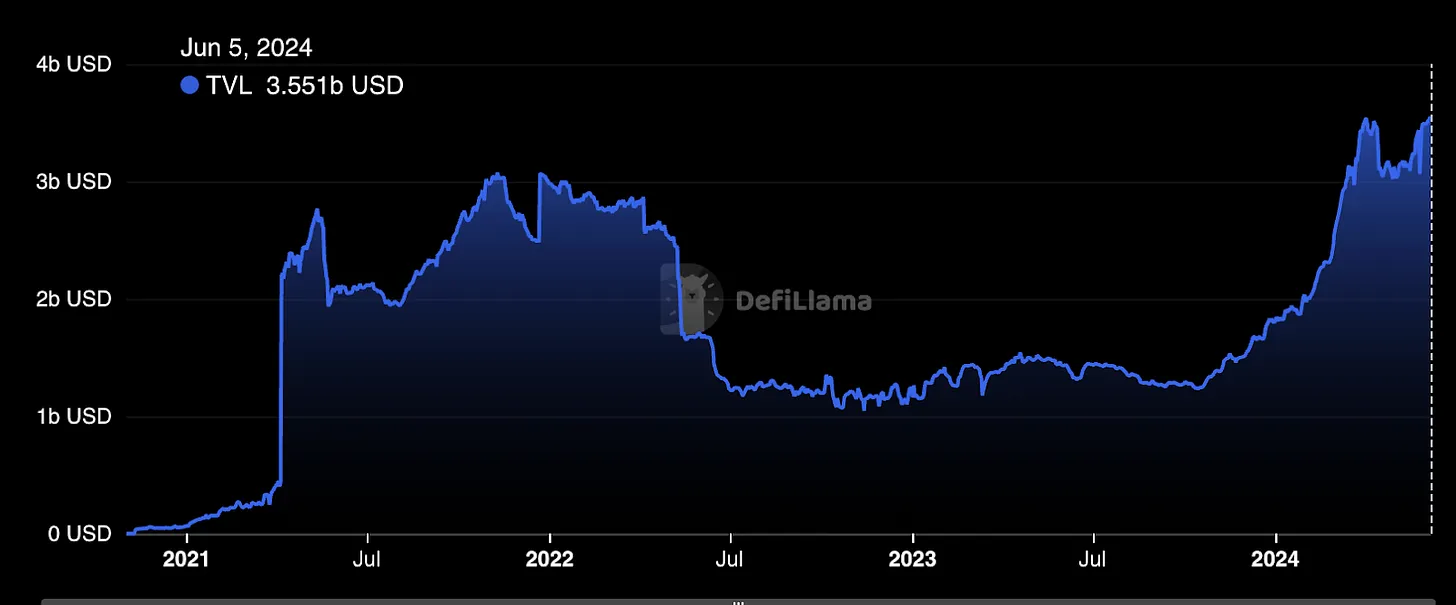
As of June 5, 2024, the Perp DEX category has a total TVL of $3.5 billion. This chart helps us understand interest in trading perpetuals over time. It also closely reflects the crypto cycle—we can observe that from mid-2021 to mid-2022, TVL hovered around $3 billion. It declined in 2023, reflecting the bear market phase, and started recovering in 2024, surpassing the previous cycle’s peak.
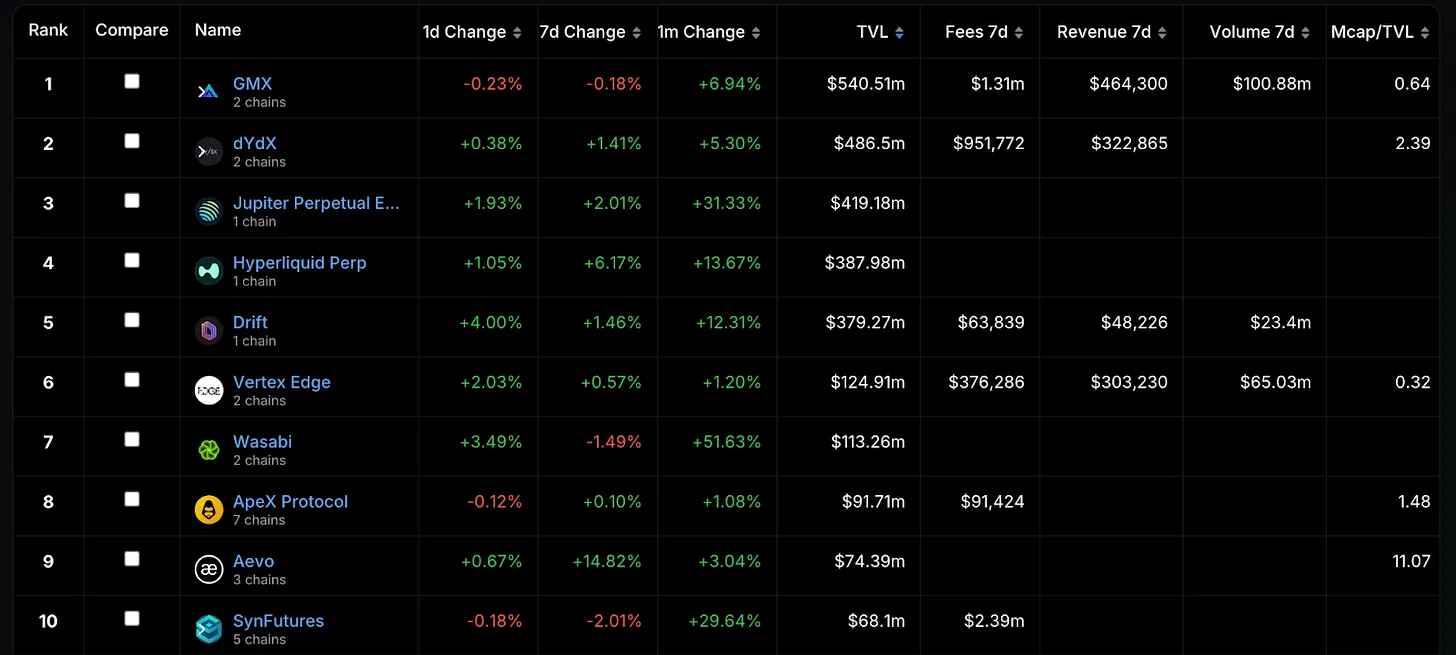
Looking at the top 10 perpetual exchanges by TVL, we see that GMX and dYdX have similar TVLs, each close to $500 million. Following them are Jupiter, Hyperliquid, and Drift, each with around $400 million. These top five dominate the market share, with a noticeable drop—about one-third—after Drift.
Deep Dive into Hyperliquid
The Hyperliquid team explored various trading mechanism models, including market makers (MM), request-for-quote (RFQ), and oracle-based systems. Their analysis concluded that an order book is the optimal long-term solution at scale. The second question concerned which blockchain to use for the application. After evaluating existing environments like Solana and Arbitrum, they concluded that building a new chain from scratch was necessary to address these challenges.
The Hyperliquid Chain
Hyperliquid's vision is to develop an open financial system on-chain. At the core of this ecosystem is Hyperliquid L1. Every interaction—orders, cancellations, liquidations—is executed on-chain.
The core principle of Hyperliquid is achieving true decentralization. It uses Tendermint’s Byzantine Fault Tolerant (BFT) consensus to ensure consistent transaction ordering as long as two-thirds (weighted by staked/delegated tokens) of validators remain honest. It supports up to 20,000 operations per second.
Hyperliquid’s architecture is built from the ground up for full-stack optimization, independent of the Cosmos SDK. The core state transition logic of L1 is written in Rust and connected to Tendermint via an ABCI server. The network is secured through a Proof-of-Stake (PoS) mechanism. Staking and slashing functions resemble those of Cosmos, with further details to be released after the native token launch.
Hyperliquid plans to adopt HyperBFT, a new consensus algorithm that will replace Tendermint. Currently, HyperBFT implementation is in the final testing phase.
Key improvements brought by HyperBFT:
-
Currently, Tendermint supports up to 20,000 orders per second. With HyperBFT, throughput is expected to increase 100-fold—practically reaching around 200,000 orders per second.
-
Unlike Ethereum and current Tendermint, HyperBFT can continue ordering transactions without waiting for the execution of the current block hash.
-
Block generation speed depends on validator communication speed to reach quorum, improving and stabilizing confirmation latency.
Native EVM Support
Hyperliquid L1 will offer native EVM support integrated with native L1 components such as HIP-1 assets, spot trading, perpetual contracts, and other DeFi primitives. The team views this as a strategic approach to effectively scale L1. This integration benefits builders who wish to develop on EVM, allowing them to deploy smart contracts using familiar EVM tools.
HIP-1 assets will enable atomic transfers with their corresponding ERC-20 contracts, showcasing composability on L1. This feature makes Hyperliquid L1 an ideal platform for developing, launching, and trading tokens.
Bridging to Hyperliquid L1
HyperLiquid onboards via Arbitrum. HyperLiquid operates a native bridge secured by the same validator set as HyperLiquid L1. Deposits are confirmed upon L1 validator signatures, while withdrawals are escrowed on L1 and individually signed by validators as separate L1 transactions. Both deposits and withdrawals require approval from two-thirds of the staked weight to settle. During withdrawals, users do not pay gas fees on Arbitrum. Instead, HyperLiquid charges a fixed fee of 1 USDC.
In case of malicious withdrawals mismatching L1 state, a dispute period is triggered, during which the bridge can be locked. Unlocking requires cold wallet signatures from two-thirds of the weighted validator set. The bridge and its integration with L1 staking mechanisms have been audited by Zellic.
Perpetual Exchange
Hyperliquid perpetuals are derivatives with no expiration date. Their price is regulated by a funding rate mechanism to closely track the underlying asset price. Funding rates are recalculated every eight hours and paid hourly at one-eighth of the rate, capped at 4% per hour.
Hyperliquid offers a single margin option for these contracts: USDC margin with USDT-denominated linear contracts. This means contracts are priced in USDT while collateral is held in USDC. This setup enhances trading convenience and liquidity by eliminating currency conversion, effectively treating these contracts as quanto contracts where P&L in USDT is settled in USDC.
Exchange Components
Order Book
Hyperliquid’s order book is on-chain, with orders placed in multiples of tick size and lot size. Orders follow a price-time priority system. Available order types include market orders, limit orders, stop-market orders, and stop-limit orders.
Margin
Traders on Hyperliquid have two margin options: cross-margin and isolated margin. Cross-margin is the default setting, allowing collateral to be shared across all positions to maximize capital efficiency. Isolated margin restricts collateral to specific assets, protecting other positions from being affected by their liquidation.
Oracles
Validators play a crucial role in maintaining market integrity. Hyperliquid oracles publish prices for each perpetual asset every three seconds, used to determine funding rates. Each validator calculates the spot oracle price by taking a weighted median price across multiple exchanges—Binance, OKX, Bybit, Kraken, Kucoin, Gate IO, and MEXC—with weights of 3, 2, 2, 1, 1, 1, and 1 respectively.
The final oracle price used for liquidations is the weighted median of prices submitted by each validator, with contributions weighted by their staked amount.
Liquidator Treasury
The Liquidator Treasury plays a vital role in Hyperliquid’s liquidation process. It liquidates positions below maintenance margin and controls their collateral and associated positions.
Insurance Fund
As the name suggests, the insurance fund acts as a safety net. It compensates users for losses in the event of any platform failure. It is funded by collecting a portion of trading fees—a practice also adopted by centralized exchanges.
Fees
On Hyperliquid, all fees are distributed back to the community, including HLP and the insurance fund. Referrers earn 10% of the trading fees generated by users they refer.
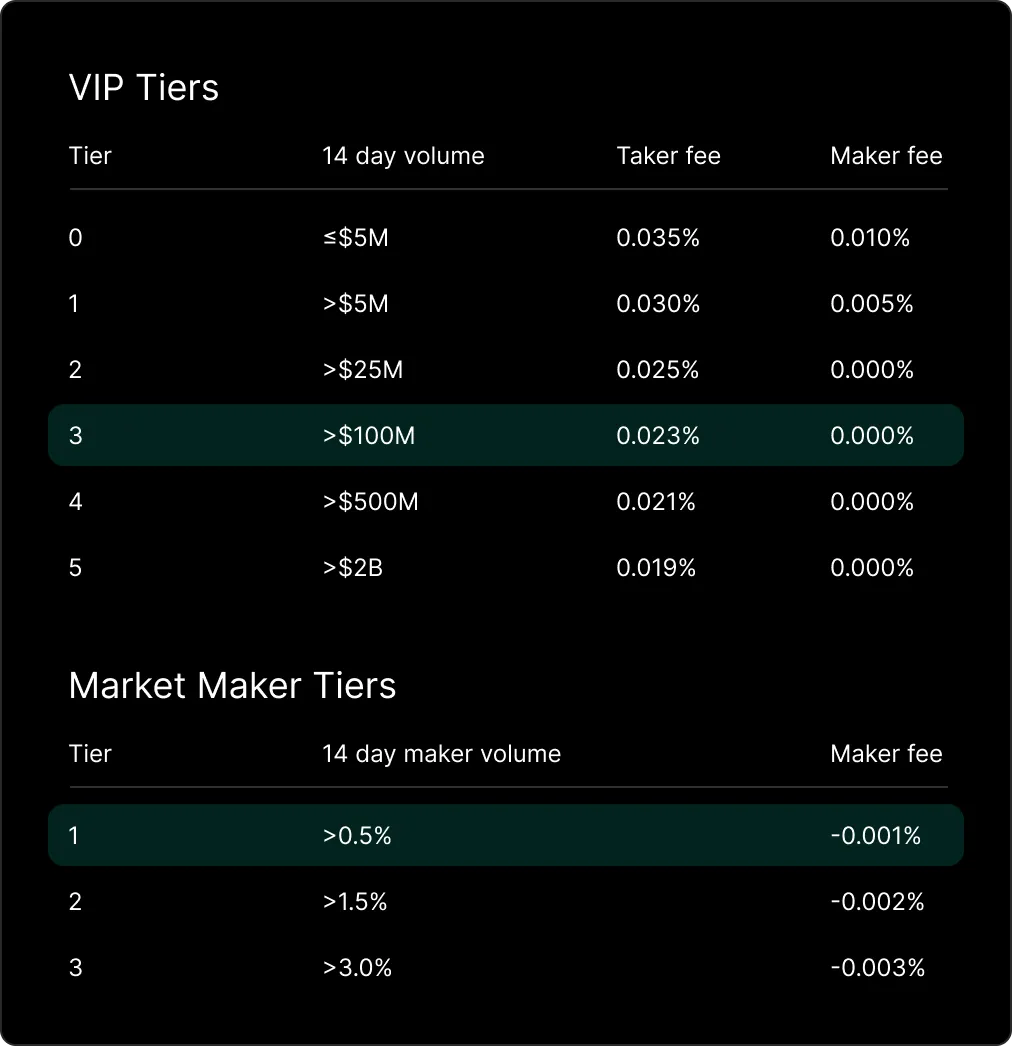
This image clearly helps explain the fee structure
Sub-Products
Index Perpetual Contracts
These contracts offer a new approach by tracking formula-derived indices. They function similarly to traditional perpetuals. Users can speculate on a basket of assets through these contracts. Two contracts are available for trading: NFTI and FRIEND.
-
NFTI-USD
It represents an index of top NFT collections such as Bored Ape Yacht Club, Mutant Ape Yacht Club, Azuki, DeGods, Pudgy Penguins, and Milady Maker. The index is a 3-minute EMA of total floor price—the sum of each collection’s floor price, with BAYC divided by 10. Floor prices are calculated by aggregating data from OpenSea and Blur.
-
FRIEND-USD
FRIEND-USD was the first index perpetual listed on Hyperliquid, based on the social app Friendtech. Friendtech tokenizes user influence into Keys that can be traded. Its core audience is Crypto Twitter (CT), where prominent CT figures create profiles and trade Keys among each other. The index rebalances every two weeks, including the top 20 profiles on Friend.tech. Selection criteria include price, at least 5,000 Twitter followers, and filtering out outliers in trading activity and holder count. FRIEND has recently been delisted.
Uniswap Perpetuals
These perpetuals use Uniswap V2 or V3 AMM prices as the underlying spot asset. These contracts are limited to isolated margin—cross-margin is not allowed. Uniswap pool prices are always converted to USDT prices based on CEX oracle prices, covering tokens like RLB, Unibot, etc.
Introduction to Hyperps
Hyperps trade like perpetuals but do not require an underlying spot or index oracle price. Hyperps are pre-launch tokens designed to help discover the price of upcoming tokens. This model has been widely used this cycle, initially pioneered by Binance.
Hyperps operate similarly to regular perpetuals, except the external spot/index oracle price is replaced by an 8-hour exponentially weighted moving average of the minute mark price from the previous day. When the pre-launch token officially launches spot trading on centralized exchanges like Binance and Bybit, the Hyperp converts into a normal USD perpetual contract.
Hyperliquid’s Market Making Model - HLP
The Hyperliquid team recognized the challenge of bootstrapping liquidity in early stages and believed the best solution was to open market making to users. Previously, the team handled market making during its closed alpha phase.
They introduced the Hyperliquidity Provider (HLP) vault, central to Hyperliquid’s market-making strategy. It allows anyone to contribute liquidity and share profits and losses. Importantly, HLP is fee-free, with P&L distributed proportionally based on each contributor’s share in the vault. Professional market makers can also participate via its SDK.
The market-making strategy used by Hyperliquidity Providers (HLPs) involves calculating fair prices based on tick data from both Hyperliquid and major centralized exchanges. This fair price guides the vault’s actions—including market-making and take-market strategies—to provide continuous and profitable liquidity across all listed assets. Strategies are executed off-chain, but anyone can track positions, order placement, trade history, deposits, and withdrawals in real time via a browser.
Hyperliquid Improvement Proposals - HIP
Improvement proposals are standard mechanisms for specifying new features or changes. It’s common practice for any community member to submit proposals and share ideas on how to improve the product. At Hyperliquid, these are called HIPs. Currently, since Hyperliquid is not community-owned but operated by the team, participation is limited. However, as operations become more democratized, anyone will be able to participate.
HIP-1: Native Token Standard
HIP-1 is a finite-supply fungible token standard supporting on-chain spot order books between HIP-1 tokens. A globally unique hash generated by the deployment transaction indexes each token on L1. Gas fees currently paid in USDC will eventually be paid in Hyperliquid’s native token. Native spot fees follow a volume-based fee schedule similar to perpetuals.
$PURR is the first HIP-1 token, serving as Hyperliquid’s native memecoin. HIP-1 is now gaining adoption, with over 10 tokens deployed so far. These tokens see around $17 million in daily trading volume and approximately 93,000 trades. Most are memecoins.
HIP-2: Hyperliquidity
One of Hyperliquid’s core design principles is that liquidity should be democratized. For HIP-1 tokens in their early price discovery phase, a new model became important for bootstrapping liquidity. Inspired by Uniswap, Hyperliquidity interoperates with the native on-chain order book to support liquidity. HIP-2 includes a fully decentralized on-chain strategy integrated into Hyperliquid L1’s block transition logic. The strategy logic is protected by the same consensus that governs the order book.

The final strategy maintains a 0.3% spread every three seconds. A significant improvement is that Hyperliquidity is part of the universal order book. This allows active liquidity providers to join anytime and contribute liquidity, enabling the market to adapt to growing liquidity demands.
Points Program Overview
-
Program Start: The Hyperliquid points program began on November 1, 2023.
-
Duration: Six months, ending on May 1, 2024.
-
Weekly Distribution: One million points distributed weekly to active Hyperliquid users.
-
Initial Snapshot: Special snapshot of closed alpha users on October 31, 2023.
-
Phase 1 Points Distribution: Initial snapshot points were distributed on April 15, 2024.
-
Phase 2 Start: Called “L1 Season,” began on May 29, lasting four weeks.
-
Phase 2 Distribution: 700,000 points distributed weekly.
-
Activity Multiplier: Activities from May 1 to May 28 received multiplier benefits.
-
First Phase 2 Snapshot: Covers activity from May 29 to June 4.
-
Additional Points: 2 million points were distributed for activity between May 1 and May 28, due to the new phase starting one month after the first ended.
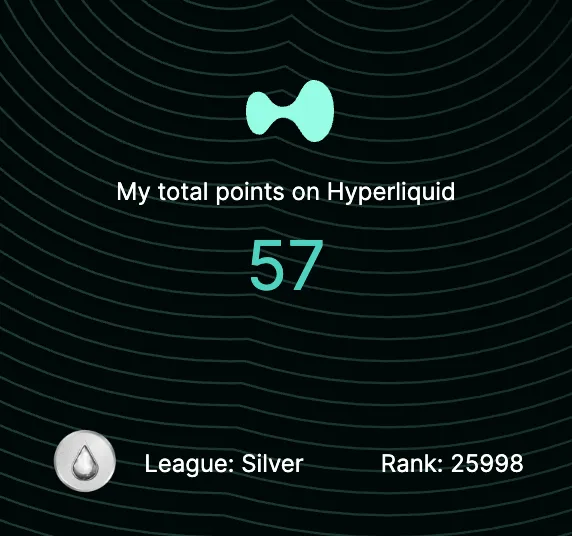
It also features an affiliate program where affiliates benefit by earning one point for every four points generated by referred users. Point allocation criteria are reviewed regularly, with distributions based on weekly recorded activity, finalized every Wednesday and distributed every Thursday.
Memecoin Airdrop - $PURR
PURR is the first spot token on Hyperliquid’s native token standard (HIP-1). Hyperliquid took an interesting approach by airdropping its native memecoin to users. It launched on April 16. There was no token sale, nor any planned utility.
A total of 1 billion $PURR tokens exist. 50% of $PURR tokens were proportionally airdropped to points holders. The remaining 50% were permanently allocated as Hyperliquidity for the PURR/USDC pair. Community feedback suggested 50% was excessive, so the team decided to burn 40% of the total supply originally allocated to HIP2.
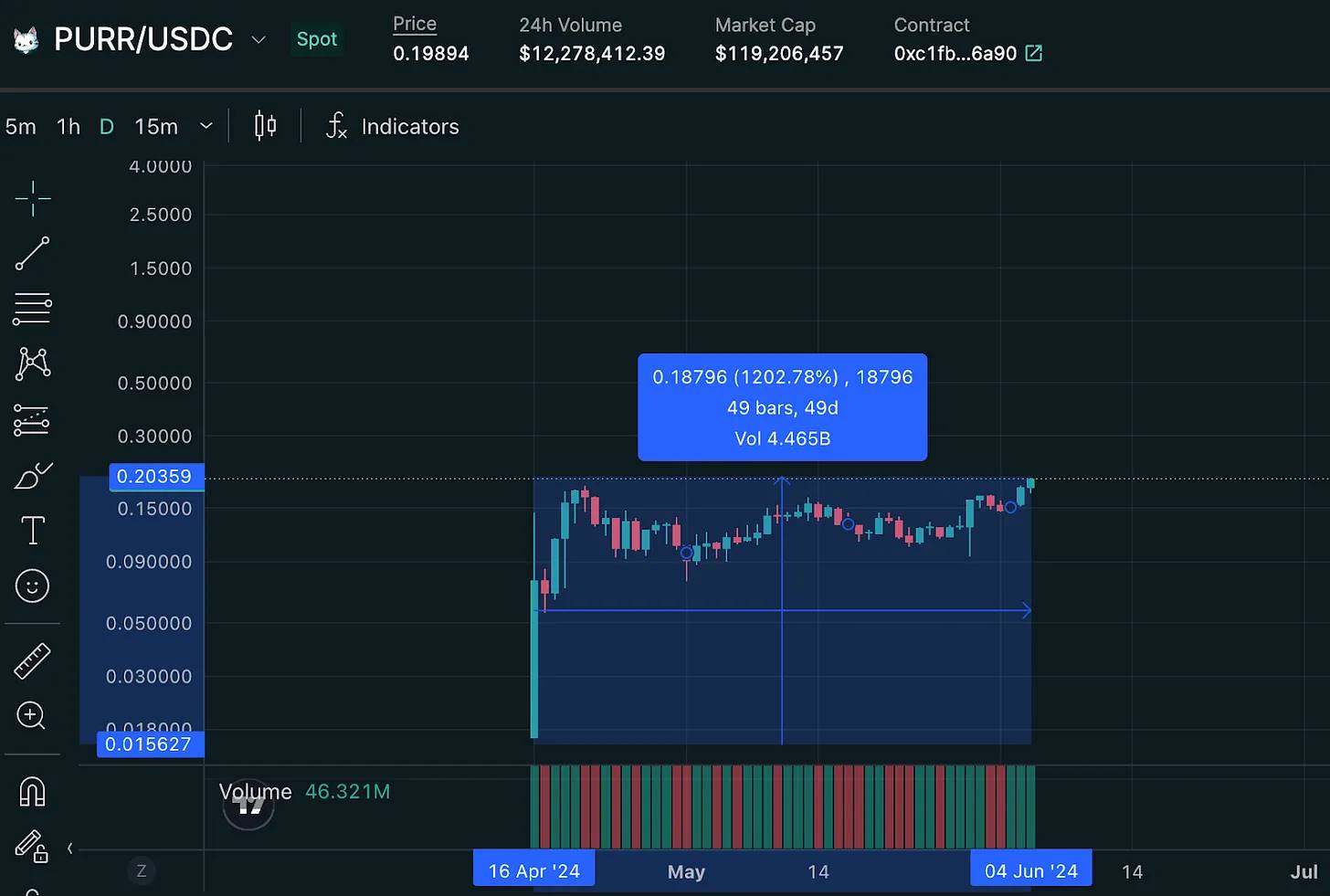
PURR achieved massive success. Typically, memecoin outcomes are predictable, but PURR’s chart tells a different story—it was “only up.” As Hyperliquid delayed its native token launch, PURR has now become a way to bet on Hyperliquid, as reflected in its chart.
What factors contributed to Hyperliquid’s growth? Clearly, Hyperliquid did many things right to achieve its current status.
Integrations
Rage Trade
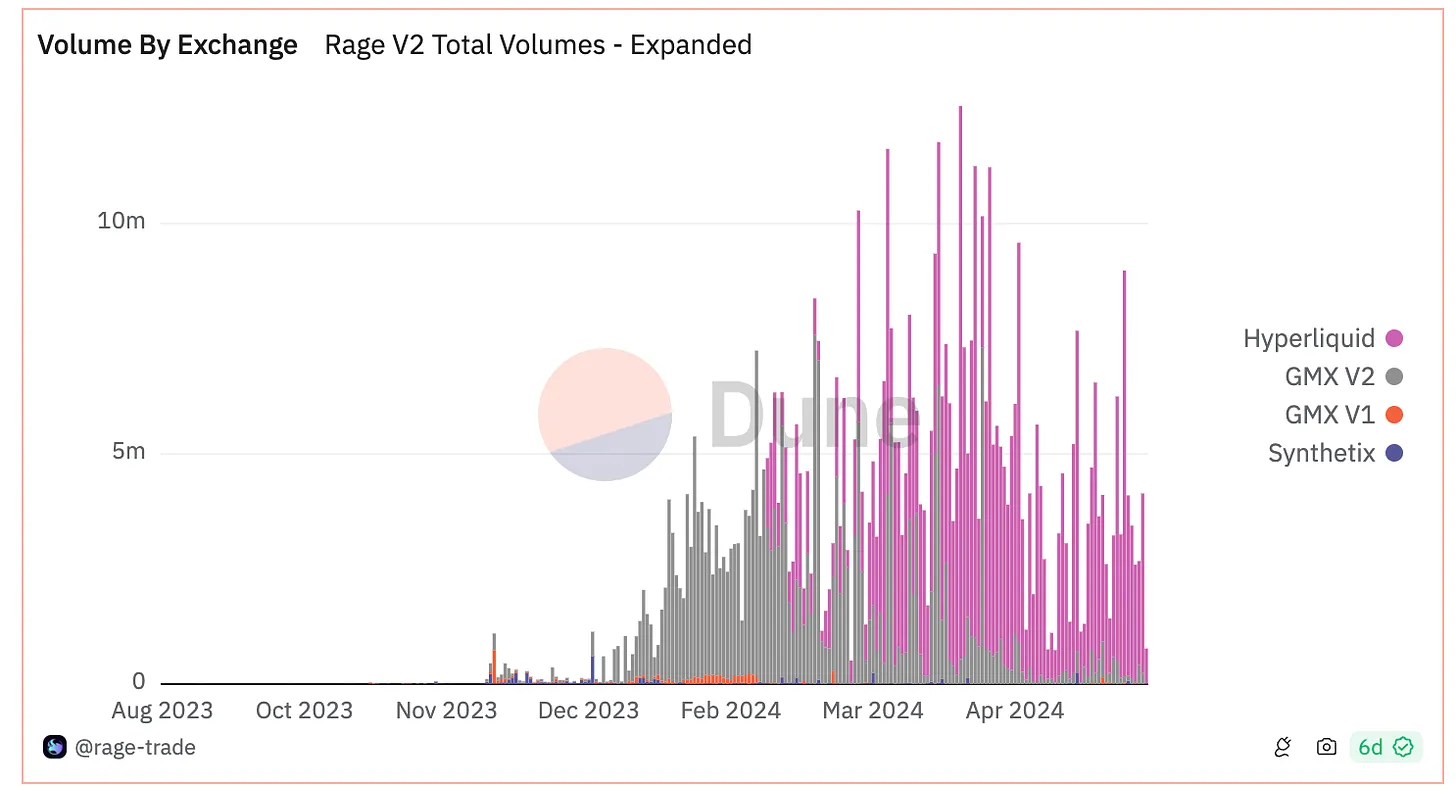
Rage Trade is an aggregator of on-chain perpetual exchanges. Hyperliquid integrated with Rage Trade on February 15 this year. Rage Trade’s total volume is approximately $641 million, with about 57.5% coming solely from Hyperliquid. While Rage Trade has also integrated other perpetual exchanges like GMX and Synthetix, Hyperliquid’s volume alone exceeds theirs, totaling around $370 million to date.
Octo
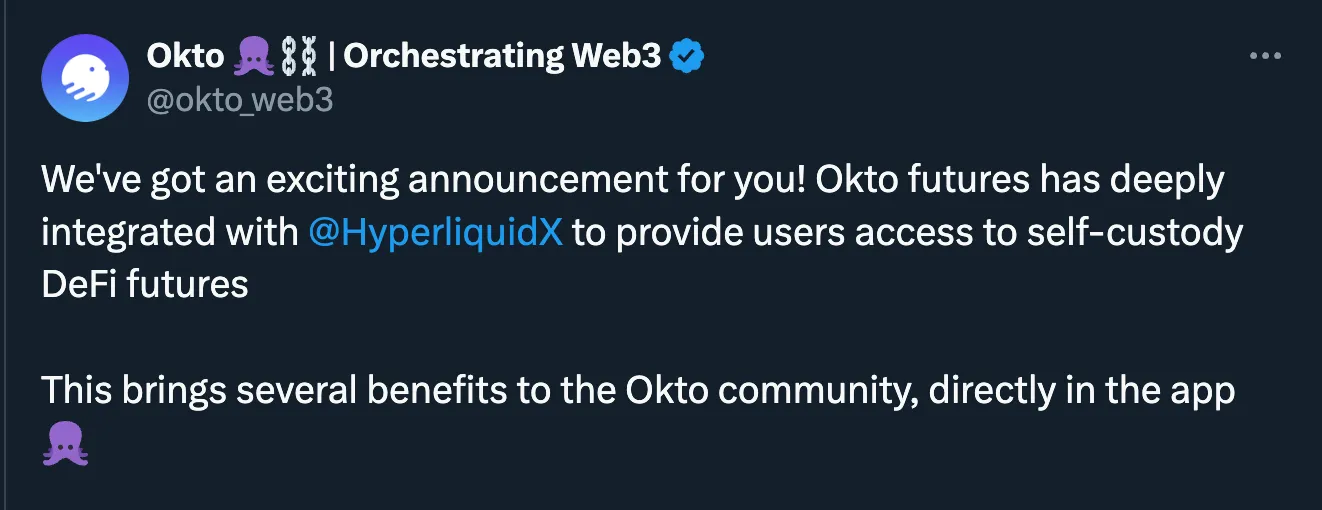
Octo, similar to a super wallet, has integrated Hyperliquid into its mobile app. Octo is a product of CoinDCX, an Indian centralized exchange. While there’s no data showing its volume contribution, such marketing efforts through integrations provide visibility and add value to Hyperliquid.
Hyperliquid Market Making
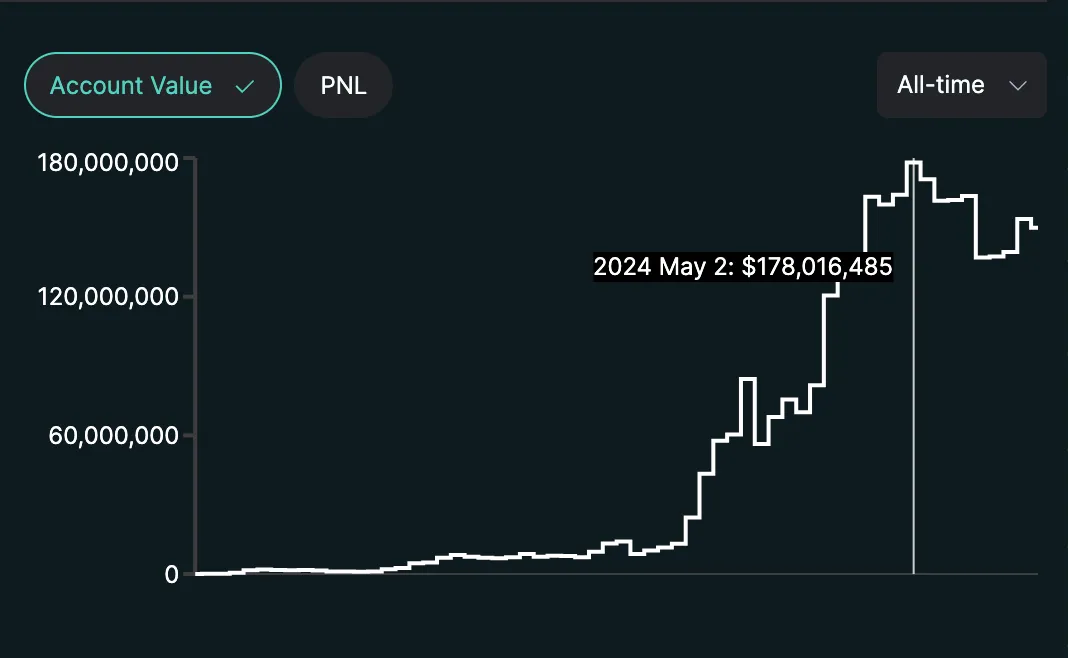
The Hyperliquid vault is a key factor driving Hyperliquid’s adoption. Initially offering users a chance to participate in profits created a very positive impression. Additionally, the platform allows professional and individual market makers to participate and execute their own strategies, helping bootstrap liquidity. This, in turn, attracted more traders, creating a virtuous cycle. The vault’s peak total deposit reached $178 million, currently around $150 million.
Targeting Centralized Exchange Traders
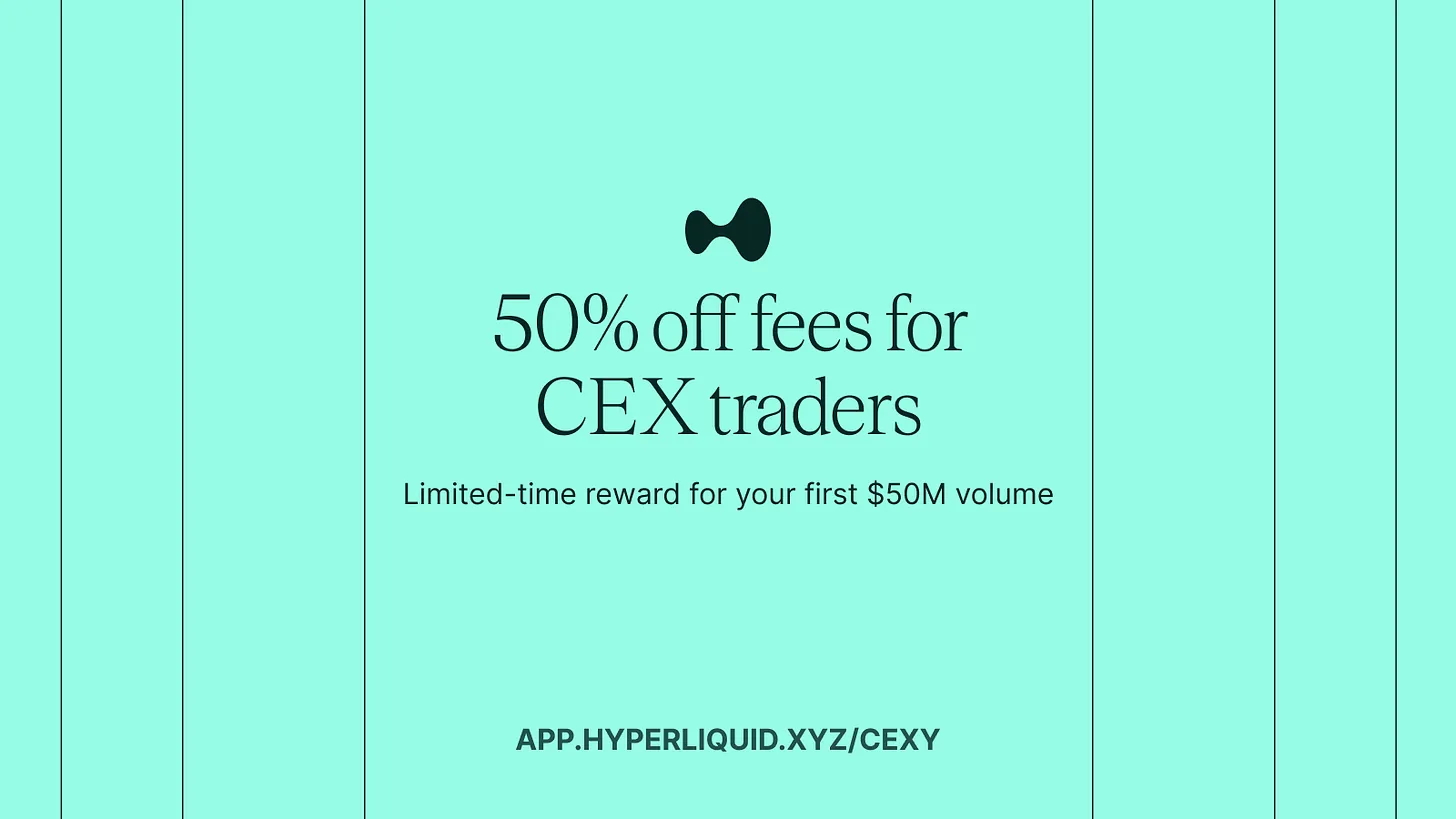
Most crypto derivatives volume comes from centralized exchanges. To attract these users to Hyperliquid, the team offered a 50% discount up to $50 million. These marketing efforts are noteworthy.
Finally, the Hyperliquid product itself.
-
Onboarding to Hyperliquid: Onboarding is seamless, thanks to Privy. Privy is an embedded wallet provider supporting sign-up via social login and standard wallets—an important breakthrough.
-
Bridging Choice: Hyperliquid chose Arbitrum as its bridge, where most major DeFi activity occurs.
-
Deposits: Hyperliquid accepts USDC as collateral. Through Lifi integration via its in-app widget, converting any other stablecoin to USDC is extremely easy for users.
-
Bridging Speed: Bringing funds into Hyperliquid is fast. While there are no official statistics on processing time, the process feels instantaneous.
-
User Experience: Hyperliquid offers a gas-free experience with a user interface resembling centralized exchanges, delivering added value to users.
Statistics
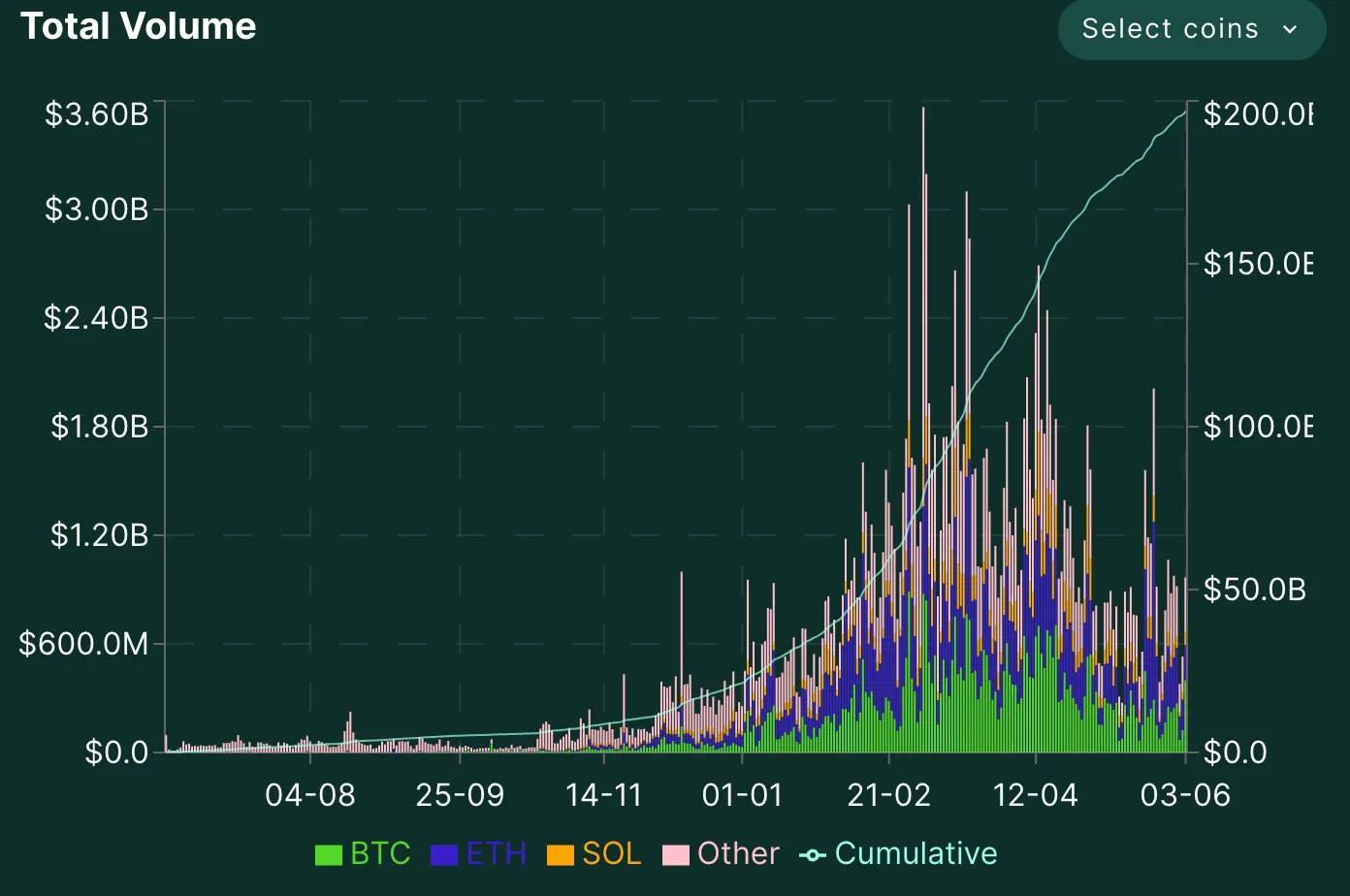
As of June 3, 2024, Hyperliquid’s total trading volume reached $196.8 billion, with approximately 136,000 users. During its operation, deposits exceeded $2 billion, with withdrawals around $1.75 billion. It ranks first on the leaderboard of cumulative trading volume among on-chain exchanges.
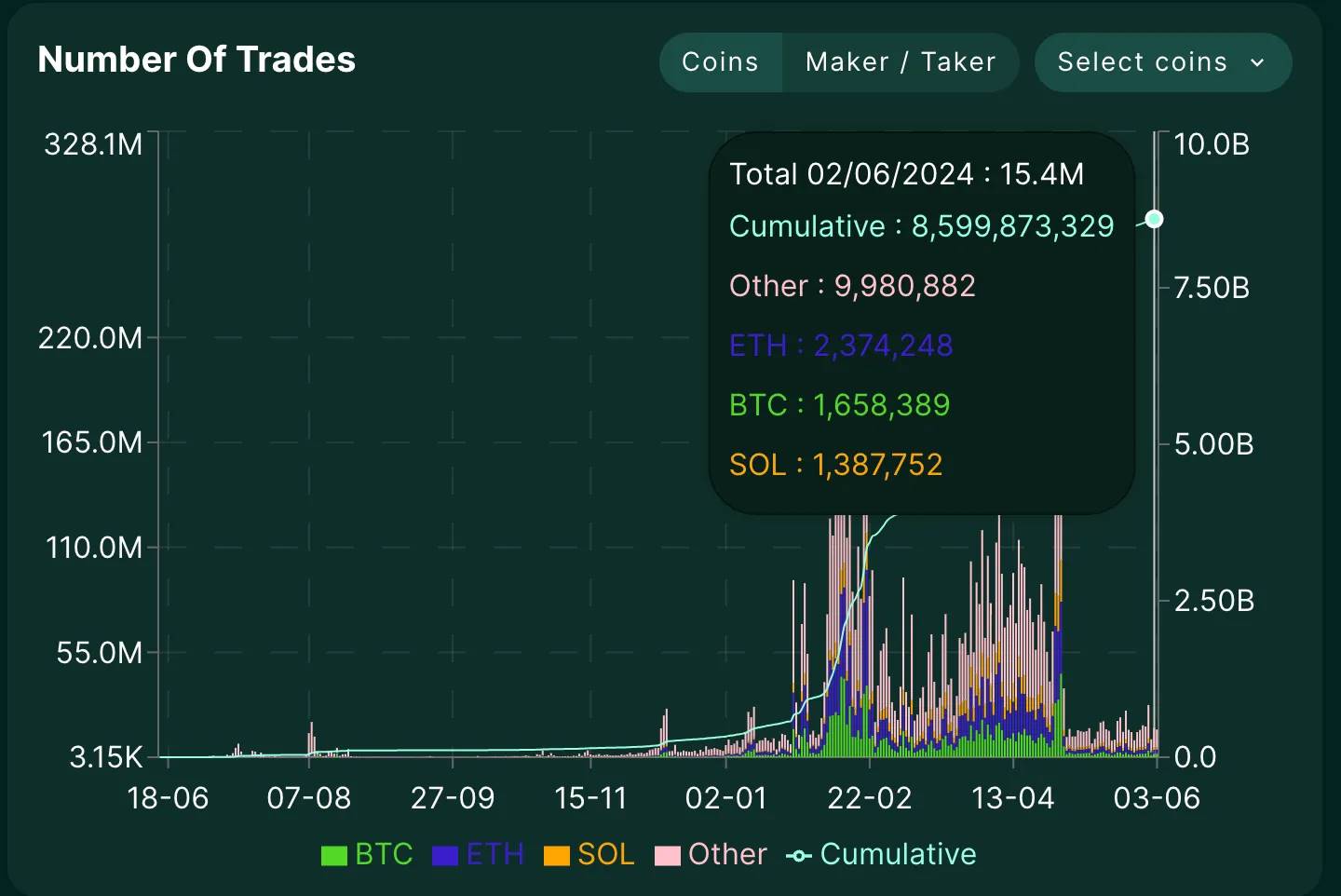
Hyperliquid’s total number of trades is approximately 8.5 billion. Most significant volume spikes occurred between January and May this year, aligning with the early bull phase. This period saw broad market rallies driven by factors like BTC ETF approvals, increasing overall activity.
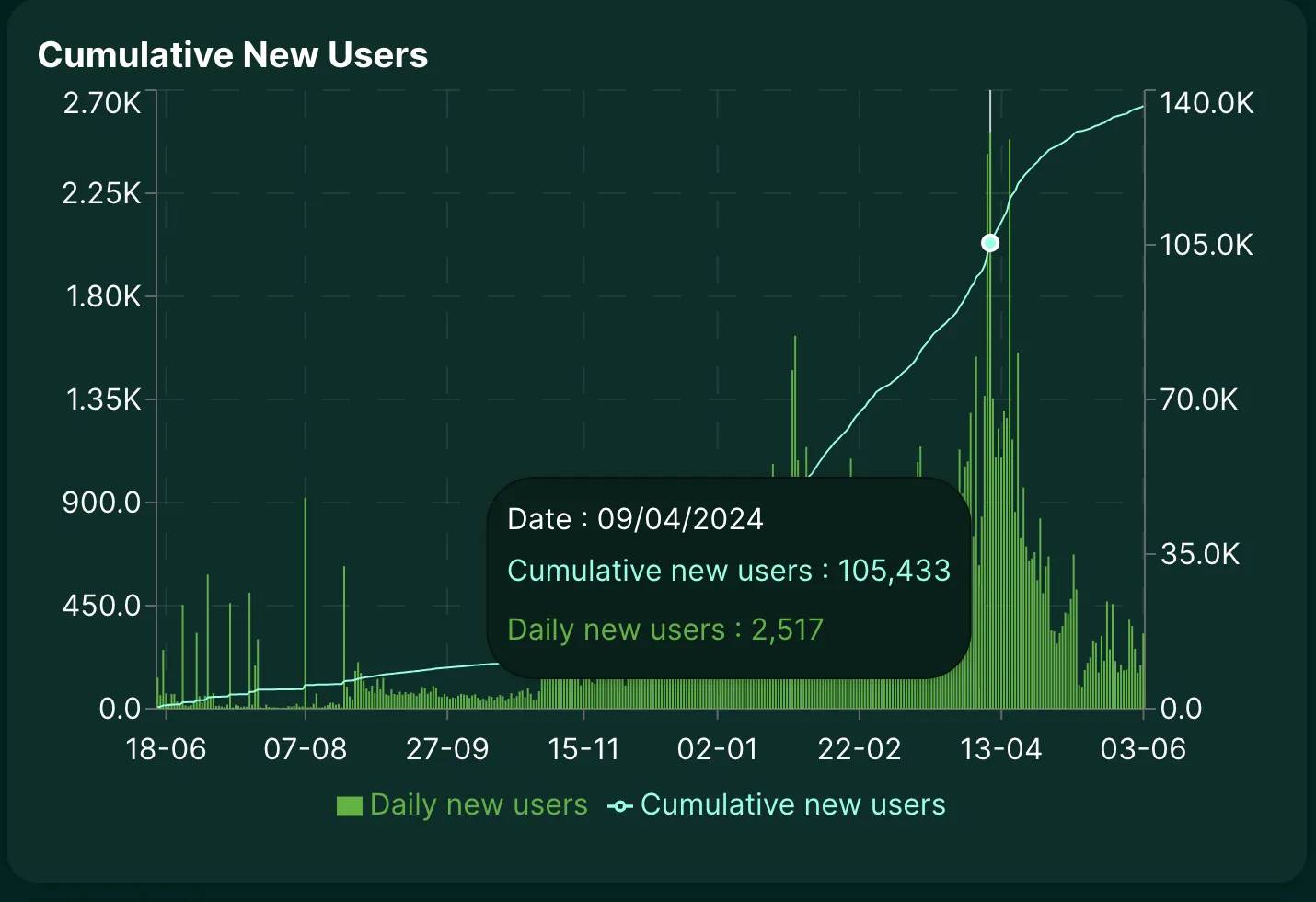
Hyperliquid has approximately 136,000 total users. The average number of new users per month from last June to June 3 this year was 385.
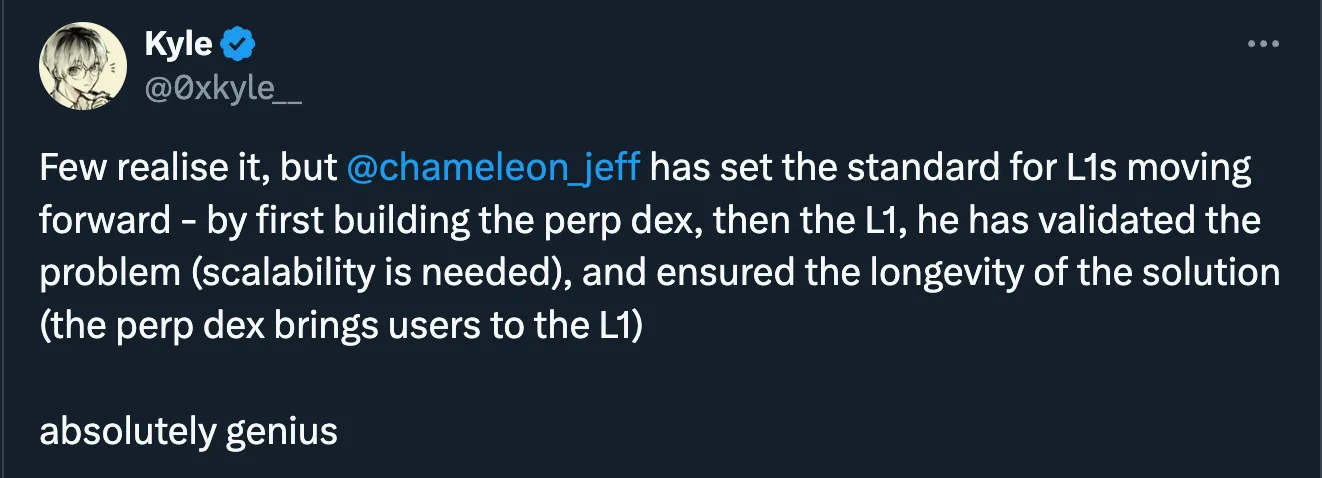
Hyperliquid has performed exceptionally well in both product and marketing. Its product has driven significant adoption, and developments like HIP-1 spot trading and democratized market making have excited the community. Additionally, Hyperliquid has no external investors, which is another advantage. However, some community members expressed dissatisfaction with the launch of a second season of the points program instead of a token generation event (TGE). As stablecoin adoption resumes momentum, enthusiasm for on-chain trading grows. Hyperliquid has evolved from a trading product into building its own ecosystem.
Join TechFlow official community to stay tuned
Telegram:https://t.me/TechFlowDaily
X (Twitter):https://x.com/TechFlowPost
X (Twitter) EN:https://x.com/BlockFlow_News
 @iamswastik23