Tabi Chain Public Sale: Diversified Revenue Strategy under Dutch Auction + Refund Mechanism
TechFlow Selected TechFlow Selected
Tabi Chain Public Sale: Diversified Revenue Strategy under Dutch Auction + Refund Mechanism
Tabi Chain is currently in testnet phase and will launch its mainnet in the third quarter.
 Navigating Web3 tides with focused insights
Author: TokenMore (Bi Meng)
Tabi Chain, a Cosmos-based modular gaming blockchain, will launch its public sale on June 13. The project has raised $11 million in funding from prominent investors including Binance, HashKey, Feng Bo, and others. It has also established partnerships with leading Web3 protocols such as EigenLayer and Bera Chain, as well as Web2 gaming giants like Blizzard Entertainment and EA Sports.
Currently in testnet phase, Tabi Chain plans to launch its mainnet in Q3. Over 20 Web3-native and Web2-ported games are already confirmed to deploy on the Tabi ecosystem.
Upgraded Dutch Auction for Fairer Price Discovery
During the public sale, 400 million TABI tokens (4% of total supply) will be sold in the form of seedTABI, which can later be converted into TABI tokens. seedTABI can be claimed after TGE (Token Generation Event).
The sale will use a Dutch auction model across three rounds, each lasting 24 hours, with a maximum of 133,333,333 seedTABI sold per round. Each round starts at $0.50 (settled in ETH) and decreases linearly over time down to a floor price of $0.10. A round ends when the total ETH contributed by bidders equals the product of the current seedTABI price and the round's total seedTABI allocation. Participants receive seedTABI proportional to their ETH contribution.
This Dutch auction mechanism enables market-driven price discovery rather than fixed pricing by the team. However, traditional Dutch auctions or LBPs often penalize early participants with higher prices. To address this, Tabi’s sale uses a uniform clearing price model—ensuring all buyers acquire seedTABI at the same final market-determined price. Under this rule, participating early to secure allocation is optimal: as the price drops, participants maintain full allocation while gaining potentially higher-than-expected token distribution.
Flexible Conversion Strategy to Capture Ongoing Yields
According to Tabi Chain’s economic model, holding seedTABI entitles users to protocol fee dividends within the Tabi ecosystem and voting rights, offering continuous ecological rewards and potential vote-buying incentives. After receiving seedTABI at TGE, buyers may choose to hold long-term for ecosystem yields or flexibly select a conversion window to convert seedTABI into TABI:
-
Conversion within 0–89 days: 20% converted to TABI, remaining 80% of seedTABI destroyed;
-
Conversion within 90–179 days: 30% converted to TABI, remaining 70% of seedTABI destroyed;
-
Conversion within 180–269 days: 50% converted to TABI, remaining 50% of seedTABI destroyed;
-
Conversion within 270–330 days: 70% converted to TABI, remaining 30% of seedTABI destroyed;
-
Conversion after 330 days: 100% converted to TABI.
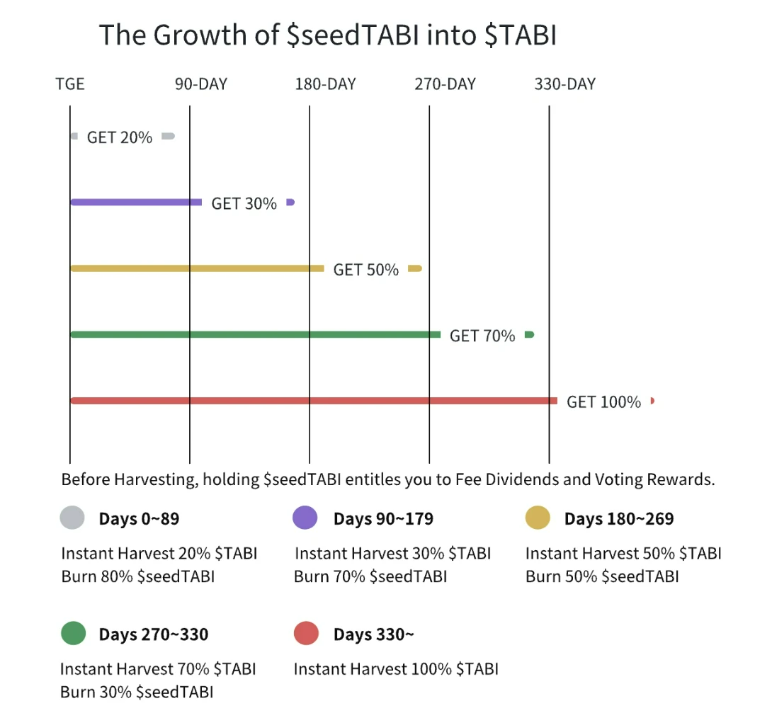
Compared to standard locked public sales, the seedTABI conversion mechanism offers greater flexibility, allowing holders to tailor strategies based on investment preferences. The yield-bearing nature of seedTABI maximizes returns for long-term value investors, while the destruction of unconverted seedTABI enhances the scarcity of TABI over time.
Anti-Dumping Refund Mechanism Enables Diverse Yield Strategies
The most distinctive feature of the seedTABI public sale is its refund mechanism. If, on day 330 after TGE, the TABI token price trades below the average purchase price across the three auction rounds, a refund is triggered. Participants can apply for a refund within one week using the wallet they used to claim seedTABI (refunds issued in stablecoins), up to a maximum of 90% of their original ETH contribution.
Notably, even if a participant converts or sells some seedTABI/TABI within the first 330 days, they still retain eligibility for the refund—provided they replenish sufficient TABI into their wallet before applying.
Thanks to this refund mechanism, investors can adopt various yield strategies based on market performance and personal risk appetite.
For long-term investors who hold beyond day 330, seedTABI fully converts to TABI. Depending on secondary market prices:
-
If market price exceeds auction price: Hold or sell for profit.
-
If market price falls below auction price: Apply for refund, accepting a 10% loss—but dividend income earned during holding period may offset or even exceed this loss.
For short-term investors, if TABI appreciates above the break-even point (accounting for early conversion penalties) within 330 days, early conversion becomes viable. For example: assume an average auction price of $0.40; if TABI reaches $1.00 at day 180, users may convert at 50% and realize immediate gains. Even after early conversion, secondary profit opportunities remain:
-
If TABI trades below average auction price after day 330, users can buy back TABI on the open market and claim a refund, generating additional profits.
-
Alternatively, users may sell their entire wallet to third parties post-conversion, effectively transferring the right to claim future refunds.
Tabi Chain’s public sale reduces price speculation during the auction phase. Buyers who are uncertain about valuation but fear missing out can participate early without hesitation, letting the market determine the fairest price. Moreover, it provides diverse yield strategies throughout nearly a year post-TGE—enabling steady returns through long-term seedTABI holding or active trading around price volatility.
Join TechFlow official community to stay tuned
Telegram:https://t.me/TechFlowDaily
X (Twitter):https://x.com/TechFlowPost
X (Twitter) EN:https://x.com/BlockFlow_News