On-Chain Liquidity Games: Developers, Snipers, and Traders Hunting Each Other in Layers
TechFlow Selected TechFlow Selected
On-Chain Liquidity Games: Developers, Snipers, and Traders Hunting Each Other in Layers
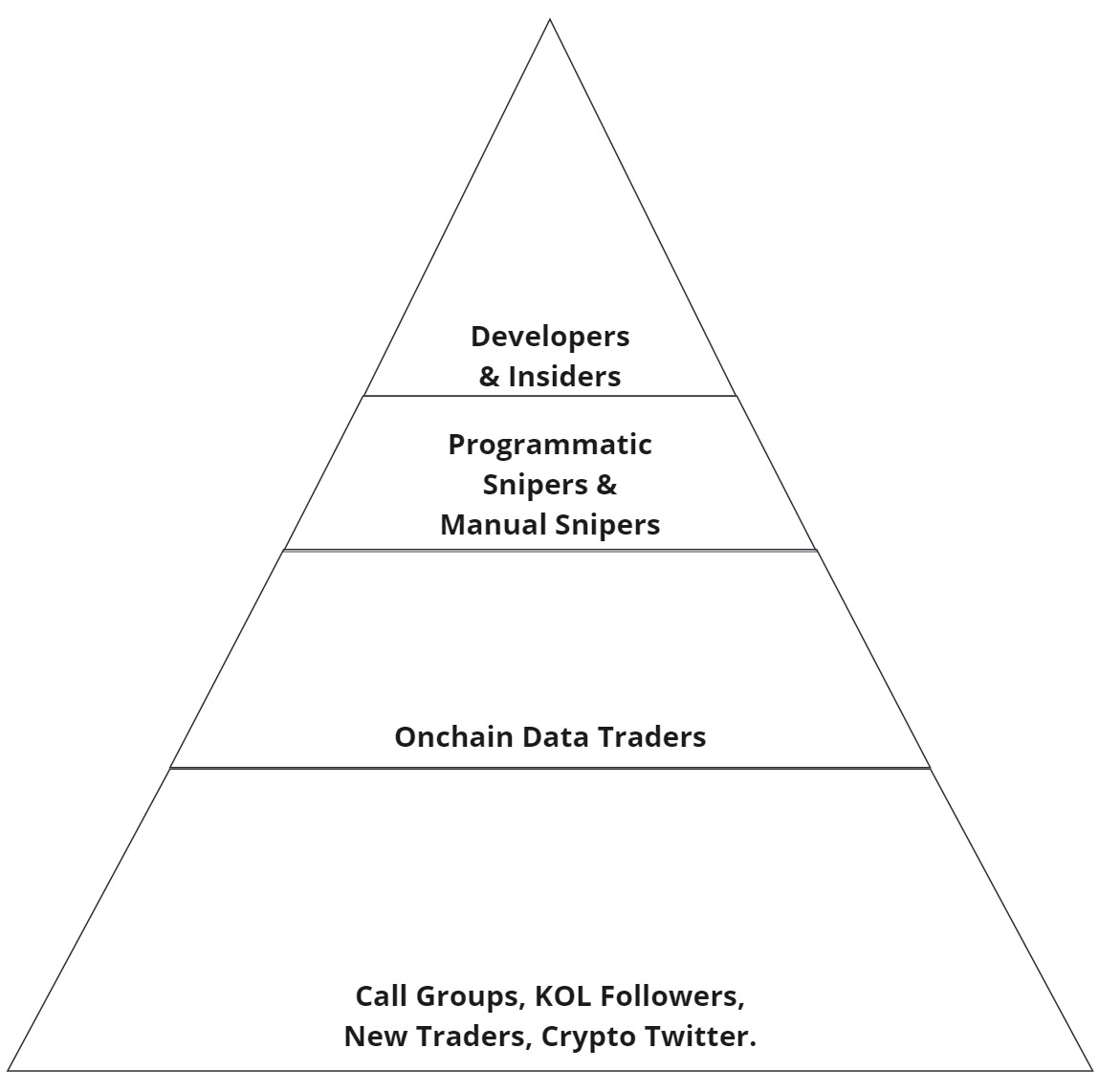
Those at the top of the pyramid reaped the majority of the rewards.
 Navigating Web3 tides with focused insights
Author: post-goa
Translation: TechFlow
Based on my research, below is a brief summary of the roles involved in playing the on-chain liquidity game.
Developers and Insiders
-
Fake utility slow pumps or “gets exploited”:
-
These were very popular during the early AI hype because no one truly understood AI, but everyone wanted early access.
-
They never complete more than 1% of their roadmap, often hyped by key opinion leaders (KOLs).
-
Teams typically allocate large token supplies to themselves at contract launch and distribute ahead of others. These tokens are then hidden across multiple wallets before being sold off.
-
Slow pump after initial rise, or pump for several weeks followed by an exploit, then rapidly exit after accumulating a significant market cap (20–100 million).
-
Involves syndicates repeatedly launching fake projects aligned with current trending narratives. These projects are often derivatives of more successful, large venture-backed initiatives.
-
Programmatic Snipers
-
Custom bots:
-
Custom bots that systematically snipe multiple ETH projects.
-
Bots follow specific parameters based on smart contracts and trading volume.
-
Aim to achieve 10–100x returns on a few projects amid many failed or rug-pulled snipes—almost like a yield strategy.
-
Manual Snipers (ETH)
-
One of the most profitable on-chain traders:
-
Search for or obtain new contract addresses through insider information.
-
Simulate contracts to check security and other indicators of potential, or investigate team backgrounds.
-
Outbid other snipers when promising contracts launch.
-
Snatch large supply during promising on-chain or stealth launches without anti-snipe defenses or pre-launch platforms like Fjord.
-
Use multiple wallets to accumulate over 1% of total supply.
-
In many cases, projects become hostage to snipers who can dump them to zero in early stages.
-
Many snipers enter projects and then play against each other, hoping “dumb money” will come in so they can exit at 500k–1 million market cap—then the project dies. This happens daily on the Ethereum mainnet.
-
Snipers combining basic analysis with machine learning to identify contracts likely to achieve profitable launches with over $5 million market cap have significantly outperformed others over the past year.
-
Most snipers hold tokens for less than a few hours.
-
On-Chain Data Traders
-
Track actions of snipers and insiders:
-
Follow movements of profitable (highest PnL) wallets.
-
Monitor volume and holder alerts.
-
Often buy strong projects after snipers sell off; alternatively, even if aware that snipers hold large supply, they may still buy if the launch appears highly promising.
-
Usually perform some fundamental or narrative analysis on new launches.
-
Long-term holders.
-
Their popularity has both diluted and increased as on-chain trading becomes a growing content segment and more on-chain tools become accessible to retail users.
-
Serve as exit liquidity for the above participants.
-
These traders frequently play against each other on newly launched projects that ultimately go to zero—it's just a matter of who exits earlier.
-
Rely on naive crypto Twitter (CT), KOLs, or later-coming on-chain traders as their exit liquidity.
-
Other Traders
-
Have not yet learned how to use Etherscan or check basic token data metrics:
-
Get information from signal groups, KOLs, and crypto Twitter (CT).
-
Slower traders who tend to buy into hype.
-
Believe crypto has utility beyond speculation.
-
Are one narrative cycle behind.
-
May have been in the space for less than a year.
-
These traders likely either gave up on buying new utility projects or memecoins, or they are gradually learning on-chain trading and upgrading into the above categories.
-
Summary
On-chain trading is a liquidity game among developers, snipers, on-chain data traders, and others. As entry-level liquidity into the on-chain space diminishes, competition among participants intensifies, resulting in those at the top of the pyramid capturing most of the returns.
Join TechFlow official community to stay tuned
Telegram:https://t.me/TechFlowDaily
X (Twitter):https://x.com/TechFlowPost
X (Twitter) EN:https://x.com/BlockFlow_News
 @NFTSWIMM3R