








Introducing EIP-7702: Accelerating Ethereum Adoption through Optimized Account Abstraction
TechFlow Selected TechFlow Selected
Introducing EIP-7702: Accelerating Ethereum Adoption through Optimized Account Abstraction
EIP-7702 paves the way for a more user-friendly and developer-friendly ecosystem.
 Navigating Web3 tides with focused insights
Author: QuickNode
Compiled by: TechFlow
EIP-7702 aims to enable mass adoption of account abstraction on Ethereum through its lean and simple implementation.
Recently, Account Abstraction (AA) has attracted significant attention as a key solution to address user experience challenges on Ethereum. However, despite its perceived potential, AA has remained difficult to implement in practice—until now.
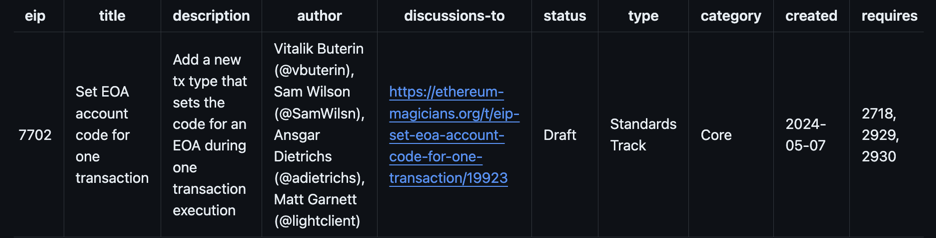
Today, EIP-7702 brings hope. This innovative proposal, introduced by Vitalik Buterin and other core Ethereum developers, aims to simplify the implementation of account abstraction.
In this article, we’ll dive into the details of EIP-7702, why it’s needed, the improvements it offers, and how it paves the way for mainstream adoption of Ethereum—making it more user-friendly and future-ready. This goal becomes even more feasible following the recent approval of Ethereum ETF applications.
But first, what is account abstraction?
What Is Account Abstraction?
Account abstraction allows the creation of smart contract accounts that can initiate and execute transactions without requiring an Externally Owned Account (EOA). Simply put, account abstraction aims to make the Web3 experience as seamless as Web2—so smooth that everyday users may not even realize they’re using it, while still enjoying all its benefits.
In the Web2 era, when customers swipe their cards at checkout terminals, all the backend systems and mechanisms operate silently behind the scenes; customers only care whether they can complete the payment, not the complex details of the transaction process. Similarly, account abstraction aims to deliver a seamless and straightforward Web3 user experience through various potential use cases.
The Potential of Account Abstraction
The power of account abstraction lies in enabling developers to directly integrate complex functionalities into user accounts—such as automated transactions and wallet recovery mechanisms. QuickNode provides a detailed guide to help developers further explore account abstraction or seek practical guidance. To implement account abstraction in your project, you can streamline the process using Stackup's plugin available via QuickNode’s marketplace.
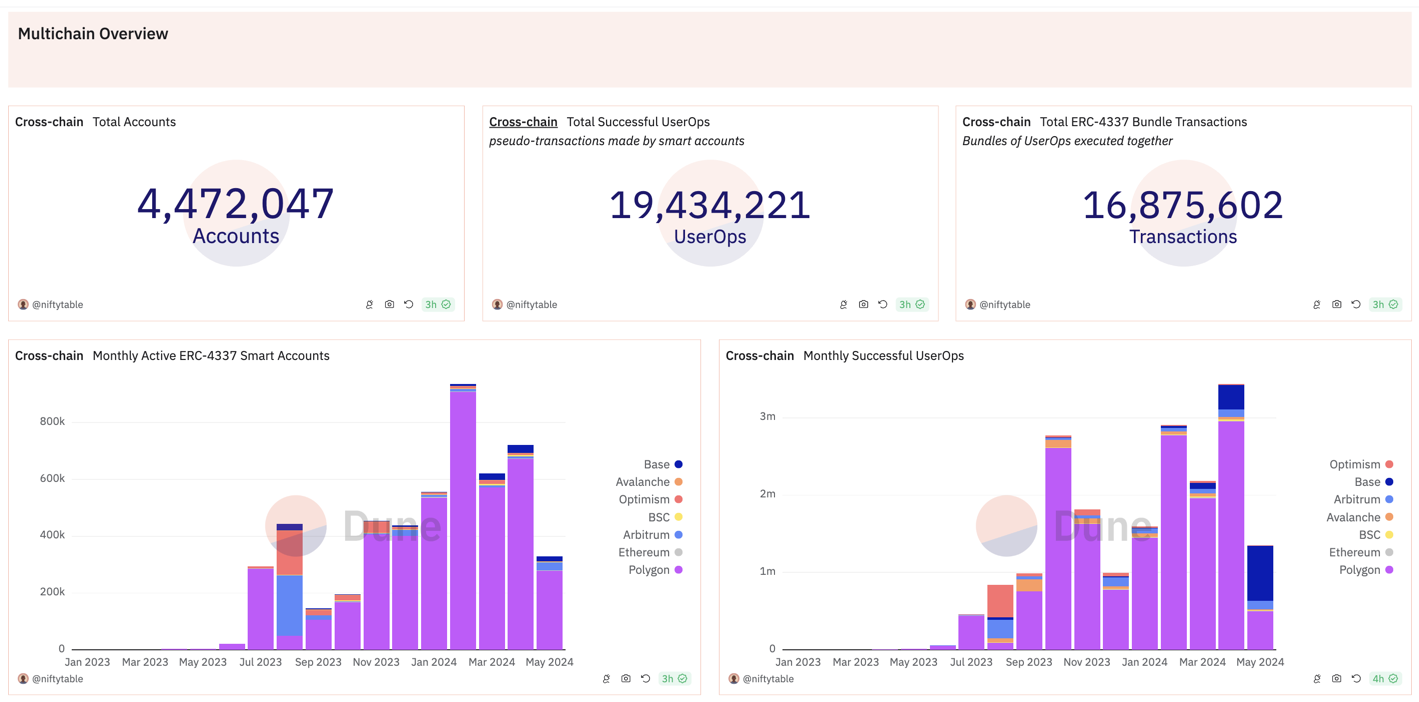
While the concept has generated great interest—as demonstrated by the growing number of wallets supporting account abstraction—the lack of native Ethereum implementation highlights inherent adoption challenges.
Challenges of Account Abstraction
Implementing account abstraction on Ethereum faces several challenges. The ERC-4337 standard has inherent issues, and additional hurdles arise during implementation. Key risks include:
-
Risk of Separating Ownership and Control: Account abstraction can separate account ownership and control into an 'EntryPoint' contract, introducing risks of unauthorized transactions and smart contract vulnerabilities. Developers must implement technical safeguards to mitigate these risks, increasing complexity.
-
Logistical Risks of ERC-4337 Compatibility: Existing EOAs are much simpler than the complex features provided by ERC-4337, requiring extensive backend logic and code refactoring. Decentralizing bundlers for security and updating popular infrastructure like MetaMask adds logistical challenges.
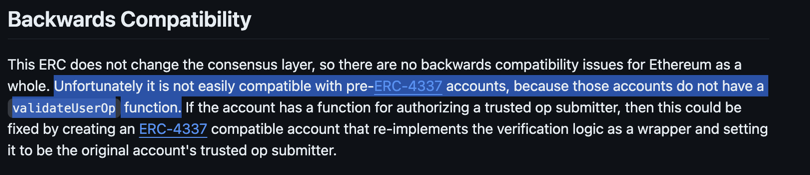
(Source: Official EIP-4337 Documentation)
-
EntryPoint Contract as a Single Point of Failure: ERC-4337 heavily relies on the EntryPoint contract to handle and validate user operations, creating a single point of failure vulnerable to security threats and reliability issues.
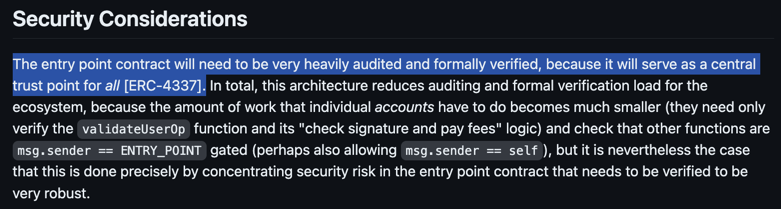
Additionally, smart contract account transactions are more expensive than traditional EOA transactions, adding further complexity.
EIP-7702: The Proposed Solution
EIP-7702 addresses these challenges by combining the best features of ERC-4337, EIP-3074, and EIP-5003, while mitigating their respective limitations. This approach ensures a more efficient and compatible implementation of account abstraction.
Key Components:
-
ERC-4337 – Smart Contract Accounts: Allows smart contracts to function as user accounts, enabling developers to build complex transaction logic and improved user experiences. However, it lacks native support for converting EOAs into smart contract accounts, has no backward compatibility, and results in high transaction costs.
-
EIP-3074 – AUTH and AUTHCALL: Enhances EOA functionality by introducing two new opcodes, AUTH and AUTHCALL, allowing EOAs to temporarily act as smart contract accounts. However, it requires a hard fork and depends on the caller, leading to centralization risks.
-
EIP-5003 – AUTHUSURP: Introduces the AUTHUSURP opcode to permanently migrate an EOA to a smart contract account by deploying smart contract code to the EIP-3074 authorized address and revoking access from the original private key.
Moreover, EIP-7702 introduces a new type of transaction that allows an EOA to temporarily execute as a smart contract wallet within a single transaction. This temporary code assignment is trustless, compatible with existing ERC-4337 infrastructure, functionally designed for easy integration, and built to be future-extensible without requiring a hard fork.
How EIP-7702 Accelerates Ethereum Adoption
EIP-7702 significantly enhances the potential for adopting account abstraction on Ethereum through the following features:
-
Trustlessness: EIP-7702 eliminates the need for centralized trust points by temporarily assigning smart contract code to an EOA within a single transaction. This trustless approach removes any access or contract signatures after the transaction completes.
-
Compatibility: EIP-7702 is fully compatible with existing ERC-4337 infrastructure, requiring neither a hard fork nor new opcodes. It works seamlessly between EOAs and smart contract accounts, unifying account abstraction across Ethereum.
-
Function-Based Validation: EIP-7702 tightly couples validation (AUTH) and execution (AUTHCALL), reducing interference and simplifying the transition. This function-based approach improves developer experience by lowering the learning curve.
-
Future Extensibility: EIP-7702 ensures backward compatibility with ERC-4337 accounts and incurs minimal technical debt. Maintenance does not require hard forks, allowing developers to confidently build long-term solutions.
A Developer-Friendly Path to Account Abstraction
To date, the promise of account abstraction has remained unfulfilled due to implementation complexity, lack of native support, and fragmented approaches. EIP-7702 offers a developer-friendly solution that directly addresses these core issues—enabling EOAs with smart contract account capabilities in a trustless, compatible, and future-extensible manner.
As Ethereum continues to evolve, EIP-7702 represents a crucial step toward realizing the true potential of account abstraction, paving the way for a more user-friendly and developer-friendly ecosystem.
Join TechFlow official community to stay tuned
Telegram:https://t.me/TechFlowDaily
X (Twitter):https://x.com/TechFlowPost
X (Twitter) EN:https://x.com/BlockFlow_News
 @QuickNode


