








Understanding ZKX: Bringing Hundreds of Thousands of Users into On-Chain Perpetual Contracts Ecosystem
TechFlow Selected TechFlow Selected
Understanding ZKX: Bringing Hundreds of Thousands of Users into On-Chain Perpetual Contracts Ecosystem
The current Perp DEX sector is a highly competitive niche market.
 Navigating Web3 tides with focused insights
Author: NingNing
In this new cycle, the emerging trio within Rollup/L1 ecosystems has become DEXs, decentralized lending protocols, and Perp DEXs (decentralized perpetual exchange platforms). DEXs serve asset issuance and trading, decentralized lending protocols facilitate asset borrowing and lending, while Perp DEXs enable risk hedging and leveraged exposure to assets.
Given that the DEX wars and decentralized lending protocol competitions have largely settled in the previous cycle, Perp DEXs have emerged as the key application-layer battleground for Rollups/L1s and VC firms in this new phase. Each Rollup/L1 incubates or grants support to two or three Perp DEX projects, and most major VCs have included one or two Perp DEXs in their portfolios.
ZKX is a dual standout born out of this context — it is both a flagship Perp DEX incubated within the Starknet ecosystem and has secured funding from prominent VC firms including Starkware (Starknet’s parent company), Hashkey, Amber, HTX Ventures, and others.
Although Perp DEXs often tout the $100 trillion derivatives market during fundraising, a closer look at Defillama's sector data reveals a fundamental truth: today’s Perp DEX landscape is a highly competitive niche market. There is a visible hard ceiling on market size, yet well-funded new entrants with strong VC backing continue to flood in.
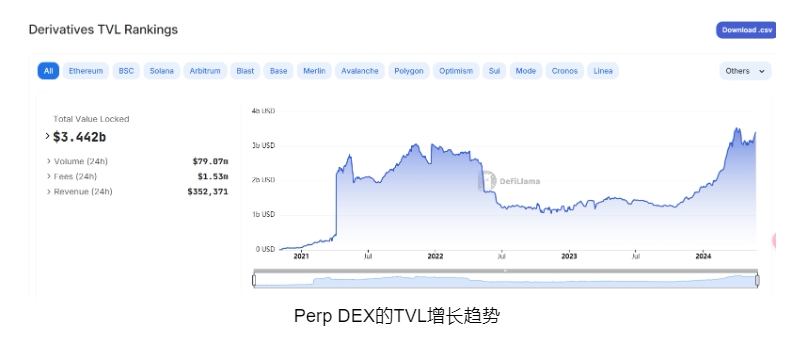
Faced with intense market competition, rather than setting ambitious goals like “bringing the next billion users into Web3” as many developers do, the ZKX team has adopted a pragmatic target: bringing hundreds of thousands of users into the on-chain perpetual contracts ecosystem. Yet even this modest goal remains unattainable for many smaller-tier Perp DEXs.
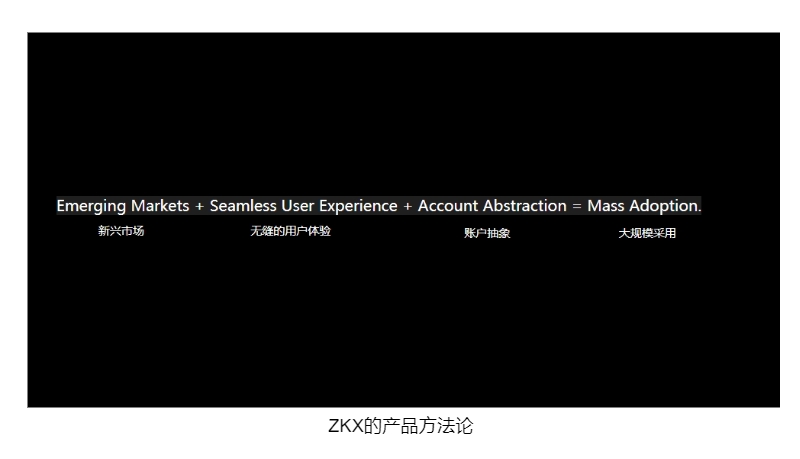
In ZKX’s view, the key to user growth lies in achieving PMF (Product-Market Fit). Their product philosophy can be distilled into one formula: Emerging Markets + Seamless User Experience + Account Abstraction = Mass Adoption.
To achieve its market objectives, ZKX is experimenting with novel primitives and paradigms across both the infrastructure and operational layers of its product stack.
ZKX Infrastructure Layer: Dapp Rollup/App Chain + CLOB Order Book
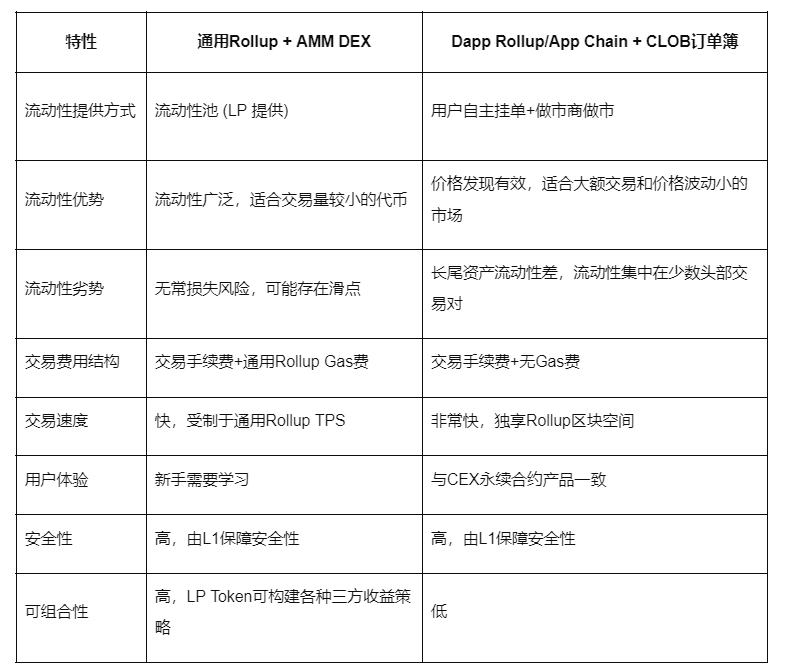
The current dominant paradigms for Perp DEXs fall into two categories: General-purpose Rollup + AMM DEX, and Dapp Rollup/App Chain + CLOB (Central Limit Order Book) order book.
Representative projects of the former include GMX; examples of the latter include ZKX, dYdX, and Aevo. These two paradigms serve different use cases, with their characteristics compared in the table below:
Blockchain scalability has evolved to a point where building and maintaining Rollups/App Chains is now cost-effective, architectural patterns are diversified, and there are more tradeoff options between security and scalability.
This shift in infrastructure paradigms directly influences application-layer development. Today, rebuilding all DeFi protocols originally designed as smart contracts using the Dapp Rollup/App Chain model has become an industry consensus and trend — and ZKX is at the forefront of this movement.
ZKX’s infrastructure layer is the ZKX AppChain, an Omni Layer built using the Substrate SDK. Its stack includes a middleware layer that synchronizes asset and state data between Starknet, parallel Rollups built with its SDK, and the ZKX AppChain. Cross-domain interoperability between L1 and ZKX AppChain is achieved via Starknet’s native cross-chain bridge, Starkway. As such, ZKX AppChain functions as an L3 within the Starknet ecosystem.
The ZKX AppChain features its own independent node network, distributed ledger, and validator set. Its design objective is to enable seamless connectivity for users across multiple L1s/Rollups to the ZKX exchange.
Within ZKX’s architecture, the ZKX AppChain and CLOB order book handle transaction processing and validation, with all records stored on-chain and publicly verifiable via block explorers.
Powered by the ZKX AppChain, ZKX offers users a unified and easy-to-use account system. Each L1/L2 has a corresponding ZKX sub-account, where users self-custody their assets. The lifecycle of a ZKX account consists of three stages: deposit → trading & settlement → withdrawal.
Deposit: Asset balances and states are synchronized between the source L1/L2 and the ZKX AppChain.
Trading & Settlement: Functions such as P&L calculation, liquidations, and funding rate computations are executed on the ZKX AppChain, then batched and rolled up to Starknet for final settlement. Validators on the ZKX AppChain participate in consensus and also provide price feeds through an internal oracle module.
Withdrawal: Asset balances and states are synchronized between the ZKX AppChain and the target L1/L2.
The combined ZKX AppChain and CLOB order book architecture delivers several key advantages: high performance and scalability (2 blocks per second), robust risk management, powerful API integration (2,000 requests per 10 seconds, sub-second internal oracle), unified liquidity, and self-custody with provable transactions.
ZKX Operational Layer: Dual Airdrop Incentives + Gamified Social Experience
In traditional Perp DEX models, traders must pay gas fees for blockspace on the underlying base protocol (L1/L2). Unpredictable gas costs make transaction expense management difficult. Additionally, traders bear extra priority gas fees during network congestion caused by other applications on the same L1/L2. Frankly speaking, in this structure, traders sit at the bottom of the value chain — their interests are neither respected nor protected.
The ZKX AppChain and CLOB order book architecture not only delivers advanced features like high performance, zero gas fees, and a consistent user experience, but also restructures the incentive alignment among base protocols (L1/L2), app developers, and traders. It significantly reduces or even eliminates rent-like blockspace fees charged by L1/L2s, placing trader needs — the core driver of product adoption — at the highest priority.
To further incentivize trader adoption, ZKX offers dual airdrop rewards: platform token $ZKX and Starknet’s native protocol token $STRK.
Beyond restructuring incentives, the ZKX AppChain and CLOB order book also allow the frontend trading experience to closely mirror that of CEX perpetual products, enabling traders to transition to Perp DEXs with virtually zero learning curve.
Observing the distribution of perpetual contract trading volume (see chart below), we see a clear stratification: a small number of whale users generate the majority of volume, while a large number of retail users contribute relatively little.
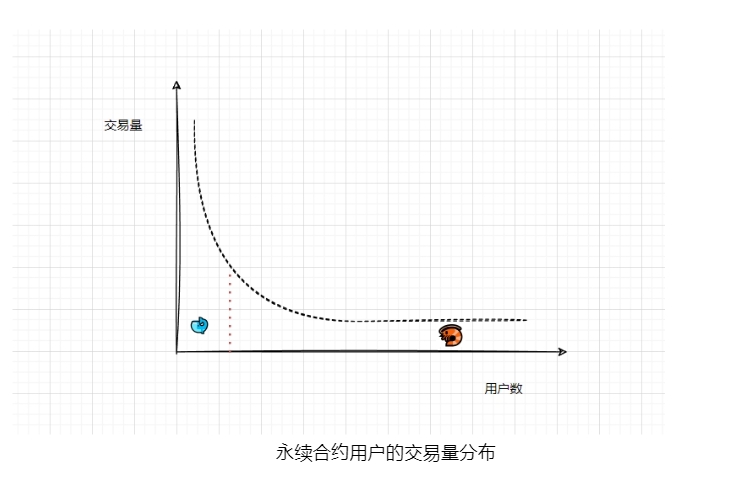
To address this tiered structure, ZKX provides two trading modes in its frontend interface: OG Trading and Pro Trading. OG Trading allows users to simply place leveraged bets on whether an underlying asset will rise or fall within a fixed timeframe — every 30 minutes per round.
Additionally, ZKX has issued four types of CLAN (tribe) NFTs — PACHINKO Adventurer, DeFi High Roller, YAKUZA Tycoon, and Ethereum Titan — distributed to real crypto traders, experienced DeFi traders, early ZKX contributors, and Ethereum ecosystem participants respectively. Holders of CLAN NFTs can represent their tribe in OG trading contests, earning exclusive tribal NFT badges and additional ZKX rewards.
OG Trading mode is ideal for retail users who want to treat perpetual trading like a social game — similar to poker or blackjack. Pro Trading mode functions like standard perpetual products. This dual-mode approach enhances inclusivity, ensuring both professional and casual traders find value in ZKX.
Conclusion
In summary, ZKX’s foundational architecture — combining Dapp Rollup/App Chain with a CLOB order book — grants greater flexibility at the operational level. By protecting trader interests, delivering consistent UX, offering dual airdrops, and introducing inclusive, gamified social experiences, ZKX is effectively launching a "sybil attack" against both CEX perpetuals and traditional Perp DEXs, steadily advancing toward its defined market goals.
Join TechFlow official community to stay tuned
Telegram:https://t.me/TechFlowDaily
X (Twitter):https://x.com/TechFlowPost
X (Twitter) EN:https://x.com/BlockFlow_News
 @0xNing0x








