The Great Debate on ZK Hardware Acceleration: A Brand New Market Comparable to PoW Mining
TechFlow Selected TechFlow Selected
The Great Debate on ZK Hardware Acceleration: A Brand New Market Comparable to PoW Mining
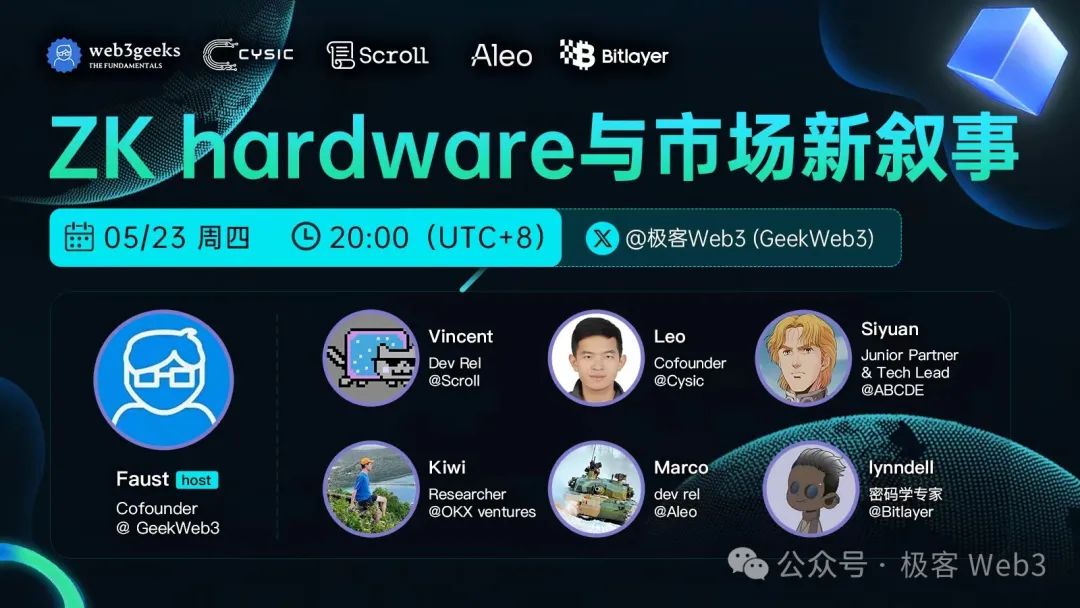
The guests delivered an exceptionally insightful discussion on the commercialization and marketization challenges of real-time ZK proof generation and hardware acceleration, and also conducted a brainstorming session on the new term "ZK Depin."
 Navigating Web3 tides with focused insights
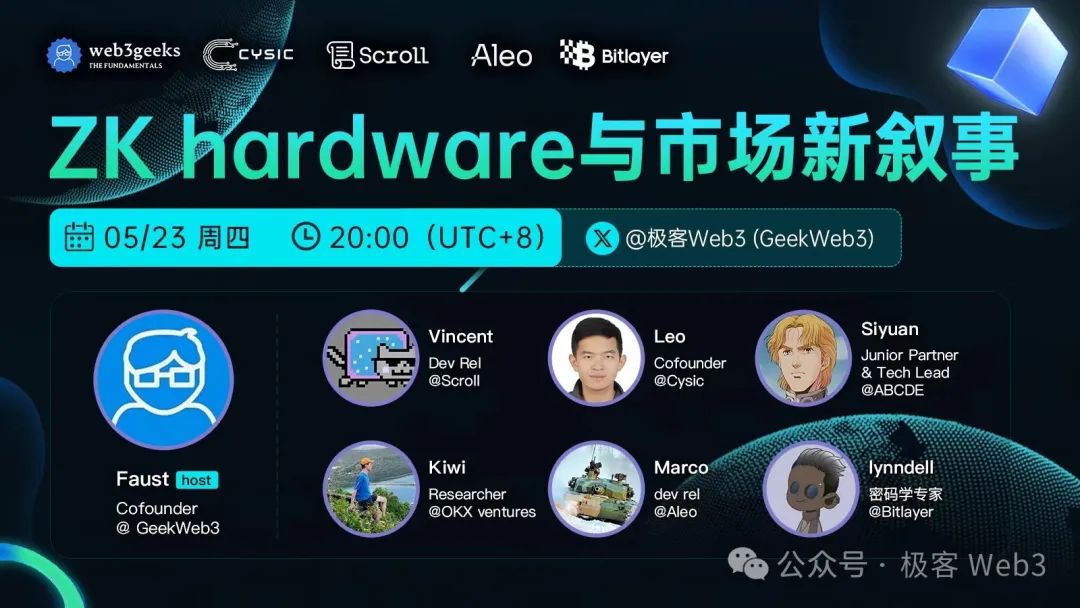
Host: Faust, Geeker Web3
Guests: Vincent, DevRel at Scroll;
Leo, Co-founder of Cysic;
Siyuan, TechLead at ABCDE Capital;
Kiwi, Researcher at OKX Ventures;
Marco, DevRel at Aleo;
Lynndell, Cryptography Expert at Bitlayer
Summary: On the evening of May 23rd, Geeker Web3 hosted a Twitter Space with guests from Scroll, Cysic, Bitlayer, Aleo, ABCDE Capital, and OKX Ventures on the topic of ZK hardware acceleration. The panelists delivered an exceptionally insightful discussion on real-time ZK proof generation and the commercialization and market challenges of hardware acceleration. They also brainstormed around the emerging concept of “ZK DePIN.” Below is the transcript.
The key questions discussed in this Space include:
1. Both Cysic and Lumoz have made ZK acceleration a core mission, and Cysic has promoted the idea of real-time ZK proof generation. How will these technologies impact Ethereum’s Danksharding roadmap?
2. There are rumors that Aleo is changing its mining algorithm. Aleo started as a privacy-focused public chain where mining was closely tied to ZK proofs. Recently, there were whispers that Aleo might be reverting to hash-based algorithms similar to mainstream PoW chains (the panel clarified this rumor).
3. What is the future vision for ZK mining, and how will the ZK-DePIN sector evolve?
4. How should we view the commercialization and market readiness of ZK-DePIN? What unresolved pain points remain?
5. What is the miner reward model in ZK mining?
6. How can we address the significant disparity in proof generation efficiency among different miners?
Transcript:1. Faust: What impact does ZK hardware acceleration have on Ethereum's Danksharding roadmap?
Background: The Danksharding roadmap introduces Verkle Trees and stateless clients, allowing regular Ethereum nodes/clients to no longer store the full state tree locally. Instead, each block will include state data associated with transactions, along with ZK proofs verifying that the data originates from Ethereum’s state tree (Verkle Tree). Compared to Ethereum’s current Merkle Tree structure, Verkle Trees are significantly optimized for efficiently generating ZK proofs that certain data belongs to the tree.
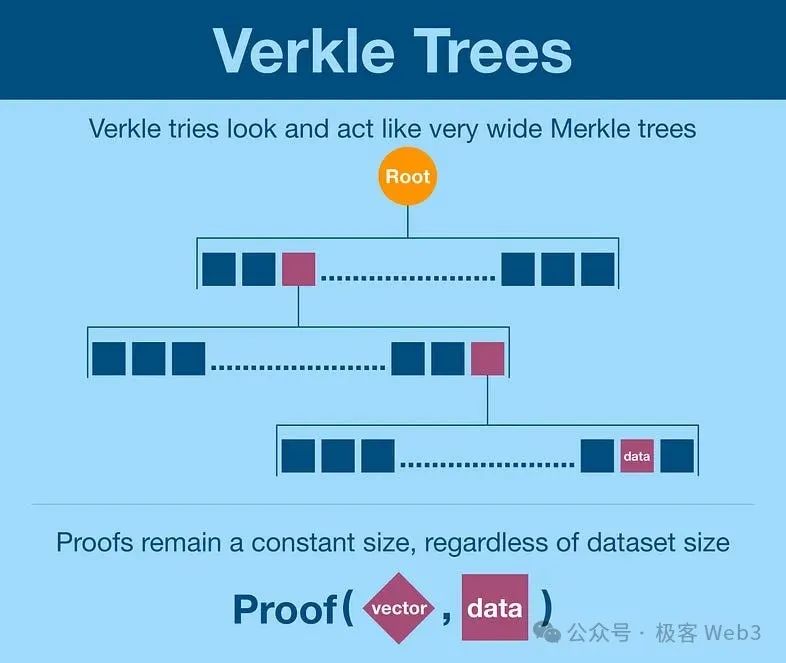
Leo: Simply put, real-time ZK proof generation greatly improves the efficiency of light clients and Verkle Trees. Compared to Merkle Trees, Verkle Trees produce many more branches/paths. If you use a Merkle Proof to verify that a piece of data belongs to a specific path in a Verkle Tree, you must open many other branches alongside it.
By replacing Merkle Proofs with ZK proofs, you can dramatically improve efficiency and compress large amounts of data into very small proofs. However, generating ZKPs using standard CPUs or GPUs is extremely computationally intensive.
I previously worked on a project called Algorand State Proof at Algorand, which required opening many branches of the Merkle Tree via Merkle Proofs—this approach proved highly inefficient. Therefore, we need real-time ZK proof generation or specialized provers to drastically boost ZK proof generation speed.
Vincent: At the Web3 Hong Kong conference in April, Vitalik emphasized the importance of ZK proofs for maximizing protocol efficiency, consistent with his long-standing technical focus on ZK. In the past, Scroll took about two to three hours to generate a fully compatible zkEVM proof; with current hardware acceleration, this has been reduced to 10 minutes. But even this isn’t fast enough for our goals.
In an ideal scenario, ZK adoption would be ubiquitous across all layers of the stack. Historically, slow ZK proof generation has limited widespread adoption. If real-time ZK proof generation becomes feasible, we won’t need to compromise on security, trustlessness, or verifiability—we could use ZK to solve previously intractable problems. Future innovations, especially at the application layer, would become much lighter and more scalable. The ZK hardware acceleration community is highly motivated and confident about making breakthroughs together in this direction.
Siyuan: I believe the most critical goal for Layer 2s, especially ZK-based ones, is achieving fast finality. Only by rapidly turning L2 transaction traces into ZK proofs and submitting them to L1 for verification can we finalize the L2 state. Some companies, for cost reasons, do not generate proofs for every L2 block—or only do so infrequently. According to Vitalik’s vision, once Ethereum L1 transitions to Verkle Trees, every block should ideally generate an immediate ZKP. Without hardware acceleration, this vision would be nearly impossible to achieve. That’s why we’re particularly bullish on Cysic.
2. Faust:There are rumors that Aleo is changing its mining algorithm. Since Aleo began as a privacy chain with ZK-related mining, some speculate it's reverting to a hash-based PoW algorithm like mainstream chains. What are your thoughts on this rumor?
Marco: It’s true that in Aleo’s recent Testnet Beta, the PoW algorithm uses a hashing mechanism combined with a Merkle Tree, calculating the final result based on the root data. However, this version is temporary—not final. The official version will be released in July, so we ask everyone to stay tuned.
Moreover, Alex, CEO of the Aleo Foundation, once stated in a talk that his ideal PoW algorithm must meet two criteria: first, it should drive practical applications of ZK algorithms and solve real-world problems; second, it must ensure fairness in mining. They’ll continue refining the design accordingly—so stay updated.
Leo: To add context, Aleo’s earlier Coinbase puzzle used MSM-based polynomial commitments. Now they’ve switched to using Merkle Trees for polynomial commitments. From a ZK perspective, this change isn’t fundamentally significant—it just replaces one component, switching from MSM-based to hash-based commitments. And this hash-based scheme actually uses a mix of various hash functions.
Vincent:I’d like to ask Marco—how does Aleo view the broader ZK hardware acceleration ecosystem? Products like Cysic’s ASIC chips or Ingonyama’s FPGA-based ZK acceleration solutions—do they influence Aleo’s development or future plans?
Marco: Definitely. The biggest challenge across the entire ZK field today is that ZK proof generation is simply too slow. As Vitalik recently noted, generating a SNARK proof for an Ethereum block takes about 20 minutes—but Ethereum produces a new block every 12 seconds. That’s a massive gap. I hope more effective ZK acceleration solutions emerge to close it.
3. Faust: Let’s now discuss ZK mining or ZK-DePIN. Leo, what’s your vision for ZK mining? How will the ZK-DePIN sector evolve?
Leo:We provide ZK proof generation services to various ZK projects. As a startup, Cysic doesn’t have the capital to buy or rent hundreds of servers ourselves, so we aim to harness community power to pool resources. We currently operate hundreds of servers running at full capacity—unlike many AI-DePIN projects.
In many AI-DePIN projects, machines often sit idle, users just chase high uptime to farm token airdrops. In contrast, Cysic Network ensures machines actively contribute to real applications, eliminating idleness and maximizing resource utilization. Miners earn not only Cysic tokens but also incentives directly from partner ZK projects.
This also benefits decentralization of ZK provers—by involving multiple provers in proof generation, we reduce reliance on any single entity. We don’t just rely on large-scale miners; we also invite community members to plug in their idle hardware, contributing to the broader ZK ecosystem.
Siyuan:Cysic serves two types of customers: large professional B2B clients, and an interesting consumer segment—Cysic has developed a compact ZK acceleration card that enables fast ZKP generation on home computers, accessible to developers and even regular users.
Leo: What Siyuan mentioned refers to our own hardware—Cysic will begin mass production and shipment of our ZK hardware next year. We offer two versions: First is the ZK Air—a device roughly the size of a MacBook charger that connects via USB-C to your computer and runs local ZK proof generation. Its performance will be 8–10 times faster than an RTX 4090, empowering developers significantly.
Vincent: Regarding ZK-DePIN, traditional DePIN often imagines mining via smartphones or smartwatches. But ZK hardware acceleration is fundamentally different. Scroll will soon launch a decentralized Prover Market, as outlined in our roadmap. Our future prover component will operate as a permissionless marketplace. While the reward models involved are complex and still being refined, our direction is clear: advance toward rapid ZK proof generation while actively avoiding the Matthew effect (rich-get-richer dynamics).
Marco: On Cysic’s consumer-grade device, let me add two points: Aleo transactions require local ZK proof generation on client devices. Generating ZKPs locally in your browser is currently very slow—sometimes taking over ten minutes. Since Aleo emphasizes private transactions and has a strong demand for ZK proofs, Cysic’s consumer hardware is highly meaningful.
4. Faust: In the current ZK hardware acceleration space, what unresolved pain points exist in commercialization and market adoption?
Leo: We can think of ZK acceleration as a form of Proof of Work—miners race to generate ZKPs fastest to earn rewards. In essence, this isn't fundamentally different from ASICs for hash-based PoW chains. But ZK algorithms are far more diverse and less standardized. Unlike fixed hash functions, in the ZK ecosystem, different projects use different proving systems—some use KZG commitments, others FRI, and so on.
As a hardware vendor, Cysic hopes the ecosystem converges on a unified ZK proving system, so we can optimize deeply and achieve maximum acceleration ratios. The current fragmentation severely hinders progress in ZK acceleration.
Marco: I see both challenges and opportunities in algorithm improvement and performance optimization. Last year’s ZPrize competition showed that the best GPU implementation for MSM took over 360 milliseconds to compute at 2^20 data scale. If we could reduce that by an order of magnitude, ZK adoption would accelerate significantly. The lack of standardization in proving systems—mentioned earlier—is indeed a major concern for hardware acceleration. Given uncertain ROI, projects hesitate to make large investments.
Leo: We were actually the architects behind this year’s ZPrize MSM acceleration track, achieving about 20–30% improvement over last year. But MSM must interact with other modules in ZK proof generation, and PCIe bandwidth becomes a bottleneck for data transfer. Last year, we built a powerful FPGA machine capable of completing MSM calculations at 2^26 scale in about 10 milliseconds—the fastest possible today. Yet even this falls short of true real-time ZK proof generation, as many steps still take minutes. Our definition of “real-time” is generating proofs for any ZK circuit within 1–5 seconds—we need better approaches to get there.
5. Faust: What are your views on the miner reward model in Prover Markets or ZK mining?
Leo: Miners primarily earn project tokens—for example, from Scroll, zkSync, and Starknet. Their income heavily depends on the value of these tokens. Long-term, this represents a vast market, especially after Bitcoin’s halving. I believe the hardware and ZK mining markets will continue expanding.
Vincent: Scroll has conducted research on ProverMarket. The size of the ProverMarket depends on the number of ZK projects and overall demand. As more projects adopt zero-knowledge technology, demand for provers will grow accordingly. This creates a positive feedback loop—broader ZK adoption drives ProverMarket expansion.
On universality: Many applications and algorithms require ZK hardware acceleration, such as the well-known SNARK algorithm. Achieving a unified ZK system depends on developing universal applications that serve all ZK projects. This requires careful evaluation and optimization of computing resource allocation—avoiding fragmentation that leaves smaller projects under-resourced, while preventing dominant players from monopolizing resources.
Marco: From Aleo’s perspective, we’re also designing a Prover Market. For private transactions, users need someone else to compute ZKPs because local computation is too slow. I’m willing to pay someone to compute my ZKP—but the key issue is security. Outsourcing ZKP computation requires sharing data, risking privacy leaks. Several proposals are now exploring solutions to this problem.
6. Faust: Finally, a question previously raised by Jan, co-founder of Nervos/CKB. Projects like Lumoz and Polygon have proposed Prover Markets, but there's a Matthew effect: miners with superior hardware always generate proofs faster, concentrating most rewards among a few large players. How can we mitigate the large disparities in proof generation efficiency among miners?
Leo:This is an age-old question—balancing efficiency and fairness. Different strategies may apply at different stages. In early phases, we may prioritize efficiency—to deliver faster, higher-quality service and attract more clients, creating a compounding network effect. Once the network grows large enough, we can shift focus toward fairness. Cysic’s own hardware will soon ship, and early adopters can purchase cost-effective units to achieve competitive performance.
From a protocol design standpoint, adjustments are possible. As hardware performance improves across the board, we can implement scheduling mechanisms to ensure slower groups still participate and earn rewards. For instance, if group A is fastest, B second, and C third—each potentially representing clusters of miners—we can schedule tasks so even slightly slower groups remain viable participants.
Fairness shouldn’t be forced—if someone invests less than large provers, they shouldn’t expect equal profits. This will guide our future design philosophy.
Marco: This is a tough question. From a PoW perspective, we want to lower barriers. During Aleo’s Testnet3, a proof could be computed equally well by an RTX 4090 or a mobile phone, with rewards scaled by capability. For real-world utility, fast and reliable service is essential—large miners competing on hardware benefits ZK users. But solving fairness is inherently difficult.
Lynndell:I think this should be left to natural evolution. Bitcoin works similarly—those with more hash power, or pools, mine more. Regular users have little chance alone and must join pools. ZK is almost identical—driven by computational power. So, let it unfold naturally.
Join TechFlow official community to stay tuned
Telegram:https://t.me/TechFlowDaily
X (Twitter):https://x.com/TechFlowPost
X (Twitter) EN:https://x.com/BlockFlow_News
 @godrealmx